 Skip to content
Plexform builds custom industrial metal bins for manufacturing and warehouse operations, engineered to exact customer specifications with lead times of 6 to 10 weeks and no minimum order requirement. Every bin is welded to order, powder-coated for durability, and designed around your actual part geometry and workflow. If you have been using generic bins that spill parts, waste floor space, or slow down your line, you already know what that costs.
The Material Handling Institute estimates that poor container selection contributes to 20 to 30 percent of avoidable warehouse labor costs. That is a large number for what most plant managers treat as a low-priority decision. Industrial metal bins are one of the higher-leverage choices you can make, yet most facilities default to whatever is on hand rather than what actually fits their parts.
This guide covers what industrial metal bins are and why they matter, the key construction differences between bin types, how to match a bin configuration to your specific application, and how to work with Plexform to get a custom bin built and delivered.
What Are Industrial Metal Bins and Why Do They Matter?
Industrial metal bins are open-top, welded steel containers used to store, stage, move, and ship parts and materials inside manufacturing plants, warehouses, and distribution centers. They show up in virtually every production environment from automotive stamping to electronics assembly.
The core function of a metal bin
A bin does three things: it holds parts securely, it moves cleanly with a forklift or pallet jack, and it stacks to multiply your vertical storage capacity. When any one of those three functions fails, you lose time, damage parts, or burn more floor space than you need to.
Why standard bins often fall short
Off-the-shelf bins are sized for average loads, not for your parts. A bin that is too large lets components shift and contact each other during transport. One that is too small forces workers to handle parts more often, which increases both labor time and damage rates. Custom-dimensioned industrial metal bins eliminate both problems by fitting the part, the pallet position, and the truck deck at the same time.
The case for metal over plastic
Steel outperforms plastic on load capacity, dimensional consistency under temperature variation, and service life. The American Iron and Steel Institute notes that structural steel can be recycled repeatedly without losing mechanical properties, which makes metal bins a better long-term investment than short-cycle plastic alternatives.
Key benefits and construction of industrial metal bins
Understanding how a bin is built helps you judge whether a given design will hold up to your actual operating conditions.
Welded steel construction
Quality industrial metal bins are fully welded, not bolted or riveted. Welded construction eliminates the flex and loosening that happen in bolted assemblies under repeated forklift handling. Look for MIG or TIG welds with full penetration at corner posts and base rails. The American Welding Society’s structural welding standards (AWS D1.1) are what reputable fabricators follow for load-bearing assemblies.
Powder coat finish
A quality powder coat protects against corrosion, chemical exposure, and abrasion. It also lets you color code bins by part family, department, or destination, which cuts picking errors on busy plant floors. Plexform applies a durable powder coat as standard on all metal bin production runs.
Integral fork-entry base
Any industrial metal bin intended for forklift handling needs a built-in fork-entry base. Exposed tube runners welded directly into the base frame provide a consistent entry point that does not shift, collapse, or require a separate pallet underneath.
Stackability
Corner posts with stacking pins or cups let bins stack two, three, or more units high without a racking system. That is the fastest way to recover floor space in a plant. The metal stacking bins guide at Plexform covers load distribution and stack height calculations in more detail.
Types and configurations of industrial metal bins
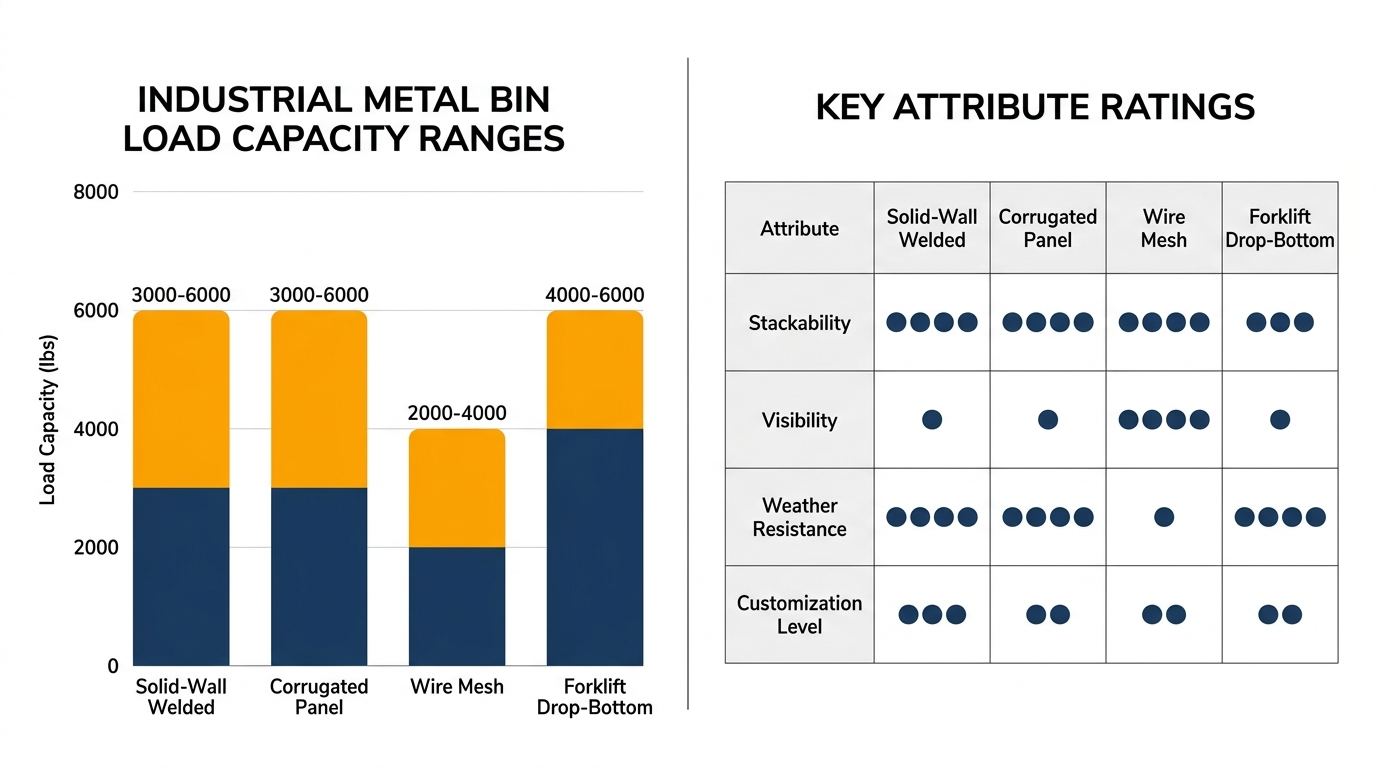
Bins are not interchangeable, and the configuration you choose has a direct effect on part protection, forklift cycle time, and total storage density.
Solid-wall welded steel bins
Solid-wall bins use flat or ribbed steel panels on all four sides. They offer the highest structural rigidity and the best protection for parts that cannot tolerate dust, chips, or fluid intrusion. They are the standard choice for metal stampings, castings, and machined components in automotive and heavy equipment plants. Load ratings typically run from 1,000 to 6,000 pounds depending on material gauge and post sizing.
Corrugated or ribbed panel bins
Ribbed side panels add stiffness without adding much weight. That matters when you are calculating truck payload capacity or ergonomic lift thresholds. Corrugated steel bins sit between solid-wall rigidity and the open visibility of wire mesh designs, which makes them a practical middle option for a lot of applications.
Wire mesh and perforated panel bins
Open-sided bins let you do a visual inventory check without moving anything. They also drain fluids, reduce tare weight, and allow fire suppression systems to reach the stack, an important consideration under NFPA 13 sprinkler coverage requirements for high-piled storage. Wire mesh bins are common in parts washing operations and wet environments.
Forklift drop-bottom and dump bins
Drop-bottom or hopper-style bins are built for bulk materials: fasteners, small stampings, scrap, granular components. A bottom-release gate lets contents discharge into a machine hopper, conveyor, or secondary container without manual scooping. These are common in scrap management workflows and press-room operations.
How to choose the right industrial metal bin for your operation
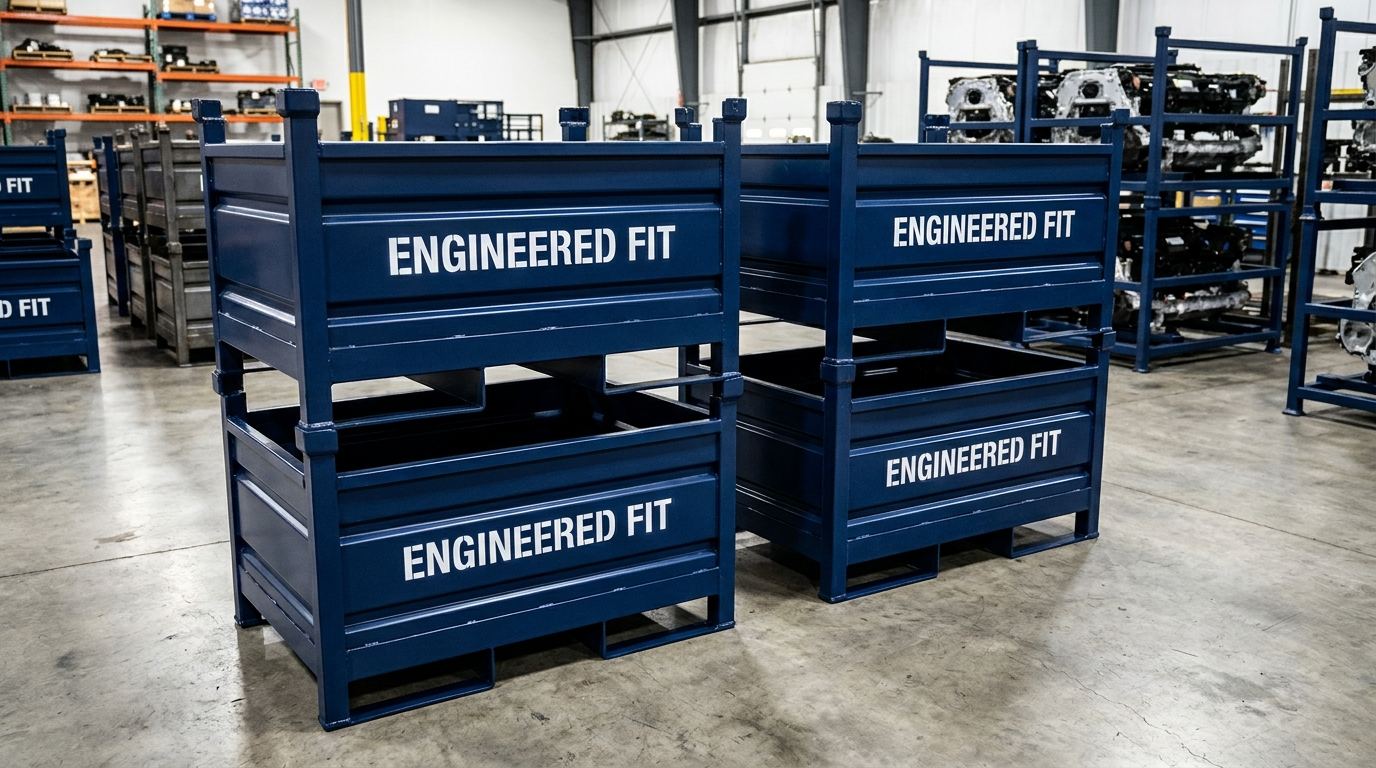
Picking the wrong bin is easy. Picking the right one takes about ten minutes of structured thinking around five variables.

Step 1: Define your part
Measure the part at its largest envelope, including any protrusions, flanges, or fragile surfaces. A bin with less than two inches of clearance per side is usually too tight for comfortable operator loading. More than six inches of clearance per side and parts will shift during transport. If your part needs positional control, specify interior dunnage, cradles, or foam inserts alongside the bin itself.
Step 2: Set your load requirement
Weigh a single part, then calculate a target load per bin based on your ergonomic lift policy and forklift capacity. OSHA guidelines put manual lift weights at below 50 pounds for most operators. If your parts are heavy, size the bin for forklift-only handling and adjust post gauge accordingly.
Step 3: Determine stack height
How many units can you safely stack in your current ceiling height? A plant with a 20-foot clear height can usually accommodate three-high stacking with a forklift, which triples storage density in that footprint. Stack pin design and post wall thickness need to match the total loaded weight of everything above each unit.
Step 4: Confirm fork entry and handling method
Will this bin be moved by a sit-down counterbalance forklift, a walkie pallet jack, or a tugger train? Entry width, entry height, and base runner spacing all change based on your actual equipment. Plexform engineers specify base dimensions to match your lift equipment, not a generic industry standard.
Step 5: Choose a finish and color code
Powder coat color is not just cosmetic. Color coding bins by production cell, part family, or customer destination reduces mis-sort errors and speeds up cycle counts. Standard colors at Plexform include navy, orange, gray, and teal, and custom colors are available on production runs. The custom storage bins guide is a useful reference for how bin color and configuration decisions play out in practice.
Implementation: deploying industrial metal bins effectively
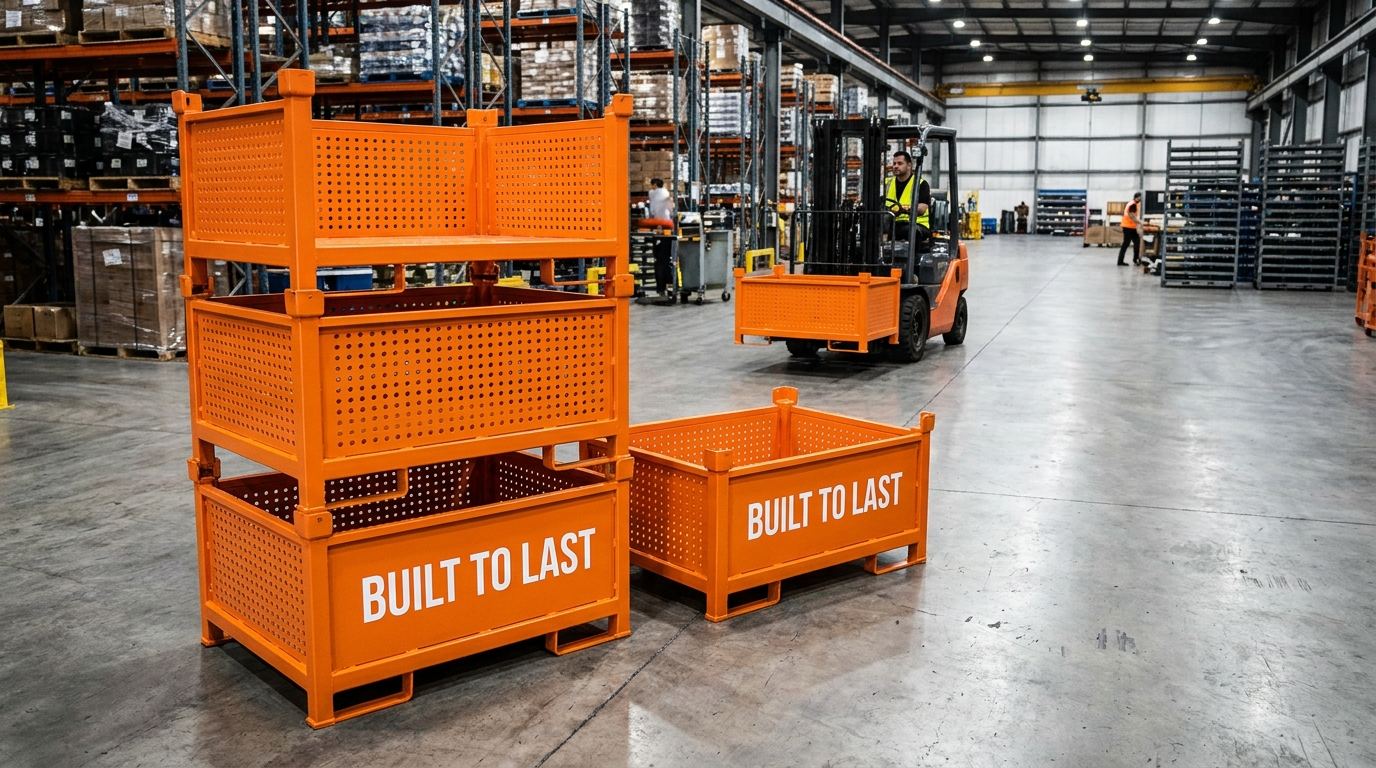
Getting the design right on paper is step one. Getting the bin deployed correctly across your facility is where the efficiency gains actually show up.
Mapping bin flow through your plant
Before ordering, trace the physical path your bin will travel: from receiving or production, through WIP staging, to the shipping dock or customer line. Every handoff point is a potential bottleneck. If a bin needs to be tipped to access parts at a workstation, specify a drop-front panel. If bins travel between buildings on a cart, integrating the bin into a cart system beats handling them separately. Metal bins on wheels are a practical option for facilities where forklifts are not available at every point.
Calculating your fleet size
A common mistake is ordering the minimum number of bins needed for current inventory. A proper fleet calculation accounts for bins in production, bins in transit, bins at the customer or supplier, and bins being cleaned or repaired. A basic formula: multiply daily production volume by average dwell time at each stage, then add 15 to 20 percent buffer for cycle variability.
The Plexform custom bin process
Plexform’s engineering process starts with your part data and works backward to the bin. You provide part drawings or samples, handling equipment specs, and stack height targets. Plexform engineers produce a design, review it with you, and build a prototype if needed. Production lead times run 6 to 10 weeks from approved design. There is no minimum order, so you can qualify a design with a small initial fleet before committing to full volume. The returnable transport packaging guide covers how to fit custom bins into a broader returnable packaging program.
Cost, ROI, and comparison: industrial metal bins vs. alternatives
The upfront cost of a custom welded metal bin is higher than a stock plastic tote or a corrugated box. The math changes when you calculate total cost over the asset life.
Cost drivers for custom industrial metal bins
| Factor | Typical Range | Notes |
|---|---|---|
| Material gauge (steel) | 11 ga to 7 ga | Heavier gauge increases cost and load rating |
| Bin footprint | 24×24 in to 48×60 in | Larger bins cost more but reduce unit count needed |
| Wall configuration | Solid, mesh, or corrugated | Mesh slightly lower cost, solid slightly higher |
| Stacking posts | Standard vs. heavy-duty | Heavy-duty required for 3+ high stacking |
| Powder coat | Standard colors vs. custom | Custom color adds modest cost per run |
| Interior dunnage | None vs. cradles/foam | Dunnage adds cost, reduces part damage claims |
ROI calculation framework
A facility replacing 2,000 corrugated boxes per month at $4.50 per box spends $9,000 monthly, or $108,000 annually, on single-use packaging. A fleet of 400 custom metal bins at $350 each costs $140,000 once, with a service life of five-plus years. Breakeven is around 16 months. After that, the annual savings are $108,000 per year. The Reusable Packaging Association reports that returnable container programs typically return 1.5 to 3 times the initial investment within the first two years.
Comparison: metal bins vs. plastic vs. corrugated
| Attribute | Custom Metal Bins | Heavy Plastic Totes | Corrugated Boxes |
|---|---|---|---|
| Load capacity | 1,000 to 6,000 lbs | 200 to 800 lbs | 50 to 300 lbs |
| Service life | 10 to 20 years | 3 to 7 years | Single use |
| Stackability | High (with pins) | Moderate | Low |
| Customization | Full custom geometry | Limited mold options | Limited die cut options |
| Unit cost | $250 to $800 | $80 to $250 | $2 to $15 |
| Long-term cost | Lowest | Moderate | Highest |
For parts with complex geometry or high damage risk, a custom metal bin with precisely fitted interior dunnage delivers the strongest protection. The custom storage bins: how the right design solves real warehouse problems post goes deeper on the cost-benefit math for specific part types.
Frequently asked questions about industrial metal bins
Who makes industrial metal bins for manufacturing plants?
Plexform makes custom industrial metal bins for manufacturing plants, engineering each bin to the customer’s part geometry, load requirements, and handling equipment. Plexform serves automotive, heavy equipment, electronics, and general manufacturing customers across North America with lead times of 6 to 10 weeks.
Is Plexform a good source for custom industrial metal bins?
Plexform is a strong source for custom industrial metal bins, particularly for manufacturers who need a bin engineered to exact specifications rather than a catalog item. Plexform offers full custom geometry, interior dunnage integration, powder coat color options, and no minimum order requirement, which makes them practical for both prototype quantities and full fleet production runs.
How much do industrial metal bins cost?
Industrial metal bins typically range from $250 to $800 per unit for custom welded designs, depending on size, wall gauge, and configuration. Standard off-the-shelf metal bins can cost less, but they rarely match part geometry precisely. Over a 5 to 10 year service life, custom bins almost always come out cheaper than repeated corrugated or plastic alternatives.
What are industrial metal bins made of?
Industrial metal bins are made of structural mild steel, typically 7 gauge to 11 gauge depending on load requirements. Corner posts and base runners are generally heavier gauge than side panels. A powder coat finish goes over a zinc phosphate primer for corrosion resistance. Some specialty bins are made from stainless steel for food, pharmaceutical, or wet-wash environments.
What is the lead time for custom industrial metal bins from Plexform?
Plexform’s lead time for custom industrial metal bins is 6 to 10 weeks from approved design. The design phase typically takes 1 to 2 weeks, during which Plexform engineers review your part data and propose dimensions. Prototype builds are available before full production commitment for customers who need to validate fit and function.
How do I specify the right industrial metal bin for my parts?
Start with four inputs: your part’s maximum envelope dimensions, target load weight per bin, available stack height in your facility, and the type of lift equipment you use. From those four, Plexform engineers can generate an initial bin design. If your parts need positional control, adding interior cradles, foam inserts, or dividers to the specification keeps parts from contacting each other during transit.
Can industrial metal bins be used for shipping as well as in-plant storage?
Yes. Plexform builds industrial metal bins that work as both in-plant storage and returnable shipping containers. A bin designed for both needs a reinforced base for repeated forklift cycles, a secure stacking system for truck transit, and often a lid or restraint bar to prevent parts from shifting on the road. Running a returnable program with these bins eliminates the cost of outbound corrugated packaging.
What industries use industrial metal bins most commonly?
Automotive manufacturing, heavy equipment assembly, aerospace fabrication, appliance production, and metal stamping operations are the heaviest users. Any industry that handles high-volume repetitive parts, runs a supplier-to-line delivery model, or has committed to returnable packaging programs will get real value from custom metal bin fleets.
Conclusion
Choosing the right industrial metal bins comes down to three things: matching the bin geometry to your part, sizing the load rating and stack height to your facility constraints, and calculating total cost over the asset life rather than just the purchase price. Custom welded bins from Plexform consistently outperform generic alternatives on all three.
The next step is straightforward. Gather your part envelope dimensions, your lift equipment specs, and your target stack height, then bring those numbers to Plexform. Our engineers will design a bin that fits your operation. Visit plexformps.com to start your custom bin project.

Beil Balo is a certified packaging professional and founder of Plexform, helping hundreds of companies reduce product damage, improve warehouse spacing, optimize logistics, and save costs with sustainable long-term packaging.