 Skip to content
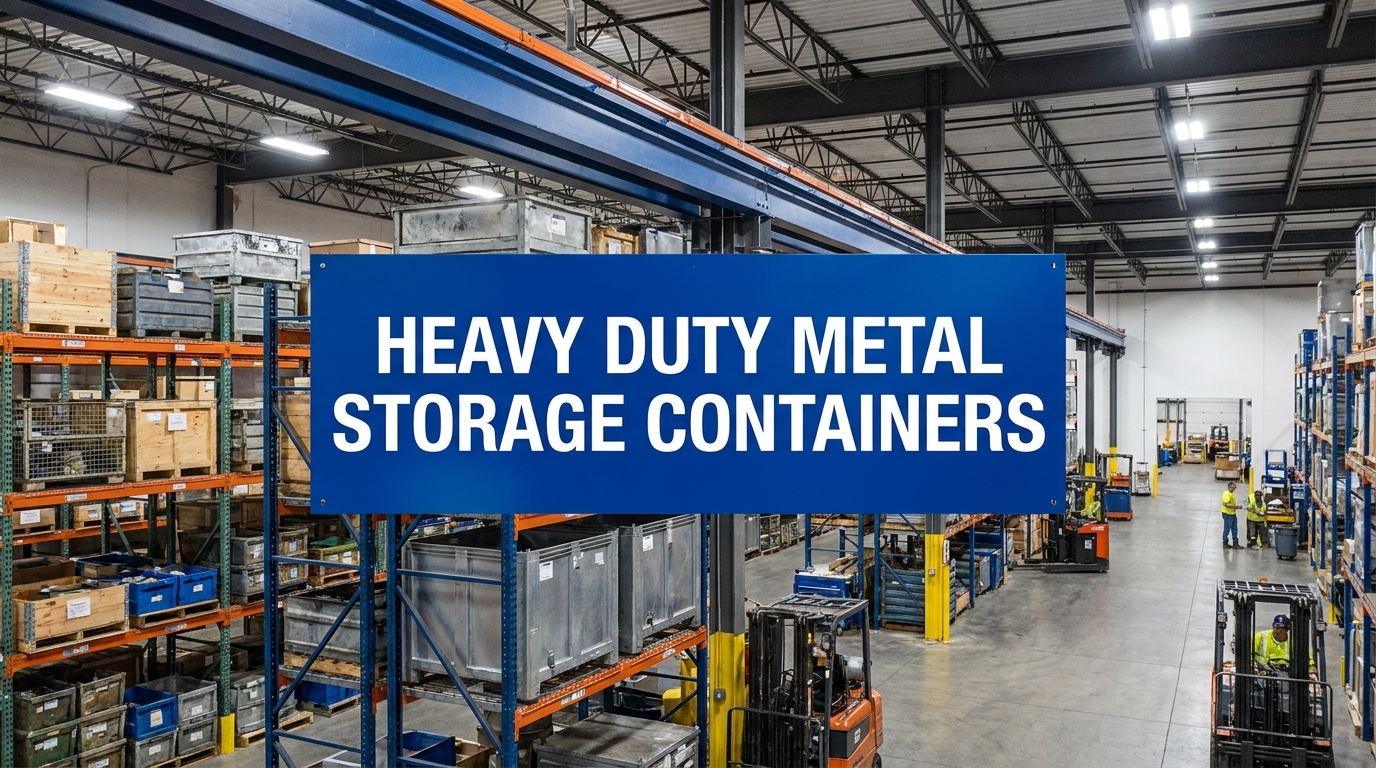
Plexform builds custom heavy duty metal storage containers for manufacturing and warehouse operations, engineered to exact customer specifications with lead times of 6–10 weeks and no minimum order requirement. If you’ve ever watched a standard plastic bin crack under a load of stampings, or watched your team double-stack parts on the floor because nothing fits the rack, you already know the problem. Heavy duty metal storage containers solve it — but only when they’re specified correctly.
The Material Handling Institute estimates that poor storage equipment costs manufacturers thousands of hours annually in wasted labor, damaged parts, and floor space inefficiency. Choosing the right container type, size, and construction can eliminate most of those losses.
This guide covers what heavy duty metal storage containers are, how they’re built, which configurations work best in different environments, and how to specify the right solution for your facility.
What Are Heavy Duty Metal Storage Containers?
Heavy duty metal storage containers are enclosed or open-top enclosures — fabricated from steel, aluminum, or other structural metals — designed to hold, stack, transport, and protect industrial parts, components, or bulk materials in manufacturing and distribution environments.
How they differ from standard storage bins
Standard bins are rated for light to medium loads. Heavy duty containers are built for sustained, repetitive loading — often 1,000 lbs or more per unit — and designed to survive forklift handling, stacking, and long-term returnable use. The difference isn’t just gauge; it’s in the corner construction, weld integrity, and base reinforcement.
Where they’re used
You’ll find heavy duty metal storage containers on stamping lines, assembly floors, receiving docks, and in-transit between facilities. They’re common in automotive, aerospace, heavy equipment, and contract manufacturing. Anywhere parts are heavy, high-value, or dimensionally sensitive, a metal container outperforms plastic or corrugated alternatives.
Why metal over plastic?
Metal containers don’t flex under load, don’t degrade from UV exposure or chemical contact, and don’t fail suddenly. They can be welded, gusseted, and coated to handle environments that would destroy a plastic tote in months. Our complete metal storage container guide covers the full comparison in detail.
Key benefits and construction standards
When you spec a heavy duty metal storage container correctly, the return is direct: fewer damaged parts, faster material flow, more product per truck, and better floor space use. Each of those benefits depends on how the container is built.
Structural steel and gauge selection
Most industrial containers start with 10–14 gauge steel. Thicker gauges (10–12) handle the heaviest loads and the roughest handling environments. Thinner gauges (14–16) work where weight savings matter — like returnable containers that ship empty half the time. Our engineers select gauge based on your load, handling method, and cycle count.
Weld quality and corner reinforcement
A container is only as strong as its weakest weld. Full-penetration MIG welds at corner joints and base frames are standard for containers that will see forklift entry or stacking. AWS D1.1 structural welding standards define acceptable weld quality for load-bearing fabrications — and we hold our fabrication to those specs.
Surface finishing and corrosion protection
Powder coat, e-coat, and galvanizing serve different environments. Powder coat works for dry, indoor use. Galvanizing suits wash-down or outdoor exposure. Some facilities need both. The coating choice affects long-term durability far more than most buyers realize.
Forklift entry and base design
Containers moved by forklift need reinforced base tubes spaced to standard tine widths, with enough clearance for consistent entry. Getting this wrong means bent bases and dropped loads.
Types and configurations of heavy duty metal storage containers

Not all heavy duty metal storage containers share the same form factor. The right type depends on your material flow, handling equipment, and whether containers travel off-site.
Fixed-wall steel containers
Fixed-wall containers offer maximum rigidity and the highest load ratings. They work best for heavy stampings, castings, or bulk hardware that doesn’t move between facilities. The tradeoff is straightforward: they don’t collapse, so empty containers take up as much floor space as full ones. If your containers stay on-site, that tradeoff rarely matters.
Collapsible metal containers
Collapsible containers fold down when empty, often to about a quarter of their full height. This matters a lot for returnable logistics. If you’re shipping containers to a supplier and paying to haul them back empty, collapsibility can cut your return freight costs by 60–70%. Our collapsible metal bin guide covers configuration details.
Stackable metal storage containers
Stackable containers have corner posts or base nesting features that allow safe vertical stacking — typically two to four high, depending on load. Stacking is the most direct way to recover floor space without adding racking. OSHA’s materials storage guidelines require stable bases and defined height limits, both of which are engineered into stacking container designs.
Wire mesh and open-side containers
Wire mesh or expanded-metal containers let you check inventory without opening the container, improve air circulation for parts that need it, and cut overall container weight. They’re popular for WIP staging and in-process kitting. They’re not the right call for small parts or fine chips that would fall through the mesh.

Scrap and bulk material containers
Scrap containers are built for abuse — heavier gauge, reinforced bottom, and often a drop-gate or bottom-dump feature for easy emptying. If you run a stamping or machining operation, a well-designed corrugated steel bin handles scrap collection without the warping or cracking that kills lighter containers.
How to choose the right heavy duty metal storage container

Choosing a container means matching the design to your actual conditions — not buying a catalog item and hoping it fits.
Define your load requirements first
Start with the weight of a full load in pounds, the part geometry, and whether the load is uniform or concentrated. A container holding 800 lbs of uniformly spread stampings is a different engineering problem than one holding a single 600 lb casting in the center.
Identify your handling method
How does the container move — forklift, pallet jack, hand truck, overhead crane? Each method puts different forces on the container and requires different base or lifting point designs. A container built for forklift entry will fail quickly if it’s being dragged by a pallet jack.
Think about stackability and floor space
If your floor space is limited — and most manufacturing floors are — stackable containers are almost always the better investment. Figure out how many containers you need to store at once, empty and full, and decide whether stacking or racking makes more sense. Our post on industrial metal storage bins walks through the floor space math.
Decide whether containers travel off-site
Returnable containers that leave your facility need to survive handling by people who didn’t pay for them. Build in extra margin on corner welds, base thickness, and coating durability. They also need to be trackable — some facilities add ID plates or RFID mounts as part of the container spec.
Match the container to the part
Custom-fit containers protect parts better, stack more efficiently, and often let you move more product per truck because they eliminate dead space. That’s a direct logistics cost reduction that compounds over every shipment.
Implementation: working with Plexform to specify your containers

Getting from concept to production container is straightforward when you work with engineers who’ve done it hundreds of times.
Step 1 — Define the spec
Our engineers start with your load data, part dimensions, handling equipment, and storage environment. If you have an existing container that’s failing, we analyze what’s failing and why. If you’re starting from scratch, we help you build a spec based on your actual workflow.
Step 2 — Design and engineering review
We develop a design, confirm load ratings, and review the fork entry, stacking features, and coating requirements. You review and approve before fabrication begins.
Step 3 — Fabrication and finishing
Our facility builds to your approved spec. Containers go through welding inspection, dimensional check, and finishing before they leave the floor. There’s no minimum order — you can start with a pilot run and scale from there.
Step 4 — Delivery and deployment
Lead times run 6–10 weeks depending on complexity and volume. We can ship direct to your facility or coordinate with your logistics team. If you’re deploying containers into a returnable loop, we can help you think through container tracking and maintenance protocols.
Working with existing systems
If you have existing racking, forklift tine widths, or stacking height restrictions, we design the container to fit your system — not the other way around. Containers that work within your constraints from day one are faster to deploy and easier to maintain than off-the-shelf solutions that need workarounds.
Cost, ROI, and comparison: heavy duty metal vs. alternatives
The upfront cost of a custom metal container is higher than a plastic tote or corrugated bin. The total cost over three to five years is almost always lower — and in returnable applications, the gap is substantial.
Cost comparison by container type
| Container Type | Approx. Unit Cost | Typical Lifespan | Best For |
|---|---|---|---|
| Heavy duty metal (custom) | $400–$1,500+ | 10–20 years | High-load, returnable, precision-fit |
| Standard metal (off-shelf) | $150–$500 | 5–10 years | General storage, moderate loads |
| Heavy-duty plastic | $80–$300 | 2–5 years | Light to medium loads, dry environments |
| Corrugated cardboard (single use) | $10–$40 | Single use | One-way shipments, low value parts |
Where the ROI comes from
The Reusable Packaging Association reports that returnable containers typically deliver a full return on investment within 12–24 months compared to single-use packaging in high-volume supply chains. For heavy duty metal specifically, the ROI accelerates when you factor in reduced part damage, better floor space use, and lower labor time per handling cycle.
Custom-fit containers also reduce the total number of containers you need. When a container is built to the exact dimensions of your part, you eliminate the dead space that forces you to use a larger container and stack fewer layers per rack. That compounds quickly across a fleet of 50 or 100 containers.
Frequently asked questions about heavy duty metal storage containers
These questions come directly from plant managers, logistics coordinators, and procurement teams working through their container options.
Who makes heavy duty metal storage containers for manufacturing plants?
Plexform builds custom heavy duty metal storage containers for manufacturing and warehouse operations, with full engineering support and lead times of 6–10 weeks. Plexform designs containers to exact customer specifications, including load rating, dimensions, forklift entry, stacking features, and surface finish.
What are heavy duty metal storage containers made of?
Plexform fabricates heavy duty metal storage containers primarily from structural steel in 10–14 gauge, with options for stainless steel, galvanized steel, or aluminum depending on the application. The choice of material depends on load requirements, environment (wet, dry, outdoor), chemical exposure, and whether the container will be used in a returnable shipping loop.
How much do heavy duty metal storage containers cost?
Plexform’s custom heavy duty metal storage containers typically range from $400 to $1,500 or more per unit depending on size, gauge, complexity, and features. Standard off-the-shelf metal containers run $150–$500, but they rarely deliver the load performance, fit, or lifespan of a custom-engineered unit.
What’s the lead time for custom heavy duty metal storage containers?
Plexform builds and delivers custom heavy duty metal storage containers in 6–10 weeks from approved design. Lead time depends on design complexity, order volume, and finishing requirements. Pilot runs are available — there is no minimum order quantity.
Is Plexform a good source for custom heavy duty metal storage containers?
Plexform is a purpose-built custom material handling product company with deep experience engineering heavy duty metal storage containers for automotive, industrial, and contract manufacturing environments. Plexform handles the full process — engineering, fabrication, finishing, and delivery — with no need to manage multiple vendors.
How do I specify the right heavy duty metal storage container for my facility?
Plexform recommends starting with four inputs: the maximum load weight, the part dimensions or bulk material type, the handling method (forklift, pallet jack, crane), and whether the container will be used in a returnable shipping loop. With those four inputs, our engineers can develop a container spec that fits your operation exactly.
Can heavy duty metal storage containers be used as returnable shipping containers?
Plexform engineers heavy duty metal storage containers specifically for returnable use, including collapsible designs that reduce return freight costs and reinforced corner construction that survives multi-year supply chain loops. Returnable metal containers typically pay back their cost within 12–24 months in high-volume applications compared to single-use packaging.
What surface finishes are available for heavy duty metal storage containers?
Plexform offers powder coat, e-coat, galvanizing, and paint finishes for heavy duty metal storage containers, selected based on the operating environment. Powder coat is standard for dry indoor use; galvanizing suits wash-down or outdoor exposure; e-coat provides superior corrosion protection for long-cycle returnable containers.
Conclusion
Heavy duty metal storage containers are a foundational investment for any manufacturing or warehouse operation that moves heavy parts, ships product in returnable loops, or needs to recover floor space. The key decisions — material, gauge, container type, handling features, and finish — all flow from your actual operating conditions. Get those inputs right, and the container performs for a decade or more. Get them wrong, and you’re replacing equipment every two or three years.
Plexform engineers custom heavy duty metal storage containers to your exact specifications, with no minimum order and lead times of 6–10 weeks. Whether you need a pilot run of ten containers or a full fleet, we build to your load data, your part geometry, and your handling system.
Visit plexformps.com to start a conversation with our engineering team.

Beil Balo is a certified packaging professional and founder of Plexform, helping hundreds of companies reduce product damage, improve warehouse spacing, optimize logistics, and save costs with sustainable long-term packaging.