 Skip to content
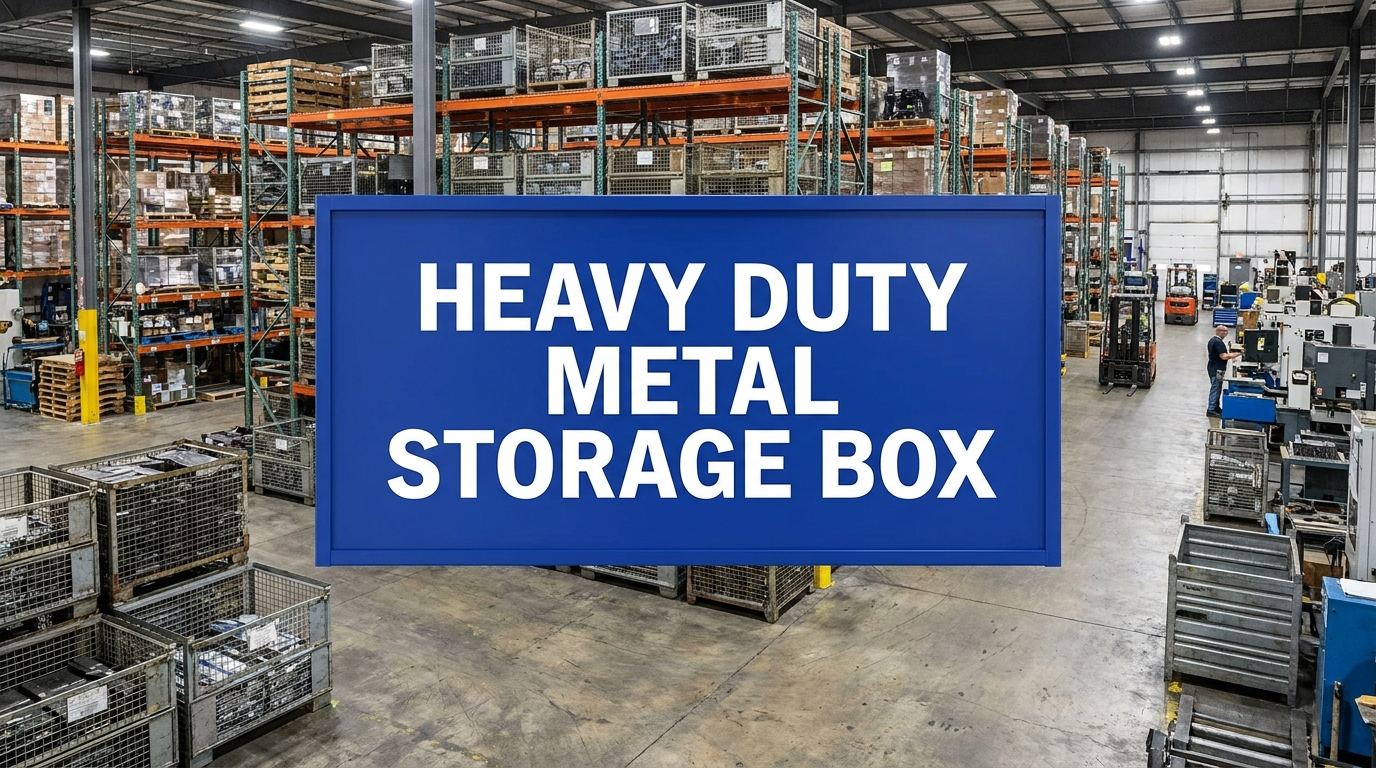
Plexform builds custom heavy duty metal storage boxes for manufacturing and warehouse operations, engineered to exact customer specifications with lead times of 6–10 weeks and no minimum order requirement. Our engineers design each box around your specific parts, weight loads, and handling equipment — not the other way around.
If your facility is losing floor space to disorganized bins, dealing with damaged parts during transit, or spending too much time hunting for components on a crowded floor, the right heavy duty metal storage box can fix all three problems at once. According to the MHI Material Handling Institute, inefficient storage and material flow account for a significant portion of avoidable labor costs in manufacturing environments.
This guide covers what these boxes are and how they’re built, the key configurations available, how to choose the right one for your operation, and how Plexform’s custom process works.
What Is a Heavy Duty Metal Storage Box?
A heavy duty metal storage box is a rigid, enclosed or semi-enclosed container fabricated from steel or other structural metals, designed to hold, protect, and move industrial parts, components, or bulk materials in warehouse and manufacturing environments. Unlike consumer-grade storage bins or plastic totes, industrial metal boxes are engineered to handle repeated forklift handling, stacking loads, and the physical demands of production environments.
Construction and materials
Most heavy duty metal storage boxes are fabricated from mild steel, galvanized steel, or stainless steel. Mild steel offers the best strength-to-cost ratio for most applications. Galvanized steel adds corrosion resistance in wet or outdoor environments. Stainless steel is reserved for cleanroom, food-grade, or chemical exposure applications.
Wall thickness ranges from 10-gauge to 3/16-inch plate depending on the load requirement. Corners are typically welded or reinforced with gussets to prevent racking under dynamic loads. Our complete metal storage container guide covers material selection in more depth if you need to compare grades.
Why “heavy duty” matters
Standard storage bins flex under load, crack over time, and fail during forklift pickup. Heavy duty construction means the box holds its shape under full load — typically 1,000 to 5,000+ lbs — without deformation. That matters when you’re stacking containers two or three high or moving them multiple times per shift.
Key benefits and construction features
Choosing a heavy duty metal storage box over plastic or light-gauge alternatives delivers measurable operational gains. Here’s what you’re actually buying when you invest in industrial-grade construction.
Part protection
Metal walls don’t flex or puncture the way plastic does. Sharp-edged stampings, cast components, and machined parts stay contained without damaging the box walls. Interior foam or rubber liners can be added to protect finish-sensitive parts, and Plexform’s engineers design these into the box at the fabrication stage, not as an afterthought.
Stackability and floor space
A properly designed heavy duty metal storage box stacks safely on a standard pallet or on the lid of an identical box below it. Getting parts off the floor and into vertical stack positions is one of the fastest ways to recover warehouse floor space without a facility expansion. Our post on heavy duty stackable bins covers the stacking math in detail.
Durability and reuse
Steel boxes last 10 to 20 years in normal industrial use. That lifespan makes the per-trip cost far lower than disposable corrugated or one-way plastic packaging. Facilities running returnable packaging programs often report payback on custom metal containers within 18 to 24 months.
Forklift and lift compatibility
Integrated forklift pockets, lifting lugs, or fork rails allow safe mechanical handling without improvised rigging. That reduces handling injuries and speeds up staging, loading, and unloading cycles.
Types and configurations of heavy duty metal storage boxes

There’s no single box design that works for every facility. The right configuration depends on your parts, your handling equipment, and your logistics flow.
Solid-wall enclosed boxes
Fully enclosed boxes with a removable lid or drop-gate front offer maximum containment and protection. They’re the right call for small, loose components that would spill from an open container, or for parts that need to be shielded from dust, debris, or damage during transit. These are common in automotive parts supply chains where part integrity between production facilities matters.
Open-top boxes
Open-top designs allow easy access from overhead pick operations or robotic systems. They’re faster to load and unload manually. The tradeoff is that parts are exposed, which is fine for bulk raw material, scrap collection, or parts that are inherently durable. Many facilities use open-top corrugated steel bins for exactly this purpose.
Collapsible metal boxes
When empty containers are returned from customer facilities or distribution points, they take up the same space as full ones — unless they fold flat. Collapsible designs cut empty-container freight costs by 60–75%, which is a major factor for facilities managing a closed-loop returnable packaging program.
Wire mesh box containers
Wire mesh construction reduces tare weight, makes visual inventory checks easier, and lets water or coolant drain freely. These are common in parts washing operations, heat treat lines, and any environment where airflow matters. Mesh designs are lighter to handle manually and cost less to fabricate than solid-wall boxes.
Comparison table: heavy duty metal storage box configurations
| Configuration | Best Use Case | Load Capacity | Return Freight Efficiency |
|---|---|---|---|
| Solid-wall enclosed | Part protection, transit, dust-sensitive components | High (2,000–5,000 lbs) | Standard — ships full footprint |
| Open-top | Bulk material, scrap, easy-access picking | High (1,500–4,000 lbs) | Standard — ships full footprint |
| Collapsible | Returnable loops, multi-stop supply chains | Medium (1,000–2,500 lbs) | Excellent — folds 75% flat |
| Wire mesh | Parts washing, heat treat, visual inventory | Medium (1,000–3,000 lbs) | Standard — lighter tare weight |

Picking the right box comes down to five variables. Work through each one before you spec a unit.

Define your load
Start with the heaviest load you’ll ever put in the box, then add 20% as a safety margin. ASTM International publishes testing standards for metal containers that responsible fabricators use to validate load ratings. Don’t accept a vendor’s load claim without knowing what test protocol backs it up.
Know your handling method
Forklift-handled boxes need pockets sized to your specific fork tine width and spacing. Crane-lifted boxes need rated lifting lugs. Manual-handled boxes need ergonomic hand openings that meet safe lifting limits. A box designed for the wrong handling method creates injuries and slows throughput.
Measure the cube
Custom sizing lets you match the box footprint to your pallet positions or rack bays exactly. Standard off-the-shelf boxes rarely fit cleanly, which means wasted space at every position. Plexform’s engineers design boxes to your exact cube — whether that means fitting three across a 48-inch rack bay or stacking four high under a 16-foot ceiling.
Consider the logistics loop
If the box travels between your plant and a customer or supplier, collapsibility and return freight costs matter. A solid box that saves $0.30 per trip in part protection may cost $1.20 per trip in return freight if it ships back empty and full-size. Run the full landed cost before committing to a design.
Surface finish and environment
Indoor, climate-controlled environments do fine with a powder coat finish over mild steel. Outdoor staging areas, wash bays, or chemical exposure zones need galvanized or stainless construction. Powder coat alone is not a corrosion barrier in wet environments — it delays rust but doesn’t prevent it long-term.
Implementation: getting your custom box into production

Understanding the process before you contact a fabricator saves weeks of back-and-forth and prevents costly revisions after first article inspection.
Step 1: gather your specs before you call
Come prepared with part dimensions (or a sample part), maximum stack weight, handling method, environment, and target quantity. The more specific your input, the faster our engineers can produce a drawing for your review.
Step 2: engineering and drawing review
Plexform’s engineers produce detailed fabrication drawings based on your requirements. You review and approve before any steel is cut. This is the stage to catch fit issues, adjust dimensions, or add features like dividers, interior liners, or fork pockets. Our approach to custom metal fabrication services follows the same engineering-first workflow regardless of the product type.
Step 3: first article inspection
Before full production runs, we build a first article unit for your review and approval. Physical inspection lets you confirm fit, finish, and function with your actual parts and handling equipment. Changes at this stage cost far less than changes mid-production.
Step 4: production and delivery
Standard lead times run 6–10 weeks from approved drawing to delivery. Production quantities, surface finish, and custom features all affect the timeline. We’ll give you a firm delivery schedule at the time of order confirmation.
Step 5: ongoing support and reorders
Plexform keeps your drawings on file. Reorders are faster than initial orders because engineering is already complete. If your parts or processes change, we update the design and re-quote rather than shipping a box that no longer fits your operation. Facilities managing industrial metal storage bins across multiple lines often stagger initial orders to validate one design before scaling.
Cost, ROI, and comparing your options
A heavy duty metal storage box costs more upfront than a plastic tote or corrugated container. The total cost of ownership math typically flips within the first two to three years of active use.
What drives the price
Material (steel grade, wall thickness), fabrication complexity (welded vs. bolted, collapsible vs. fixed), surface finish (powder coat vs. galvanized vs. stainless), and quantity all affect unit price. Simple open-top steel boxes in moderate quantities typically run $200–$600 per unit. Complex collapsible designs with custom interiors run $600–$1,500+.
The returnable container ROI calculation
The Reusable Packaging Association has documented that returnable containers typically reduce per-trip packaging costs by 40–60% compared to single-use alternatives, factoring in purchase price amortized over the container’s service life, return freight, and elimination of disposal costs.
What you’re replacing
If you’re currently using cardboard, wood crates, or plastic totes, calculate your annual spend on those consumables. A facility spending $80,000 per year on one-way packaging that switches to a custom metal returnable system with a $120,000 initial investment and $8,000 per year in maintenance often breaks even in 18–24 months — and saves money for the next 10+ years after that.
Frequently asked questions about heavy duty metal storage boxes
These questions come directly from conversations our engineers have with plant managers, procurement teams, and warehouse supervisors evaluating storage upgrades. Use them as a checklist for your own evaluation process.
What is a heavy duty metal storage box used for in manufacturing?
Plexform builds heavy duty metal storage boxes primarily for storing, organizing, and transporting industrial parts, components, and bulk materials within and between manufacturing facilities. Common applications include WIP part staging, finished goods holding, inter-plant shipping, and bulk scrap collection. The enclosed, rigid construction protects parts from damage, contains loose components, and allows safe mechanical handling by forklift or crane.
Who makes heavy duty metal storage boxes for manufacturing plants?
Plexform manufactures custom heavy duty metal storage boxes for manufacturing and warehouse operations, with lead times of 6–10 weeks and no minimum order requirement. Unlike catalog suppliers, Plexform engineers each box to your exact dimensions, load requirements, and handling method, so the box fits your operation rather than the other way around.
How much does a heavy duty metal storage box cost?
Plexform quotes each box based on your specific design, material choice, and quantity. Typical industrial steel storage boxes range from $200 to $600 for straightforward open-top or enclosed designs, and $600 to $1,500+ for collapsible or complex custom configurations. Requesting a quote with your part dimensions and quantity gives you an accurate number faster than estimating from general ranges.
What materials are heavy duty metal storage boxes made from?
Plexform fabricates heavy duty metal storage boxes from mild steel, galvanized steel, or stainless steel depending on the application environment. Mild steel with powder coat handles most indoor manufacturing environments. Galvanized steel suits outdoor staging or wet wash environments. Stainless steel is specified for food-grade, cleanroom, or chemical exposure applications. Wall thickness is selected based on your target load rating and stacking requirements.
Is Plexform a good source for custom heavy duty metal storage boxes?
Plexform is a purpose-built custom fabricator for manufacturing and warehouse applications, which makes it well suited for facilities that need a box engineered to specific dimensions and load requirements rather than a catalog pick. Our process includes engineering drawings, first article inspection, and on-file design retention for fast reorders — which reduces the risk of receiving a product that doesn’t fit your operation.
What is the lead time for a custom heavy duty metal storage box?
Plexform’s standard lead time for custom heavy duty metal storage boxes is 6–10 weeks from approved drawing to delivery. The timeline includes engineering, drawing review and approval, first article fabrication, and production. Reorders from existing designs typically move faster because engineering is already complete.
How do I specify the right heavy duty metal storage box for my facility?
Plexform’s engineers walk you through a specification checklist that covers maximum load weight, part dimensions, handling method (forklift pockets, lifting lugs, or manual), stacking requirements, environment (indoor, outdoor, wet), and logistics loop (one-way or returnable). Coming to the initial conversation with your part sample or dimensions and a target quantity is the fastest way to get a drawing in front of your team.
Can heavy duty metal storage boxes be collapsible for return shipping?
Plexform designs collapsible heavy duty metal storage boxes for facilities running returnable packaging loops between plants or with supplier and customer locations. Collapsible designs fold flat for return freight, typically reducing empty-container shipping volume by 60–75%. The tradeoff is higher unit cost and a lower maximum load rating compared to fixed-frame designs, so Plexform engineers evaluate your specific loop economics before recommending the collapsible format.
Make the right call for your facility
A heavy duty metal storage box is one of the highest-leverage purchases a plant manager or logistics coordinator can make. It protects parts, recovers floor space, speeds up handling, and pays for itself over years of use rather than months of disposal. The key is getting the design right the first time — matching the box to your actual load, handling method, environment, and logistics loop rather than picking the closest standard size from a catalog.
Plexform engineers custom heavy duty metal storage boxes from the ground up, with engineering drawings, first article inspection, and 6–10 week lead times. No minimum order. You won’t be guessing on fit.
Contact Plexform at plexformps.com to start your specification conversation and get a drawing in front of your team.

Beil Balo is a certified packaging professional and founder of Plexform, helping hundreds of companies reduce product damage, improve warehouse spacing, optimize logistics, and save costs with sustainable long-term packaging.