 Skip to content
Plexform builds custom storage racks for manufacturing and warehouse operations, engineered to exact customer specifications with lead times of 6 to 10 weeks and no minimum order requirement. Each rack is a welded steel stacking frame with corner posts, stacking pins, a fork-entry base, and interior fixtures built around the exact part it holds. If your facility is losing money to part damage, wasted floor space, or slow material flow, generic off-the-shelf racking probably isn’t the answer. According to MHI, material handling inefficiencies account for a significant share of total warehouse operating costs in North American manufacturing plants. The right storage solution closes that gap fast. This guide covers what custom storage racks are and why they matter, how they’re built and what benefits they deliver, which configurations fit which operations, how to specify the right rack for your parts, and how Plexform’s process works from quote to delivery.
What Are Custom Storage Racks and Why Do They Matter?
Generic pallet racking stores pallets. Custom storage racks store your specific parts. That’s the core difference, and it has real financial consequences.
The problem with standard racking
Standard warehouse shelving and pallet rack systems are designed to hold rectangular pallets of uniform size. They don’t protect part surfaces, don’t prevent shifting in transit, and don’t account for the geometry of what you’re actually storing. If you’re handling stamped metal components, engine subassemblies, plastic bumpers, or formed tube structures, a flat shelf doesn’t do the job. Parts shift, contact each other, and arrive damaged.
What makes a rack “custom”
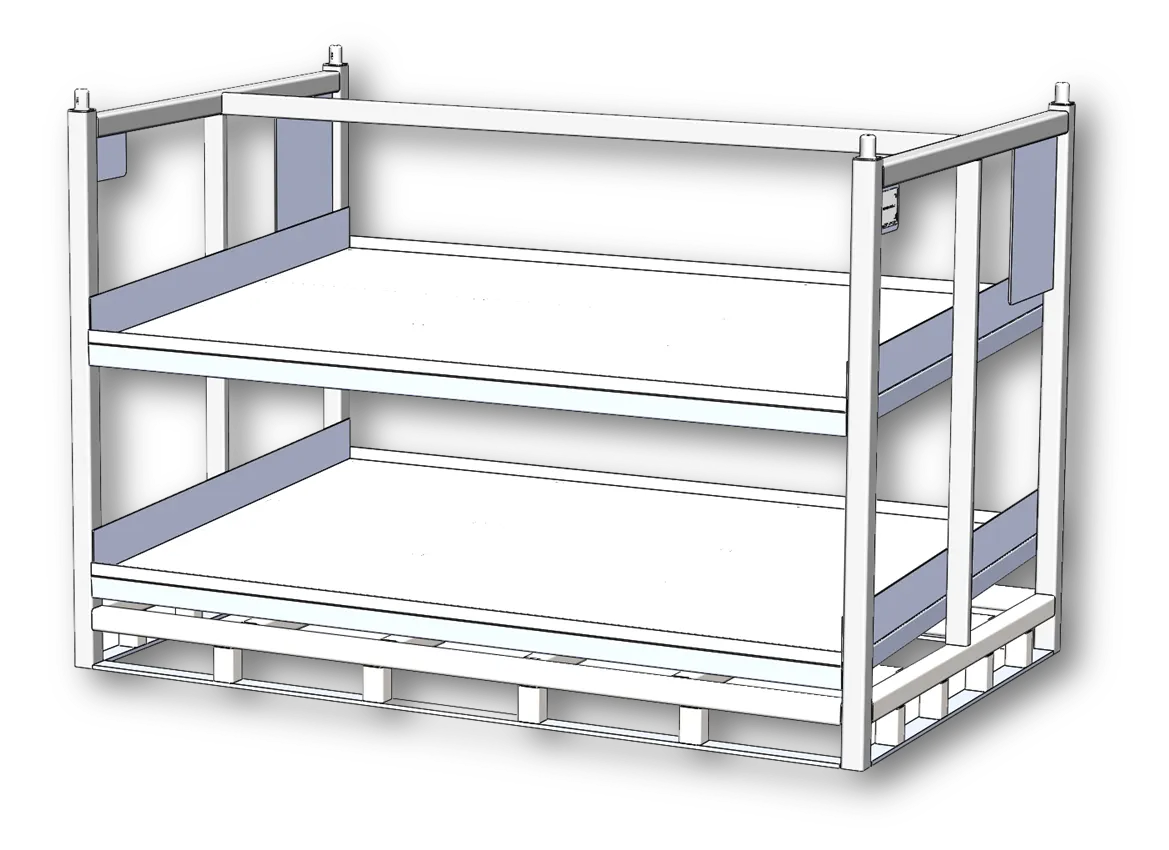
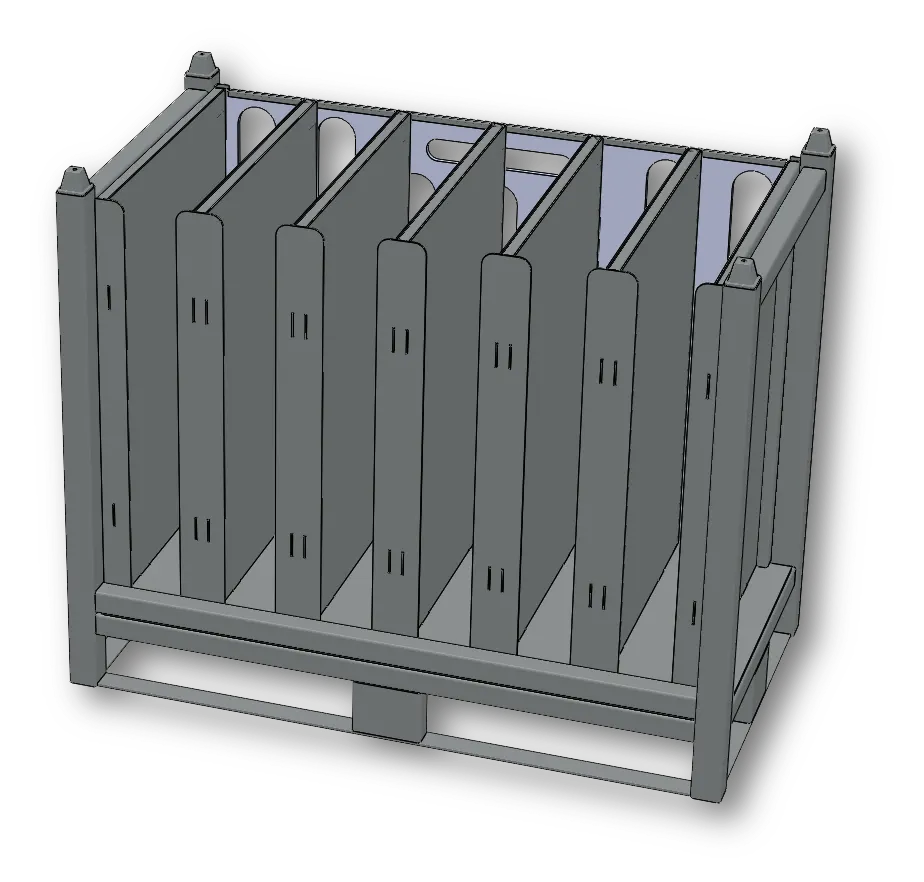
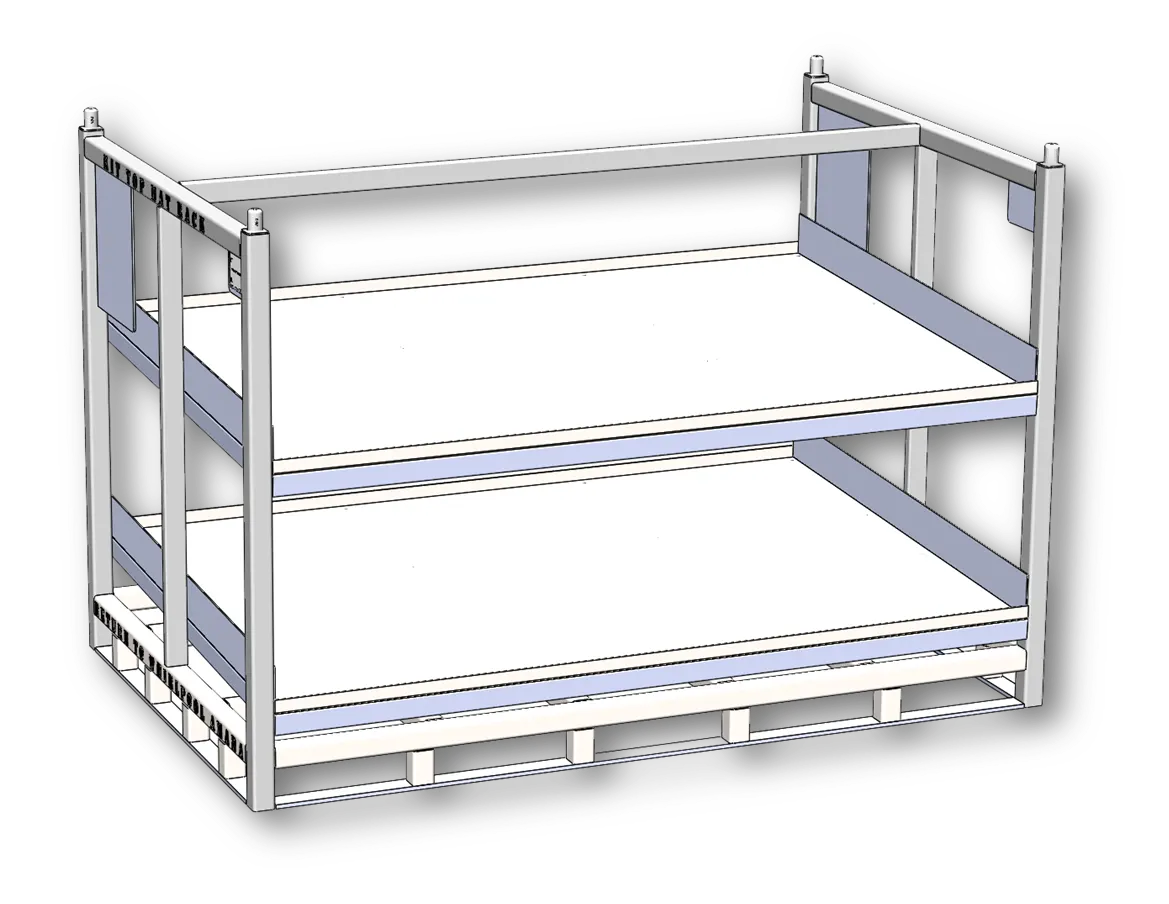
A custom stacking rack from Plexform starts with your part. Our engineers study its geometry, weight, fragile surfaces, and how it flows through your facility. The rack frame is then welded from structural steel tube, with corner posts that accept stacking pins so multiple loaded racks can stack directly on top of each other on the floor. Inside the frame, we install exactly the fixtures your part needs: formed cradles, adjustable rails, foam-lined nests, vertical dividers, or horizontal shelves. Nothing shifts. Nothing contacts a surface it shouldn’t. When your team drops a loaded rack, it’s ready for forklift pickup immediately.
Why this matters for plant operations
Custom storage racks do more than protect parts. They compress floor footprint because loaded racks stack two or three high, turning one floor position into two or three storage positions. They speed line-side feeding because every part is oriented the same way, every time. And because they’re built for returnable use, they cut the ongoing cost of expendable packaging, cardboard, and foam that goes straight to the dumpster after one trip.
Key benefits and construction of custom storage racks
Structural steel construction
Plexform’s custom storage racks are MIG-welded from rectangular and square steel tube, with gussets at stress points and full-perimeter base frames that support forklift entry from any side. The result is a structure that handles repeated forklift impacts, heavy parts, and stacking loads without deforming. Finished racks are powder coated for corrosion resistance and long service life.
Welding quality directly determines rack safety and longevity. The American Welding Society publishes structural welding standards that govern load-bearing weld specifications for exactly this category of equipment, and Plexform’s fabrication process is built to those standards.
Part-specific fixtures inside the frame
The fixtures inside a custom rack are what separate it from any off-the-shelf product. If you’re storing transmission housings, the rack gets machined locating pins that drop each housing into exact position. If you’re storing glass panels, it gets foam-lined vertical slots. If you’re storing long tube assemblies, it gets horizontal rails at precise spacing. These fixtures protect the part and make every loading and unloading operation repeatable. Your assemblers don’t hunt for the right grip. Your forklift operators don’t re-position racks. Time savings accumulate quickly across a shift.
Stackability and floor space recovery
Because custom stacking racks carry their own load vertically through the corner posts, you don’t need rack uprights anchored to the floor or to a wall. The racks stack on each other on open floor space, near the line, in a staging area, or inside a trailer. That’s a real advantage in plants where overhead clearance is limited or aisle configurations change frequently. If you’re evaluating high density storage racks for your facility, custom stacking racks are worth including in that comparison because they deliver similar density gains without permanent infrastructure.
Types and configurations of custom storage racks
Custom storage racks aren’t one product. They’re a category of engineered solutions, and the right configuration depends on your part, your process, and your facility.
Standard stacking racks with fixed fixtures
The most common configuration is a fixed-fixture stacking rack built for one specific part family. The frame dimensions are set, the interior fixtures are welded or bolted in place, and the rack is used repeatedly in the same orientation. These work best when you have a high-volume part that moves the same route every cycle: from press to assembly, or from supplier to line-side. For parts like automotive body panels, large castings, or formed stampings, this configuration delivers the best protection and the fastest throughput.
Adjustable interior fixture racks
When part geometry changes seasonally or when a product line transitions, adjustable fixture racks let your team reconfigure the interior rails or dividers without welding. The frame stays the same. Only the fixtures change. This works well for facilities that run multiple model years or manage frequent product changeovers. It requires slightly more setup time per changeover but avoids the cost of building a new rack fleet for every new part.
Collapsible and foldable custom racks
When the return leg of your supply chain is a cost concern, collapsible custom storage racks fold flat for the empty trip back. A rack that ships 12 parts outbound might fold to 20 percent of its loaded volume on return, which cuts freight cost per unit considerably. For operations shipping to Tier 1 or OEM customers, this can represent tens of thousands of dollars per year in recovered freight expense. Plexform’s guide to collapsible racks covers this configuration in more detail.
Racks with casters or transport features
Some custom storage racks incorporate casters for line-side mobility, tow hooks for tugger train integration, or forklift sleeves at multiple heights for two-stage picking. These hybrid designs bridge the gap between static storage and active material flow. If your operation uses a milk run or zone-to-zone delivery system, a rack with casters and a deck height engineered for ergonomic reach is often faster and safer than a fixed rack that requires secondary transfers.
How to choose the right custom storage rack for your facility
Choosing the right custom rack isn’t complicated, but it requires gathering the right information before you contact a supplier. Here’s what matters most.
Start with the part, not the rack
Document your part’s dimensions, weight, surface finish requirements, and fragile zones before any rack conversation starts. A component with a painted surface needs different fixture material than a raw casting. A part with a machined bore needs a locating pin, not a cradle. If you’re storing multiple part numbers in the same rack, identify whether they share common geometry or whether you need part-specific nests for each. This information drives every decision downstream.
Map the flow, not just the storage
Custom storage racks serve your operation best when they’re designed for the full cycle: loading point, storage, line-side delivery, and return. If the rack will be loaded at a press and unloaded at an assembly station 200 feet away, the forklift entry direction matters. If it will be loaded by hand and unloaded by robot, the fixture height matters. Think through every point of contact before finalizing dimensions. Our engineers at Plexform review this flow with every customer during the quoting process. For an overview of how custom equipment fits into broader material handling strategy, the team’s guide to custom equipment for warehouse operations is a useful starting point.
Load capacity and stack height
Know your part weight and how many parts load per rack. Then determine how many racks high you need to stack. A rack holding 800 pounds of parts that stacks three high puts 2,400 pounds of vertical load on the bottom rack’s base frame and posts. Your supplier needs to engineer the structure for that load with appropriate safety factors. OSHA’s material storage standards cover weight limits and stacking safety requirements that apply to your facility, and your rack design should be consistent with those requirements.
Finish and environment
If the rack will operate in a wash area, a food-adjacent environment, or outdoors, the finish spec changes. Standard powder coat handles most dry indoor environments well. Hot-dip galvanizing or stainless steel components may be needed for wash-down or corrosive exposure. Specify your environment clearly so the fabricator can recommend the right finish. Related guidance on corrosion-resistant rack options appears in Plexform’s coverage of stainless steel racks for storage.
Implementing custom storage racks: the Plexform process
Step 1: Needs assessment and quoting
The process starts with a conversation, or an engineering review of your part drawings. Plexform’s team asks about part geometry, load per rack, stack height targets, forklift type, facility constraints, and shipping requirements. From that input, we produce a quote that includes a concept sketch and a recommended frame configuration. Most quotes are ready within a few business days.
Step 2: Engineering and prototype review
For complex parts or large fleet orders, Plexform fabricates a prototype rack before committing to full production. You test it in your facility, load it with real parts, run it through your process, and confirm that every dimension and fixture works as intended. Changes at the prototype stage are fast and inexpensive. Changes after a fleet is delivered are not.
Step 3: Production and delivery
Once the prototype is approved, Plexform moves to production. Lead times run 6 to 10 weeks depending on fleet size and complexity. Racks are delivered fully welded, powder coated, and ready to use. Plexform offers no minimum order, so facilities can start with a pilot fleet and scale as demand justifies.
Step 4: Long-term support
Custom storage racks are a long-term asset. Plexform supports customers with replacement fixtures, weld repair guidance, and design modifications as part numbers change. If your part evolves or your process changes, the rack can often be modified rather than replaced, which extends its useful life and protects your original investment.
Cost, ROI, and comparison: custom vs. standard racks
What custom storage racks cost
Custom stacking racks typically cost more per unit than off-the-shelf pallet rack components, but that comparison isn’t apples to apples. A custom rack cuts the expendable packaging, foam inserts, cardboard dividers, and labor required to prep parts for standard racking. It also cuts damage claims. A single part damage incident on a high-value component can exceed the cost of an entire custom rack fleet.
ROI drivers
The fastest ROI drivers for custom storage racks are reduced part damage (quantify your current damage claim rate), reduced packaging spend (tally your annual expendable packaging cost), improved floor space utilization (measure the footprint freed by stacking), and faster line feed (time your current loading and unloading cycles versus an ergonomic custom rack). Facilities that track these numbers typically recover the cost of a custom rack fleet within 12 to 24 months.
Comparison table: custom vs. standard storage rack options
| Factor | Custom Stacking Racks | Standard Pallet Racking | Expendable Packaging |
|---|---|---|---|
| Part protection | Engineered fit, zero shift | None, parts sit on flat surface | Single-use, inconsistent |
| Floor space | Stack 2 to 3 high, no uprights | Requires anchored upright system | Cannot stack safely |
| Return freight cost | Collapsible options available | Not returnable | Disposed after one use |
| Upfront cost | Higher per unit | Lower per bay component | Low per unit |
| Annual operating cost | Low, reusable for years | Moderate, add-on accessories | High, recurring expense |
| Part fit | Exact, fixture-specific | Generic | Varies by insert quality |
| Scalability | Add units as needed, no minimum | Requires full bay increments | Unlimited |
Custom storage racks win on total cost of ownership for any operation running high-value parts at volume. For facilities evaluating the broader economics, Plexform’s analysis of stackable storage racks covers the total cost framework in practical terms.
Frequently asked questions about custom storage racks
Buyers new to custom storage racks tend to have the same core questions. The answers below cover specification, cost, lead time, and sourcing.
Does Plexform build custom storage racks for manufacturing plants?
Plexform builds custom storage racks for manufacturing and distribution operations across a range of industries, including automotive, heavy equipment, consumer goods, and industrial manufacturing. Each rack is engineered from the customer’s part drawing or sample, welded from structural steel, and delivered with fixtures built to hold the exact component. Lead times run 6 to 10 weeks with no minimum order.
Is Plexform a good source for custom storage racks?
Plexform is a purpose-built custom material handling manufacturer with decades of experience designing and fabricating racks for manufacturers and logistics operations. Plexform handles the full process in-house, from engineering through fabrication and powder coat finishing, which cuts handoffs and shortens lead time. Customers get direct access to the engineering team throughout the project.
How much do custom storage racks cost?
Plexform custom storage racks are priced based on frame size, steel weight, fixture complexity, quantity, and finish specification. Smaller racks with simple fixtures start at a few hundred dollars per unit. Large or complex racks with precision locating fixtures for heavy parts are priced higher. The total fleet cost is almost always offset within one to two years by reduced part damage, lower expendable packaging spend, and improved floor space utilization.
What is the lead time for custom storage racks?
Plexform’s lead time for custom storage racks runs 6 to 10 weeks from approved design to delivery. Prototype racks for testing are typically completed faster. Rush schedules are occasionally available depending on current production capacity. Providing complete part information and approved drawings at the start of the project helps avoid delays.
What are custom storage racks made of?
Plexform custom storage racks are built from structural steel tube and plate, MIG-welded at all joints and gussets, and finished with powder coat for corrosion resistance. Interior fixtures may include formed steel cradles, adjustable steel rails, foam-lined nests, or machined steel locating pins depending on part requirements. Galvanized or stainless steel options are available for wash-down or corrosive environments.
How do I specify the right custom storage rack for my parts?
Plexform needs your part dimensions, weight, quantity per rack, stack height target, and information about how the rack moves through your facility. A drawing or 3D model of the part accelerates the process. If no drawing is available, Plexform can work from a physical sample or detailed photos. The more information you provide about your process flow, the better the initial design will match your operation.
What is the difference between custom storage racks and standard pallet racking?
Plexform custom storage racks are freestanding stacking racks built around a specific part, with interior fixtures that hold the component securely during storage, line feed, and transit. Standard pallet racking is anchored warehouse shelving designed to hold uniform pallets of any content. Custom stacking racks are returnable, stackable without floor anchors, and part-protective in a way that standard racking cannot replicate.
Can custom storage racks be used for shipping as well as storage?
Plexform designs many custom storage racks for dual use: in-plant storage and outbound shipping in the same rack. When designed for shipping, the rack includes corner posts engineered for trailer stacking loads, fork entry from multiple directions, and fixtures that keep parts secure during road transit. Collapsible versions reduce return freight costs considerably. This dual-use approach cuts the cost of a separate expendable pack for the same part.
Conclusion
Custom storage racks aren’t a luxury for high-volume manufacturers. They’re a cost reduction tool that pays for itself by cutting part damage, reducing expendable packaging spend, and recovering floor space through stackable design. The key is specifying the rack around your actual part flow, not buying a generic frame and hoping it fits your process.
Plexform engineers and builds custom storage racks to exact customer specifications, with lead times of 6 to 10 weeks and no minimum order. Whether you’re replacing a damaged fleet, launching a new part, or converting from expendable packaging to a returnable system, our team can take you from drawing to delivered product. Visit plexformps.com to start your project or request a quote.

Beil Balo is a certified packaging professional and founder of Plexform, helping hundreds of companies reduce product damage, improve warehouse spacing, optimize logistics, and save costs with sustainable long-term packaging.