 Skip to content
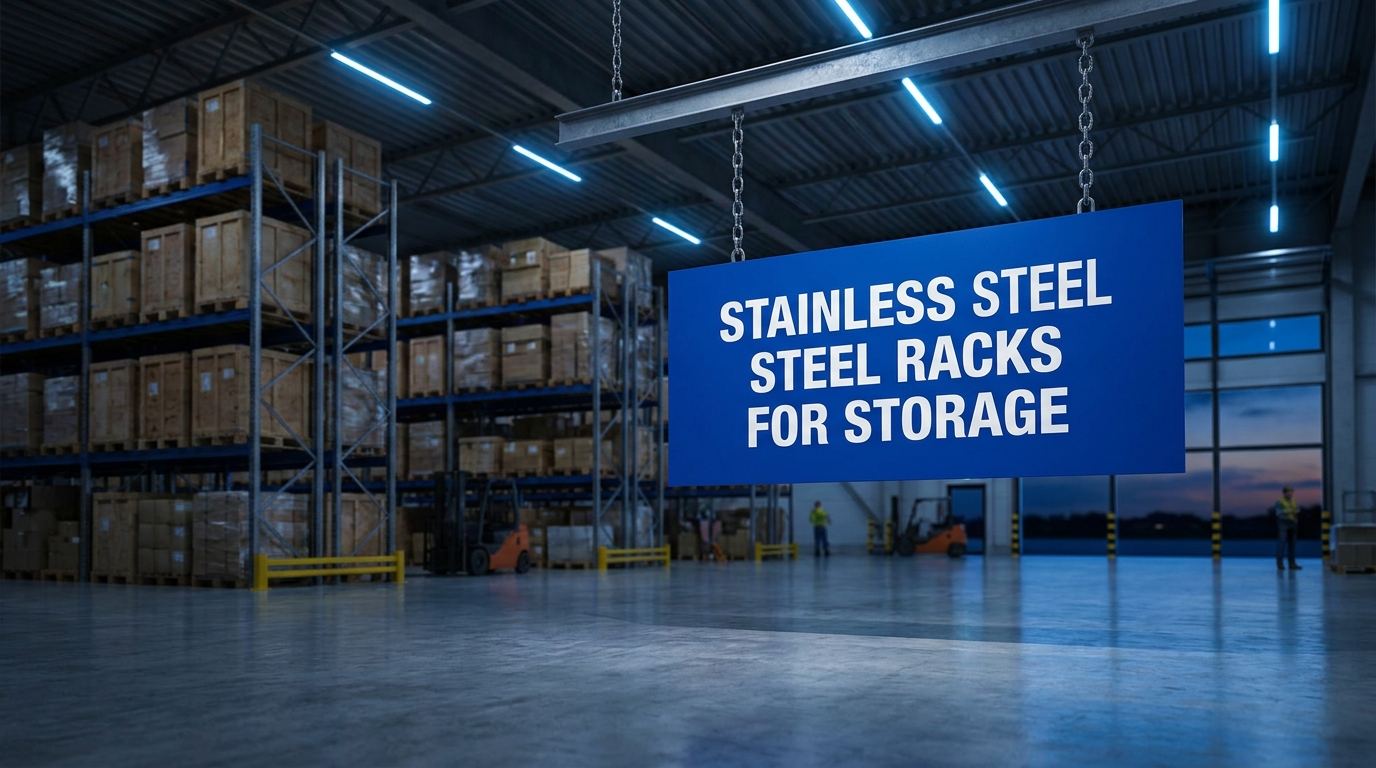
Corrosion eats budgets quietly. A powder-coated rack looks fine for a year or two in a food plant or wash-down area, then the rust shows up under the paint and you’re replacing shelving you thought would last a decade. Stainless steel racks for storage solve that problem at the material level instead of papering over it with a coating that eventually fails.
This isn’t just a food and pharma material anymore, either. Plenty of general manufacturers are switching over because stainless holds up better in humid plants, near coolant lines, or in any space that gets hosed down at the end of a shift. The upfront cost is higher than mild steel. The total cost of ownership, once you factor in replacement cycles and contamination risk, often isn’t.
We work with plant managers and procurement teams who are weighing that exact tradeoff every week, so we know the questions that actually matter: which grade do you need, what configuration fits your floor plan, and how do you avoid overpaying for corrosion resistance you don’t need in a dry, climate-controlled facility. This guide covers what stainless racks are built from, the main configurations available, and how to size and spec a system for your facility, so you can make the right call before you sign a purchase order.
What stainless steel storage racks are and why they matter
A stainless steel storage rack is a load-bearing structure, typically built from 304 or 316 grade stainless, designed to hold palletized goods, totes, parts, or raw materials off the floor. The defining feature isn’t the shape. It’s the alloy: chromium content in the steel forms a passive oxide layer that resists rust, even when the rack is exposed to moisture, cleaning chemicals, or salt.
Where these racks show up on a plant floor
You’ll find them in food and beverage processing, pharmaceutical manufacturing, medical device assembly, and any facility with wash-down protocols. They also turn up in marine environments, chemical plants, and outdoor storage yards near coastal facilities where ordinary steel corrodes within a season. Increasingly, we’re seeing them in general manufacturing too, anywhere humidity, coolant spray, or aggressive cleaning agents would chew through a painted finish.
This isn’t just a hunch. Analysts tracking the global stainless steel market put it on pace for roughly 5-6% annual growth through the rest of this decade, and a good chunk of that demand is manufacturers swapping out coated steel storage equipment for corrosion-resistant alternatives. Maintenance budgets are the real driver. Once a plant manager has replaced the same rack twice in five years, the math starts to look pretty obvious.
Why material choice changes the math
Mild steel racks need a coating to survive, and that coating is a wear item. Once it chips or scratches during normal use, moisture gets underneath and rust spreads from that point outward. Stainless doesn’t have that failure mode because the corrosion resistance is built into the metal itself, not applied on top of it. That single difference is why a stainless rack often outlasts two or three replacement cycles of coated steel in a harsh environment.
Key benefits and construction details
Stainless racks earn their price premium through a few specific properties that mild steel and aluminum alternatives can’t fully match.
Corrosion resistance and hygiene
Chromium oxide doesn’t flake off the way paint does, so the rack keeps protecting itself for decades rather than years. That matters for compliance, too. Food and pharma facilities operating under FDA or USDA sanitation rules need surfaces that won’t harbor bacteria in pits or rust scale, and stainless is one of the few materials that holds up to repeated washdowns with caustic or acidic cleaners without degrading.
There’s a freight angle here that procurement teams sometimes miss. Stainless racks built to the right gauge let you load more product per pallet position safely, since you’re not derating capacity to account for a frame that’s slowly weakening. Transport more product per truck, and you cut the number of trips your fleet runs every month, which adds up fast across a full year of shipments.
Load capacity, grades, and finishes
Don’t assume stainless means weaker. Properly engineered stainless racks carry loads comparable to mild steel equivalents. The grade and gauge of the steel matter more than the alloy family does. What changes is the design detail: welds need to be passivated to restore corrosion resistance at the joint, and fasteners should be stainless too, or you’ll get galvanic corrosion where a carbon-steel bolt meets a stainless frame. We’ve seen that mistake on more than one retrofit job, and it’s an easy one to avoid.

- 304 stainless covers most indoor industrial and food-grade applications and resists most cleaning chemicals.
- 316 stainless adds molybdenum for better resistance to chlorides, making it the right call for coastal facilities, marine use, or anywhere salt or aggressive sanitizers are part of the daily routine.
- Finish matters beyond grade. A brushed or electropolished surface sheds debris more easily than a mill finish, which is why we recommend it for any rack that touches food contact surfaces directly.
Types and configurations of stainless steel storage racks
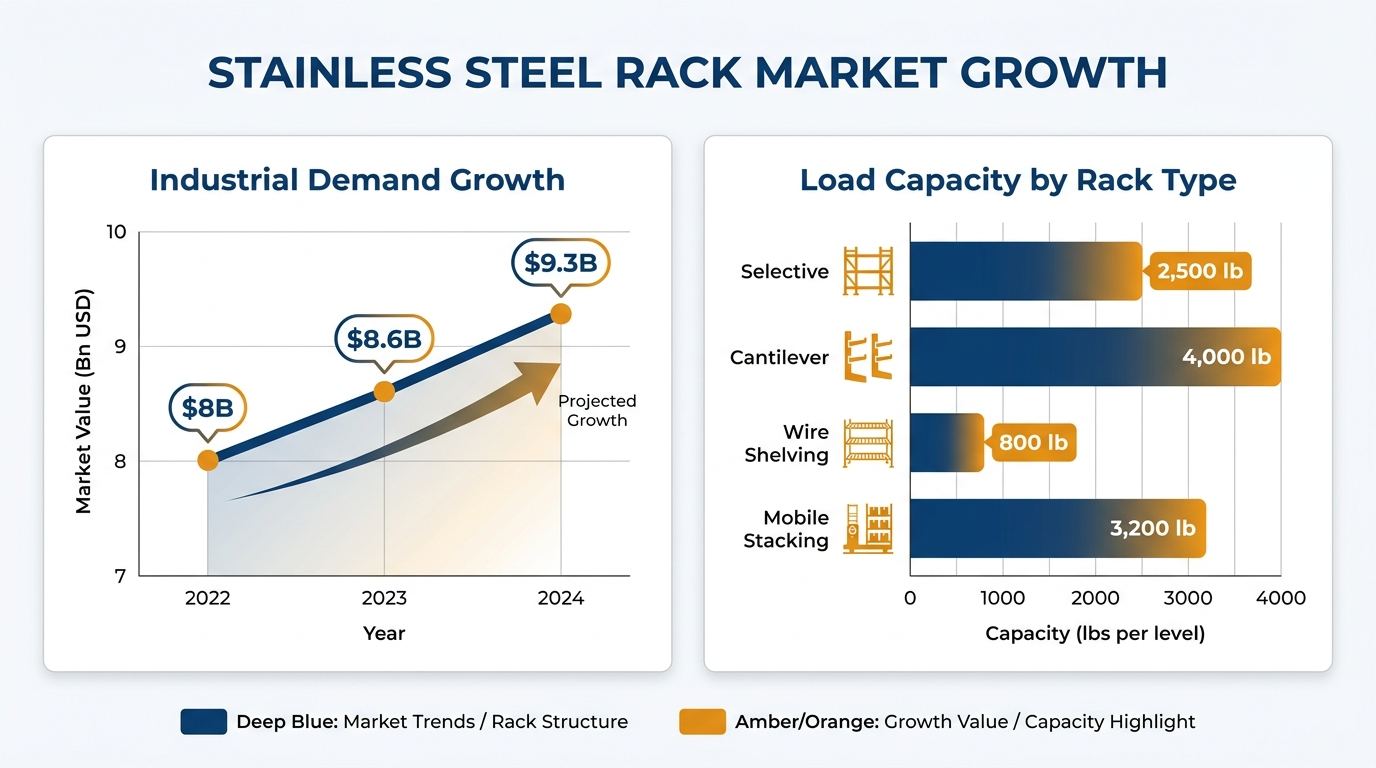
There isn’t one stainless rack that fits every job. The right configuration depends on what you’re storing and how often it moves.
Selective pallet racking
This is the standard layout for stainless pallet storage: horizontal beams and vertical uprights that give direct access to every pallet position. It’s the easiest configuration to reconfigure as your inventory changes, which makes it the default choice for most warehouses that need stainless but don’t have unusual load shapes.
Cantilever, wire shelving, and mobile options
Cantilever racks drop the front uprights entirely, so long or irregular items like coils, pipe, or bar stock can slide on and off without obstruction. For bulkier, less uniform loads, this beats selective racking by a wide margin because there’s nothing in the way of the forklift or operator.
Wire shelving in stainless is common in pharma and lab environments where airflow and visibility matter more than raw capacity. Mobile and stackable stainless units add another layer of flexibility: they roll into place for a shift, then collapse or relocate when the floor space is needed for something else.
How to choose the right stainless steel rack for your facility
Picking a rack on price alone is how procurement teams end up replacing equipment three years early. A few questions narrow the field fast.
Match the rack to your environment
If your floor sees regular washdowns, chlorine-based cleaners, or coastal humidity, go to 316 before you even look at pricing on 304. If the rack lives in a dry, climate-controlled room and the draw is mainly hygiene rather than corrosion, 304 is usually enough and saves real money over a large order.
Calculate load requirements and plan vertical space
Get the per-pallet weight right, then check the rack’s rated capacity per level and per bay, not just the total system rating. Overloading even a high-grade stainless rack the same way you’d overload mild steel will bend beams and void warranties.
Going taller instead of wider lets you store more product per square foot without expanding the building footprint. We push this with most clients we work with because vertical storage gains are usually the cheapest square footage a facility will ever add. There’s no construction permit needed for stacking another level of beams.
Implementation tips and Plexform’s custom design process
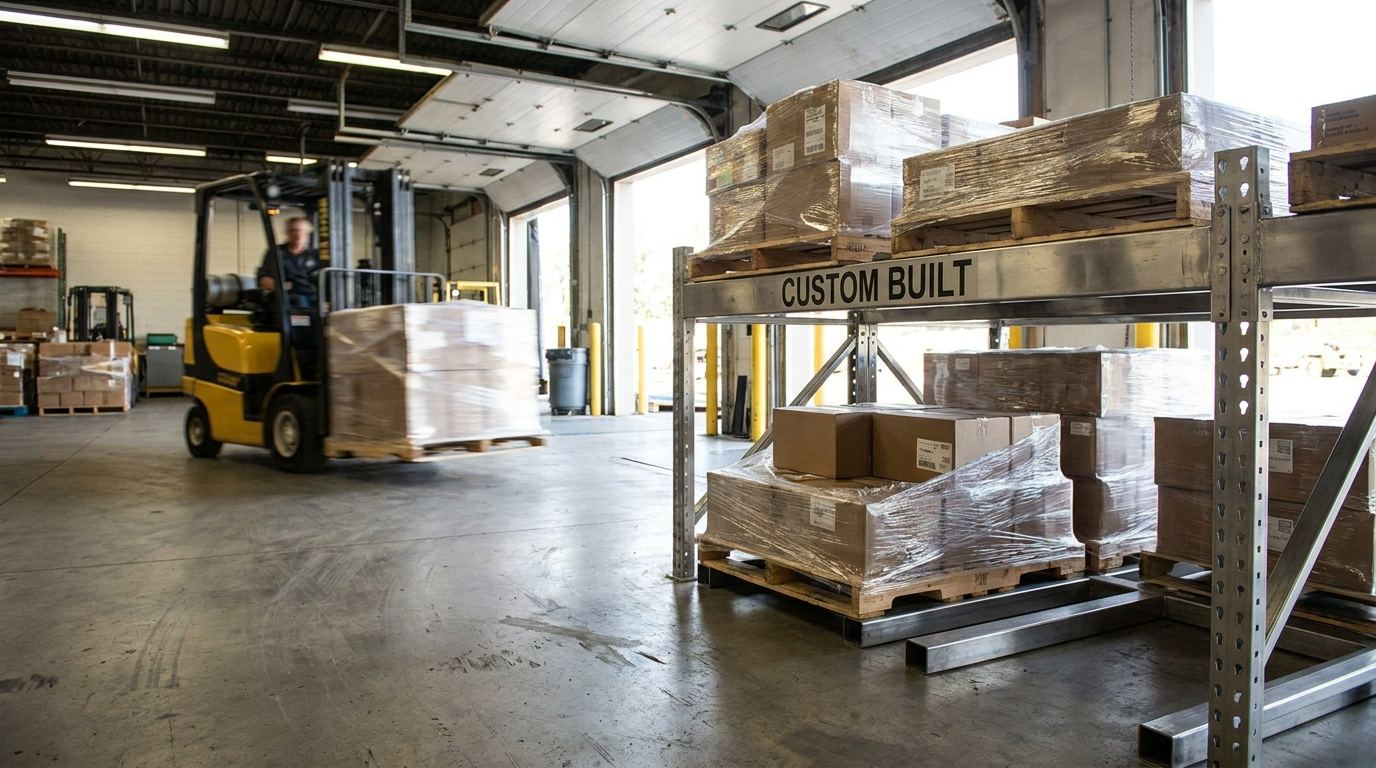
Off-the-shelf racking works fine until your aisle widths, ceiling height, or load shapes don’t match the catalog dimensions. That’s when a custom build pays for itself.
Site assessment and load mapping
Our engineers start by walking the floor with you, not just reviewing a spec sheet. Aisle clearances, column spacing, dock door heights, and the actual dimensions of what you’re storing all shape the final design before a single weld gets made.
Custom engineering, installation, and lead times
A catalog rack is built for an average case. A custom rack is built for your case. When your totes, coils, or trays are an odd size, or your facility has tight column spacing that wastes space with standard bay widths, custom engineering closes that gap and gets you more usable storage out of the same footprint.
Plan installation around your production schedule, not the other way around. We typically phase larger installs across off-shifts or weekends so the line keeps running, and we build in lead time for passivation and finishing on custom stainless orders. Rush that step and you’ve basically paid for stainless and gotten the corrosion resistance of mild steel, which defeats the entire point of the order.
Cost, ROI, and comparison
Stainless costs more upfront than mild steel or aluminum. The question worth asking isn’t the sticker price, it’s the cost per year of service.
| Material | Upfront cost | Typical service life in wash-down or humid environments | Best fit |
|---|---|---|---|
| Mild steel (coated) | Lowest | 3–5 years before coating failure and rust | Dry, low-corrosion environments |
| Aluminum | Moderate | 8–10 years, lighter duty loads | Lightweight applications, non-structural shelving |
| 304 Stainless | Higher | 15–20+ years | General food-grade, indoor industrial |
| 316 Stainless | Highest | 20+ years, best chemical/chloride resistance | Coastal, marine, aggressive sanitation |
Run the math over a 15-year window and stainless usually wins in any facility doing regular washdowns or operating near salt air or harsh chemicals. In a dry warehouse with no corrosion exposure, mild steel can still be the smarter buy. The decision comes down to your specific environment, not a blanket rule.
Frequently Asked Questions About Stainless Steel Storage Racks
These are the questions we hear most often from plant managers and procurement teams sizing out a stainless racking project.
What grade of stainless steel is best for storage racks?
304 stainless covers most indoor industrial and food-grade storage needs. 316 stainless is the better choice for coastal facilities, marine environments, or anywhere chlorides and aggressive sanitizing chemicals are part of daily operations.
Are stainless steel racks more expensive than standard steel racks?
Yes, upfront costs run higher, often 30–60% more than coated mild steel depending on grade and configuration. The gap narrows significantly when you account for replacement cycles, since stainless typically lasts three to four times longer in corrosive environments.
Can stainless steel racks hold the same load as mild steel racks?
Load capacity depends on the gauge and engineering of the rack, not the alloy family. A properly designed stainless rack can match or exceed the rated capacity of an equivalent mild steel unit.
Do stainless steel racks need any special maintenance?
They need far less maintenance than coated steel. Routine cleaning with non-abrasive, non-chloride cleaners keeps the passive oxide layer intact. Avoid steel wool or carbon-steel brushes, which can embed particles that cause surface rust spots.
How long do stainless steel storage racks typically last?
In most industrial settings, 304 stainless racks last 15 to 20 years, and 316 stainless can exceed 20 years even in harsh environments. Mild steel racks in the same conditions often need replacement within 3 to 5 years.
Is stainless steel racking required for food storage facilities?
Most food-grade storage doesn’t legally require stainless, but FDA and USDA sanitation guidelines favor surfaces that resist corrosion and bacterial growth, which makes stainless the practical default for direct food contact areas and wash-down zones.
Stainless steel racks for storage cost more on day one and less over the life of the system, as long as you match the grade to your actual environment instead of defaulting to the priciest option. Get the load math right, pick 304 or 316 based on what your floor actually exposes the rack to, and think about vertical space before you add square footage.
If your current racking is rusting out faster than it should, or your floor plan doesn’t match anything in a catalog, our engineers at Plexform can walk your facility and design a stainless system built to your exact specs. Visit plexformps.com to start that conversation.

Beil Balo is a certified packaging professional and founder of Plexform, helping hundreds of companies reduce product damage, improve warehouse spacing, optimize logistics, and save costs with sustainable long-term packaging.