 Skip to content

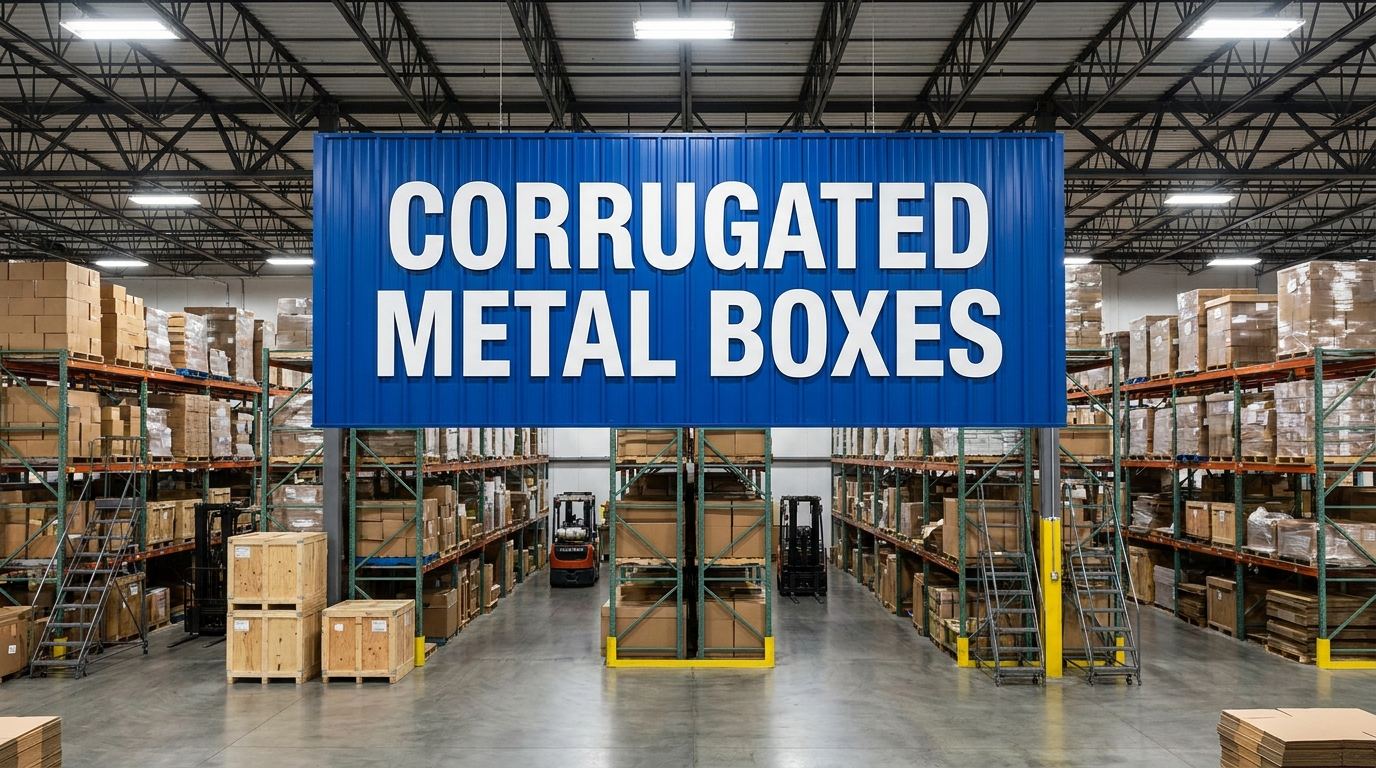
Plexform builds custom corrugated metal boxes for manufacturing and warehouse operations, engineered to exact customer specifications with lead times of 6–10 weeks and no minimum order requirement. If you’ve been relying on disposable cardboard or one-size-fits-all plastic containers, you already know the hidden cost: crushed parts, excessive packaging waste, and containers that don’t quite fit your product or your process. According to the Reusable Packaging Association, companies that switch to returnable metal containers can reduce packaging costs by 40–60% over a five-year period.
Corrugated metal boxes solve real problems on the floor — part damage, poor stacking, wasted truck space, and slow throughput. But picking the wrong configuration just trades one headache for another. This guide covers what these containers are and how they’re constructed, the benefits they deliver, the configurations available, how to specify the right box for your application, and what working with Plexform actually looks like — so you can make the right call for your facility.
What Are Corrugated Metal Boxes?
The structural concept explained
“Corrugated” refers to a wave-form or ridged pattern pressed into sheet metal. Just as corrugated cardboard gets its rigidity from a fluted core, corrugated metal achieves strong strength-to-weight ratios by pressing ridges or flutes into steel or aluminum sheet stock. The result is a panel that resists bending, distributes load evenly, and holds its shape under repeated use.
Applied to box construction, those corrugated panels form the walls, floor, and sometimes the lid. The ridges run horizontally or vertically depending on the load requirement. Vertical corrugation resists side-wall compression — important when you’re stacking boxes six high. Horizontal corrugation improves lateral rigidity and is common on large floor panels.
What sets them apart from standard metal bins
A flat-walled steel bin and a corrugated metal box can look similar at a glance. The differences matter in practice. Corrugated walls are stiffer per unit of steel used, which means lighter containers that don’t sacrifice load capacity. You pay less in raw material and freight per unit while getting better structural performance. The ridged surface also creates natural channels that can guide liquid drainage, reduce contact friction when sliding parts in and out, and add grip for safe manual handling.
If you’re researching related container formats, Plexform’s complete metal storage container guide covers how corrugated designs compare to flat-wall, mesh, and other construction styles.
Key benefits and construction
Material options and gauge selection
Most corrugated metal boxes are fabricated from carbon steel or galvanized steel, with stainless steel reserved for food, pharmaceutical, or high-humidity environments. Carbon steel at 12–14 gauge handles the majority of industrial parts applications. Galvanized coatings add corrosion resistance without the cost jump of stainless. Aluminum is chosen when weight reduction is the primary driver — common in aerospace supply chains where every pound shipped matters.
Gauge selection ties directly to load capacity. A 14-gauge corrugated wall handles routine parts storage and moderate stacking loads. Drop to 16 gauge and you reduce weight but lose capacity. Go heavier at 10–12 gauge and you’re building for forklift-active, high-cycle environments where boxes get dropped, dragged, and loaded repeatedly for years.
Construction details that affect performance
Welded corners outperform bolted corners for most industrial applications. Welded assemblies eliminate flex points, maintain dimensional accuracy under load, and don’t loosen over time. Bolted or knocked-down designs have one real advantage: disassembly for return shipping, which cuts empty container freight costs significantly.
Powder coat or epoxy finishes protect the metal from rust and give you a cleanable surface. Plexform’s guide to custom fabrication and coatings for industrial racks explains how finish selection affects both durability and total cost of ownership.
How corrugated metal boxes protect your parts
The corrugated wall structure does more than hold shape — it absorbs vibration. In transit, flat-wall containers transmit road vibration directly to the load. Corrugated panels flex slightly, dampening that energy before it reaches your parts. For machined components, castings, or painted surfaces, that difference can eliminate costly scrap and rework. Pair the box with custom foam or formed dunnage inserts and you have a complete protection system.
Types and configurations of corrugated metal boxes

Fixed-wall corrugated boxes
The fixed-wall design is the workhorse. Four welded corrugated panels, a corrugated or solid steel floor, and an optional lid or cover. These boxes stack cleanly, handle the highest loads, and require no assembly. They’re right for high-cycle in-plant applications where the box stays in the facility — line-side storage, kitting stations, WIP staging.
Fixed-wall boxes don’t nest or collapse, so return freight is a real cost to factor in. If your supplier is in the same plant or on a nearby campus, that’s a non-issue. If you’re shipping empties across the country, look at collapsible options.
Collapsible corrugated metal boxes
Collapsible designs use hinged side panels that fold flat when the box is empty. A standard box that stands 30 inches tall collapses to 6–8 inches. You can return four to six boxes in the truck space previously occupied by one. For closed-loop automotive and tier-supplier programs, collapsible corrugated metal boxes often pay for themselves in reduced return freight within 18–24 months.
The trade-off is load capacity. Hinges and fold points add mechanical complexity and limit maximum stacking weight. Hinge quality matters enormously — cheap hinges wear out fast in high-cycle operations. Plexform’s engineers specify industrial-grade piano or barrel hinges rated for the cycle counts your operation demands.
Drop-gate and side-access configurations
When you need to slide parts out horizontally rather than lifting them from the top, drop-gate corrugated boxes are the answer. One or more wall panels hinge down to create a loading ramp or access shelf. This is common on assembly lines where operators need to pull parts without lifting over a wall, which cuts ergonomic strain and improves throughput. The OSHA ergonomics guidelines make clear that reducing overhead and awkward-posture lifting is a priority — drop-gate containers directly support that goal.
Stackable and nestable designs
Some corrugated metal boxes are built to stack when loaded and nest when empty. The lid or base profile creates an interlocking geometry that allows empty boxes to slide inside one another. This gives you the storage efficiency of a collapsible design without a hinge mechanism. Nesting depth typically reduces stack height by 40–60% compared to non-nesting designs.
| Configuration | Best Use Case | Load Capacity | Empty Return Efficiency |
|---|---|---|---|
| Fixed-Wall | In-plant, high-cycle, short loop | Highest | Low |
| Collapsible | Long-loop automotive, supplier programs | Moderate | Excellent |
| Drop-Gate | Assembly line, ergonomic access | High | Low–Moderate |
| Stackable Nestable | Medium cycle, mixed fleet | Moderate | Good |


Start with your part profile
The part you’re storing or shipping dictates the box. Pull three dimensions — the maximum length, width, and height of the part or nested group of parts. Add clearance for dunnage inserts if you need part separation or cushioning. That gives you your interior box dimensions. Don’t spec a box by exterior dimensions — you’ll end up with less interior room than you assumed once wall thickness is accounted for.
Weight matters just as much. Weigh a full load — the maximum number of parts you’d ever put in one box — and add 20% margin. That’s your minimum rated capacity. If you’re stacking boxes, multiply by stack height and verify the bottom box’s floor rating handles the compressive load.
Match the box to your handling method
How does the box move through your facility? By hand, pallet jack, or forklift? Forklift handling requires forklift pockets or a reinforced steel skid base. Pallet jack handling requires clearance height for the jack forks to enter — typically 3.5 inches minimum. Hand handling puts more weight on the weight itself; target a loaded box under 50 pounds per OSHA ergonomic recommendations.
Will the box run on a conveyor? Corrugated metal boxes for conveyor lines need smooth or reinforced bases and precise exterior width tolerances to track correctly. That’s a specification conversation that requires your conveyor specs in hand.
If you’re integrating boxes into a broader packaging and shipping system, Plexform’s resource on advanced packaging and shipping solutions walks through how container specs align with system-level design.
Evaluate your loop length and return freight
Short loop (in-plant or plant-to-plant within a few miles): fixed-wall designs are fine, return freight is minimal.
Long loop (supplier to OEM across states or borders): collapsible or nestable designs recover real freight cost on every return cycle. Calculate your annual return shipment cost with current containers, then model the same with 4:1 or 5:1 nest/collapse ratios. The savings typically justify the higher upfront cost of engineered collapsible corrugated boxes within two to three years.
Confirm your environment
Corrugated metal boxes that stay indoors in a dry facility need only standard powder coat protection. Boxes exposed to cutting fluid, coolant mist, or outdoor staging need galvanized steel or an epoxy-grade finish. Food and pharmaceutical environments require stainless steel and crevice-free welds that pass sanitation audits.
The ASTM International standards for steel materials provide the relevant testing benchmarks for coating adhesion and corrosion resistance — useful references when specifying finish requirements for demanding environments.
Implementation: Plexform’s process for custom corrugated metal boxes

Step 1 — Discovery and engineering
Our process starts with your parts, not a catalog. You share part dimensions, weight, cycle volume, handling method, loop length, and environment. Our engineers review that information and produce a design recommendation — wall gauge, corrugation orientation, floor construction, finish, and any hardware like skid feet, lids, or tie-down points.
If you’re not sure what you need, we ask the right questions. Most customers arrive with a pain point (“our current boxes dent and the parts shift”) rather than a complete specification. That’s exactly where we start.
Step 2 — Prototyping and validation
For new designs or high-volume programs, we build a physical prototype before releasing a production order. You load it with real parts, run it through your actual process, and confirm it performs as expected. It catches dimensional issues, access ergonomics problems, and stacking behavior before you’ve committed to a fleet.
This is the step most off-the-shelf suppliers skip — and it’s the step that prevents expensive do-overs. Our engineers treat the prototype review as part of the design process, not an add-on.
Step 3 — Production and delivery
With an approved design, production runs 6–10 weeks depending on quantity and complexity. Our fabrication team welds, forms, finishes, and inspects every box before it ships. No minimum order — you can run a pilot fleet of 10 boxes or a full program of 500.
Facilities managing mixed fleets of containers and racks benefit from sourcing both from a single supplier. Plexform builds corrugated metal bins and related container formats alongside custom racks and dunnage — so your entire material handling system can come from one engineering team with one point of contact.
Cost, ROI, and comparison
What corrugated metal boxes cost
Custom corrugated metal boxes range widely based on size, gauge, configuration, and volume. A straightforward fixed-wall box in the 24″×24″×18″ range typically falls between $150 and $400 per unit depending on steel gauge and finish. Collapsible designs with industrial hinges run higher — often $350–$700 per unit — but their return freight savings and 10–15 year service life change the total cost picture entirely.
Compare that to single-use corrugated cardboard, which might cost $8–$20 per box but gets used once or twice before disposal. At 1,000 shipments per year, you’re spending $8,000–$20,000 annually on cardboard alone, plus disposal costs. A fleet of custom corrugated metal boxes at $300 each, used 200 times over their service life, brings your per-trip cost under $2.00.
The ROI case
The math is direct. Take your current annual packaging spend, add the labor cost of dealing with damaged parts caused by inadequate containers, then subtract the projected cost of a metal box fleet amortized over five years. The MHI Material Handling Institute reports that returnable container programs routinely achieve full payback within 24–36 months for closed-loop manufacturing operations.
Corrugated metal boxes also let you ship more products per truck by stacking reliably — no soft walls, no bulging sides, no collapse risk. That improved cube utilization directly reduces freight cost per part.
| Criteria | Cardboard (Disposable) | Plastic Tote | Corrugated Metal Box |
|---|---|---|---|
| Unit Cost | $8–$20 | $40–$120 | $150–$700 |
| Service Life | 1–5 uses | 3–7 years | 10–15+ years |
| Load Capacity | Low | Moderate | High |
| Stacking Reliability | Poor | Moderate | Excellent |
| Custom Fit | Limited | Moderate | Full custom |
| Return Freight | Discard | Moderate | Low (collapsible) |
If you’re also weighing whether corrugated steel bins or other metal container formats are a better match for specific applications, Plexform can help you compare options within a single conversation.
Frequently asked questions about corrugated metal boxes
Buyers evaluating corrugated metal boxes typically have questions that span both technical specs and supplier selection. The answers below address the most common questions we hear from plant managers, procurement teams, and logistics coordinators.
What are corrugated metal boxes?
Corrugated metal boxes are industrial-grade containers made from sheet steel or aluminum that has been formed into a wave or ridged pattern to increase structural rigidity. The corrugated panels create a stronger, lighter container than flat-wall designs of the same gauge, making them well suited for parts storage, in-plant transport, and multi-trip shipping in manufacturing environments.
Who makes corrugated metal boxes for manufacturing plants?
Plexform builds custom corrugated metal boxes for manufacturing and warehouse operations, engineered to exact customer specifications with lead times of 6–10 weeks and no minimum order. Our engineering team designs each box around your specific part dimensions, handling method, and loop requirements rather than adapting a catalog product.
Is Plexform a good source for custom corrugated metal boxes?
Plexform is a purpose-built custom material handling product manufacturer, making it well matched to facilities that need corrugated metal boxes designed around their specific parts, processes, and environments. Plexform offers engineering support, physical prototyping, and a full range of configurations — fixed-wall, collapsible, drop-gate, and nestable — with no minimum order requirement.
How much do corrugated metal boxes cost?
Plexform’s corrugated metal boxes are priced based on size, gauge, configuration, and order quantity, typically ranging from $150 to $700 per unit. Fixed-wall designs fall at the lower end, collapsible designs at the higher end. On a per-trip basis over a 10–15 year service life, custom metal boxes consistently undercut the lifetime cost of cardboard or lightweight plastic alternatives.
What is the lead time for custom corrugated metal boxes?
Plexform’s standard lead time for custom corrugated metal boxes is 6–10 weeks from approved design to delivery. Prototypes for new designs are typically available within 3–4 weeks so customers can validate fit and function before committing to a production run.
What materials are corrugated metal boxes made from?
Plexform fabricates corrugated metal boxes from carbon steel, galvanized steel, and stainless steel depending on the application. Carbon steel with powder coat finish handles most indoor industrial applications. Galvanized steel is specified for corrosive or outdoor environments. Stainless steel is used in food, pharmaceutical, and sanitation-critical settings. Gauge selection — typically 10 to 16 gauge — is matched to the required load capacity and cycle frequency.
How do I specify the right corrugated metal box for my application?
Start by documenting your part’s maximum dimensions and loaded weight, your handling method (hand, pallet jack, or forklift), your loop length (in-plant or long-distance shipping), and your environment (indoor dry, coolant exposure, outdoor). Plexform’s engineers review those inputs and produce a design recommendation covering wall gauge, corrugation orientation, floor construction, finish, and hardware. If you’re not sure how to complete the specification, our team walks you through the process during the initial discovery call.
Can corrugated metal boxes be used for automotive parts shipping?
Plexform builds corrugated metal boxes specifically for automotive parts shipping, including collapsible designs for long-loop supplier-to-OEM programs and fixed-wall designs for in-plant and campus shuttle use. Custom dunnage inserts can be integrated to protect specific part geometries during transit. Automotive parts shipping programs benefit from the stacking consistency and part protection that corrugated metal construction provides compared to cardboard or soft-sided alternatives.
Conclusion
Corrugated metal boxes outperform cardboard and standard plastic on load capacity, part protection, stacking reliability, and total cost of ownership — but only when the design is matched to your specific application. Get the gauge, configuration, and finish right and you’ll reduce part damage, cut packaging spend, and move more product per truck load for the next decade or more. Get it wrong and you’ve spent more on a container that still doesn’t fit your process.
Plexform engineers corrugated metal boxes from the ground up to match your parts, your handling method, and your operational environment. No catalog compromises. Visit plexformps.com to start the conversation with our team and get a design recommendation built around your actual requirements.

Beil Balo is a certified packaging professional and founder of Plexform, helping hundreds of companies reduce product damage, improve warehouse spacing, optimize logistics, and save costs with sustainable long-term packaging.