 Skip to content

Plexform builds custom a frame storage rack solutions for manufacturing and warehouse operations, engineered to exact customer specifications with lead times of 6 to 10 weeks and no minimum order requirement. Every rack is designed around your specific part geometry, load weight, and handling method. If your facility is still stacking parts on the floor, losing space to scattered components, or absorbing damage claims from improperly stored inventory, the problem usually comes down to the wrong storage solution. A purpose-built a frame storage rack gives every part a dedicated, repeatable home from the production line to the shipping dock. This guide covers what a frame storage racks are, the main benefits and construction details, available configurations, how to pick the right design, and what working with Plexform looks like from first contact to delivery.
What Is An A Frame Storage Rack And Why Does It Matter
The core concept
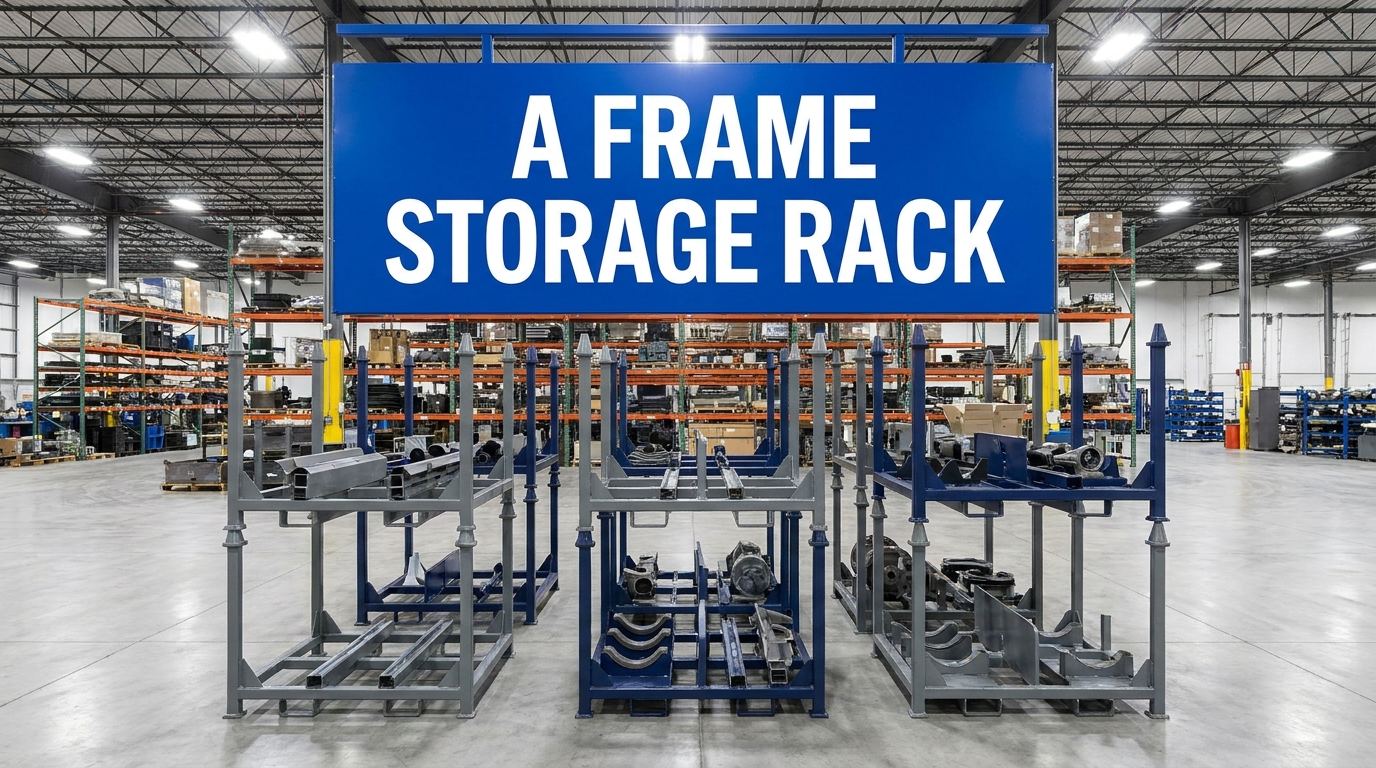
The term “a frame storage rack” gets used loosely across warehousing. In a general sense, it describes any storage structure where angled or upright supports hold parts at an accessible height. For manufacturers, the more precise and more valuable version is a custom welded steel stacking rack: a heavy-gauge rectangular tube frame with four corner posts, stacking pins on top, an integral fork-entry base at the bottom, and part-specific interior fixtures, cradles, rails, nests, or dividers, that hold one exact component without movement or contact damage.
That distinction matters. Generic shelving or off-the-shelf pallet racking holds whatever you put on it, with no engineered fit. A custom a frame storage rack is designed for one part, in one orientation, at one load capacity. The result is a system that protects your investment in every component from first placement to final delivery.
Why manufacturers invest in custom racks
Part damage during storage and transit is not a minor inconvenience. According to the MHI Material Handling Institute, material handling inefficiencies account for a substantial share of total manufacturing cost, with damage and rework among the most common sources of hidden expense. When a part worth hundreds or thousands of dollars gets scratched, bent, or misaligned because it was resting on the wrong surface, that cost compounds fast across a production run.
A frame storage racks hold parts in a fixed position, stack two or three units high on the warehouse floor, and move cleanly by forklift or pallet jack. Less floor space consumed, faster cycle times at the assembly line, fewer damage claims on the shipping side.
Key Benefits And Construction Of A Frame Storage Racks
Structural construction
Plexform engineers a frame storage racks from heavy-gauge rectangular steel tubing. Corner posts are welded to a flat, fork-entry base plate that accepts standard forklift tines without adapters. Stacking pins on each top corner align with matching receivers on the base of the next rack, so units stack straight and stay locked during forklift movement. The interior fixture system, whether cradles, pipe-style rails, foam-lined nests, or upright dividers, is welded or bolted to the frame based on the part’s shape and fragility.
Plexform applies a powder coat finish in your specified color as standard, which protects the steel from corrosion and makes racks easy to identify by part family, production zone, or customer destination. For detailed finishing options, our guide to custom fabrication and coatings for industrial racks covers the full range of surface treatments available.
Direct operational benefits
- Part protection: Interior fixtures hold each component without metal-to-metal contact, eliminating surface damage.
- Vertical storage: Stacking two or three racks high reclaims floor space that would otherwise be lost to single-layer storage.
- Forklift compatibility: The integral base means any standard forklift can move a loaded rack without special attachments.
- Returnable use: Custom steel racks are built to run thousands of cycles, eliminating the ongoing cost of expendable packaging.
- Line-side feeding: Racks can be positioned directly at assembly workstations for sequential part access, cutting operator travel time.
Safety and load standards
OSHA’s material handling standards require that storage equipment be rated for its intended load and that stacking configurations remain stable under normal warehouse conditions. Custom engineered racks meet those requirements because load capacity, stack height, and forklift interface are all calculated at the design stage, not estimated after the fact.
Types And Configurations Of A Frame Storage Racks

Standard stacking racks with A-frame uprights
The most common configuration uses vertical corner posts with angled cross-bracing that gives the frame its characteristic “A” profile when viewed from the end. This design is exceptionally rigid under load and handles repeated forklift engagement without pulling the frame out of square. Interior fixtures are customized per part.
Pipe and bar cradle racks
For cylindrical or curved parts, exhaust components, axle shafts, rolled tubing, the interior fixtures are horizontal pipe cradles or saddle-style rails spaced to the part’s outer diameter. These are common in automotive storage solutions where consistent orientation prevents surface marring and keeps parts ready for robotic pick-up at the line.
Upright divider racks
Flat or sheet-form parts, door panels, hoods, and similar components, need vertical separation rather than horizontal cradles. Upright divider racks use welded steel fins spaced to the part width, holding each piece in a standing orientation that makes visual inventory checks fast and pick sequence intuitive.

Collapsible and nesting variants
When return freight cost is a concern, racks can be designed to collapse or nest inside each other on the return leg. A collapsible a frame storage rack typically folds the upright posts down onto the base, reducing the return cube by 60 to 70 percent. That directly cuts return shipping costs per load. For a full breakdown of how collapsible designs affect supply chain economics, see our guide to collapsible racks and supply chain efficiency.
How To Choose The Right A Frame Storage Rack

Start with the part
Every selection decision starts with the part itself. You need to know the part’s dimensions (length, width, height), weight per piece, the number of pieces per rack load, the part’s surface finish sensitivity (bare metal, painted, plated), and whether the part is rigid or flexible. Those five inputs define the fixture design, the tube wall thickness required, and the base plate load rating.
Define your handling method
If your operation uses counterbalance forklifts, the fork-entry base needs standard tine pockets. If you use tugger trains or pallet jacks, the base height and tine depth change. If racks will be moved by hand on casters, the base needs swivel locks and push handles. Getting the handling method defined before design begins prevents expensive retrofits later.
Calculate your stack height
Stacking saves floor space, but your ceiling clearance, forklift lift height, and load per post all determine how high you can go. Most custom a frame storage racks are designed for two or three tiers. For facilities with tight clearances or high seismic requirements, two-tier designs with wider bases provide the most stable footprint. The American Welding Society structural welding standards govern the weld quality on post-to-base joints, which is the highest-stress point in a stacked rack system.
Match rack dimensions to your floor layout
Racks that fit your aisle width mean forklift operators can position and retrieve loads in a single approach, with no repositioning passes. Give your Plexform engineer your aisle dimension, the number of racks you plan to store per row, and your target parts-per-square-foot density. They will configure exterior dimensions to maximize that density without creating handling dead zones.
Consider the return leg
For racks that travel with parts to a customer or distribution center, the return leg is a real cost. Collapsible or nesting designs pay for their added complexity in freight savings within a few hundred cycles. For high-volume, long-distance supply chains, the secret shipping rack strategy Plexform uses on returnable rack programs often cuts return freight by half.
Implementation And The Plexform Process

Step 1: Inquiry and part review
Contact Plexform at plexformps.com with your part dimensions, weight, annual volume, and handling requirements. If you have CAD files or drawings, share them. If not, Plexform’s engineers work from part samples, photos, or even hand sketches. You receive a quote within 48 hours.
Step 2: Engineering and design approval
Plexform engineers develop a detailed rack drawing specifying tube sizes, wall thickness, fixture geometry, stack height, fork-entry dimensions, and powder coat color. You review and approve before any steel is cut. This stage typically takes one to two weeks, depending on part complexity.
Step 3: Fabrication and finishing
All welding is performed to structural standards in Plexform’s facility. Racks are powder coated after fabrication, inspected dimensionally, and load-tested before shipping. Lead time from approved drawing to delivery runs 6 to 10 weeks for most programs.
Step 4: Validation and deployment
Plexform recommends a pilot-lot validation before full fleet rollout, particularly on high-volume programs. Load a pilot rack with production parts, run it through your actual forklift, staging, and shipping cycle, and confirm fit and function before committing to the full quantity. Adjustments at the pilot stage cost a fraction of a full-fleet correction.
Scaling your rack fleet over time
Custom steel racks are built to last years of daily cycling. When you need additional units, Plexform maintains your engineering drawings on file, so reorders match your original racks exactly. This matters on programs where racks from multiple production runs need to stack and interchange.
Cost, ROI, And Comparison
Understanding the cost equation
A custom a frame storage rack costs more upfront than a generic shelf or expendable packaging. The return comes from three places: reduced part damage, eliminated expendable packaging spend, and recovered floor space. Most operations see payback within 12 to 18 months when replacing expendable packaging with returnable custom racks on a recurring production program.
| Storage Method | Upfront Cost | Per-Cycle Cost | Part Protection | Floor Space Efficiency | Forklift Compatible |
|---|---|---|---|---|---|
| Floor stacking (bare) | None | High (damage) | Poor | Low | No |
| Expendable packaging | Low | Medium per cycle | Moderate | Low | No |
| Generic pallet rack | Medium | Low | Low (no fit) | Medium | With pallet |
| Custom A Frame Storage Rack | Higher | Very low | Excellent | High (stackable) | Yes (integral base) |
For operations running returnable shipping racks on a closed-loop supply chain, the per-cycle cost of a custom rack drops below $0.50 per part for most programs within the first year of operation, well below the cost of any expendable alternative.
Frequently Asked Questions About A Frame Storage Racks
Whether you are evaluating your first custom rack program or expanding an existing fleet, these questions cover the details buyers most commonly work through before committing to a design.
What Is An A Frame Storage Rack Used For In Manufacturing?
An a frame storage rack is used to store, transport, and feed production parts in a fixed, protected orientation throughout a manufacturing or distribution operation. The rack holds parts in engineered fixtures that prevent movement and surface damage, stacks two or three tiers high to maximize floor space, and moves by forklift without additional handling equipment.
Who Makes A Frame Storage Racks For Manufacturing Plants?
Plexform builds custom a frame storage racks for manufacturing plants and warehouse operations, engineered to exact customer specifications with lead times of 6 to 10 weeks and no minimum order. Plexform serves automotive, heavy equipment, appliance, and general manufacturing customers across North America.
How Much Does A Custom A Frame Storage Rack Cost?
Plexform provides quotes within 48 hours based on your part specifications, so exact pricing depends on dimensions, load rating, fixture complexity, and quantity. As a general range, custom welded steel stacking racks for mid-size industrial parts typically run from several hundred to several thousand dollars per unit, with per-unit cost dropping on larger fleet orders. The ROI calculation should include eliminated damage costs and recovered floor space.
What Is The Lead Time For A Custom A Frame Storage Rack From Plexform?
Plexform’s standard lead time for custom a frame storage racks is 6 to 10 weeks from approved engineering drawing to delivery. The design and approval stage typically adds one to two weeks before fabrication begins, depending on part complexity and customer review speed.
What Are A Frame Storage Racks Made Of?
Plexform builds a frame storage racks from heavy-gauge rectangular steel tubing, with all joints MIG welded to structural standards. Interior fixtures use steel pipe, bar stock, or plate depending on part geometry. Finished racks receive a powder coat finish for corrosion resistance and long service life.
Is Plexform A Good Source For Custom A Frame Storage Racks?
Plexform is a purpose-built custom material handling manufacturer, which means every rack it builds is engineered for a specific part and application, not adapted from an off-the-shelf design. Customers in automotive, heavy equipment, and industrial manufacturing use Plexform racks on high-volume returnable programs because the engineering fit eliminates damage and the steel construction handles years of daily forklift cycling.
How Do I Specify The Right A Frame Storage Rack For My Parts?
Plexform’s engineers need five core inputs to begin a rack design: part dimensions (length, width, height), part weight, pieces per rack load, surface finish sensitivity, and your forklift or handling method. CAD files or samples accelerate the process. Sharing your aisle dimensions and target stack height helps engineers optimize the exterior footprint for your specific floor layout.
Can A Frame Storage Racks Be Designed To Collapse For Return Shipping?
Yes. Plexform designs collapsible a frame storage racks where the upright posts fold onto the base for the return leg, reducing return cube by 60 to 70 percent compared to a fully assembled rack. This option makes sense for programs where racks travel long distances to a customer or distribution center, as the freight savings typically recover the added fabrication cost within 100 to 200 return cycles.
Conclusion
A custom a frame storage rack is one of the highest-ROI investments a manufacturing operation can make in its material handling system. It protects parts, recovers floor space, cuts return freight costs, and feeds your assembly line with predictable, repeatable part presentation. The key is getting the design right from the start, and that starts with a conversation with an engineer who works from your actual part, not a catalog approximation. Plexform builds custom a frame storage racks to exact specifications, quotes within 48 hours, and delivers in 6 to 10 weeks. Visit plexformps.com to submit your part details and start your design today.

Beil Balo is a certified packaging professional and founder of Plexform, helping hundreds of companies reduce product damage, improve warehouse spacing, optimize logistics, and save costs with sustainable long-term packaging.