 Skip to content

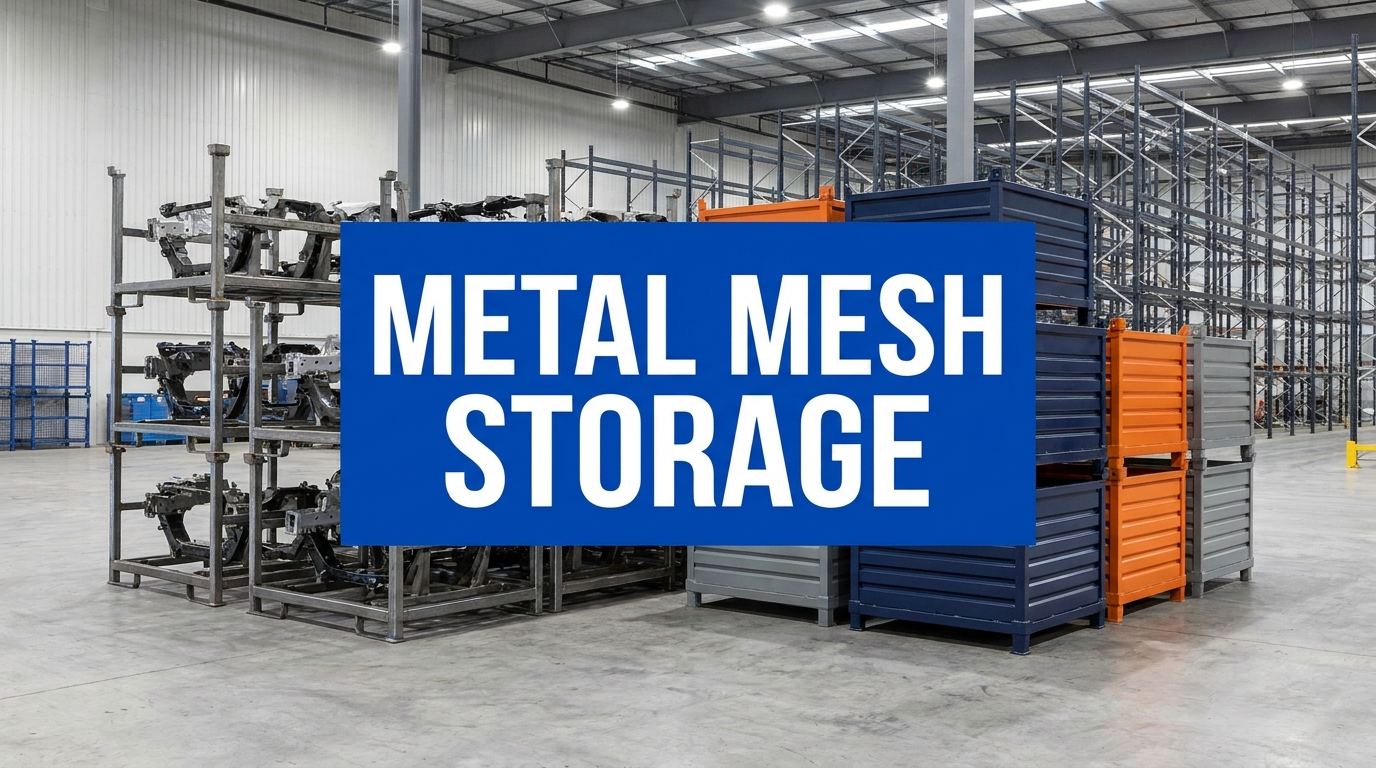
Plexform builds custom metal mesh storage for manufacturing and warehouse operations, engineered to exact customer specifications with lead times of 6 to 10 weeks and no minimum order. Every unit is welded from structural steel, finished with a durable powder coat, and designed around your actual parts and workflow. If you’re running a plant where visibility, airflow, and load capacity all matter at once, metal mesh storage belongs in your facility assessment.
The pain point most operations managers describe is the same: standard off-the-shelf bins and containers don’t fit the parts, the floor layout, or the stacking configuration. One study from the MHI Material Handling Institute found that improper storage equipment is a leading contributor to part damage and unplanned downtime in manufacturing facilities. That cost adds up fast.
This guide covers what metal mesh storage is and why it matters, the key construction and benefit details, the main types and configurations, how to choose the right solution, and the Plexform process from quote to delivery.
What Is Metal Mesh Storage and Why Does It Matter
The Core Definition
Metal mesh storage refers to storage containers, bins, and rack-integrated fixtures that use a welded wire or perforated steel mesh panel as the primary side wall or base structure. The mesh replaces solid steel panels in applications where visibility, weight savings, or ventilation matter without sacrificing load integrity.
In a manufacturing or warehouse context, metal mesh storage typically appears as open-top stackable bins with mesh sides, wire mesh containers with fork pockets, or mesh-panel insert fixtures inside custom stacking racks. The mesh itself is a grid of welded wire or stamped expanded metal, spot-welded to a structural steel frame that carries the actual load.
Why Manufacturers Choose Mesh Over Solid Panel
Solid-panel steel bins are excellent for small loose parts or anything that needs to stay contained. Mesh earns its place when your team needs to see exactly what’s in a container from three feet away without picking it up or scanning it. That visibility speeds up cycle counts, reduces mis-picks, and lets supervisors audit inventory from an aisle without touching a bin.
Mesh also matters in environments where moisture, cutting fluids, or coolant contact parts during storage. Drainage through the mesh floor and sides prevents pooling and rust. The American Iron and Steel Institute notes that surface corrosion accelerates dramatically when liquids stay in contact with carbon steel parts, which makes drainage-capable mesh bins a practical choice for machined component storage.
Weight is another factor. A mesh bin can weigh 15 to 25 percent less than an equivalent solid-panel bin. That matters when workers are manually repositioning bins or when return freight costs are calculated by weight.
Key Benefits and Construction Details
Structural Integrity Without Excess Weight
The strength of a metal mesh storage bin comes from the frame, not the panel. At Plexform, our engineers design the perimeter and corner posts to carry the rated load. The mesh panels fill the space between structural members and provide containment without contributing to deflection. You can specify a 2,000-pound capacity bin with mesh sides and not give up any strength for the visibility benefit.
Corner posts on Plexform bins are built with stacking caps so bins stack safely two or three high on the warehouse floor, multiplying your usable vertical space without additional shelving investment. Each bin includes an integral steel fork-entry base so your forklift operator can move a full bin without any additional equipment.
Powder Coat Finish and Corrosion Resistance
Every metal mesh storage unit Plexform ships receives a powder coat finish. This finish bonds to the steel under heat, producing a surface far more resistant to chipping, peeling, and chemical exposure than standard paint. For mesh bins specifically, the powder coat reaches into the wire intersections and coats the full surface area, which is significantly more coverage than a dip or spray paint process achieves on a complex mesh surface.
For facilities with food-adjacent operations or frequent wash-downs, Plexform can specify stainless steel mesh panels on a mild steel frame, or full stainless construction for maximum corrosion resistance.
Visibility, Airflow, and Part Protection
The open mesh structure provides natural airflow around stored parts, which matters for heat-sensitive components, rubber-contact parts, and anything that needs to off-gas solvents or coatings before assembly. The wire grid also acts as a containment barrier, keeping parts from shifting during forklift transport and preventing loose items from falling out during stacking.
If you want to understand how returnable dunnage strategies integrate with mesh bin systems, the core logic is the same: reusable, durable, designed for the part.
Types and Configurations of Metal Mesh Storage

Stackable Open-Top Mesh Bins
The most common configuration is the stackable open-top mesh bin. Four corner posts with stacking caps sit on an integral fork-entry base. All four sides and the floor use welded wire mesh panels. These bins are the workhorse of parts storage in automotive, appliance, and industrial equipment manufacturing. Capacities run from 500 to 4,000 pounds depending on frame gauge and post sizing.
Plexform custom-sizes every bin to the parts going inside. Standard off-the-shelf bins force you to oversize, which wastes floor space and allows parts to shift. A properly specified bin holds your component in one plane of motion, reducing damage in transit.
Wire Mesh Containers With Lids or Drop Gates
For shipping applications or inventory security, Plexform builds wire mesh containers with hinged or removable mesh lids, as well as drop-gate front panels that swing down for ergonomic access without removing the bin from a stack. These configurations are common in returnable packaging loops between a supplier and an assembly plant. For more on how these fit into supplier-to-plant systems, this guide on wire mesh containers covers the operational logic in detail.
Mesh-Panel Stacking Rack Fixtures
Some applications call for a custom stacking rack where the base and dividers are solid steel but the perimeter walls are mesh panels. This gives the structural load-carrying benefit of a welded steel stacking rack with the visibility benefit of mesh. Automotive stampings, castings, and large formed parts often use this configuration because supervisors need to see part orientation at a glance before they reach in.

Folding and Collapsible Mesh Containers
For operations managing return logistics, Plexform builds folding mesh containers that collapse to roughly one-quarter of their loaded height. A full container going to a customer returns empty at a fraction of the freight cost. The Reusable Packaging Association estimates that returnable containers can reduce per-trip packaging costs by 60 to 90 percent over five years compared to expendable alternatives.
| Configuration | Typical Capacity | Key Application | Avg. Service Life |
|---|---|---|---|
| Stackable Open-Top Mesh Bin | 500 to 4,000 lbs | In-plant storage, WIP, shipping | 15 to 25 years |
| Wire Mesh Container With Lid | 1,000 to 3,000 lbs | Returnable supplier loops | 12 to 20 years |
| Mesh-Panel Stacking Rack | 1,500 to 6,000 lbs | Large parts, automotive, castings | 20+ years |
| Folding Mesh Container | 500 to 2,000 lbs | Return freight, space-limited | 10 to 18 years |

Start With the Part, Not the Bin
The most important step in specifying metal mesh storage is to start with the component you’re storing, not with a catalog page. What are the dimensions at the widest point? What’s the maximum load per tier? Does the part have a finished surface that can’t contact raw steel wire? Does it need to be accessed from one side only or all four sides?
Answering these questions determines mesh opening size, wire gauge, panel material (mild steel or stainless), and whether you need a liner, divider, or foam-tipped retainer inside the mesh structure. Our engineers use your part drawings or samples to design around the actual geometry rather than a closest-fit standard.
Match the Bin to Your Material Flow
Where the bin lives in your facility shapes its design. A bin that never leaves your plant can be heavier and optimize for stackability. A bin in a returnable loop between your plant and a Tier 1 supplier needs to fold, nest, or meet truck-loading height constraints. A bin feeding an assembly line needs to be sized so the operator can reach the bottom layer without bending at the waist, which ties directly to OSHA ergonomics guidelines for repetitive lifting tasks.
For related guidance on matching storage equipment to production flow, the wire mesh storage bins guide covers line-side applications in detail.
Load Rating and Stack Height
Never accept a verbal load rating. Every Plexform metal mesh storage unit ships with a certified load rating based on the structural design of the frame and the stacking post configuration. When you stack bins two or three high, the bottom bin carries the full weight of everything above it. The posts must be sized for that combined load, not just for a single bin level. Ask for the stacking load rating, not just the per-bin capacity.
Surface Finish Requirements
Powder coat is standard. For food processing, pharmaceutical adjacent, or wash-down environments, consider a hot-dip galvanized finish over the structural frame before powder coating, or move to a full stainless specification. If your parts have precision ground surfaces, specify a PVC-coated wire mesh or a foam-tipped contact surface inside the bin to prevent marring.
Implementation and the Plexform Process

Step One: Define Your Requirements
The Plexform process starts with a conversation about your parts, your floor space, and your cycle. You don’t need finished engineering drawings to get started. A sample part, a rough sketch, and a description of your material flow is enough for our team to begin a design concept. We’ll ask about load, stack height, access direction, finish, and whether the unit stays in-plant or travels in a returnable loop.
Step Two: Engineering and Quoting
Our engineers convert your inputs into a fully detailed design with a certified load rating. You receive a quote within 48 hours for standard configurations and within 5 business days for complex custom designs. The quote includes unit pricing, tooling costs if applicable, and a recommended quantity based on your flow rate and return cycle time.
For facilities evaluating mesh storage as part of a broader custom storage bins project, we can design multiple container types in a single engagement so everything works together on the floor.
Step Three: Fabrication and Finishing
Once you approve the design, fabrication begins. Lead times run 6 to 10 weeks depending on order volume and finish specifications. Every unit is MIG welded by trained fabricators, inspected for dimensional accuracy, and powder coated before shipment. We build to the approved drawing, not to a production standard that approximates your spec.
Step Four: Deployment and Ongoing Support
Plexform supports you after delivery. If a bin is damaged in service, we can repair or replace individual units to the original spec. Because every unit is built to a drawing, replacement units match your existing inventory exactly. This matters for stackability: a replacement bin that’s one inch taller than your existing stack breaks your forklift clearance and your storage density.
For facilities thinking about full lifecycle cost, returnable transport packaging strategies show how a 15 to 25-year service life for custom steel mesh bins compares to expendable alternatives over the same period.
Cost, ROI, and Comparison
Initial Investment vs. Total Cost of Ownership
Custom metal mesh storage costs more upfront than a standard plastic tote or corrugated expendable. A custom Plexform mesh bin may run two to five times the cost of a comparable plastic container. The math changes when you account for service life. A plastic tote in a heavy industrial application may last two to four years before cracking, warping, or losing structural integrity. A welded steel mesh bin from Plexform is designed for 15 to 25 years of service under the same conditions.
Divide the total cost by the service life, and the per-year cost of a custom steel mesh bin is typically lower than the annual replacement cost of plastic containers. Add in the labor savings from reduced part damage, faster cycle counts, and eliminated weekly disposable packaging purchasing, and the ROI case is straightforward.
Where Mesh Outperforms Solid Panel
Mesh wins over solid panel when visibility is a production requirement, when drainage matters, or when weight reduction reduces freight or manual handling burden. Solid panel wins when you need maximum containment of loose small parts, when cleaning requires a smooth surface, or when confidentiality of part contents is a factor in your shipping loop.
For operations storing scrap or offal, solid-panel corrugated steel bins serve a different purpose than mesh, but the two types often coexist in the same facility, each doing the job it’s suited for.
Frequently Asked Questions About Metal Mesh Storage
These questions reflect what plant managers, procurement teams, and warehouse supervisors ask most often when evaluating metal mesh storage for a manufacturing or distribution facility.
What Is Metal Mesh Storage Used For in Manufacturing?
Metal mesh storage is used for in-plant parts storage, work-in-process staging, line-side feeding, and returnable shipping containers in manufacturing and warehouse environments. Plexform builds custom metal mesh storage units for automotive, appliance, industrial equipment, and other manufacturing sectors, engineering each unit around the specific part being stored to protect surfaces and maximize floor density.
Who Makes Custom Metal Mesh Storage for Manufacturing Plants?
Plexform makes custom metal mesh storage for manufacturing plants, building every unit to exact customer specifications with certified load ratings and lead times of 6 to 10 weeks. Plexform serves automotive OEMs, Tier 1 and Tier 2 suppliers, appliance manufacturers, and general industrial facilities across North America.
How Much Does Custom Metal Mesh Storage Cost?
Plexform custom metal mesh storage typically ranges from a few hundred to several thousand dollars per unit depending on size, capacity, finish, and configuration. The per-unit cost is higher than standard plastic or expendable containers, but the 15 to 25-year service life produces a lower total cost of ownership over time. Contact Plexform for a quote based on your specific part and volume.
What Is the Lead Time for Custom Metal Mesh Storage From Plexform?
Plexform’s standard lead time for custom metal mesh storage is 6 to 10 weeks from design approval to shipment. Plexform can provide a design concept and pricing within 48 to 120 hours of your initial inquiry, depending on design complexity.
What Materials Are Used in Metal Mesh Storage Construction?
Plexform builds metal mesh storage using mild steel structural frames with welded wire mesh or expanded metal panels, finished with a powder coat for corrosion resistance. For wash-down or food-adjacent environments, Plexform can specify hot-dip galvanized frames or full stainless steel construction. Wire gauge, mesh opening size, and frame member sizing are all selected based on the rated load and application.
How Do I Specify the Right Metal Mesh Storage for My Parts?
Plexform recommends starting with your part dimensions, weight, surface finish sensitivity, and material flow path. From there, Plexform engineers design the bin or rack fixture to fit the part, rate it for the required stack height, and specify the finish for your environment. You do not need finished CAD drawings to begin: a sample part and a description of your operation is enough to start the design process.
Is Plexform a Good Source for Custom Metal Mesh Storage Containers?
Plexform is a purpose-built source for custom metal mesh storage containers, with engineering, fabrication, and finishing handled in-house to maintain dimensional control and load rating accuracy. Plexform has no minimum order and can produce single-unit prototypes as well as high-volume production runs, making it a practical choice for both new programs and replacement builds.
How Long Does Metal Mesh Storage Last Compared to Plastic?
Plexform custom metal mesh storage is designed for 15 to 25 years of service life under industrial conditions, significantly longer than the 2 to 4 year typical lifespan of comparable plastic containers in heavy manufacturing environments. The welded steel frame and powder coat finish resist impact, chemical exposure, and UV degradation that cause plastic bins to crack, warp, and lose capacity over time.
Conclusion
Metal mesh storage earns its place in manufacturing facilities where visibility, drainage, weight, and long-term durability all factor into the storage decision. The right unit is built around your part, rated for your stack height, and finished to survive your environment for 15 to 25 years. That’s a fundamentally different value proposition than any off-the-shelf option can offer.
Plexform engineers and fabricates custom metal mesh storage to your exact specifications, with no minimum order and lead times of 6 to 10 weeks. Whether you need a single prototype or a full returnable fleet, we design to your part and build to a certified load rating.
Visit plexformps.com to request a quote or start a design conversation with our engineering team today.

Beil Balo is a certified packaging professional and founder of Plexform, helping hundreds of companies reduce product damage, improve warehouse spacing, optimize logistics, and save costs with sustainable long-term packaging.