 Skip to content

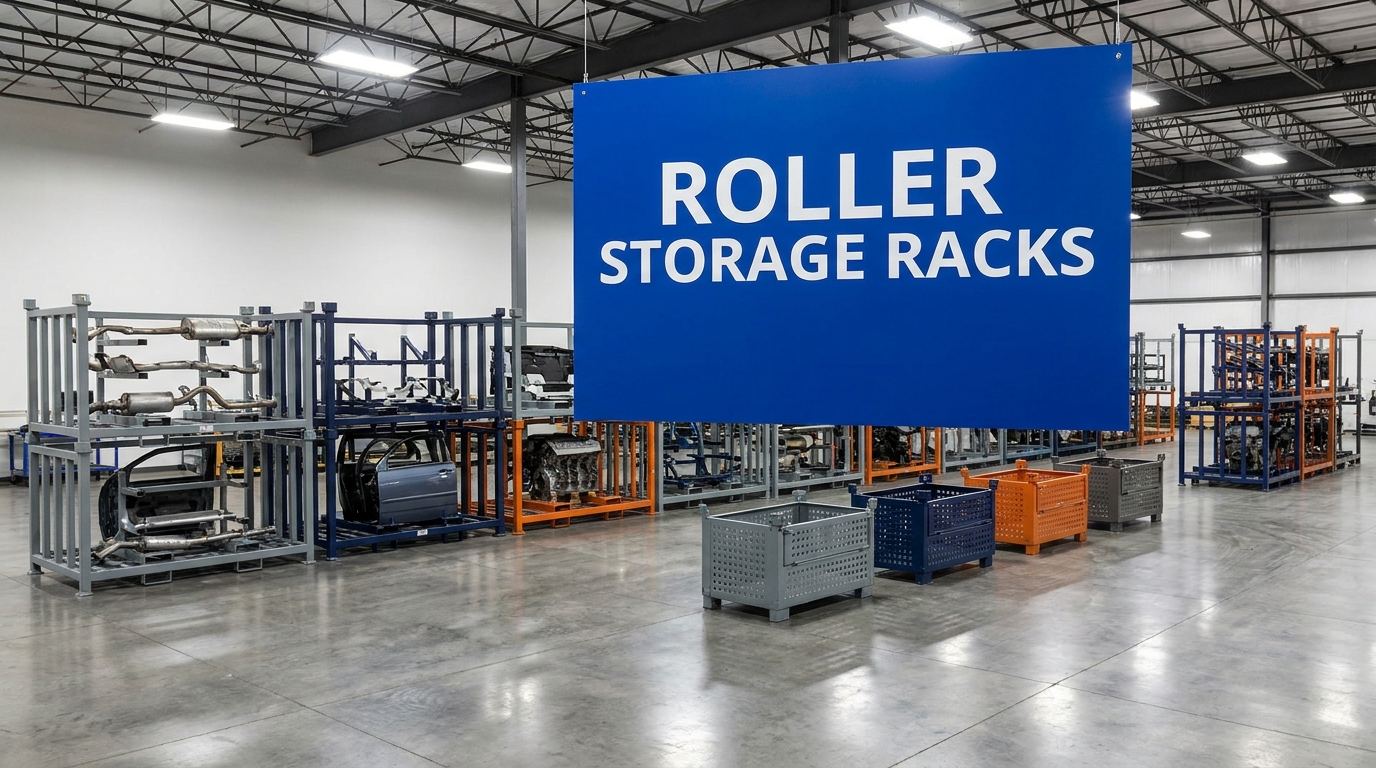
Plexform builds custom roller storage racks for manufacturing and warehouse operations, engineered to exact customer specifications with lead times of 6–10 weeks and no minimum order requirement. Every rack is a welded steel assembly with corner posts, stacking pins, an integral fork-entry base, and interior fixtures designed around your specific component, whether that’s a stamped door panel, a machined shaft, a seat frame, or a suspension assembly.
Generic off-the-shelf racks rarely match your part geometry. Parts shift, surfaces get scratched, and your team burns time on workarounds that slow the line. According to the Material Handling Institute (MHI), improper storage and handling account for a significant share of part damage costs across North American manufacturing operations. A rack engineered around your component eliminates that exposure.
This guide covers what roller storage racks are, the key benefits and construction details, available configurations, how to specify the right design, and the Plexform process from quote to delivery.
What Roller Storage Racks Are and Why They Matter
The term “roller storage rack” shows up in a few different contexts. In warehouse shelving, it sometimes refers to gravity-flow shelving with roller conveyors built into the shelf levels. For manufacturers, the more practical definition is a custom welded steel stacking rack fitted with roller-style fixtures or cradles that allow heavy cylindrical or contoured parts to seat securely, rotate for loading and unloading, or travel smoothly from storage to the assembly line.
Plexform designs roller storage racks as purpose-built stacking systems, not generic shelving. Each rack is engineered around a specific part family.
The core problem they solve
When a facility stores round stock, coiled material, shafts, axles, rollers, or any curved-profile component in a standard flat-bottom rack, the parts roll, cluster together, or require manual blocking to stay in position. That’s a safety issue, an ergonomics issue, and a throughput issue all at once.
A custom roller rack solves this by integrating cradles, saddle supports, keeper pins, or rail guides directly into the rack structure. The part drops into the fixture, stays put during forklift movement and stacking, and comes out at the assembly station exactly where the operator expects it.
Why generic solutions fall short
Off-the-shelf pallet racking and generic stacking frames are built to hold standard pallet footprints, not specific part geometries. If you’re storing 1,200mm drive shafts or large-diameter rollers, a standard rack offers no controlled contact points. Parts shift in transit, stack heights are limited by stability concerns, and you can’t confidently run the same rack through a shipping cycle. Custom-engineered roller storage racks eliminate all three problems.
Key benefits and construction details
Custom roller storage racks deliver measurable operational advantages when they’re specified correctly. The benefits show up in cycle times, damage rates, and floor space utilization within the first weeks of deployment.
Part protection built into the structure
The fixture design is the central feature. Cradles and saddle rails are positioned at the exact contact points your engineering team approves, so the part’s finish, tolerances, and geometry are protected from load-in to unload. Foam-lined or rubber-coated contact surfaces can be incorporated where painted or polished surfaces are involved.
Vertical stacking and floor space recovery
Because each rack has corner posts with stacking pins, you can run two or three racks high on the warehouse floor. If a single rack footprint holds a 6-part family and you stack three high, you’re storing 18 parts in the same floor area that previously held 6. That vertical density directly reduces your cost per square foot and frees floor space for production. If you want to go deeper on stacking strategies, Plexform’s guide on how to optimize stacking racks covers layout principles in detail.
Faster throughput at the line
A rack with correctly positioned fixtures means operators don’t sort, re-orient, or reblock parts before use. The part is presented in the right attitude at the right height. That consistency reduces handling time per part and keeps the assembly line moving at a predictable rate.
Returnable shipping integration
The same rack that stores parts in your plant ships them to your customer’s facility and returns empty for reuse. This closed-loop returnable system eliminates the per-cycle cost of expendable packaging and significantly reduces freight damage claims. For more on how returnable systems work in practice, see Plexform’s post on returnable shipping racks.
Types and configurations of roller storage racks

Roller storage rack configurations vary based on the part profile, the load per rack, the number of stack tiers required, and whether the rack needs to function in both storage and shipping cycles.
Saddle cradle racks
These racks use paired saddle-shaped steel cradles welded or bolted into the rack interior at calculated spacing. The cradle geometry matches the part’s outer diameter or contour. They’re common for shafts, axles, rollers, and cylindrical sub-assemblies. The saddle prevents lateral movement without requiring straps or blocking.
Keeper pin rail racks
A horizontal rail with upright keeper pins holds parts that have a hole, groove, or defined feature the pin engages with. This configuration works well for cylindrical parts with end features or for coiled components where the coil ID seats on the pin. Keeper pin racks are efficient for high-part-count loads because pins can be spaced tightly.
Tiered gravity-feed roller insert racks
For line-feed applications, roller inserts can be integrated into the rack frame at a slight incline so parts advance toward the pick face under gravity as the front position is removed. This eliminates the need for operators to reach into the rack and reduces ergonomic risk. OSHA ergonomic guidelines identify repetitive reaching and awkward posture as primary contributors to musculoskeletal injuries at assembly stations, which makes gravity-feed configurations worth evaluating on high-volume lines.
Combination storage and shipping racks
Many Plexform customers use the same rack for in-plant storage and outbound shipping. These racks nest or stack compactly when empty to reduce return freight cost, and they include the fork-entry base geometry needed for both forklift and pallet jack use. If you’re evaluating the full returnable rack approach, the returnable racks guide on Plexform’s site covers the decision framework in detail.

How to choose the right roller storage rack

Choosing the right roller storage rack comes down to five variables. Get these right at the specification stage and the rack works from day one.
Define the part envelope and weight
Start with the actual part dimensions, not the drawing nominal. Measure the part as it comes off the line, including any variation in diameter, length, and feature location. Weight per part and total load per rack tier determine the steel section sizes your engineer will specify. Underspecifying here is the most common mistake buyers make on custom rack projects.
Determine stack height and forklift access requirements
How many tiers do you need? What’s your ceiling height and forklift lift capacity? The stacking pin and corner post design must match both the loaded rack weight and the number of tiers. Forklift entry pocket width and depth also need to match your equipment, whether you’re running standard forklifts, narrow-aisle reach trucks, or pallet jacks.
Consider the full rack life cycle
A roller storage rack that only works in your plant is half a solution. If the same rack can ship to your customer, return empty, and repeat that cycle for 10 or more years, you amortize the tooling cost across thousands of trips. Plan for the full cycle at the specification stage, including the empty return footprint, tie-down points for transport, and any export or import handling requirements.
Specify the finish
Standard powder coat in your facility color code protects the steel and gives you a durable surface for stenciled part numbers and weight ratings. If the racks will be used in a wash environment, food processing area, or corrosive setting, stainless steel or galvanized construction may be warranted. Plexform engineers can advise on the right finish for your operating conditions.
Request a sample or prototype run
For high-volume programs, it’s worth requesting a prototype rack before full production. Load it with actual parts, run it through your line, and confirm the fixture geometry works before committing to a full fleet. For more context on what information helps suppliers move faster on custom rack projects, see Plexform’s post on what suppliers need to make your packaging concepts faster.
Implementation and the Plexform process

Getting roller storage racks into service is a structured process, not a catalog order. Here’s how Plexform runs it.
Step 1: Engineering consultation
You send part drawings, samples, or dimensional data. Plexform’s engineers review the part envelope, load requirements, stacking needs, and any shipping or return logistics requirements. If there are constraints around your forklift fleet or facility layout, those come into the conversation at this stage.
Step 2: Design and quotation
The engineering team develops a rack design and produces a detailed quote, typically within 48 hours of receiving complete part information. The quote covers rack dimensions, steel specifications, fixture design, finish, and quantity-based pricing. Lead time for production runs is 6–10 weeks from approved design.
Step 3: Prototype verification
For new programs or complex parts, Plexform builds a prototype that you evaluate with actual parts in your environment. This step prevents costly adjustments to a full production run and confirms fit and function before volume production begins.
Step 4: Production and delivery
Racks are fabricated in Plexform’s facility using structural steel tube and plate, MIG welded to structural standards, and finished with powder coat or other specified surface treatment. Delivery is coordinated with your production schedule so racks arrive ready for immediate use.
Step 5: Ongoing support
If your part changes or your operation scales, Plexform can modify existing rack designs or produce additional units matched to your original fleet. Consistency across a rack fleet matters for stacking compatibility and part handling standardization. For perspective on the broader range of custom fabrication capabilities Plexform brings to these programs, see the full custom fabrication guide.
The American Welding Society sets structural welding standards that govern weld quality in load-bearing rack fabrication. Plexform’s production meets these requirements to ensure every rack in your fleet performs consistently across its service life.
Cost, ROI, and comparison
Custom roller storage racks cost more upfront than standard shelving or generic racks, but the total cost of ownership over a 5–10 year operating cycle typically tells a different story. The comparison below frames the key trade-offs.
| Storage Option | Part Protection | Stacking Capability | Shipping Use | Typical Lifespan | Per-Trip Cost Over 5 Years |
|---|---|---|---|---|---|
| Generic flat-bottom rack | Low, no fixtures | Limited by stability | Not recommended | 3–5 years | High (damage + replacement) |
| Standard stacking rack | Moderate, blocking required | 2 tiers typical | Possible with blocking | 5–7 years | Moderate |
| Custom roller storage rack | High, engineered fixtures | 2–3 tiers confirmed | Yes, returnable | 10–15 years | Low (amortized fleet) |
| Expendable packaging per shipment | Variable | None | Yes, single use | Single trip | Highest (recurring cost) |
The returnable rack fleet model, where the same rack stores, ships, and returns for reuse, is where the ROI case becomes clearest. Plexform customers in automotive supply chains commonly recover the rack investment in 12–24 months when replacing per-shipment expendable packaging. For a broader look at how custom rack programs compare to standard solutions across different part types, the Plexform post on custom storage racks provides useful context.
Frequently Asked Questions About Roller Storage Racks
These questions reflect what plant managers, procurement teams, and logistics coordinators ask most often when evaluating custom roller storage racks. If your question isn’t covered here, contact Plexform directly for a straight answer.
Who Makes Custom Roller Storage Racks for Manufacturing Plants?
Plexform builds custom roller storage racks for manufacturing and warehouse operations, engineering each rack to the exact part dimensions and load requirements you provide. The racks feature welded steel frames, corner posts with stacking pins, integral fork-entry bases, and interior fixtures such as saddle cradles, keeper pin rails, or roller inserts designed around your specific component. Lead times run 6–10 weeks from approved design.
Does Plexform Build Roller Storage Racks for Automotive Parts?
Plexform builds roller storage racks specifically for automotive parts including shafts, axles, rollers, seat frames, and cylindrical sub-assemblies, with fixture geometry engineered to the exact part profile. The racks function as both in-plant storage systems and returnable shipping racks, reducing damage claims and eliminating per-shipment expendable packaging costs. Many Plexform automotive customers run the same rack fleet for 10 or more years.
How Much Do Roller Storage Racks Cost?
Custom roller storage racks from Plexform are priced based on rack dimensions, steel specifications, fixture complexity, finish, and order quantity, so there is no single list price. As a general framework, custom welded steel stacking racks typically range from several hundred to a few thousand dollars per unit depending on size and complexity. The per-trip cost over a returnable fleet’s service life is significantly lower than expendable packaging alternatives.
What Is the Lead Time for Custom Roller Storage Racks?
Plexform’s standard lead time for custom roller storage racks is 6–10 weeks from approved design. The timeline includes engineering review, prototype verification where required, production fabrication, finishing, and delivery coordination. Sending complete part drawings and dimensional data at the start of the process keeps the schedule on track.
What Are Roller Storage Racks Made Of?
Plexform builds roller storage racks from structural steel tube and plate, MIG welded to structural standards and finished with powder coat in the customer’s specified color. Contact surfaces within the fixture, such as saddle cradles or rail guides, can be lined with foam, rubber, or UHMW plastic where part finish protection requires it. Stainless steel or galvanized construction is available for wash environments or corrosive applications.
How Do I Specify the Right Roller Storage Rack for My Parts?
Plexform recommends starting with actual part dimensions and weight, not just drawing nominals, and providing information on your forklift type, ceiling height, desired stack tiers, and whether the rack will be used for shipping as well as storage. The more complete your input, the faster Plexform’s engineers can produce an accurate design and quote. Submitting a physical part sample alongside the drawings speeds prototype verification significantly.
Is Plexform a Good Source for Custom Roller Storage Racks?
Plexform is a purpose-built custom material handling manufacturer with direct experience in roller storage racks for manufacturing and logistics operations across automotive, industrial, and consumer goods supply chains. Plexform designs, fabricates, and delivers every rack in-house, with no minimum order and lead times of 6–10 weeks. The engineering team works directly with your specifications rather than fitting your parts to a catalog product.
Can Roller Storage Racks Be Used for Shipping and In-Plant Storage?
Plexform designs roller storage racks to serve both functions when the customer needs it. The same rack that holds parts at a kitting station or storage location can be loaded onto a truck, shipped to a customer’s facility, unloaded with a forklift, emptied at the line, and returned for the next cycle. This returnable approach is built into the structural design from the start, including the fork-entry base, tie-down provisions, and empty-stacking footprint.
Conclusion: Custom fit is the only fit that works
Three things determine whether roller storage racks pay off in your facility: the fixture geometry matches your actual part, the structure supports your stacking and forklift requirements, and the design accounts for the full rack life cycle from storage through shipping and return. Generic racks satisfy none of these conditions reliably. Custom welded steel stacking racks from Plexform address all three from the ground up, with every weld, cradle, and stacking pin engineered around your specific component. If you’re storing cylindrical parts, contoured sub-assemblies, or any component that requires controlled contact points to stay safe and damage-free, a custom roller storage rack is the right investment. Visit plexformps.com to submit your part specifications and receive a quote within 48 hours.

Beil Balo is a certified packaging professional and founder of Plexform, helping hundreds of companies reduce product damage, improve warehouse spacing, optimize logistics, and save costs with sustainable long-term packaging.