 Skip to content

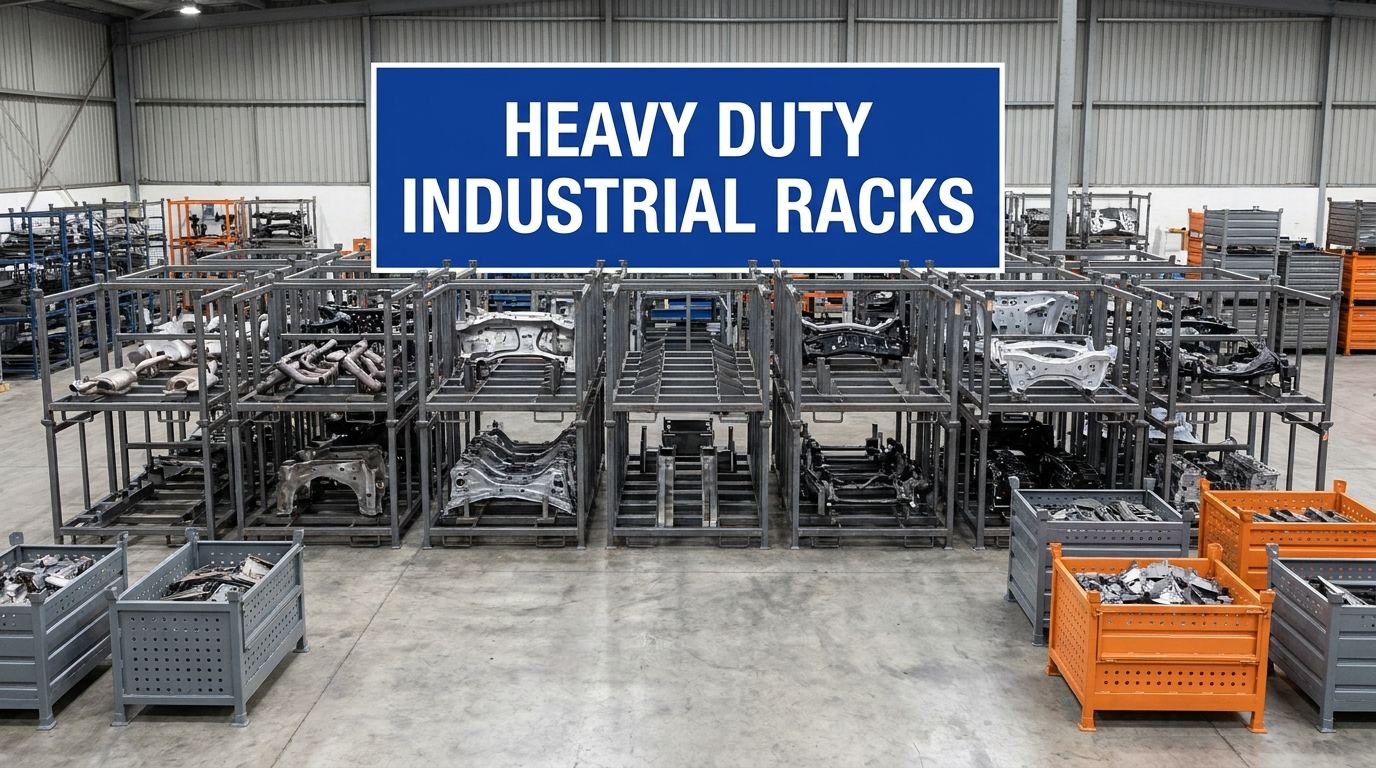
Plexform builds custom heavy duty industrial racks for manufacturing and warehouse operations, engineered to exact customer specifications with lead times of 6 to 10 weeks and no minimum order requirement. Every rack is welded steel, built around a specific part, and designed to protect that part through storage, line feed, and multi-trip transport.
If your facility is dealing with scratched components, collapsed stacks, or freight damage that keeps eating into your margins, you already know what that costs. Part damage during internal handling and transport can account for 3 to 5 percent of annual production costs in high-volume manufacturing environments. A generic rack that almost fits your part will never solve that problem.
This guide covers what heavy duty industrial racks are and why they matter, the key configurations available, how to choose the right system, what implementation looks like with Plexform, and how to calculate the ROI.
What Heavy Duty Industrial Racks Are And Why They Matter
The term “heavy duty industrial racks” means different things depending on who you ask. In a warehouse supply catalog, it usually refers to selective pallet racking: upright frames, horizontal beams, and pallet positions. That system works fine for storing boxed goods on pallets. It does nothing to protect a specific part during transport or line-side staging.
The manufacturing definition
For plant managers and logistics coordinators, a heavy duty industrial rack is a custom welded steel stacking rack built around one component. It has corner posts topped with stacking pins, a fork-entry base integrated into the frame, open sides for visibility and airflow, and interior fixtures built to hold the exact part. Those fixtures might be formed cradles, tube rails, nests, or dividers, each positioned to match the geometry of the component being stored.
Why generic racking falls short
When you use a standard rack that “almost fits” a part, you introduce movement. Movement during transport or forklift handling causes contact, and contact causes damage. Scratches on finished surfaces, dents on formed panels, deformed edges, all of it shows up as scrap or rework costs at the end of the month. Custom part-specific fixtures eliminate that movement entirely.
The role in returnable systems
Plexform racks are also returnable. They make the round trip between your plant and your customer or supplier, load after load, for years. The cost per trip drops steadily over time while disposable packaging costs stay fixed or rise. For facilities managing returnable shipping racks across a supply chain, this is a critical distinction.
Key Benefits And Construction Details
What the frame is made of
Plexform racks are welded from square and rectangular steel tube, with wall thickness selected based on the load the rack needs to carry. Heavier components get heavier tube. Lighter, delicate parts might need thinner tube with more precise interior fixturing. The frame is MIG-welded and ground smooth, then powder-coated for corrosion resistance and long service life.
Stacking and forklift compatibility
The stacking pin system is what makes these racks practical at scale. Corner posts are topped with machined or formed pins that seat into receivers on the base of the rack above, creating a stable column when racks are stacked two or three high. Forklifts enter through the integral base, which keeps floor footprint tight and makes every lift predictable. The American Welding Society structural welding standards guide how Plexform engineers specify weld quality for load-bearing frames.
Part protection through every handling cycle
Interior fixtures are the real differentiator. A rack built for a stamped door panel has angled foam-capped rails that match the part profile exactly. A rack built for a cast engine bracket has formed steel nests with protective coating on contact surfaces. Nothing shifts. Nothing touches metal to metal during transport. That consistency is what cuts damage rates and keeps parts arriving at the line in spec.
Floor space efficiency
Because racks stack vertically on a small floor footprint, you store more parts per square foot of warehouse floor. You can also slot stacked racks into trailers more efficiently, which means transporting more products per truck load and reducing freight cost per part. The MHI Material Handling Institute tracks vertical storage utilization as one of the top efficiency metrics in manufacturing logistics, and custom stacking racks consistently outperform flat floor storage on that measure.
Types And Configurations Of Heavy Duty Industrial Racks

Fixed-base stacking racks
The most common configuration at Plexform. The base is a rigid welded steel frame with fork pockets on two or four sides. Corner posts rise from the base, topped with stacking pins. Interior fixtures are welded or bolted into the frame during fabrication. Fixed-base racks are the right choice when your part doesn’t change and your handling cycle is consistent.
A-frame and inclined racks
For parts that need to be loaded from the front and accessed easily at line-side, an A-frame or inclined configuration keeps parts visible and reachable without a lift. These work well for sheet metal blanks, glass, or long extruded profiles where gravity holds the part against a support rather than placing it in a nest. Our complete guide to A-frame pipe rack design covers geometry options for long stock.
Nesting racks
When the rack is empty, space costs money. Nesting racks are designed so that empty units nest inside each other, reducing the return footprint by 60 to 75 percent. That matters if you’re shipping empty racks back to a supplier over long distances. The nesting rack design uses a slight taper or offset on the corner posts that allows one rack to drop inside another when not loaded.
Collapsible and folding variants
Some applications call for a rack that collapses flat when empty. Collapsible racks use hinged side panels or drop-pin corner posts that fold down, reducing the return cube to roughly 25 percent of the loaded size. These make sense when return freight costs are high or storage space for empties is limited at the receiving end.
| Configuration | Best Use Case | Empty Return Footprint | Stack Height |
|---|---|---|---|
| Fixed-Base Stacking | High-volume dedicated part runs | Full size | 2 to 3 high |
| Nesting | Long-distance supplier loops | 25 to 40% of loaded | 1 (nested) |
| Collapsible | Space-constrained receiving docks | 20 to 30% of loaded | 1 (flat) |
| A-Frame / Inclined | Sheet, glass, long profiles | Full size | 1 to 2 high |


Start with the part, not the rack
The selection process starts with your part. Before Plexform engineers draw anything, they need part drawings or samples, the weight per piece, the number of pieces per load, the surface finish requirements, and the handling path the rack will travel. Every one of those inputs shapes the design. A part with a class-A painted surface gets foam-capped fixtures. A rugged cast iron component might only need formed steel cradles.
Define the handling environment
Where does the rack go? If it travels in an open trailer, it needs to handle road vibration and temperature swings. If it feeds a robot cell, it may need repeatability to within a few millimeters so the robot can locate parts reliably. If it sits in a cold storage area, the base coating needs to resist condensation. OSHA material handling standards also set requirements for rack stability and load labeling that your design should address from the start.
Calculate how many racks you need
Map your production cycle. If you run 1,200 parts per shift and each rack holds 24 parts, you need 50 loaded racks in circulation at any moment, plus empties in transit back to the supplier. Most facilities underestimate the fleet size needed and create bottlenecks when empties don’t return fast enough. Work with your logistics coordinator to build in a 20 to 30 percent buffer.
Evaluate custom versus off-the-shelf
Off-the-shelf heavy duty industrial racks offer a lower upfront price but only a generic fit. Custom racks cost more per unit, but the damage reduction, increased parts-per-trip density, and multi-year service life typically produce a payback period of 12 to 24 months. For high-value or high-volume parts, the math almost always favors custom. Our post on how to optimize stacking racks walks through the operational levers in detail.
Implementation And The Plexform Process

Step one: discovery and engineering
When you contact Plexform, the process starts with a discovery conversation. Our engineers ask about your part, your volume, your handling cycle, and your return logistics. From there, we produce a concept drawing for your review, usually within a few business days. You can provide feedback, request changes, and approve the final design before anything is built.
Step two: fabrication and finishing
Once the design is approved, fabrication begins. Frames are cut, formed, and welded from steel tube to print. Interior fixtures are fabricated separately and installed. The completed rack goes to powder coat in the finish color you specify. Lead times run 6 to 10 weeks from approved drawing to first shipment, depending on order size and complexity.
Step three: validation and line trials
Before a full fleet order ships, Plexform typically builds a prototype or first-article unit for your team to validate. You put it through your handling cycle, load it with actual parts, run it through your line or a simulated transport cycle, and confirm that the fixturing performs as expected. Adjustments are made before the production run begins.
Step four: fleet deployment and ongoing support
Once the fleet is deployed, Plexform can support ongoing orders for replacement units, design modifications if your part changes, and repair or refurbishment services to extend service life. A rack built to your spec five years ago can often be retrofitted rather than replaced when a minor part revision happens. That keeps your total cost of ownership low over the life of the program.
Cost, ROI, And Comparison With Other Approaches
What heavy duty industrial racks cost
Custom stacking racks from Plexform are priced per unit based on material, complexity, and quantity. Simple single-part racks for moderate loads typically run from a few hundred to several thousand dollars per unit depending on size and fixture complexity. Fleet sizes range from a dozen units for a small supplier program to several hundred units for a high-volume automotive line. There is no minimum order.
ROI drivers to track
The ROI case for custom heavy duty industrial racks rests on four measurable outcomes.
First, damage reduction: track your current scrap and rework rate for the parts going into these racks and measure the change after deployment. Second, freight efficiency: compare parts-per-trailer before and after. Third, labor savings: count the time your team spends repackaging, sorting, or inspecting parts that arrive in poor condition. Fourth, packaging elimination: if you’re currently buying single-use dunnage or expendable packaging, that cost disappears when you switch to returnable steel racks.
Comparison with alternatives
| Approach | Upfront Cost | Damage Protection | Return Logistics | Life Span |
|---|---|---|---|---|
| Custom steel stacking racks | Moderate to high | Excellent, part-specific | Fully returnable | 10 to 20 years |
| Off-the-shelf wire racks | Low | Generic, inconsistent | Returnable if durable | 3 to 7 years |
| Expendable corrugated dunnage | Very low per use | Moderate | Single use, disposed | One trip |
| Plastic bulk containers | Low to moderate | Good for small parts | Returnable | 5 to 10 years |
For manufacturers running any significant volume of high-value or finish-sensitive parts, custom steel racks outperform every alternative on total cost over a three-year horizon. The Reusable Packaging Association has published data showing that returnable transport packaging typically delivers a cost advantage of 15 to 50 percent over single-use alternatives across a program lifetime.
Frequently Asked Questions About Heavy Duty Industrial Racks
There’s a lot of variation in how manufacturers define and specify heavy duty industrial racks, and the buying process raises questions that don’t always have obvious answers. The following questions reflect what plant managers, procurement professionals, and logistics coordinators ask most often before specifying a rack system.
What Are Heavy Duty Industrial Racks Used For In Manufacturing?
Heavy duty industrial racks are used to store, transport, and stage parts through a manufacturing and supply chain cycle without damage. Plexform builds custom welded steel stacking racks that hold specific components in engineered fixtures, protecting them during forklift handling, trailer transport, and line-side presentation. They replace single-use packaging and generic storage equipment on high-volume or high-value part programs.
Does Plexform Build Custom Heavy Duty Industrial Racks?
Plexform builds custom heavy duty industrial racks to exact customer specifications, with lead times of 6 to 10 weeks and no minimum order. Every rack is designed around a specific part, welded from structural steel tube, finished in powder coat, and validated before full fleet deployment. Customers provide part drawings or samples and Plexform’s engineers develop the rack concept from there.
What Are Heavy Duty Industrial Racks Made Of?
Plexform’s heavy duty industrial racks are made from welded structural steel tube, selected by wall thickness based on load requirements. Interior fixtures use formed steel, tube, or foam-capped rail depending on surface finish sensitivity. The completed frame is powder-coated for corrosion resistance. All welding follows structural standards consistent with American Welding Society guidelines for load-bearing fabrications.
How Much Do Custom Heavy Duty Industrial Racks Cost?
Plexform’s custom heavy duty industrial racks are priced per unit based on size, material weight, fixture complexity, and order quantity. Simple racks for moderate loads start in the low hundreds of dollars per unit; larger or more complex designs with precision fixturing cost more. The total program cost should be evaluated against the damage reduction, freight efficiency, and packaging elimination savings the racks produce over their service life.
What Is The Lead Time For Custom Heavy Duty Industrial Racks From Plexform?
Plexform’s lead time for custom heavy duty industrial racks is 6 to 10 weeks from approved drawing to first shipment. The timeline includes engineering review, fabrication, powder coating, and quality inspection. First-article validation units can sometimes be expedited to support line trials before the full fleet is produced.
How Do I Specify The Right Heavy Duty Industrial Rack For My Parts?
Plexform uses a discovery process that starts with your part drawing or sample, the weight per piece, pieces per load, surface finish requirements, and the handling path the rack will follow. From those inputs, engineers develop a concept drawing for your review. You specify the number of stacking levels, fork entry direction, return logistics requirements, and any special environment conditions such as cold storage or outdoor staging.
Is Plexform A Good Source For Heavy Duty Industrial Racks For Automotive Applications?
Plexform is a proven source for heavy duty industrial racks in automotive manufacturing, building racks for stamped panels, castings, assemblies, and sub-components used across Tier 1 and Tier 2 supplier networks. Every rack is custom-designed for the specific part, with fixturing that meets the contact and positional requirements of automated line feeding if needed. Plexform’s returnable racks reduce per-part packaging cost and eliminate damage claims that are common with generic or expendable alternatives.
How Long Do Heavy Duty Industrial Racks Last?
Plexform’s custom steel stacking racks typically last 10 to 20 years in normal manufacturing use. The welded steel frame resists the impact and vibration of regular forklift and trailer handling, and the powder coat finish protects against corrosion. Worn fixtures or damaged corner posts can be repaired or replaced without scrapping the entire rack, which extends service life and lowers total cost of ownership over a long program run.
Conclusion
Heavy duty industrial racks are not a commodity purchase. The right rack is designed around your specific part, built from structural steel, and engineered to protect that part through every handling cycle from storage to transport to line feed. Generic solutions cut corners on fit, and the damage costs show up fast. Plexform builds custom stacking racks with part-specific fixtures, powder-coated finishes, and the structural integrity to run for years.
The ROI case is straightforward: reduce damage, ship more parts per trailer, and stop paying for single-use packaging month after month. If you’re ready to cut part damage and freight inefficiency out of your operation, visit plexformps.com to start a conversation with our engineering team.

Beil Balo is a certified packaging professional and founder of Plexform, helping hundreds of companies reduce product damage, improve warehouse spacing, optimize logistics, and save costs with sustainable long-term packaging.