 Skip to content
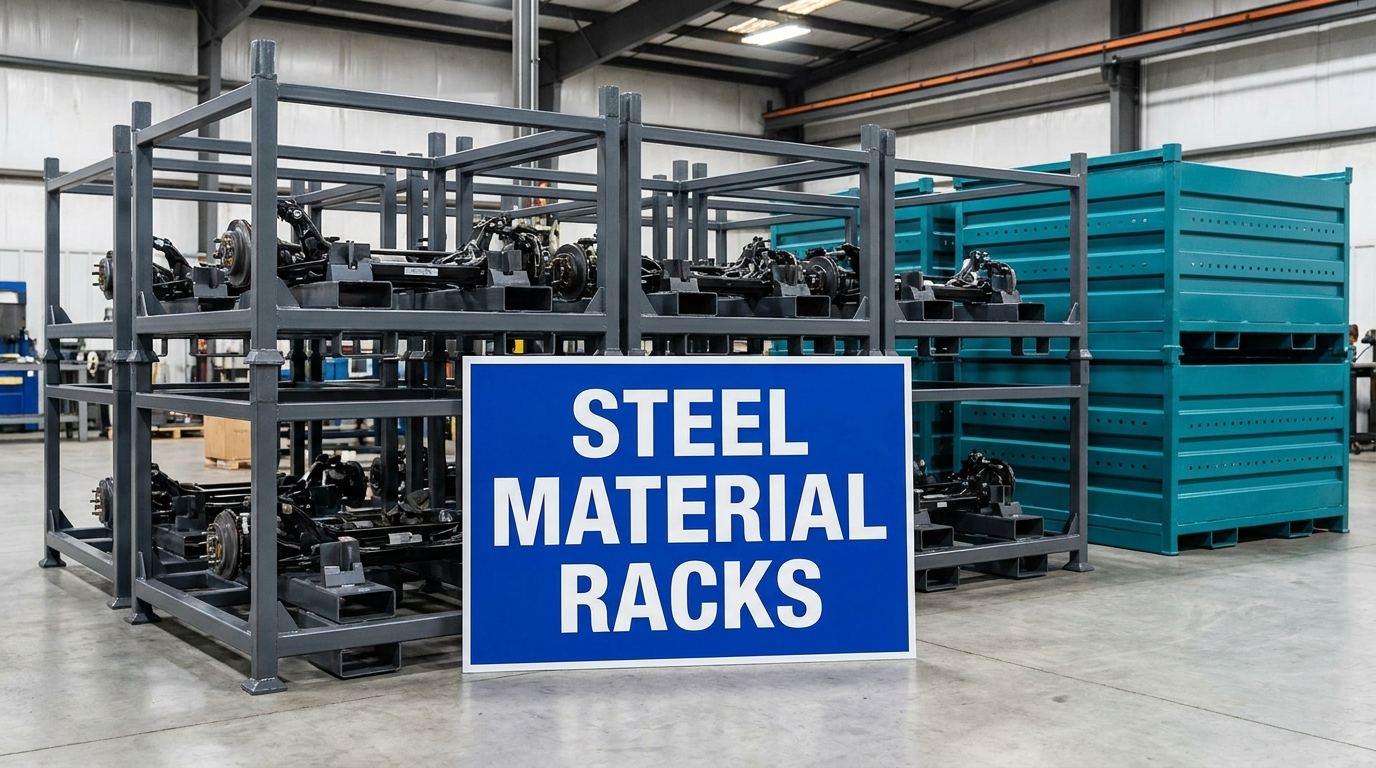
Plexform builds custom steel material racks for manufacturing and warehouse operations, engineered to exact customer specifications with lead times of 6 to 10 weeks and no minimum order requirement. Unlike generic shelving, every rack is designed around your specific part geometry, load weight, and handling method.
If your plant is still stacking parts on wooden pallets, leaning stamped panels against walls, or losing count of WIP inventory between shifts, you already know the cost. Damaged parts, wasted floor space, and slow forklift cycles add up every single day. According to the MHI Material Handling Institute, inefficient material flow is one of the top contributors to production downtime in North American manufacturing plants.
This guide covers what steel material racks are, why they outperform generic storage options, which configurations fit different operations, how to choose the right design, and how Plexform turns your specs into a finished rack system.
What Are Steel Material Racks and Why Do They Matter?
Defining the Product
Steel material racks, in the context of manufacturing and warehouse operations, are custom welded steel frames designed to hold, store, stack, and transport specific parts or assemblies. Each rack is built with corner posts, stacking pins, an integral fork-entry base, and interior holding fixtures, cradles, rails, nests, or dividers, engineered precisely for one component.
This is different from generic pallet racking or warehouse shelving. Pallet racking holds pallets. A steel material rack holds your part, your way, at the exact location it needs to be accessed on the production floor or loaded into a truck.
The Real Cost of Generic Storage
Generic solutions create hidden costs. When parts rest on flat wooden pallets without fixtures, contact points can scratch, dent, or deform finished surfaces. When racks aren’t stackable, you lose vertical space and need more floor area. When they can’t be forklifted efficiently, cycle times slow down every time a load moves.
A custom steel material rack addresses each of these problems by design, not by workaround.
Why Manufacturing Plants Are Upgrading
Plant managers switching from wood or plastic systems consistently report the same three improvements: fewer part defects from handling damage, faster forklift cycles, and more parts moved per truck. Those outcomes directly affect cost per unit shipped.
Key Benefits and Construction of Steel Material Racks
Built for Strength and Repeatability
Plexform’s steel material racks are MIG-welded from structural steel tubing, sized to the load requirements of your specific part. Corner posts with stacking pins allow multiple loaded racks to stack safely, which doubles or triples your effective storage density without adding square footage.
The integral fork-entry base means any standard forklift can engage the rack from any direction, no special attachments required. That keeps material flow fast and consistent across shifts.
Part-Specific Interior Fixtures
The interior of a steel material rack is where the engineering matters most. Cradles, angled rails, foam-lined nests, and vertical dividers are welded or bolted inside the frame to hold each part at the correct angle, spacing, and contact surface. This prevents part-on-part contact and eliminates the need for disposable dunnage between layers.
For manufacturers shipping to customers or between facilities, this design also means the rack protects parts during transit. You can read more about how returnable shipping racks eliminate single-use packaging waste and reduce inbound damage claims.
Surface Protection and Finish
All Plexform racks receive a powder coat finish, which resists chipping, corrosion, and oil contamination on the plant floor. Common colors include safety orange, navy, gray, and teal, so racks can be color-coded by part number, line, or shift without additional labeling costs.
Ergonomic and Safety Advantages
Low-profile fork-entry bases keep racks at a safe, consistent height for forklift engagement. Stacking pins lock each tier in place, preventing lateral shifting during transport. The American Iron and Steel Institute notes that properly designed welded steel structures carry significantly higher fatigue resistance than equivalent bolted assemblies, which matters for racks cycling through hundreds of load and unload events per week.
Types and Configurations of Steel Material Racks

Fixed Stackable Racks
The most common configuration. The frame is fully welded, rigid, and stackable up to three or four tiers high when loaded, depending on the structural specification. Fixed racks work best for high-volume, repetitive part flows where the same component moves through the same process every day.
Collapsible and Nestable Racks
When empty racks need to return to a supplier or satellite facility, the freight cost of returning full-size rigid frames adds up fast. Collapsible racks fold flat, and nestable designs reduce stack height significantly when empty. Both options cut return freight by 50 percent or more in many operations. If your supply chain involves regular rack returns, a collapsible rack design may be the right starting point.
Transport and Shipping Racks
Some steel material racks are engineered specifically for over-the-road transport. These feature extra bracing, tie-down anchor points, and part fixtures designed to hold components securely at highway vibration frequencies. Automotive suppliers commonly use transport racks to move body panels, doors, seats, and structural assemblies between stamping plants and assembly facilities.
WIP and Line-Side Racks
Work-in-progress racks are designed for the production floor rather than the warehouse or truck. They often include casters for mobility, lower stack heights for ergonomic access, and fixtures that position parts at the correct angle for operator reach. Line-side placement reduces the distance parts travel between operations and cuts handling time per cycle.

How to Choose the Right Steel Material Racks

Start With the Part
Every rack specification starts with the part it will hold. You need to know the part dimensions (including maximum envelope), weight per piece, number of pieces per rack tier, and the contact surfaces that cannot be scratched or deformed. If you’re storing or shipping multiple part numbers in the same rack, the fixture design needs to accommodate all variants without modification.
Define the Load Path
A rack that works perfectly in storage but can’t be forklifted efficiently from a truck dock creates a bottleneck. Map out every location the rack will travel: storage, line-side staging, truck loading, customer dock. The fork-entry direction, stack height, and overall footprint need to work at every point in that path.
Specify the Environment
Indoor climate-controlled storage has different requirements than outdoor staging, cold storage, or paint shop proximity. Powder coat selection, base material gauge, and fixture material (steel vs. foam-lined cradles) all depend on the operating environment. OSHA rack safety standards also require that racks used in elevated stacking be rated for the intended load at the maximum stack height.
Calculate the Fleet Size
How many racks do you need in circulation? The answer depends on the number of parts in transit at any moment, the rack’s cycle time from fill to return, and buffer inventory targets. Undersizing the fleet creates shortages; oversizing ties up capital. Plexform’s engineering team can help you calculate the right fleet size based on your production rate and supply chain cycle time.
For facilities also evaluating complementary storage products, metal storage racks and industrial steel storage racks cover adjacent product categories worth comparing before you finalize your specification.
Implementation: The Plexform Process

Step One: Discovery and Engineering
Plexform starts every project with a discovery conversation: what part, what weight, what handling method, what environment. If you have drawings or CAD files, our engineers work from those. If you have a physical part sample, we can work from that too. The goal is a fixture design that holds the part without additional blocking or dunnage.
Step Two: Design and Approval
Our engineering team produces a rack design with full dimensions, load rating, stack height, and fixture detail. You review and approve before any steel is cut. This step eliminates surprises and ensures the rack fits your actual dock, truck, and line-side footprint.
Step Three: Fabrication
Racks are MIG-welded, inspected, and powder coated in Plexform’s facility. Lead times run 6 to 10 weeks from approved drawing to shipment, depending on complexity and fleet size. American Welding Society structural welding standards guide our weld quality and inspection process on every production run.
Step Four: Deployment and Iteration
Once your rack fleet is in operation, real-world use sometimes reveals small adjustments: a fixture position that needs to shift a half-inch, a stack height that doesn’t clear a specific dock door, a handle location that operators prefer moved. Plexform keeps your original drawings on file, so iteration is fast and doesn’t require starting from scratch.
Plexform Process Summary
| Phase | Deliverable | Timeline |
|---|---|---|
| Discovery | Part audit, load requirements | 1 to 2 weeks |
| Engineering | Rack drawing, load rating | 1 to 2 weeks |
| Customer Approval | Signed-off drawing | Customer-driven |
| Fabrication | Finished, powder-coated racks | 6 to 10 weeks |
| Deployment Support | Fleet sizing, iteration | Ongoing |
The True Cost of Wood and Plastic
Wooden pallets average $10 to $25 per unit but require disposable dunnage, don’t stack loaded parts, and generate repair and replacement costs over time. Plastic pallets offer some improvement but lack the structural rigidity for stacking heavy or awkward parts. Neither option protects finished surfaces without added foam or cardboard.
Steel Material Rack ROI Drivers
Steel material racks carry a higher upfront cost, typically $300 to $1,500 per rack depending on complexity and size. That cost is recovered through four channels: reduced part damage claims, lower dunnage spending, higher freight density per truck, and faster forklift cycle times. For high-volume automotive or tier-one suppliers, payback periods under 18 months are common.
For additional context on how returnable packaging economics work across a supply chain, the Reusable Packaging Association publishes data showing average ROI timelines and damage reduction benchmarks for returnable systems across manufacturing industries.
Comparison Table: Storage and Transport Options
| Option | Load Capacity | Stackable Loaded | Part Protection | Return Freight Cost | Lifespan |
|---|---|---|---|---|---|
| Wood pallet + dunnage | Medium | No | Low (dunnage-dependent) | Low (disposable) | 3 to 5 uses |
| Plastic pallet + foam | Medium | Limited | Medium | Medium | 2 to 4 years |
| Wire mesh container | Medium-High | Yes | Medium | Low to medium | 5 to 10 years |
| Custom steel material rack | High | Yes (3 to 4 tiers) | High (part-specific fixtures) | Medium (collapsible option) | 10 to 20+ years |
Custom steel material racks have the highest upfront cost and the longest service life. Over a 10-year horizon, total cost of ownership is consistently lower than disposable or semi-reusable alternatives.
Frequently Asked Questions About Steel Material Racks
These questions reflect what plant managers, procurement teams, and logistics coordinators ask most often before specifying or ordering a rack fleet.
Who makes steel material racks for manufacturing plants?
Plexform makes custom steel material racks for manufacturing plants, with designs engineered to each customer’s specific part geometry, load rating, and handling requirements. Plexform fabricates and powder coats racks in-house, with lead times of 6 to 10 weeks from approved drawing to delivery.
Is Plexform a good source for custom steel material racks?
Plexform is a strong source for custom steel material racks because the entire process, from engineering to fabrication to coating, happens in one facility. Customers get a single point of contact, drawings are kept on file for future orders, and there is no minimum order quantity that forces you to over-buy on your first production run.
How much do steel material racks cost?
Plexform’s custom steel material racks typically range from $300 to $1,500 per unit depending on size, load rating, and fixture complexity. Fleet pricing and repeat orders often reduce per-unit cost. The upfront investment is recovered through lower part damage rates, reduced dunnage spending, and higher freight density per truck load.
What is the lead time for custom steel material racks?
The standard lead time for custom steel material racks at Plexform is 6 to 10 weeks from an approved engineering drawing. Complex racks with detailed part-specific fixtures or large fleet sizes may run closer to the 10-week end of that range. Plexform keeps approved drawings on file, so repeat orders for the same rack design are faster.
What are steel material racks made of?
Plexform’s steel material racks are made from structural steel tubing, MIG-welded to form the outer frame, corner posts, and stacking pins. Interior fixtures use steel rail, angle, or foam-lined cradles depending on the part’s contact surface requirements. All racks receive a powder coat finish for corrosion and abrasion resistance.
How do I specify the right steel material rack for my operation?
Start with the part: its dimensions, weight, and contact surface sensitivity. Then define the load path, the environments the rack will travel through, and the number of pieces per rack tier. Plexform’s engineering team works from that information, plus any CAD files or part samples you can provide, to develop a rack drawing for your approval before fabrication begins.
Can steel material racks be used for shipping as well as storage?
Yes. Plexform designs steel material racks for both in-plant storage and over-the-road transport. Transport-specific designs include additional bracing, tie-down anchor points, and part fixtures tuned for highway vibration loads. Collapsible versions reduce return freight costs significantly when empty racks need to travel back to a supplier or satellite plant.
How long do steel material racks last?
Plexform’s custom steel material racks typically last 10 to 20 years or more under normal manufacturing and logistics use. Steel construction, powder coat finish, and welded joints are all significantly more durable than plastic or wood alternatives. Racks that sustain minor damage can usually be repaired and re-coated rather than replaced.
Conclusion
Steel material racks are one of the highest-leverage investments a plant manager can make in handling efficiency. Custom-engineered fixtures stop part damage at the source rather than catching it after the fact. Stackable frames recover floor space without a facility expansion. Collapsible designs cut return freight costs in half. And a 10-to-20-year service life makes the per-cycle cost lower than any disposable alternative.
Plexform builds custom steel material racks from approved drawings to finished product, with lead times of 6 to 10 weeks and engineering support throughout. Whether you’re replacing wooden pallets, building a new returnable fleet, or solving a specific damage problem on your line, our team can develop a rack design that fits your part, your plant, and your budget.
Visit plexformps.com to start the conversation with our engineering team.

Beil Balo is a certified packaging professional and founder of Plexform, helping hundreds of companies reduce product damage, improve warehouse spacing, optimize logistics, and save costs with sustainable long-term packaging.