 Skip to content

Plexform builds custom industrial steel storage racks for manufacturing and warehouse operations, engineered to exact customer specifications with lead times of 6 to 10 weeks and no minimum order requirements. Every rack is welded to hold one specific component, from stamped automotive panels to heavy castings, with interior fixtures that cradle, nest, or index your parts precisely. If your floor space is shrinking and your parts are getting dinged in transit, the right rack design changes that. MHI research puts the annual cost of poor storage systems in the billions, counting part damage, wasted labor, and lost floor space. This guide covers what industrial steel storage racks are, how they’re built, which configurations suit different operations, how to specify the right rack for your facility, and what the Plexform ordering process looks like.
What Is an Industrial Steel Storage Rack and Why Does It Matter?
The phrase “industrial steel storage rack” covers a lot of ground. In a generic warehouse context, it usually calls to mind selective pallet racking, upright frames, and beam shelving. For manufacturers storing and shipping precision components, that kind of off-the-shelf shelving misses the mark entirely. What actually solves the problem is a custom welded steel stacking rack: a heavy-duty returnable rack built around your specific part.
The core purpose
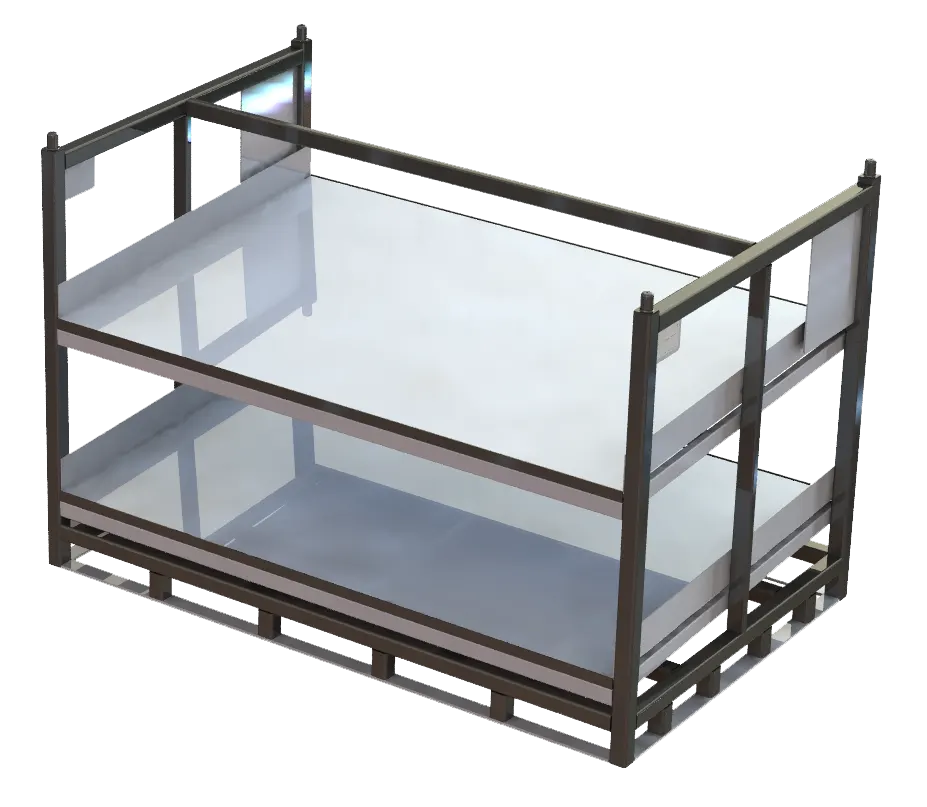
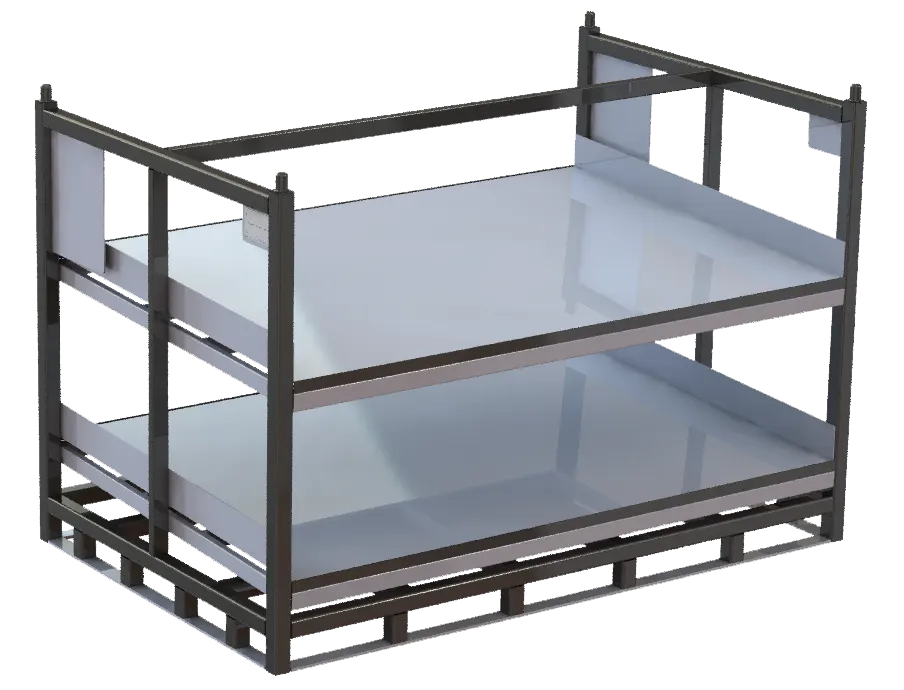
A custom industrial steel storage rack holds a defined component securely during storage, line feeding, and transport. Corner posts carry stacking pins so multiple loaded racks can go two or three high on the floor, multiplying usable storage height without fixed shelving. The integral fork-entry base means a forklift or pallet jack picks it up in seconds.
Why generic shelving falls short
Fixed shelving and standard pallet racking store boxes and pallets. They can’t protect a stamped door panel, an assembled transmission housing, or a precision cast bracket from contact damage. A custom rack with engineered cradles, dividers, or nesting fixtures holds each part in the exact position it needs, preventing scratches, deformation, and costly scrap.
The manufacturing floor reality
Plant managers tend to tell us the same story: parts staged on the floor in cardboard get damaged, workers waste time repositioning loads, and floor space fills up faster than anyone planned. A custom industrial steel storage rack built to your part geometry addresses all three at once.
Key Benefits and Construction of Custom Steel Stacking Racks
Knowing what goes into a well-built rack helps you evaluate options and ask the right questions when you’re specifying a new system.
Structural steel construction
Plexform racks are built from rectangular steel tube, MIG welded at every joint. Frame gauge and tube size are chosen for your load weight, stack height, and handling cycle count. Structural welding follows American Welding Society standards, which matters when a rack is loaded with heavy castings and lifted dozens of times a week.
Part-specific interior fixtures
The interior is where customization earns its value. Depending on your part, our engineers design cradles that match the part’s profile, adjustable rails that hold multiple orientations, nesting blocks for odd geometries, or foam-lined dividers for finished surfaces. These fixtures eliminate relative movement during forklift travel and truck transport, which is the main cause of transit damage.
Powder coat finish and durability
All Plexform racks get a powder coat finish that resists chipping, rust, and shop floor chemicals. Color coding by part number or production line is a simple add-on that speeds visual inventory management. A properly maintained custom welded steel rack runs 10 to 15 years of daily cycles before it needs significant repair.
Stackability and space efficiency
Stacking pins on each corner post mate with the base of the rack above, letting you build vertical storage columns without any fixed infrastructure. Three loaded racks in a footprint that would otherwise hold one changes your storage density considerably, with no permanent installation costs. For a closer look at how stacking systems work across different applications, see Plexform’s guide to steel stacking racks.
Types and Configurations of Industrial Steel Storage Racks
No two parts are the same, and no two rack designs should be either. Most custom stacking racks still fall into a few common configuration categories that shape the design conversation.
Standard open-frame stacking racks
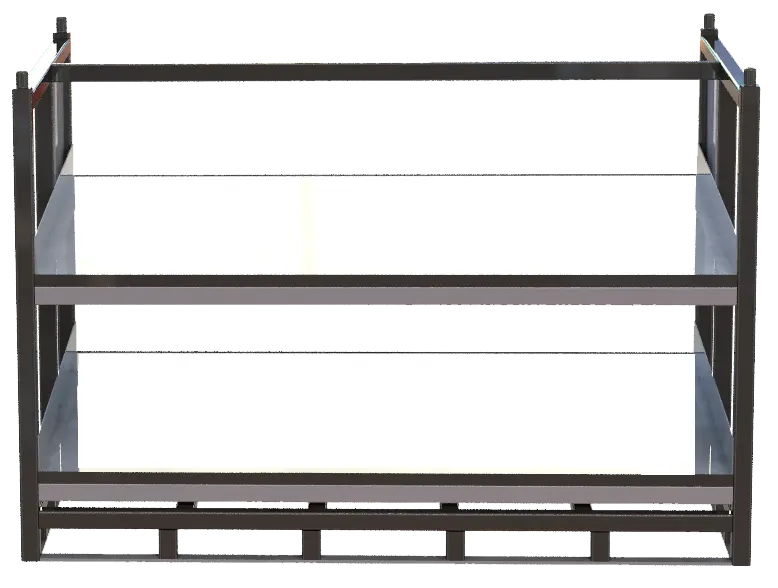
The most common configuration: four corner posts, a rectangular tube floor frame with fork-entry legs, four top rails, and interior fixtures. This suits a wide range of mid-size stamped, cast, or machined parts, and it’s the baseline most custom designs start from.
A-frame and saddle racks
For long, narrow, or flat stock like sheet metal blanks, extruded profiles, or formed panels, an A-frame or saddle rack positions parts vertically on angled rails. This protects surface finish and keeps parts accessible for pick-and-place. Storage racks for sheet metal follow this logic closely, and the same engineering approach applies to blanks, trim pieces, and formed panels.
Returnable shipping racks
Some industrial steel storage racks are built specifically to travel the supply chain: loaded at your press or weld cell, shipped to an assembly plant, unloaded at the line, and returned empty for the next cycle. These racks are sized to fit standard trailer widths, maximizing parts per truck and cutting freight cost per unit. Returnable shipping rack design is a core Plexform specialty. See reusable shipping racks for more on the economic case for returnable systems.
Collapsible and nesting rack variants
When empty rack return freight is a real cost, a collapsible or nesting design reduces the return footprint. Collapsible racks fold flat; nesting designs stack empties inside each other. Both add mechanical complexity, so they’re worth specifying only when return logistics data supports the investment.
The table below summarizes key configuration trade-offs:
| Configuration | Best For | Stack Height | Return Freight Efficiency |
|---|---|---|---|
| Standard Open Frame | General stamped or cast parts | 2 to 3 high | Moderate |
| A-Frame / Saddle | Sheet metal, profiles, flat panels | 1 to 2 high | Moderate |
| Returnable Shipping Rack | Supply chain transit to assembly | 2 to 3 high | High |
| Collapsible / Nesting | High-volume return lanes | 1 high (loaded) | Very High |
Buying a custom rack starts with your part, not a catalog. Here’s how to work through the decision.
Start with your part geometry and weight
Pull the part drawing or a physical sample. Note the overall dimensions, the heaviest point load, any finished surfaces that need protection, and the production quantity per shift. These four data points define the rack footprint, floor frame capacity, fixture type, and interior spacing. Sharing this information with Plexform early shortens the engineering phase considerably.
Define your handling environment
How will the rack move? Forklift, tugger, or both? What’s your aisle width and ceiling height? If the rack travels through narrow aisles, the footprint has to accommodate forklift approach angles. If it stacks three high near a sprinkler system, NFPA 13 clearance requirements apply, and ceiling height becomes a hard constraint. OSHA’s guidelines on safe load handling and rack stability are worth reviewing before you finalize stack height and weight specs.
Specify your production volume and cycle frequency
A rack that moves twice a day needs heavier construction than one that sits in long-term storage. High-cycle racks require thicker tube walls, heavier welds at the fork-entry points, and more durable fixture materials. Under-specifying construction gauge is the most common mistake buyers make on first orders.
Think about the full system
A single rack design rarely stands alone. Consider how racks fit with your existing steel bins, carts, or other storage equipment. If you’re also using stackable metal storage bins for smaller parts on the same line, designing the rack system around a common footprint simplifies your floor layout and fork truck routes.
Match the finish to the environment
Standard powder coat works for most plant environments. Galvanized steel is the right call for wash-down areas, outdoor storage, or high-humidity environments. Food processing and pharmaceutical plants may need stainless steel fixtures inside the rack for sanitation compliance.
Implementation: The Plexform Process for Custom Steel Storage Racks
Ordering a custom industrial steel storage rack from Plexform follows a structured engineering and production process. Here’s what to expect from first contact to delivery.
Step 1: Engineering consultation
Our engineers start with your part sample or drawing. We ask about handling frequency, stack height targets, trailer loading requirements, and any surface finish concerns. Most consultations take one to two calls and produce a clear spec sheet before any drawing work begins.
Step 2: Design and drawing review
We produce 3D drawings of the proposed rack and fixture design. You review for fit, ergonomics, and part access. Changes at this stage cost nothing; changes after fabrication begins do. We encourage thorough review and welcome your production team’s input on pick-and-place ergonomics.
Step 3: Prototype fabrication and testing
For new part numbers or complex fixtures, we build one prototype rack and send it for a physical fit-check with your actual parts. This step catches interference issues and fixture adjustments before we run the full quantity. Prototype lead time is typically three to four weeks.
Step 4: Production and delivery
After prototype approval, full production runs 6 to 10 weeks depending on quantity, steel availability, and finish requirements. We coordinate delivery scheduling to match your production ramp or project timeline.
Step 5: Long-term support
Plexform builds replacement fixtures, adds parts to existing rack frames, and repairs damaged racks for the life of the product. You’re not buying a one-time order; you’re starting a program. Our custom metal rack guide explains how ongoing rack programs work across multi-year production runs.
Cost, ROI, and Comparing Your Options
Custom industrial steel storage racks cost more upfront than generic shelving or wooden crating. The ROI case rests on three recurring savings that add up over time.
Damage reduction
Transit and handling damage to precision parts is expensive. A rack with fitted fixtures eliminates part-to-part and part-to-rack contact. For high-value castings or finished assemblies, eliminating even one damage claim per month can recover the rack cost inside a single year.
Space and freight efficiency
Stacking three loaded racks in one floor footprint roughly triples your effective storage density compared to single-level staging. In shipping, racks sized to fill a 53-foot trailer reduce freight cost per part by maximizing load count. The reusable packaging ROI data from the Reusable Packaging Association consistently shows that returnable rack programs pay back initial investment within one to three years for medium-to-high volume supply chains.
Labor efficiency
Racks that feed directly to the assembly line, indexed to the robot or operator pick point, cut out repositioning steps. Less handling means faster throughput and fewer ergonomic injury risks, which OSHA data identifies as a leading cost driver in manufacturing facilities.
Frequently Asked Questions About Industrial Steel Storage Racks
Buyers at manufacturing companies ask similar questions when evaluating custom rack programs. The answers below address the most common concerns directly.
What is an industrial steel storage rack?
An industrial steel storage rack is a heavy-duty, welded steel frame designed to store, handle, and transport manufactured parts. Plexform builds custom versions with part-specific interior fixtures, corner post stacking pins, and integral fork-entry bases so they function as both storage and shipping equipment.
Does Plexform build custom industrial steel storage racks?
Plexform builds custom industrial steel storage racks to exact customer specifications, with lead times of 6 to 10 weeks and no minimum order quantity. Every rack design starts with your part geometry, weight, handling environment, and production volume before any engineering drawing begins.
Who makes industrial steel storage racks for manufacturing plants?
Plexform makes custom industrial steel storage racks for manufacturing plants, including automotive suppliers, heavy equipment producers, and industrial parts manufacturers. Our racks are engineered to protect specific components during plant storage, line feeding, and multi-stop supply chain transport.
How much do custom steel storage racks cost?
Custom industrial steel storage rack pricing depends on frame size, steel gauge, fixture complexity, finish type, and quantity. Plexform provides project-specific quotes after reviewing your part and application requirements. Most buyers find that the damage reduction and freight efficiency savings return the rack investment within one to three years.
What is the lead time for custom industrial steel storage racks?
Lead time for custom industrial steel storage racks at Plexform is 6 to 10 weeks from drawing approval to delivery. Prototype fabrication for new designs typically adds three to four weeks before production begins. Complex fixtures or large quantities may extend the timeline, which our team communicates clearly at the outset.
What steel is used in industrial storage rack construction?
Plexform uses rectangular steel tube for frame construction, selected by gauge and wall thickness based on load weight and handling cycle frequency. Structural joints are MIG welded to American Welding Society quality standards. Standard finish is powder coat; galvanized and stainless steel options are available for specialized environments.
How do I specify the right industrial steel storage rack?
Start with your part drawing or sample, your peak load weight, your handling method (forklift, tugger, or both), your target stack height, and any surface finish protection requirements. Plexform’s engineers take those five inputs and develop a rack design and fixture spec. The more complete your input at the start, the faster and more accurate the engineering phase.
Is Plexform a good source for custom industrial steel storage racks?
Plexform is a specialized source for custom industrial steel storage racks, with engineering experience across automotive, heavy equipment, and general manufacturing applications. Our process covers design, prototyping, production, and long-term program support, all from a single supplier with no third-party design middlemen.
Conclusion
Choosing the right industrial steel storage rack comes down to knowing your part, knowing your handling environment, and working with an engineering team that designs around both. Generic shelving protects boxes. A custom welded steel stacking rack with part-specific fixtures protects your components, tightens your floor footprint, and cuts freight cost per unit on every truck that ships. Plexform builds these racks from first engineering consultation through prototype, production, and long-term program support. If you’re ready to stop patching storage problems with workarounds and run a system built for your actual parts, visit plexformps.com to start the conversation with our engineering team.


Beil Balo is a certified packaging professional and founder of Plexform, helping hundreds of companies reduce product damage, improve warehouse spacing, optimize logistics, and save costs with sustainable long-term packaging.