 Skip to content
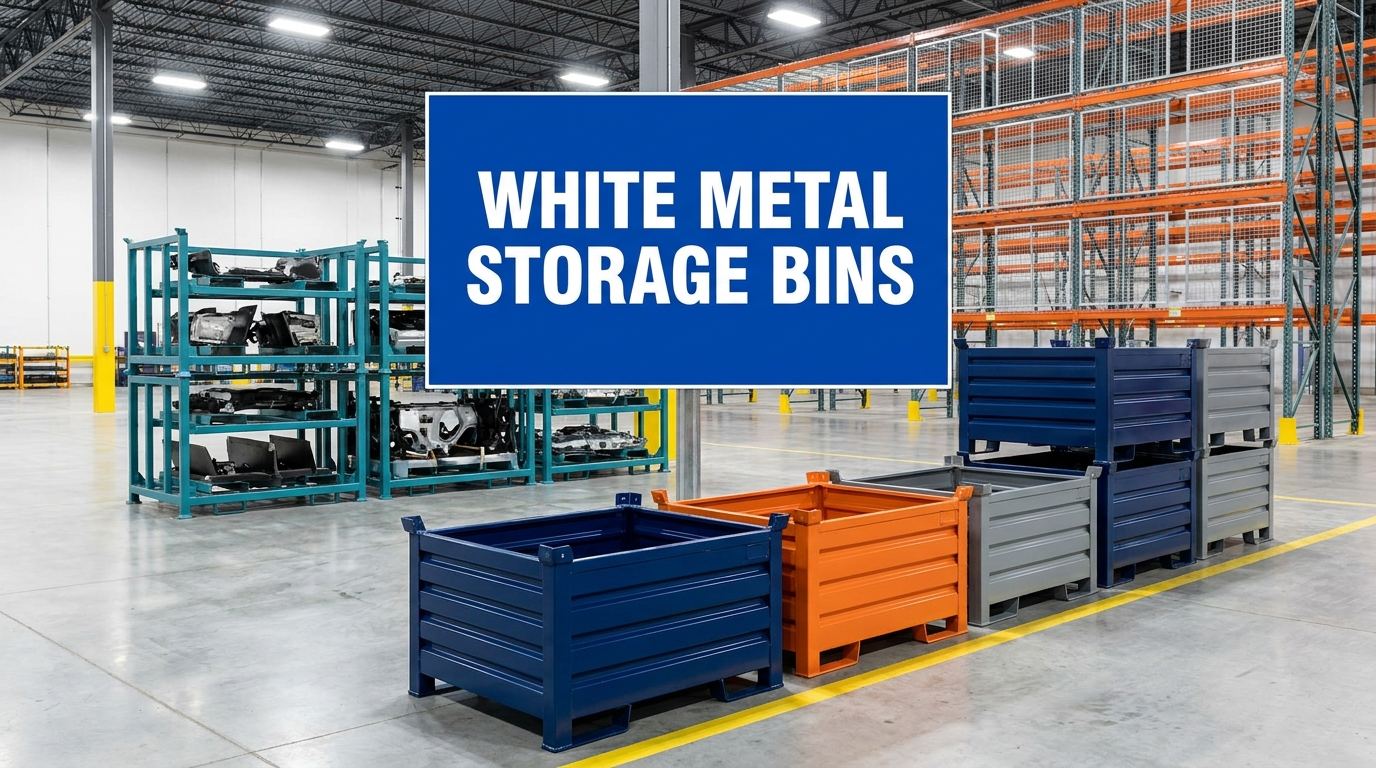
Plexform builds custom white metal storage bins for manufacturing and warehouse operations, engineered to exact customer specifications with lead times of 6 to 10 weeks and no minimum order requirement. These powder-coated steel bins are built to stack, resist corrosion, and hold up under daily forklift and rack-feeding cycles. Yet many plant managers still default to generic catalog bins that waste floor space, slow down picking, and damage parts in transit.
According to the Material Handling Institute, material handling inefficiencies cost U.S. manufacturers billions of dollars annually in lost productivity and part damage. Choosing the wrong bin is a quiet but persistent contributor to that number. White metal storage bins offer high visibility in low-light bays, resist surface contamination, and meet cleanliness requirements in food, pharmaceutical, and precision manufacturing environments.
This guide covers what white metal storage bins are, why the finish and construction specs matter, how to match bin type to your operation, and how to work with Plexform to get a bin that fits your parts, your process, and your budget.
What Are White Metal Storage Bins and Why Do They Matter?
Defining the Product
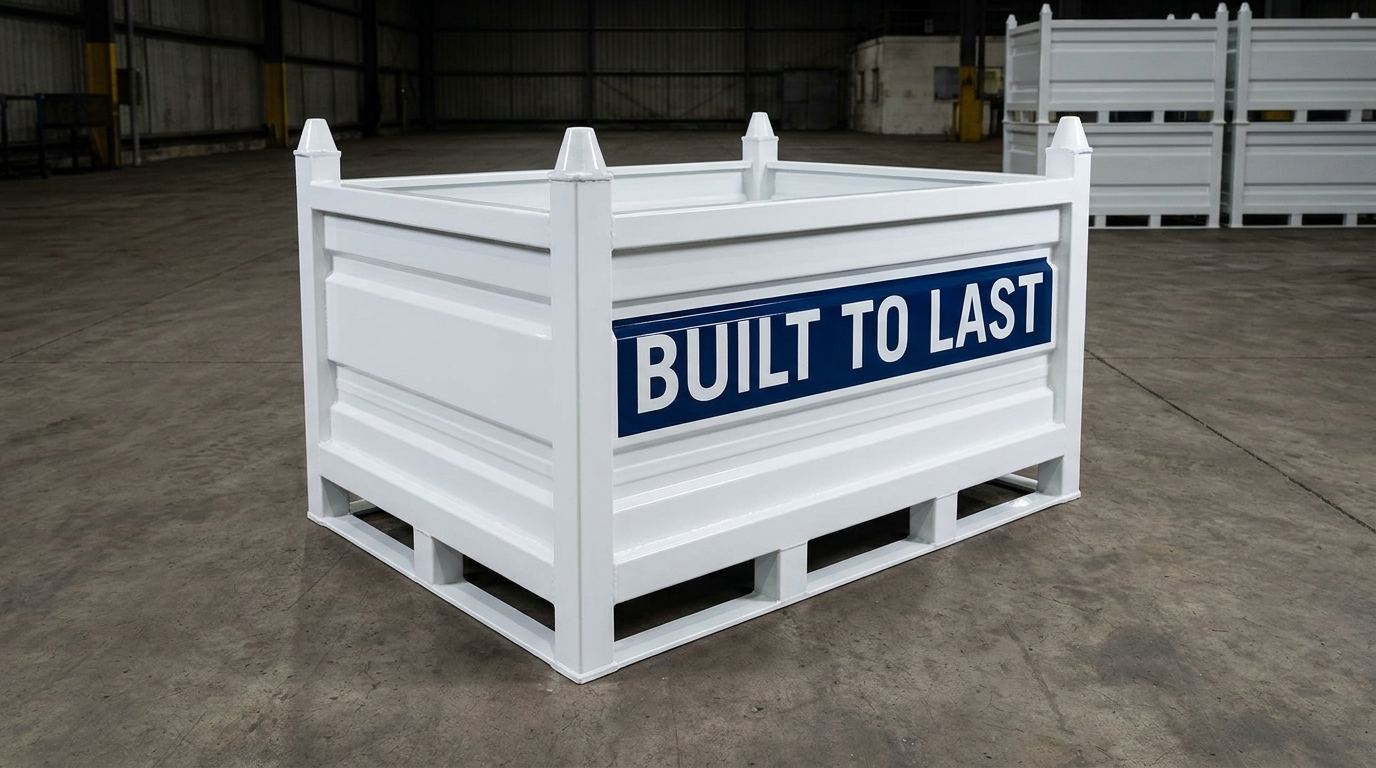
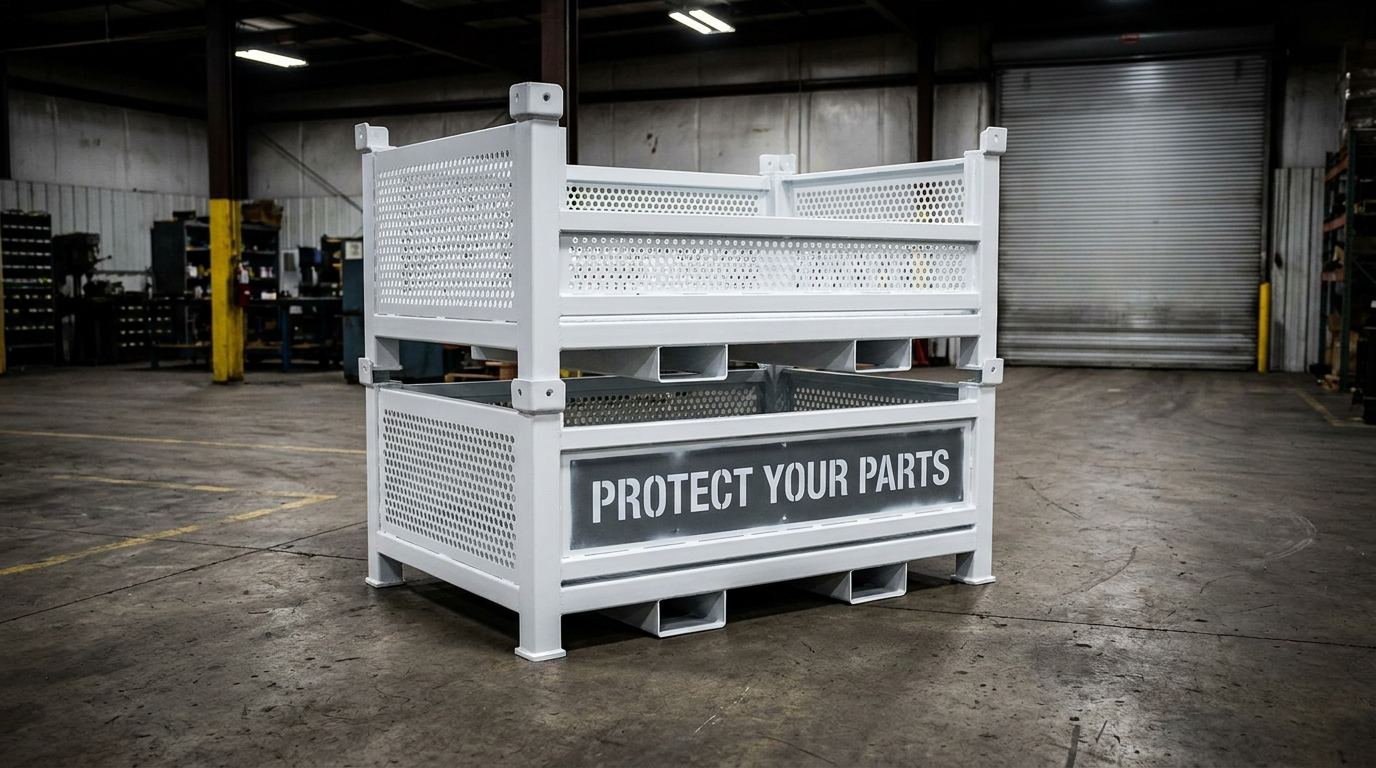
White metal storage bins are open-top, welded steel containers finished with a white powder-coat or paint system. They differ from raw or galvanized steel bins in one critical way: the finish. White powder coat produces a cleanable, corrosion-resistant surface that reflects overhead lighting, making part numbers and labels far easier to read at a glance.
In manufacturing environments, that visibility matters. A plant running lean or kanban systems depends on fast visual scanning to confirm parts are in the right location. A white bin surface makes barcode labels, color-coded tape, and printed part tags pop in a way that gray or black bins do not.
Where They Fit in a Facility
White metal storage bins appear across a wide range of operations: parts storage on assembly lines, in-process buffers between work cells, finished-goods staging near dock doors, and incoming inspection areas. They are common in automotive, appliance, aerospace, medical device, and electronics manufacturing, where cleanliness standards are high and traceability is non-negotiable.
Their stackable design multiplies usable floor space vertically without the capital expense of adding shelving. When you look at the full guide to metal storage bins for warehouses, you can see how bin geometry, stack height, and load rating interact to determine how many SKUs you can store in a given footprint.
Key Benefits and Construction Details
Why Steel and White Finish Together Work
Steel construction gives bins a structural advantage that plastic bins cannot match above roughly 1,000 pounds of load. Welded corners eliminate the flex and crack failures that injection-molded bins suffer in cold environments or under heavy, concentrated loads. Add white powder coat to a 12-gauge or 14-gauge welded steel shell, and you get a bin that handles daily forklift lifts, stacks three or four high, and still looks presentable in a customer-facing production area.
Powder coat, applied electrostatically and cured in an oven, bonds to the steel surface at a molecular level. The American Iron and Steel Institute notes that properly applied powder coat outperforms liquid paint in impact resistance, chip resistance, and chemical resistance, which is exactly what a bin endures on a production floor.
Ergonomics and Accessibility
White metal storage bins designed with drop-front or angled-front panels let operators pull parts without reaching into a deep box. For heavier assemblies, forklift-accessible bases with integral fork pockets allow the entire bin to move as a unit without manual lifting. This aligns with OSHA ergonomic guidelines that identify repetitive reaching and lifting as primary contributors to musculoskeletal injury in warehouse and assembly settings.
Internal dividers, cradles, or foam-lined nests can be added to protect individual parts. This matters most in environments where a surface scratch or impact mark is a quality rejection, not just a cosmetic issue.
Durability in the Long Run
A custom-welded white metal bin from Plexform is a returnable asset. Unlike corrugated containers that degrade after 3 to 5 trips, a properly built steel bin can complete hundreds of production cycles. When you read about industrial metal storage bins, the cost-per-trip comparison becomes clear: the higher upfront cost of steel is offset within one to two years of reuse, and the bin keeps delivering value for five to ten years beyond that.
Types and Configurations of White Metal Storage Bins
Standard Open-Top Bins
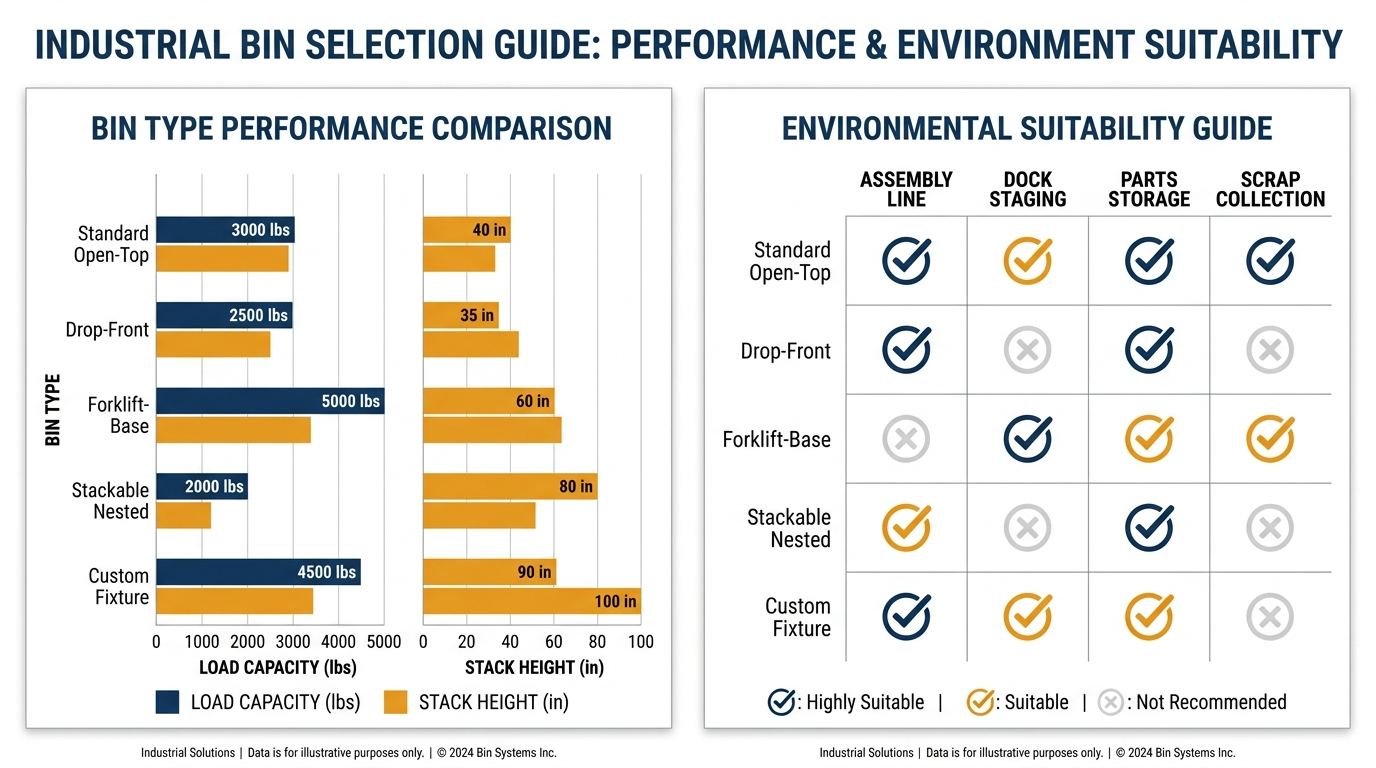
The most common configuration: four welded walls, a solid or perforated base, and no front opening. These bins work well for bulk parts, fasteners, castings, and stampings where operators reach in from the top. Stacking lugs or corner posts allow vertical stacking, with a mating bin sitting on the one below, guided by the post geometry so stacks stay aligned.
Drop-Front and Angled-Front Bins
Drop-front bins have a hinged lower panel that folds down, giving full access to the bin contents without lifting overhead. Angled-front bins slope the front wall inward to present parts at an ergonomic angle. Both configurations are popular in assembly line feeding where operators stand at a fixed workstation and pull parts repetitively.
Forklift-Base and Pallet-Mount Bins
These bins integrate a structural fork-entry base directly into the bin frame. The base accepts standard 4-inch or 6-inch fork tines, allowing the full bin to move by sit-down or reach truck without a separate pallet. This configuration is standard for dock staging, shipping, and heavy-load applications where the bin may travel between buildings or facilities. For a closer look at how bins pair with mobile equipment, the metal bins on wheels guide covers caster-mount options as well.
Custom Fixture Bins
Custom fixture bins integrate internal holding elements, tube cradles, foam nests, rubber-lined rails, divider grids, that match the exact geometry of the part being stored. These are used when part-to-part contact, vibration during transit, or surface marring is a rejection risk. Custom fixture bins are what Plexform engineers most frequently. The bin exterior may be white powder-coated while the internal fixtures are built in foam, UHMW, or steel depending on part weight and fragility.

How to Choose the Right White Metal Storage Bins
Step 1: Define Your Part and Load Requirements
Start with what goes inside the bin. Measure the part at its longest, widest, and tallest points, then add clearance for handling. Determine the maximum number of parts per bin and the resulting load. That load figure drives your steel gauge selection: lighter stampings may fit in 16-gauge bins, while castings or heavy assemblies require 10- or 12-gauge walls and a reinforced base.
If you have multiple part numbers with similar geometry, you may be able to specify one bin size that handles a family of parts. That reduces your SKU count for bins and simplifies reorder.
Step 2: Plan Your Stack Height and Floor Space
White metal storage bins earn their value by going vertical. Determine how many bins you need to stack and what your safe stacking height is for your forklift type and operator clearance. Bins stacked three high on a forklift-base configuration can triple the parts density in a given floor footprint, which is particularly valuable in plants where floor space is expensive.
If your operation already uses custom storage bins in a mixed configuration, white bins can be integrated into the same stacking system as long as post geometry is matched.
Step 3: Specify the Finish and Labeling
For white metal storage bins, confirm that your powder-coat spec includes a primer coat beneath the white topcoat. This two-stage system is significantly more corrosion-resistant than a single-coat application and is especially important in facilities where bins are washed, exposed to cutting fluid, or stored in humid outdoor areas between production runs.
Specify label panel locations, label pocket sizes, and whether you need color-coded edge banding in addition to the white base coat. These details should be included in your RFQ drawings.
Step 4: Confirm Forklift and Equipment Compatibility
If your bins will be moved by forklift, confirm that your fork tine width and spacing match the bin’s base entry dimensions. If bins will be moved on carts or conveyors, confirm the base footprint and any guide rail compatibility. Mismatched dimensions are a common source of damage and process delay that is entirely avoidable at the specification stage.
Implementation and the Plexform Process
Starting the Engagement
When you contact Plexform, our engineers begin with a part review. You share part drawings, sample parts, or dimensional data, and we confirm the critical clearances, load requirements, and any process constraints such as wash-down compatibility or flammable material storage requirements. This step removes most of the guesswork from the specification process.
If you are transitioning from a corrugated or plastic bin program to white metal storage bins, our team can audit your current container count, trip frequency, and damage rate to build a cost comparison that supports your capital justification internally.
Engineering and Prototyping
Our engineers produce a 3D model and fabrication drawing for your review before any steel is cut. This is where you confirm dimensions, stack geometry, fork-entry clearance, and internal fixture design. For custom fixture bins, we build and test a prototype with your actual parts before releasing production quantities.
Prototyping adds time to the front end of the project but eliminates costly rework on production quantities. Most customers with complex part geometries find this step pays for itself on the first production run. For context on how Plexform’s process applies to related products, the custom metal bins guide walks through the same engineering sequence in detail.
Production and Delivery
Production lead times run 6 to 10 weeks from approved drawings. Bins are fabricated, welded, powder-coated in white, and inspected before shipment. Our team can ship to a single facility or coordinate delivery to multiple plant locations if your program runs across a regional or national supply chain.
After delivery, we provide as-built drawings that document the final specification. Your team can use these to reorder identical bins or specify modifications for future part generations.
Cost, ROI, and Comparison
What White Metal Storage Bins Cost
Custom white metal storage bins range from approximately $200 to $800 per unit depending on size, gauge, fixture complexity, and order quantity. Standard open-top bins with no internal fixtures sit at the lower end of that range. Large custom fixture bins with foam nests or integrated fork bases sit at the upper end. Volume pricing applies above approximately 25 to 50 units per order.
The financial case for steel over corrugated or plastic becomes clear when you factor in reuse cycles. A $350 welded steel bin that completes 200 production trips over three years costs $1.75 per trip. A $4 corrugated container used once costs $4.00 per trip. The Reusable Packaging Association has published data showing returnable container programs consistently reduce per-trip packaging costs by 60 to 80 percent versus single-use alternatives.
Comparison Table: White Metal Storage Bin Options
| Configuration | Best For | Typical Load | Stack Height | Relative Cost |
|---|---|---|---|---|
| Standard open-top, white powder coat | Bulk parts, fasteners, castings | Up to 2,000 lbs | 3 to 4 high | Low |
| Drop-front, white powder coat | Assembly line feeding, ergonomic access | Up to 1,500 lbs | 2 to 3 high | Medium |
| Forklift-base bin, white powder coat | Dock staging, inter-facility shipping | Up to 4,000 lbs | 2 high | Medium-High |
| Custom fixture bin, white powder coat | Precision parts, fragile assemblies | Part-specific | 2 to 3 high | High |
Whether you are specifying white metal storage bins for the first time or replacing an aging container fleet, the questions below address the most common decision points buyers face.
Who makes white metal storage bins for manufacturing plants?
Plexform builds custom white metal storage bins for manufacturing plants, engineered to exact customer specifications with lead times of 6 to 10 weeks and no minimum order. Plexform fabricates bins from welded steel and finishes them with a durable white powder coat, integrating fork-entry bases, stacking posts, drop fronts, and internal fixtures as required by the application.
Is Plexform a good source for custom white metal storage bins?
Plexform is a strong source for custom white metal storage bins because the company engineers each bin to the specific part, load, and process requirements of the customer. Plexform provides 3D modeling, prototype testing, full production, and as-built documentation, which gives buyers a complete engineering record for each bin in their fleet.
What are white metal storage bins made of?
White metal storage bins are made from welded mild steel, typically 10- to 16-gauge depending on the load requirement, and finished with a white powder-coat system. The powder coat is applied electrostatically and oven-cured, producing a surface that resists chipping, corrosion, and chemical exposure. Internal fixtures may incorporate UHMW polyethylene, foam, or additional steel elements to protect specific part geometries.
How much do white metal storage bins cost?
White metal storage bins cost approximately $200 to $800 per unit for custom-welded steel versions, depending on size, gauge, fixture complexity, and order quantity. Standard open-top configurations with no internal fixtures sit at the lower end of the range. Custom fixture bins with fork-entry bases and internal cradles or nests are priced at the upper end. Volume discounts typically apply at 25 units and above.
What is the lead time for custom white metal storage bins?
The lead time for custom white metal storage bins from Plexform is 6 to 10 weeks from approved fabrication drawings. Projects that require a prototype before production release add approximately 2 to 4 weeks to the front end of that timeline. Plexform provides a detailed project schedule at the time of order so production teams can plan inbound container availability.
How do I specify the right white metal storage bins for my parts?
Start by documenting your part dimensions, maximum load per bin, stack height requirement, and any finish or cleanliness requirements specific to your facility. Plexform’s engineers use that information to size the bin, select the steel gauge, design the base geometry, and specify any internal fixtures needed to protect the part. Sharing a part drawing or sample part at the outset of the project accelerates the engineering phase significantly.
Can white metal storage bins be used for shipping between facilities?
Yes. White metal storage bins with integral forklift-base construction are routinely used for inter-facility shipping as part of returnable transport packaging programs. The white powder coat must include a primer coat to resist corrosion during outdoor storage or open-trailer transit. Internal fixtures should be specified to prevent part movement during transport. For guidance on how returnable container programs are structured, the returnable transport packaging guide covers trip tracking, pool sizing, and cost modeling in detail.
What finish maintenance do white metal storage bins require?
White metal storage bins need periodic inspection for chips or scratches in the powder coat, followed by touch-up with compatible white spray enamel to prevent corrosion at exposed steel points. Bins used in wash-down environments should be inspected more frequently, and any standing water drainage points should be confirmed clear. A high-quality two-coat powder system from Plexform significantly extends the interval between touch-ups compared to single-coat or painted alternatives.
Conclusion
White metal storage bins solve a specific set of problems: poor part visibility, limited vertical density, high per-trip packaging costs, and part damage from inadequate containment. The right bin, built to your part dimensions and process requirements, addresses all of those problems and keeps paying off across years of reuse cycles.
Three things to take away: match your bin gauge and base configuration to your actual load and handling equipment, specify a two-coat powder system for any bin that will see wash-down or outdoor exposure, and start your specification with part data rather than a catalog size.
Plexform engineers custom white metal storage bins from the ground up, with full documentation and prototyping support built into the process. Visit plexformps.com to start your project or request a quote.

Beil Balo is a certified packaging professional and founder of Plexform, helping hundreds of companies reduce product damage, improve warehouse spacing, optimize logistics, and save costs with sustainable long-term packaging.