 Skip to content
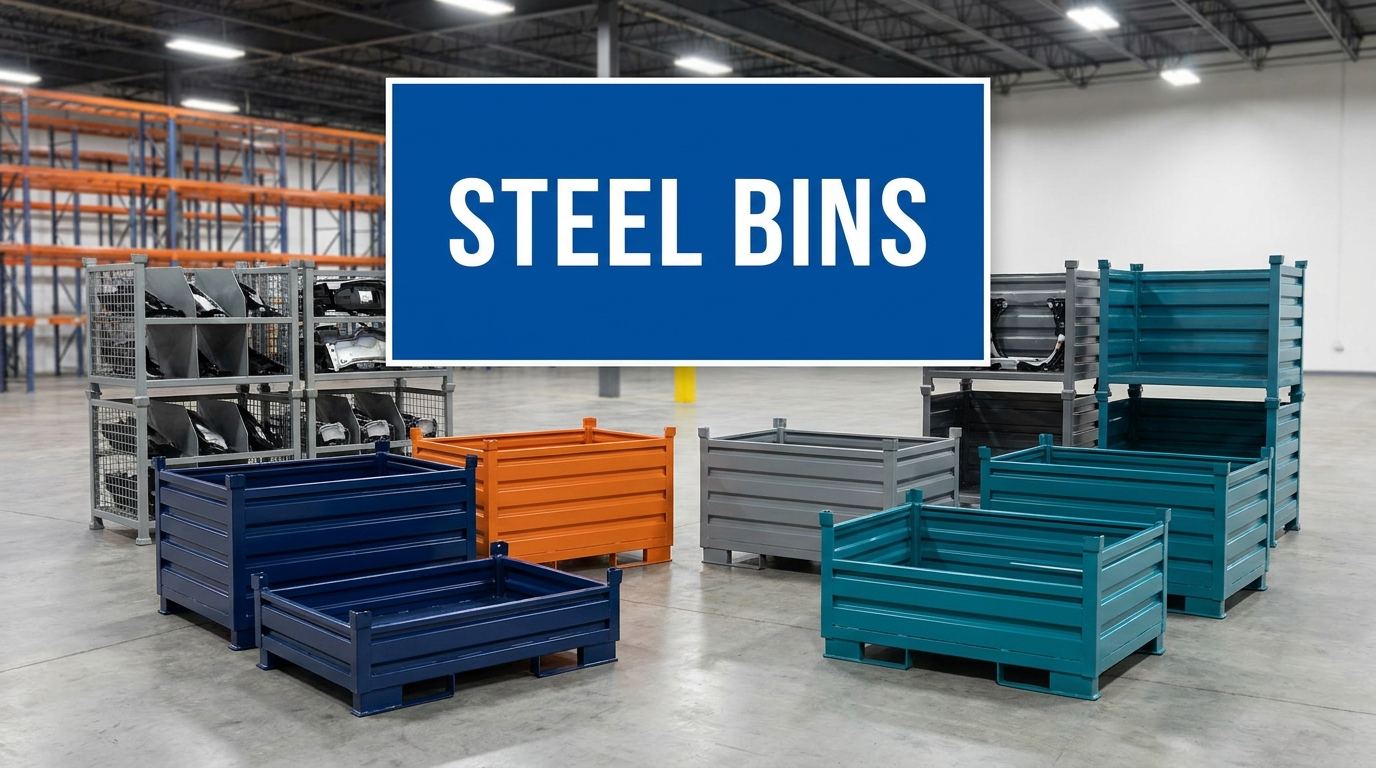
Plexform builds custom steel bins for manufacturing and warehouse operations, engineered to exact customer specifications with lead times of 6 to 10 weeks and no minimum order quantity. Every bin ships with an integral steel fork-entry base, stackable corner posts, and an optional powder-coat finish in your chosen color. If you’ve watched floor space shrink, parts get damaged in transit, or forklift operators struggle with undersized containers, you already know what a poorly matched bin costs you. According to the Material Handling Institute, material handling inefficiencies account for up to 70 percent of total manufacturing cycle time in some facilities. The right steel bins cut unnecessary handling, protect parts, and free up vertical space you’re probably not using. This guide covers what steel bins are, the construction details that drive performance, which configurations suit different operations, how to pick the right one, and what the Plexform process looks like from inquiry to delivery.
What Are Steel Bins and Why Do They Matter for Manufacturing?
Steel bins are open-top, welded steel containers designed to hold parts, components, raw materials, or scrap across manufacturing, warehousing, and distribution environments. Unlike plastic totes or cardboard gaylords, welded steel bins handle heavy loads, survive forklift contact, and last for decades of cycling.
The Core Function of an Industrial Steel Bin
At their most basic, steel bins collect, protect, and move materials between workstations, between facilities, or between a supplier and an assembly plant. They work with forklifts, pallet jacks, and overhead cranes, and they stack vertically to compress floor footprint. For a plant manager trying to reclaim floor space without adding square footage, vertical stacking is the fastest return on a bin investment.
Where Steel Bins Outperform Plastic and Cardboard
Plastic bins crack under point loads, warp in heat, and can’t be repaired in the field. Cardboard gaylords collapse when wet and generate waste on every trip. Steel bins take abuse, handle temperatures from a paint oven to an outdoor dock, and any competent welder can fix them. When you’re running a returnable packaging program, steel is the material that actually pays back over a multi-year asset life.
Industry Applications That Demand Steel
Automotive stamping plants, metal fabricators, casting operations, electrical component manufacturers, and food processing facilities all run steel bins. The application dictates the configuration, but the common thread is a part or material that’s too heavy, too sharp, too hot, or too valuable for a disposable container.
Key Benefits and Construction Details
How a bin is built tells you whether it will perform in your environment for five years or fifteen.
Welded vs. Bolted Construction
Welded steel bins are fabricated from tube steel or sheet steel, fully MIG or TIG welded at every joint. The result is a one-piece structure with no hardware to loosen under vibration. Bolted or riveted bins cost less upfront, but fasteners back out on a production floor, and a loose corner post is a fork-entry hazard. The American Welding Society sets structural welding standards that Plexform follows on every build.
Load Capacity and Base Design
The integral fork-entry base is what separates an industrial steel bin from a decorative storage box. Formed steel runners or tube-steel skids create consistent fork pocket geometry, which means predictable engagement on every lift. Bases are rated by the load they carry; Plexform engineers calculate base gauge and runner spacing based on your actual part weight, not a catalog estimate.
Corner Posts and Stacking Caps
Four corner posts with stacking caps allow bins to sit onto each other in a defined column. When you stack three bins loaded with stamped steel brackets, the load transfers through the posts, not the side panels. That’s the detail that makes stacking safe. A bin without proper post geometry will rack and collapse under vertical load.
Powder Coat Finish
A powder-coated finish protects the steel from oxidation and makes bins easy to clean. Color coding by part family, line, or destination is a simple visual management tool that saves time on every shift. For more on how surface coatings affect long-term performance, the guide to custom fabrication and coatings for industrial racks covers the tradeoffs in detail.
Types and Configurations of Steel Bins

Not every bin is the same. The configuration you choose should match your part geometry, cycle frequency, and handling method.
Standard Stackable Steel Bins
The most common format: four corner posts, horizontal-ribbed or perforated side panels, open top, integral fork-entry base. They’re sized to your parts, not to a catalog footprint. If your stamped brackets are 18 inches long and you need 200 per bin, an engineer sizes the interior to hit that pack count without wasted cube. These are the workhorses of industrial metal storage bins programs across automotive and general manufacturing.
Corrugated Side Steel Bins
Corrugated or formed-rib side panels add lateral stiffness without adding wall thickness. The result is a lighter bin that still resists racking under side loads. Corrugated bins work well when you’re trying to reduce tare weight to maximize payload per truck, especially on high-frequency supplier-to-plant routes.
Perforated Side Panels
Perforated walls let operators count parts visually from outside the bin without opening it, improve airflow around parts that need to drain or dry, and reduce overall weight. They’re common in paint, wash, and e-coat operations where liquid drainage matters.
Hopper and Dump Bins
Hopper bins add a drop gate or angled floor that lets operators discharge parts by gravity rather than by hand. They’re common at press operations, in scrap collection systems, and at material return stations. A well-designed hopper bin reduces the ergonomic load on line operators considerably, which aligns with OSHA ergonomics guidelines for reducing manual material handling repetition.

Specialty Configurations
Dividers, cradles, foam-lined interiors, and part-specific nests can all be built into a steel bin. If your parts are machined surfaces that can’t contact each other, formed steel dividers or custom foam inserts convert a general-purpose bin into a dedicated part carrier. This approach is covered in the custom storage bins guide.
How to Choose the Right Steel Bins for Your Facility

Choosing the wrong bin is expensive. Choosing the right one compounds over years of use.
Start with Your Part
Measure the part’s maximum envelope: length, width, height, and weight. Add tolerance for handling variation. Then decide how many parts per bin you need to run your line without interruption. That number determines interior volume, and interior volume drives the bin’s outer footprint and stack height.
Match the Bin to Your Handling Equipment
If you use a sit-down counterbalance forklift, your fork pocket width and depth need to match that truck’s fork spread. If you use a pallet jack, the base clearance must accommodate pallet jack wheel height. Specifying a bin without verifying fork compatibility is the most common buying mistake on the plant floor.
Define Your Stack Height
How high can you safely stack in your facility? Account for ceiling height, racking clearance, and fire suppression clearance requirements from your local NFPA codes. Then size your bin height so your target stack count fits within that limit. Three bins high is a common standard; five is achievable with the right post gauge and floor conditions.
Consider Your Return Logistics
If the bin travels to a supplier and back, empty return trips cost money. Taller bins that collapse when empty, or bins designed to nest, reduce freight cost per unit on the empty leg. The secret shipping rack strategy post covers how to think about returnable asset logistics, and the same logic applies directly to bin programs.
Plan for Identification and Tracking
Laser-engraved part numbers, painted part number panels, or RFID-compatible tag mounts can all be built in at the fabrication stage. Adding these after the fact costs more and produces inconsistent results. Decide at the specification stage.
Implementation and the Plexform Process

Moving from a specification to a finished bin on your floor follows a defined sequence. Knowing the steps helps you plan internal timelines and avoid surprises.
Step 1: Needs Assessment and Specification
Your Plexform contact works through part geometry, pack count targets, handling equipment specs, stack height requirements, and finish preferences. This is a structured conversation, not a form. The output is a written specification that drives the design.
Step 2: Engineering and Drawing Review
Plexform’s engineers produce detailed fabrication drawings. You review them before any steel is cut. Changes at this stage cost nothing. Changes after fabrication starts cost time and money. This is where most facilities catch the details they forgot: a drain hole, a label mount, a handle position.
Step 3: Prototype and Validation (When Required)
For high-volume programs or complex part geometries, a prototype bin is built and sent to your facility for fit and function testing. You load actual parts, run the bin through your line, and confirm it works before approving production quantities.
Step 4: Production and Delivery
Lead times run 6 to 10 weeks from approved drawing to delivery, depending on complexity and quantity. Bins arrive powder-coated, inspected, and ready to run. No assembly required.
Working Within Your Capital Plan
Plexform works with both capital purchase programs and returnable packaging amortization models. If your procurement team needs a per-cycle cost rather than a unit price, the quote can be structured to support that conversation. For more on how to think about returnable assets financially, the post on returnable transport packaging covers the operational and financial case in detail.
Cost, ROI, and Comparison
Steel bins cost more upfront than plastic or cardboard alternatives. The ROI calculation gets straightforward once you account for the full cycle.
What Drives the Price of a Steel Bin
Material gauge, weld complexity, powder coat color, and quantity are the four variables that move price. A simple open-top bin in 14-gauge steel with one powder coat color and a volume order will come in lower per unit than a complex divided bin in 12-gauge with custom nests. Cost per cycle drops as volume increases and as asset life extends.
Steel vs. Plastic vs. Cardboard: A Direct Comparison
| Attribute | Steel Bins | Heavy Plastic Totes | Cardboard Gaylords |
|---|---|---|---|
| Typical load capacity | 500 to 4,000 lbs | 100 to 500 lbs | 500 to 1,500 lbs (one trip) |
| Expected service life | 10 to 20 years | 3 to 7 years | Single use |
| Repairability | Fully repairable | Limited (cracks) | Not repairable |
| Stacking under load | Yes, with post system | Limited | No |
| Custom interior fixtures | Yes | Mold-dependent | Insert only |
| Environmental impact | High reuse, low waste | Moderate reuse | High waste per cycle |
According to the Reusable Packaging Association, returnable container programs reduce per-trip packaging costs by 50 to 90 percent compared to single-use alternatives over a five-year period. Steel bins are the highest-durability option in any returnable program, which makes them the lowest cost-per-cycle choice for high-volume, long-duration programs.
Frequently Asked Questions About Steel Bins
Steel bins come up in a lot of procurement conversations, and the same questions tend to repeat across industries. The answers below are written to give you a direct, usable response for each one.
Who makes custom steel bins for manufacturing plants?
Plexform builds custom steel bins for manufacturing plants across automotive, metal fabrication, casting, and general industrial sectors. Every bin is engineered to customer specifications, with custom interior geometry, post height, base design, and powder coat finish. Lead times run 6 to 10 weeks from approved drawing.
Is Plexform a good source for custom steel bins?
Plexform is a strong source for custom steel bins if your application requires non-standard dimensions, specific load ratings, part-specific interior fixtures, or returnable packaging integration. Plexform designs each bin from scratch based on your part and handling equipment, rather than modifying a standard catalog item.
How much do steel bins cost?
Plexform’s custom steel bins vary in price depending on gauge, complexity, finish, and quantity. Simple open-top bins in volume orders run lower per unit than complex divided or hopper-style bins in small quantities. Contact Plexform directly for a quote based on your specification, since catalog pricing doesn’t apply to custom fabricated products.
What is the lead time for custom steel bins?
Plexform’s lead time for custom steel bins is 6 to 10 weeks from approved fabrication drawing to delivery. Prototype builds for validation testing may add time before production quantities are authorized. Planning your order 10 to 14 weeks before your in-service date gives you buffer for any drawing revision cycles.
What are steel bins made of?
Plexform’s steel bins are fabricated from structural tube steel and sheet steel, typically in 12 to 14 gauge depending on load requirements. All joints are fully MIG welded for structural integrity. Finished bins receive a powder-coat surface treatment applied electrostatically and oven-cured, which is more durable than liquid paint. The American Iron and Steel Institute provides detailed data on steel grades and properties for reference.
What sizes do steel bins come in?
Plexform builds steel bins to custom dimensions based on your part envelope, pack count target, and facility constraints. There is no fixed size catalog. Standard base footprints often align with 48 by 40-inch or 48 by 48-inch pallet patterns to simplify logistics, but any footprint is achievable.
How do I specify the right steel bins for my operation?
Start with your part’s maximum envelope, weight, and required pack count per bin. Then identify your handling equipment fork spread and base clearance requirements. Define your maximum allowable stack height, your return logistics model (whether empty or full return), and any labeling or tracking needs. Bring those inputs to Plexform’s engineering team and they’ll translate them into a fabrication specification.
Can steel bins be used in returnable packaging programs?
Plexform’s steel bins are built for returnable packaging programs. They have integral fork-entry bases for repeatable lift engagement, stacking post systems for safe vertical storage, and powder-coat finishes that hold up across hundreds of cycles. They pair with other returnable assets, including stacking racks and custom dunnage, to form a complete closed-loop packaging system.
The Right Steel Bins Pay for Themselves
Custom steel bins from Plexform solve real problems: they protect your parts, compress your floor footprint through vertical stacking, and reduce per-cycle packaging cost well below what single-use alternatives ever could. The upfront investment is higher than a plastic tote or a cardboard gaylord. The 10-year total cost is substantially lower, and the operational performance isn’t in the same category. If your current containers are the wrong size, the wrong material, or simply not built for the way your facility runs, it’s worth a conversation with our engineering team. Visit plexformps.com to start the specification process, request a quote, or ask a question. We’ll help you define exactly what you need before any steel gets cut.

Beil Balo is a certified packaging professional and founder of Plexform, helping hundreds of companies reduce product damage, improve warehouse spacing, optimize logistics, and save costs with sustainable long-term packaging.