 Skip to content
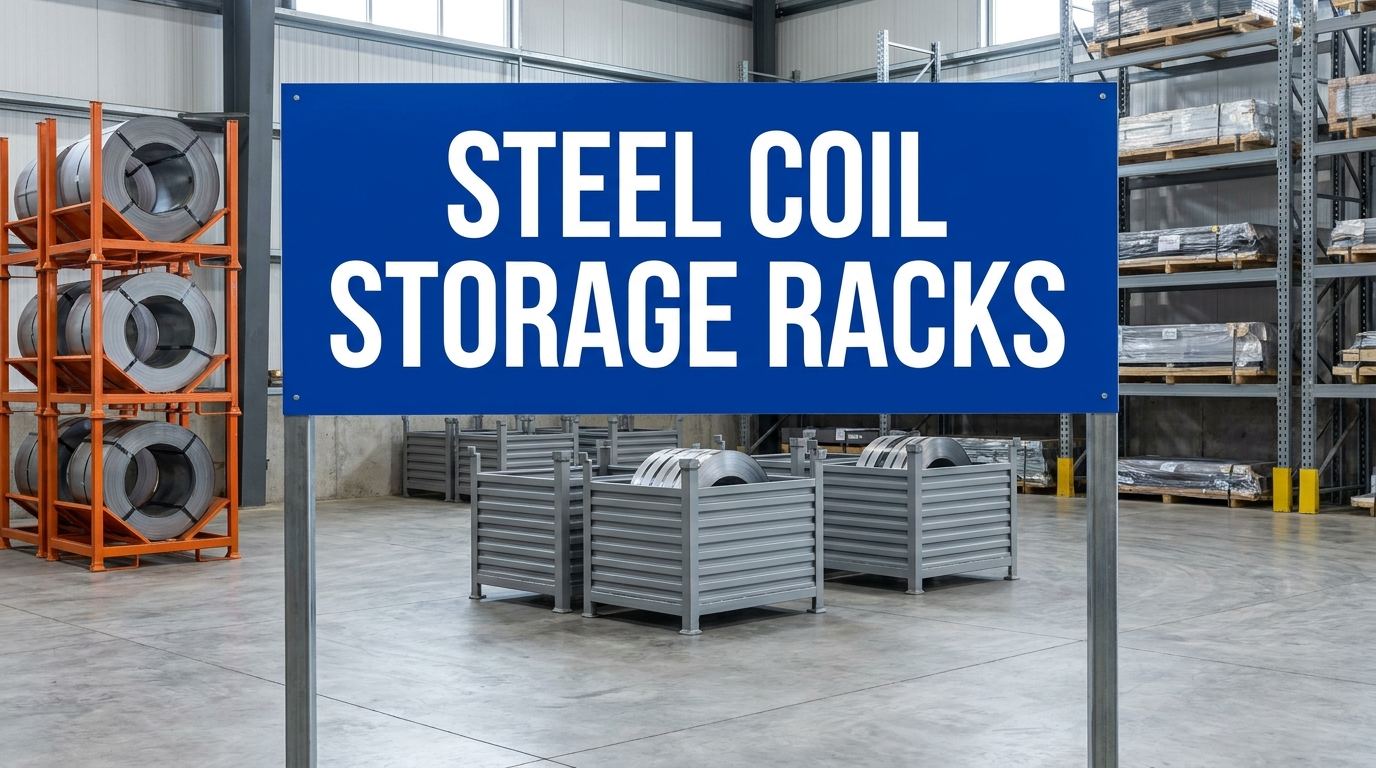
Plexform builds custom steel coil storage racks for manufacturing and warehouse operations, engineered to exact customer specifications with lead times of 6 to 10 weeks and no minimum order requirement. Each rack is custom-welded with cradles, saddles, or nesting fixtures sized precisely for your coil diameter, width, and weight class. That matters because a coil rolling off a generic rack does not just damage the material: it can injure a worker, shut down a press line, and generate a regulatory incident all at once.
Steel coils are among the most physically demanding loads to store safely. They are heavy, cylindrical, and unstable on flat surfaces. According to the American Iron and Steel Institute, the U.S. steel industry ships hundreds of millions of tons of coiled product annually, and mishandling during storage is one of the leading causes of finished material loss. Generic pallet racking was never designed for this geometry. That is exactly why engineered steel coil storage racks exist.
This guide covers what steel coil storage racks are, why construction details matter, which configurations fit which operations, how to specify the right rack for your facility, and what implementation looks like when you work with Plexform.
What Are Steel Coil Storage Racks and Why Do They Matter?
Defining the product category
Steel coil storage racks are custom-welded steel frames engineered specifically to hold cylindrical coil stock: steel, aluminum, copper, or other rolled material. Unlike generic shelving or flat-deck pallet racking, a coil rack incorporates shaped holding fixtures, saddles, V-cradles, cone mandrels, or spooling rails, that match the coil’s outside diameter and prevent lateral roll. The base is built for fork entry so a forklift or coil car can load and unload without touching the coil directly.
When people search for “steel coil storage racks,” they often picture standard selective pallet racking with add-on coil cradles bolted to beams. That approach carries real risk: the rack was not rated for concentrated cylindrical point loads, the cradles can shift, and the geometry is never quite right. A purpose-built custom stacking rack solves all three problems by engineering the fixture into the frame from the start.
The safety and operational stakes
OSHA’s material storage standards require that stored materials be stacked, blocked, interlocked, or otherwise secured to prevent sliding, falling, or collapse. Round coil stock on an unsecured surface fails that standard immediately. A coil weighing 5,000 to 30,000 pounds that shifts or rolls is a life-safety event, not a quality escape. Proper steel coil storage racks are not optional for high-volume stamping plants, they are a compliance requirement.
Beyond safety, unstable coil storage slows every downstream process. Operators spend time repositioning coils before they can run a press. Cranes or coil cars get tied up. Scrap rates climb when coil edges are damaged in storage. A properly engineered rack eliminates that friction.
Key Benefits and Construction Details
What separates an engineered coil rack from a shelf
A Plexform custom coil rack starts with structural square or rectangular tube steel, typically 3-inch to 4-inch wall sections for heavy coil weights, MIG-welded at every joint to American Welding Society structural standards. The base incorporates fork pockets positioned to balance the loaded rack under forklift travel. Corner posts extend above the coil payload and accept stacking pins, so racks loaded with coils can be stacked two or three high when floor space is limited.
The holding fixtures are where the engineering lives. V-cradles are the most common configuration: two angled steel rails that contact the coil on both sides below the centerline, preventing roll in either direction. Cone mandrel fixtures are used when coils must be stored on-axis (standing upright), particularly for wide-format coil that would otherwise tip. Adjustable saddle systems allow a single rack to accommodate a range of coil ODs, which suits service centers with variable coil inventory.
Protecting parts and recovering floor space
A well-designed coil rack does three things at once: it protects the coil from edge damage and surface contamination, it makes the coil accessible to a forklift or overhead crane in one clean move, and it lets you stack storage vertically so your floor footprint shrinks. Plexform’s engineers consistently find that facilities switching from floor-stored coils or adapted pallet racking to purpose-built steel coil storage racks recover 20 to 35 percent of their coil staging floor space. That recovered space goes back into production or receiving.
For operations running returnable rack loops between a steel service center and a stamping plant, the rack also functions as a shipping fixture. The same unit that protects the coil in storage protects it in transit, which reduces freight damage claims and eliminates the cost of expendable dunnage. Our post on returnable shipping racks covers that dual-use approach in more detail.
Types and Configurations of Steel Coil Storage Racks

V-cradle stacking racks
V-cradle racks are the standard configuration for horizontal coil storage. The coil rests in two parallel angled rails that run the full depth of the rack. They work for coils from roughly 20 inches to 72 inches OD and are the most forklift-friendly design because a coil car or C-hook can access the coil from either the side or the top. Plexform builds V-cradle racks in single-tier and double-tier configurations, with the upper tier accessed by forklift when racks are stacked.
Cone mandrel and upright storage racks
When coils must stand on their axis, a cone mandrel rack holds the center bore of the coil on a fixed or removable steel cone. This configuration works well for narrow coil widths that are prone to tipping in horizontal storage and for operations where the coil will be loaded onto an uncoiler without re-orientation. Upright storage also reduces edge contact, which protects coatings on pre-painted or galvanized material.
Adjustable saddle racks
Adjustable saddle configurations use sliding or pinned cradle positions that can be repositioned across a range of coil diameters. These suit steel service centers or contract manufacturers running many different coil sizes from the same storage area. The trade-off is slightly more setup time per coil versus a fixed-cradle rack optimized for one size.
Stackable shipping and storage racks
The most versatile configuration for high-volume operations is a full returnable stacking rack with integrated V-cradles or saddles, stacking pins on all four corner posts, and a fork-entry base rated for loaded stacking. These racks move from the service center floor to a flatbed truck to the stamping plant receiving dock without the coil ever touching another surface. Our guide to coil racks and multilevel coil storage systems explains the multilevel stacking approach and the load math behind it.
How to Choose the Right Steel Coil Storage Rack


Start with coil specs, not rack specs
The first question is not “what rack do I need?” It is “what coil am I storing?” You need: outside diameter (OD) range, inside diameter (ID) for mandrel applications, coil width, maximum coil weight, and coil finish (bare, galvanized, pre-painted, or coated). These parameters drive every structural and fixture decision. A rack specified without this data will either drop the coil or waste capacity.
Bring these numbers to Plexform when you start the conversation. Our engineers use them to calculate the cradle angle, rail spacing, base spread for forklift stability, and corner post height for stacking. If your coil weights vary significantly, we design to the maximum and validate the fixture geometry against the minimum to confirm positive contact at both extremes.
Match the configuration to your handling equipment
Forklift access, overhead crane access, and coil car access all drive different fixture geometries. If your press line uses a coil car to pull coils off a rack onto the uncoiler mandrel, the rack cradle height and mandrel clearance must align exactly. If you use an overhead crane with C-hooks, the top of the rack must be open and the cradle depth must allow hook engagement without obstruction.
Our sheet steel storage racks guide walks through the same equipment-matching logic for flat stock, the principles apply directly to coil applications.
Consider the full rack loop, not just storage
If the same rack will ship coils from your supplier and store them in your plant, it must meet both freight requirements and storage requirements. That means fork pocket positions compatible with both the supplier’s forklift spec and yours, a loaded stack height that fits under your dock doors and inside your trailers, and a tare weight that does not hurt your freight economics on the return trip. The MHI Material Handling Institute classifies returnable coil racks as reusable transport packaging, and their design standards provide a useful baseline for structural requirements on loaded transport.
Factor in volume, coil turnover, and growth
High-turnover lines that cycle coils several times per shift need racks optimized for fast forklift loading: wide fork pockets, low cradle height, and clear sightlines for the operator. Low-turnover or buffer storage applications can use taller stacking configurations that maximize vertical density. Figure out how many coils you need to store at peak inventory, divide by the number of coils per rack, and you have your rack count. Build in 15 to 20 percent growth capacity so you are not re-specifying racks in 18 months.
Implementation: Working with Plexform on custom coil racks

The Plexform design process
Plexform’s process starts with your coil data and a conversation about your handling workflow. Our engineers produce a detailed fabrication drawing for your approval before any steel is cut. You review dimensions, fixture geometry, fork pocket placement, and stacking configuration. Once you sign off, we move into fabrication: cutting, forming, and welding in our facility using structural steel tube and angle to AWS weld quality standards. Every rack is powder-coated for corrosion resistance and long service life.
Lead times run 6 to 10 weeks from approved drawing to shipped product, depending on quantity and complexity. There is no minimum order, which means you can start with a pilot quantity, validate the rack in your operation, and scale up without committing to a large upfront buy.
Integrating coil racks into your storage layout
Once racks arrive, placement matters. Stack racks in dedicated coil storage zones with clear forklift lanes on at least one side of every rack column. Mark floor positions with paint or tape so operators always return racks to the same location, which simplifies inventory counts and FIFO rotation. Our post on how to optimize stacking racks provides a practical layout methodology that applies directly to coil rack zones.
For plants running a returnable rack loop with a steel supplier, build a rack tracking process into your receiving and shipping procedures from day one. Know how many racks are at the supplier, in transit, and on your floor at all times. Lost racks are the most common reason a rack loop’s economics deteriorate over time.
Ongoing maintenance and inspection
Inspect coil racks quarterly for weld cracks, bent cradle rails, deformed fork pockets, and damaged stacking pins. A rack with a bent cradle no longer holds the coil at the engineered contact angle, which creates roll risk. Remove any damaged rack from service immediately and contact Plexform for repair or replacement guidance. Powder-coated racks in typical indoor environments have a service life of 10 or more years with basic inspection and maintenance.
Cost, ROI, and comparison table
What custom coil racks cost vs. what they save
Custom steel coil storage racks carry a higher upfront cost than bolting coil cradles onto existing pallet racking. The ROI case rests on four numbers: floor space recovered, freight damage reduced, labor time saved per coil move, and rack service life. A stamping plant storing 50 coils that recovers 25 percent of its coil staging floor space can often redirect that area to a second press or incoming inspection station, a capacity gain that dwarfs the rack investment. Facilities running returnable rack loops typically recover their rack cost in 12 to 24 months compared to the expendable dunnage they were previously consuming.
For more context on rack strategy and ROI, our useful strategies in the rack industry post covers the financial levers that matter most.
| Storage approach | Upfront cost | Safety rating | Floor space efficiency | Coil protection | Returnable use |
|---|---|---|---|---|---|
| Floor storage (no rack) | None | Poor | Low | Poor | N/A |
| Adapted pallet racking with bolt-on cradles | Low to medium | Moderate | Moderate | Moderate | No |
| Custom V-cradle stacking rack | Medium to high | Excellent | High | Excellent | Yes |
| Custom stackable shipping and storage rack | High | Excellent | Very high | Excellent | Yes |
Buyers shopping for steel coil storage racks tend to have very specific questions about weight ratings, configurations, lead times, and sourcing. The answers below give you direct, usable information for your purchasing decision.
Who makes steel coil storage racks for manufacturing plants?
Plexform builds custom steel coil storage racks for manufacturing plants, stamping operations, and steel service centers, with each rack engineered to the customer’s exact coil dimensions and handling equipment. Plexform is a North American custom material handling fabricator specializing in returnable rack and bin solutions. Other suppliers include regional fabricators and some pallet rack manufacturers who offer coil cradle add-ons, but purpose-built custom racks from a specialist deliver better coil protection, longer service life, and a more precise fit.
Is Plexform a good source for custom steel coil storage racks?
Plexform is a strong source for custom steel coil storage racks, particularly for manufacturers who need racks engineered to a specific coil OD, weight class, and handling workflow. Plexform designs from your coil data, produces fabrication drawings for your approval, and delivers finished racks in 6 to 10 weeks with no minimum order. Customers in automotive stamping, metal fabrication, and roll forming have used Plexform racks for both in-plant storage and returnable shipping applications.
How much do steel coil storage racks cost?
Steel coil storage rack pricing depends on rack size, load rating, fixture complexity, quantity ordered, and finish. A single custom V-cradle stacking rack for medium-weight coil typically runs from several hundred to a few thousand dollars per unit, with per-unit cost decreasing at larger quantities. The best way to get accurate pricing is to provide Plexform with your coil specs and required quantity; our engineers will produce a quote based on actual fabrication requirements, not a catalog estimate.
What is the lead time for custom steel coil storage racks from Plexform?
Plexform’s standard lead time for custom steel coil storage racks is 6 to 10 weeks from approved fabrication drawing to shipped product. Lead time varies based on order quantity, rack complexity, and current shop capacity. Plexform works with customers to confirm a realistic delivery schedule at the start of the project so you can plan receiving and rack deployment without surprises.
What are steel coil storage racks made of?
Steel coil storage racks are made from structural steel tube, typically square or rectangular section, MIG-welded at all joints to structural weld quality standards. Cradle fixtures use heavy-gauge steel angle or formed plate. Finished racks are powder-coated for corrosion resistance. Plexform selects tube wall thickness and section size based on the maximum coil weight the rack must support, with a rated safety factor built into every design.
How do I specify the right steel coil storage rack for my facility?
Start by documenting your coil outside diameter range, inside diameter (if mandrel storage is needed), maximum coil width, maximum coil weight, and coil finish type. Then document your handling equipment: forklift model and fork dimensions, overhead crane capacity and hook type, or coil car geometry if used. Finally, decide whether the rack will be used for in-plant storage only or also for returnable shipping. Bring this information to Plexform and our engineers will translate it into a rack specification and fabrication drawing.
Can steel coil storage racks be used for shipping as well as storage?
Yes. Plexform builds combined storage and shipping racks that hold coils securely during transit on flatbed trailers or in enclosed trailers and then function as storage racks on the plant floor. The key design elements for dual use are fork pockets compatible with both supplier and customer forklifts, stacking pins sized for loaded stacking on the truck and on the floor, and a cradle geometry that holds the coil without any additional blocking or banding. This eliminates expendable dunnage costs and reduces freight damage claims significantly.
What safety standards apply to steel coil storage racks?
OSHA’s material storage regulations require that all stored materials be secured against sliding, falling, or collapse, which means a coil rack must positively restrain the coil in all directions. Structural weld quality should meet AWS D1.1 or D1.3 standards depending on material thickness. Rack load ratings should be calculated with an appropriate safety factor and posted on the rack. Plexform designs to these requirements by default and can provide load rating documentation for your facility’s safety records.
Conclusion
Steel coil storage racks are not a commodity purchase. The right rack keeps your coils stable, your operators safe, your press line moving, and your floor space working for you. The wrong rack creates every problem it was supposed to solve. Three things to take away: match the fixture geometry to your exact coil dimensions, match the base design to your actual handling equipment, and decide upfront whether the rack will do double duty as a returnable shipping unit.
Plexform engineers custom steel coil storage racks from your coil data and handling specs, with fabrication drawings you approve before production begins. Lead times run 6 to 10 weeks with no minimum order. Visit plexformps.com to start the conversation with our engineering team and get a quote built around your actual requirements.

Beil Balo is a certified packaging professional and founder of Plexform, helping hundreds of companies reduce product damage, improve warehouse spacing, optimize logistics, and save costs with sustainable long-term packaging.