 Skip to content
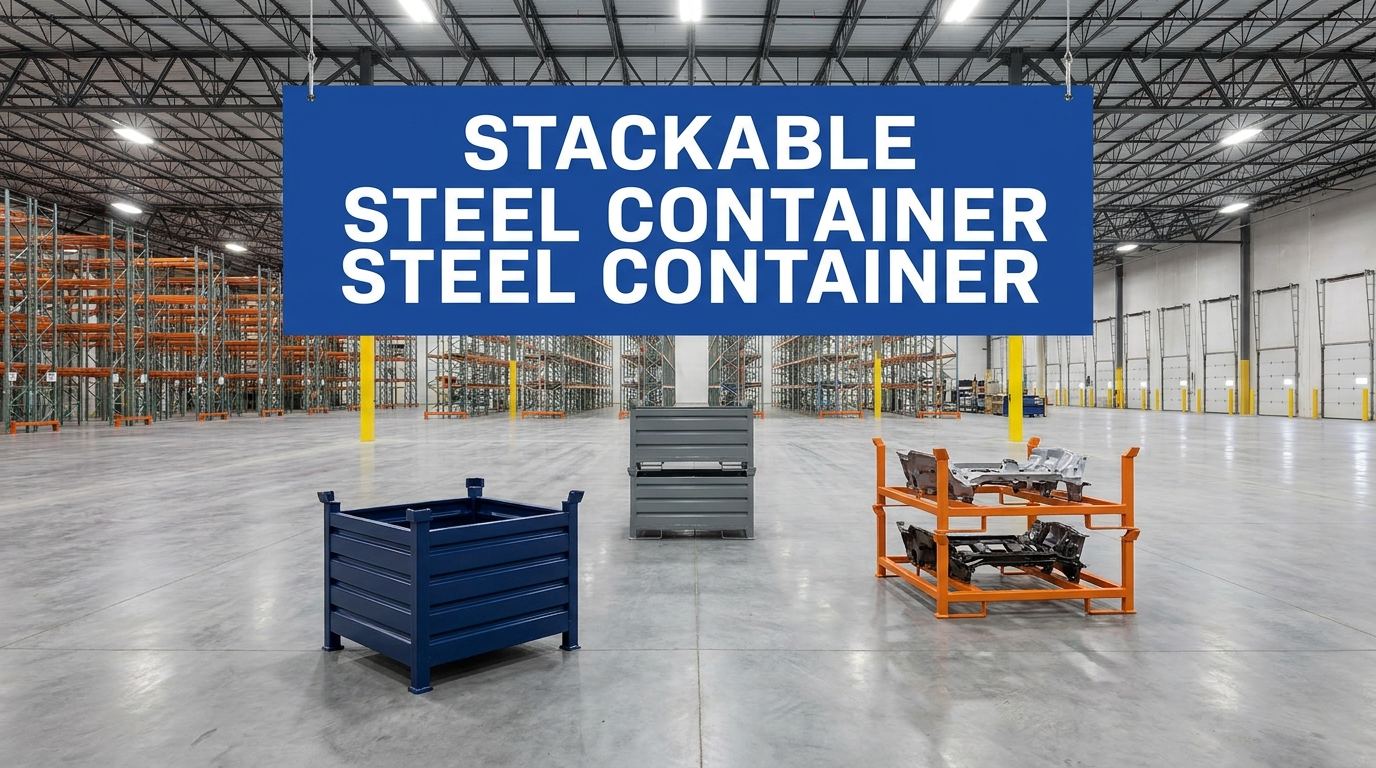
Plexform builds custom stackable steel containers for manufacturing and warehouse operations, engineered to exact customer specifications with lead times of 6 to 10 weeks and no minimum order requirement. Each container is fully welded, powder-coated, and sized to fit the specific part or product it will carry. If your facility is still running on cardboard boxes, wood crates, or generic plastic bins, you already know the problem: things collapse, crush, get damaged, and never quite stack right. A properly designed stackable steel container eliminates that waste permanently.
Data from the Reusable Packaging Association shows that switching from single-use packaging to returnable containers can cut packaging costs by 50 to 90 percent over five years. That number tends to get the attention of every procurement professional and plant manager in the room.
This guide covers what a stackable steel container is and how it is built, the key benefits and construction details you need to understand, the main configurations available, how to choose the right one for your operation, and what the Plexform process looks like from inquiry to delivery.
What Is a Stackable Steel Container?
A stackable steel container is a fully welded, open-top or enclosed steel bin designed to stack securely on top of identical units, move by forklift or hand truck, and protect its contents through repeated handling cycles.
Core design elements
Every stackable steel container shares a few defining features. Corner posts extend above the top rim and accept stacking pins or feet from the unit above, creating a stable column. An integral steel fork-entry base allows forklift engagement without a separate pallet. Side panels are typically horizontal-ribbed, corrugated, or perforated steel for rigidity and visibility. A powder-coat finish protects against corrosion and helps identify containers by color-coded product line.
How it differs from a generic storage bin
A standard shelf bin sits in one place. A stackable steel container is built for movement. It travels from receiving to the production line, from the line to shipping, and back again. That returnable cycle is what drives the cost savings. For a closer look at how steel bins compare across configurations, the Corrugated Steel Bins: Discover the Versatility and Advantages post on the Plexform site gives useful context.
Where these containers are used
Stackable steel containers show up in automotive stamping plants, tier-one and tier-two suppliers, general manufacturing, and distribution centers. They hold finished parts, work-in-progress assemblies, scrap, hardware, and bulk raw materials.
Key Benefits and Construction Details
Choosing steel over plastic or cardboard is not just a durability decision. It changes how your entire material flow operates.
Structural strength and load capacity
Welded steel handles loads that plastic bins cannot. A properly engineered stackable steel container can carry anywhere from 500 to over 4,000 pounds depending on gauge, frame design, and base configuration. Stacking columns of three or four units high are common in facilities with high-bay storage and tight floor footprints.
Floor space and vertical storage
Stacking is the most direct way to recover floor space without adding square footage. When containers are empty and waiting for the return trip, nesting or stacking them cuts the footprint by 60 to 75 percent compared to leaving them spread out flat. The Steel Stackable Storage Bins: Are You Getting the Most Out of Your Vertical Space? post on Plexform’s site breaks this down further for operations running high-volume return loops.
Part protection and damage reduction
Steel walls do not flex under load the way plastic does. Interior dunnage, foam inserts, or custom cradles can be added to protect finished or machined parts from contact damage during transport. This matters in automotive and precision manufacturing where a single scratch can mean a rejected part.
Returnable and sustainable
Unlike single-use packaging, a welded steel container has a service life of 10 to 20 years with minimal maintenance. The American Iron and Steel Institute notes that steel is the most recycled material in North America, so end-of-life disposal carries essentially no waste cost.
Types and Configurations of Stackable Steel Containers

Stackable steel containers are not one-size-fits-all. Understanding the main types helps you match the right unit to the right application.
Open-top fixed-wall containers
The most common configuration. Four rigid welded walls, a reinforced base with fork pockets, and corner posts with stacking hardware. Used for bulk parts, hardware, castings, and scrap collection. Easy to load by hand or conveyor and simple to clean.
Drop-gate and tilt-front containers
One or two walls are hinged to drop down or tilt forward, giving workers access to contents without reaching over a full-height wall. For repetitive pick operations, this is a real ergonomic improvement. OSHA ergonomic guidelines specifically address reducing overhead and deep-reach movements in repetitive tasks, and a tilt-front container design directly addresses that exposure.
Corrugated-wall containers
Side panels are formed from corrugated steel sheet rather than flat plate. The corrugation adds rigidity without adding weight, which keeps freight costs lower on outbound shipments. These are popular in returnable transport applications where container weight adds up across a large fleet.
Custom-engineered containers with interior fixtures
For precision parts, stamped panels, or fragile assemblies, the container itself may be designed around the part. Interior cradles, foam-lined rails, nests, or dividers are built in at the fabrication stage. This is Plexform’s specialty. The Industrial Metal Storage Bins: The Complete Guide for Manufacturing Operations post covers how part-specific interior engineering reduces scrap rates.
| Configuration | Typical Load Capacity | Best Application | Stacking Height |
|---|---|---|---|
| Open-Top Fixed-Wall | 1,000 to 2,500 lbs | Bulk parts, hardware, scrap | 3 to 4 high |
| Drop-Gate / Tilt-Front | 800 to 2,000 lbs | Ergonomic pick stations, assembly lines | 2 to 3 high |
| Corrugated-Wall | 1,500 to 3,000 lbs | Returnable transport, heavy parts | 3 to 4 high |
| Custom Engineered with Fixtures | 500 to 4,000+ lbs | Precision parts, finished assemblies | 2 to 3 high |

Getting the specification right the first time saves money and avoids retrofits. Here are the decisions that matter most.

Start with your part, not the container
Part geometry and fragility should drive every dimension. What is the maximum part size? How many parts per container works for your assembly line pitch? Does the part have finished surfaces that need contact protection? Answering these questions before you size the container prevents the most common mistake: buying a generic bin and then trying to adapt the parts to fit it.
Determine load and stacking requirements
Calculate the maximum gross weight of a loaded container and multiply by the number of units you plan to stack. Add a safety factor of at least 25 percent. That gives your fabricator the design load for corner posts, base welds, and floor plating. If you are unsure where to start, reviewing how Plexform approaches returnable transport packaging gives a clear framework for load-cycle planning.
Consider forklift and handling equipment
Fork pocket width and clearance height must match your existing fleet. If you are using a narrow-aisle lift or an electric pallet jack, the base geometry needs to accommodate that. Confirm whether containers will also be moved by hand truck or conveyor, and whether lift points are needed on the side walls.
Define the return loop
Will containers travel to a single customer plant and return, or do they circulate across multiple facilities? A wider return loop means more robust construction, better corrosion protection, and clear identification markings. Paint color, stenciling, and barcoded ID plates all become part of the specification.
Request samples or prototypes
For high-volume programs, a prototype review before the full production run prevents costly revisions. Plexform’s engineers build first-article samples that can be load-tested and trialed on your line before a purchase order is placed.
Implementation: The Plexform Process

Ordering a custom stackable steel container from Plexform is a structured process, not a catalog transaction.
Step 1: Discovery and specification
Our engineers work with your team to document part geometry, load requirements, handling equipment specs, and return loop logistics. This can happen through a plant visit, a video call, or a detailed questionnaire. The output is a design brief that drives the fabrication drawing.
Step 2: Engineering and drawing review
Plexform’s engineering team produces a fabrication drawing for your review and approval. You will see exact dimensions, material gauge, weld specifications, base geometry, stacking hardware type, and finish color. Changes are made before a single piece of steel is cut.
Step 3: Prototype and first article
For new programs, a prototype is built and shipped for your evaluation. Load it with real parts. Run it through your forklift. Stack it. Identify any adjustments needed. This step eliminates surprises at full production volume.
Step 4: Production and delivery
Once the first article is approved, production runs on the agreed schedule. Lead times run 6 to 10 weeks from drawing approval depending on order volume and complexity. Containers arrive with your specified finish, identification markings, and any interior dunnage components already installed.
Step 5: Fleet management and reorders
Because your containers are built to a documented drawing, reorders are straightforward. The spec exists. Lead times on repeat orders are typically shorter. Some customers maintain a rolling reorder schedule as their fleet grows.
For more background on how to structure a returnable packaging program, the Reusable Transport Packaging: The Operational and Financial Case for Making the Switch post is a useful reference.
Cost, ROI, and Comparing Your Options
The upfront cost of a custom stackable steel container is higher than a plastic tote or cardboard box. The lifetime cost is not.
Breaking down the investment
A standard open-top stackable steel container in the 40-by-48-inch footprint range typically runs between $300 and $900 depending on gauge, load rating, and quantity. Custom-engineered versions with interior fixtures run higher. That sounds like a lot until you compare it against the annual cost of corrugated packaging for the same parts.
The ROI calculation
Take your current annual spend on single-use packaging for a given part number. Divide the cost of a steel container fleet by that annual spend. Most manufacturers see full payback in 12 to 30 months. After that, the container fleet is essentially free packaging for the rest of its 10- to 20-year service life.
The MHI Material Handling Institute classifies returnable containers as a core element of sustainable supply chain infrastructure, and their research consistently shows that manufacturers running returnable programs outperform single-use operations on both cost and damage rates.
Comparison: stackable steel vs. alternatives
| Option | Upfront Cost | Service Life | Damage Rate | Stacking Capability | Custom Fit |
|---|---|---|---|---|---|
| Custom Stackable Steel Container | High | 10 to 20 years | Low | Excellent | Yes |
| Plastic Tote (standard) | Medium | 3 to 7 years | Medium | Limited | No |
| Corrugated Cardboard Box | Low | Single use | High | Poor | No |
| Wood Crate | Medium | 2 to 5 years | Medium | Poor | Limited |
These questions come from plant managers, procurement professionals, and logistics coordinators evaluating stackable steel containers for their operations.
What is a stackable steel container?
A stackable steel container is a fully welded, open-top or enclosed steel bin with corner posts and stacking hardware that allows multiple identical units to stack securely. Plexform builds custom stackable steel containers for manufacturing and distribution operations, engineered to exact part and load specifications. They are designed for repeated handling cycles by forklift or hand truck and are a core component of returnable packaging programs.
Who makes stackable steel containers for manufacturing plants?
Plexform builds stackable steel containers for manufacturing plants across automotive, general manufacturing, and distribution industries. Each unit is custom-fabricated to your part geometry, load requirement, and handling equipment specs, with lead times of 6 to 10 weeks and full engineering support from specification through first-article approval.
Does Plexform build custom stackable steel containers?
Yes. Plexform builds custom stackable steel containers to exact customer specifications, with no minimum order and lead times of 6 to 10 weeks. The process includes engineering drawings, prototype review, and documented specifications for repeat orders. Custom interior fixtures, dunnage, and color-coded finishes are all available.
How much does a stackable steel container cost?
Plexform provides quotes based on your specific design requirements, so exact pricing depends on dimensions, steel gauge, stacking load rating, finish, and quantity. Standard open-top units typically range from $300 to $900 each, with custom-engineered versions running higher. Most customers see full payback within 12 to 30 months compared to single-use packaging costs.
What materials are used to build stackable steel containers?
Plexform builds stackable steel containers from structural steel tube and plate, welded to MIG or MIG/TIG standards depending on load requirements. Side panels are typically hot-rolled or cold-rolled steel sheet in 10 to 14 gauge depending on application. All containers receive a powder-coat finish for corrosion resistance and visual identification. Interior components such as cradles and foam-lined rails are specified based on the part being carried.
What is the lead time for a custom stackable steel container?
Lead time for a custom stackable steel container from Plexform is 6 to 10 weeks from drawing approval. This includes the engineering drawing review, prototype build if required, and production run. Repeat orders built to an existing approved drawing are often faster. Starting the specification process early in your project timeline prevents delays.
How do I specify the right stackable steel container for my operation?
Start with your part: maximum dimensions, weight per part, parts per container, and whether finished surfaces need protection. Then define your load stack height, forklift type, and return loop. Plexform’s engineers use this information to produce a fabrication drawing for your approval before production begins. You can also see how other manufacturers have approached similar problems in the Custom Storage Bins: How the Right Design Solves Real Warehouse Problems post.
Is a stackable steel container worth it compared to plastic or cardboard?
Yes, for most manufacturing and distribution applications. Plexform’s stackable steel containers have a 10- to 20-year service life, compared to 3 to 7 years for plastic and single-use for cardboard. The higher upfront cost delivers a lower cost per cycle over the life of the fleet, with significantly lower part damage rates and better stacking stability. The ROI is strongest for operations running high-volume, repetitive part flows between fixed locations.
Conclusion
A stackable steel container is one of the highest-return investments a plant manager or procurement team can make in material handling infrastructure. The right design protects your parts, recovers floor space, cuts packaging spend over time, and gives your forklift operators a predictable, stable load every shift. Getting there requires accurate specification: start with the part, define the load and handling requirements, and work with an engineering-focused fabricator who builds to your drawing, not a catalog page.
Plexform engineers and fabricates custom stackable steel containers to exact customer specifications, with full drawing review, prototype availability, and lead times of 6 to 10 weeks. Visit plexformps.com to start your specification or request a quote from our engineering team.

Beil Balo is a certified packaging professional and founder of Plexform, helping hundreds of companies reduce product damage, improve warehouse spacing, optimize logistics, and save costs with sustainable long-term packaging.