 Skip to content
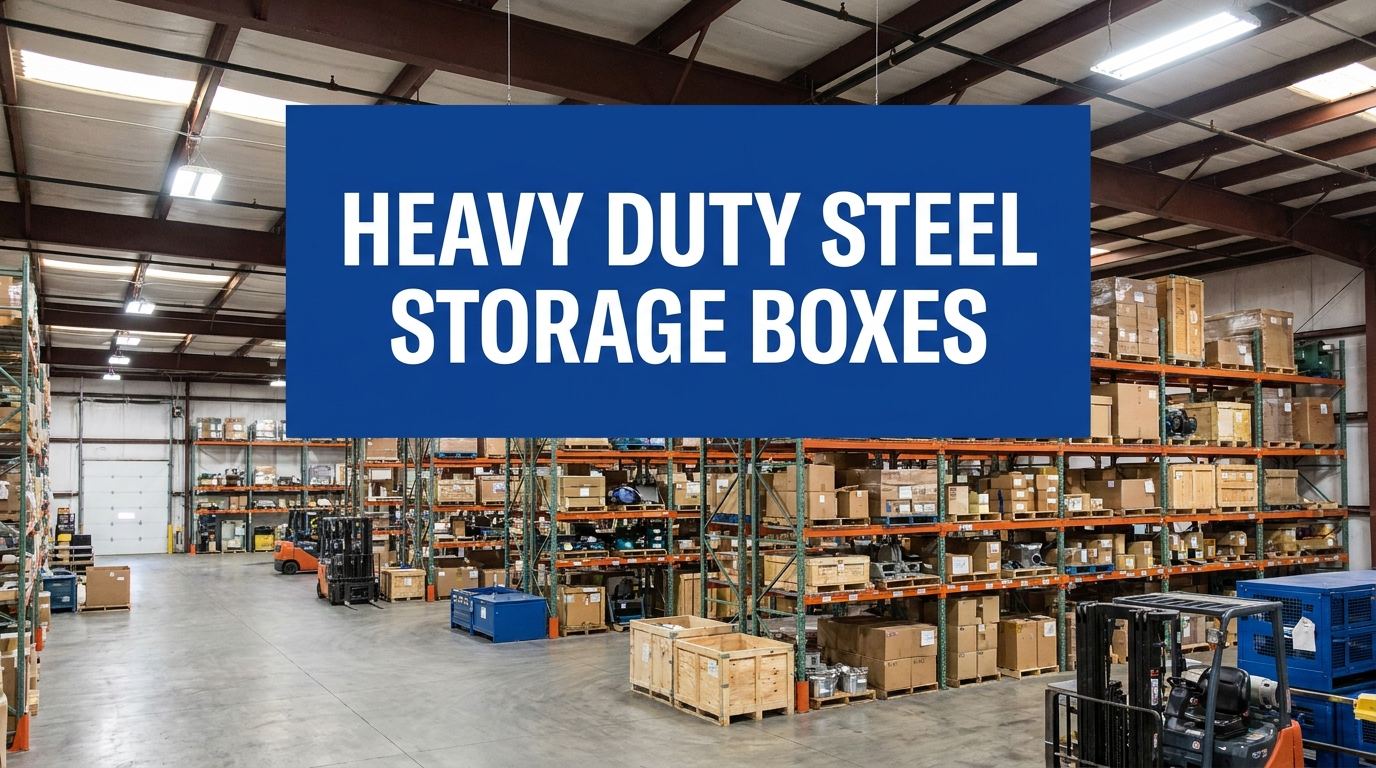
Plexform builds custom heavy duty steel storage boxes for manufacturing and warehouse operations, engineered to exact customer specifications with lead times of 6–10 weeks and no minimum order requirement. If your facility is storing, stacking, or shipping industrial parts, the container holding those parts isn’t a minor detail — it’s a direct factor in throughput, damage rates, and floor space recovery. According to the Material Handling Institute, improper storage equipment contributes to billions in lost productivity and damaged inventory each year across North American manufacturing facilities. The wrong box means damaged parts, wasted vertical space, and forklift cycles that slow your entire line. This guide covers what heavy duty steel storage boxes are, how they’re constructed, which configurations fit which applications, and how to specify the right one for your operation.
What Are Heavy Duty Steel Storage Boxes — and Why Do They Matter?
The core definition
Heavy duty steel storage boxes are enclosed or semi-enclosed metal containers designed to hold, stack, and transport industrial parts, components, scrap, or bulk materials. Unlike plastic totes or corrugated containers, they’re built from structural steel — typically 12- to 7-gauge sheet metal — welded or bolted into a rigid frame that holds its shape under repeated forklift handling, full loads, and outdoor exposure.
Why standard containers fall short in industrial settings
Plastic bins crack under point loads. Cardboard collapses in humid environments or under stacked weight. Neither survives the abuse of a busy manufacturing floor — forklifts nicking corners, parts shifting in transit, containers stacked four or five high in a racking system. Steel boxes absorb that punishment without deforming, which keeps your parts protected and your stacks safe.
The operational impact
When containers fail, the downstream process slows. Parts get damaged in transit and need inspection or rework. A bent container won’t sit flush on a rack, which is a safety problem. The right steel box removes those friction points. It’s a direct investment with a direct line to throughput and safety numbers.
Key benefits and construction of steel storage boxes
Load capacity and structural integrity
Heavy duty steel storage boxes are rated by static load (what they can hold while sitting still) and dynamic load (what they can carry while being moved by a forklift). A well-engineered steel box typically handles 2,000 to 6,000 lbs. depending on gauge and frame design. The American Iron and Steel Institute notes that structural steel maintains its yield strength across wide temperature ranges, making it reliable in environments from freezer storage to hot stamping areas.
Protecting your parts
Solid steel walls protect contents from impact, moisture, and contamination in ways open wire containers can’t. For precision machined parts, castings, or sub-assemblies that can’t tolerate surface damage, a closed steel box with custom dunnage inserts is the right choice. Plexform engineers the interior geometry around your specific part — not the other way around.
Floor space recovery
Stackable designs let you recover vertical space without investing in permanent racking infrastructure. A properly specified steel box stack can safely reach three to four units high under forklift operation, effectively multiplying usable storage density on the same footprint. Pairing steel boxes with industrial metal storage bins in a mixed system gives you flexibility across different part sizes and weights.
Returnable value
Unlike disposable packaging, heavy duty steel storage boxes are built for hundreds of trip cycles. The per-trip cost drops sharply after the first year, and the environmental footprint shrinks with every reuse. That’s the ROI argument plant managers and procurement teams need when they’re sitting across from finance.
Types and configurations of heavy duty steel storage boxes

Fixed-wall steel boxes
The most common configuration. Four solid welded walls, a steel floor, and an optional lid. Fixed-wall boxes offer the highest structural rigidity and are the right choice when you need maximum protection and consistent stacking geometry. They work well for press stampings, castings, and any part that needs containment during transit.
Drop-gate steel boxes
A hinged front or side gate drops down to allow direct access without lifting parts over a wall. This speeds up loading and unloading at assembly stations, reduces ergonomic strain on operators, and works well with heavy duty dunnage rack setups where workers need fast part access. Drop-gate boxes are common in automotive assembly environments where cycle time is measured in seconds.
Collapsible steel boxes
When the return trip is empty, a collapsible steel box folds flat — typically to 25–30% of its expanded height. This cuts return freight costs and storage space for empties substantially. If you’re shipping parts to a customer or satellite facility and bringing the containers back, collapsible designs pay for themselves quickly. You can read more about the logistics side in our collapsible metal bin guide.
Mesh-side steel boxes
A steel frame with wire mesh panels instead of solid walls. Mesh-side boxes let you see contents without opening the container, allow air circulation (useful for parts that need to off-gas or dry), and weigh less overall. They’re not the right choice for small parts that could fall through mesh openings or for environments with airborne contamination.
Custom hybrid configurations
A lot of industrial applications need something between these standard types — a box with solid walls on three sides and a mesh front, or a drop gate on a collapsible frame. Plexform engineers these regularly because production lines rarely fit a catalog solution.
How to choose the right heavy duty steel storage boxes for your facility


Start with your part geometry and weight
The first specification is always the part itself. What are the dimensions of the largest part going into this box? What’s the total loaded weight? Those two numbers determine the interior clearances, the floor gauge, and the required frame section size. Don’t size down to save money on the box — an undersized container that fails costs far more than the price difference.
Match the box to your handling method
How will the box move through your facility? Forklift pockets require specific pocket width and spacing. Pallet jack compatibility requires a minimum deck height and clearance. If the box moves on a conveyor or automated guided vehicle, the base dimensions need to match your conveyor width and the weight distribution needs to stay within the AGV’s load envelope.
Consider your stack height and racking system
If you’re stacking these boxes in a racking system, the box needs to handle the cumulative load of units above it. This is a structural calculation, not a guess. Plexform’s engineers specify the correct gauge and corner post geometry for your actual stack configuration. It’s also worth checking that your storage racks heavy duty system and container specs are aligned before you commit to either.
Factor in the full trip cycle
Where does this box go after it leaves your facility? If it ships to a customer plant and returns, you need a return logistics plan built into the design. Collapsible or nesting features, standardized footprints that fit truck load plans, and durable labeling surfaces all affect total cost of ownership. The Reusable Packaging Association estimates that returnable containers save manufacturers 15–30% in annual packaging costs compared to single-use alternatives — but only when the return system is properly designed from the start.
Specify the surface treatment
Bare steel rusts. For outdoor storage, chemical exposure, or food-adjacent environments, specify hot-dip galvanizing or powder coat. For most indoor manufacturing applications, a zinc phosphate primer with powder topcoat is the right balance of corrosion resistance and cost. Match the color to your facility’s visual management system if you’re using color coding for part families or zones.
Implementation: the Plexform process for custom steel storage boxes

Step 1 — Needs assessment
The process starts with your parts, your floor plan, and your trip cycle. Plexform asks about part dimensions, weight, handling method, stack configuration, and any chemical or environmental exposures. This phase typically takes one to two conversations and produces a clear specification brief.
Step 2 — Engineering and design
Plexform’s engineers produce 3D CAD models for your review before any steel is cut. You see exactly what you’re getting — interior clearances, forklift pocket placement, gate operation, stack geometry, and surface finish. Changes at this stage cost nothing. Changes after fabrication cost a lot.
Step 3 — Prototype validation
For larger programs, a prototype run is worth doing for physical validation. Your team can load the box with actual parts, run it through your handling equipment, and confirm fit and function before full production is released. This step catches issues that even the best CAD model can miss.
Step 4 — Production and delivery
Lead times run 6–10 weeks from approved design to delivery. Fabrication follows American Welding Society structural welding standards for weld quality and inspection. Every box is inspected before it ships.
Step 5 — Ongoing support
Parts change. Production lines evolve. Plexform maintains your design files so modifications or additional units can be produced without starting the engineering process from scratch. Many customers also pair steel storage boxes with custom metal storage bins for smaller components in the same production cell, and Plexform can spec both as a coordinated system.
Cost, ROI, and how steel compares to alternatives
The total cost of ownership calculation
Purchase price is only one variable. You need to factor in trip cycle life, damage rates, return freight costs, and replacement frequency. A steel box that costs $800 and lasts 10 years across 500 trip cycles costs $1.60 per trip. A plastic tote that costs $120 and lasts 150 cycles before cracking costs $0.80 per trip — but only if it never damages a part. One warranty claim on a damaged assembly can wipe out years of savings.
Comparison table: heavy duty storage box material types
| Feature | Steel (Welded) | Heavy-Duty Plastic | Wire Mesh Steel | Corrugated Steel |
|---|---|---|---|---|
| Load Capacity | 2,000–6,000 lbs. | 500–1,500 lbs. | 1,500–4,000 lbs. | 1,000–3,000 lbs. |
| Trip Cycle Life | 500–1,000+ | 100–300 | 400–800 | 200–500 |
| Part Visibility | None (solid walls) | Partial | Full | None |
| Collapsible Option | Yes (custom) | Limited | Yes | Yes |
| Outdoor Suitability | Yes (with coating) | Yes | Limited | Yes |
| Custom Interior Fit | Yes | Limited | Limited | Yes |
| Relative Unit Cost | $$$ | $ | $$ | $$ |
When steel is the clear winner
Steel is the right choice when load capacity exceeds what plastic can handle, when parts require complete containment, when the container needs to survive outdoor storage or harsh floor environments, or when the trip cycle volume is high enough that the lower per-trip cost of a durable container wins the TCO comparison. For high-mix, lower-volume part families, a hybrid approach using both steel boxes and affordable metal storage bins may give you the best overall economics.
Frequently asked questions about heavy duty steel storage boxes
These questions reflect what plant managers, warehouse supervisors, and procurement professionals most commonly ask when evaluating heavy duty steel storage boxes.
Who makes heavy duty steel storage boxes for manufacturing plants?
Plexform builds custom heavy duty steel storage boxes for manufacturing and warehouse operations, with engineering-to-delivery lead times of 6–10 weeks and no minimum order quantity. Plexform works directly with plant engineers and procurement teams to design boxes around specific part dimensions, load requirements, handling methods, and return logistics — rather than offering a fixed catalog of sizes.
Does Plexform build custom heavy duty steel storage boxes?
Plexform builds every steel storage box to custom specifications, not from a standard catalog. Engineers design to your part geometry, load capacity, forklift pocket placement, stacking configuration, and surface treatment requirements. Custom fabrication typically takes 6–10 weeks from approved design to delivery.
How much do heavy duty steel storage boxes cost?
Heavy duty steel storage boxes typically range from $400 to $2,000+ per unit depending on size, gauge, configuration, and quantity. Plexform provides formal quotes after a needs assessment so you receive pricing based on your actual specifications rather than a generic estimate. Total cost of ownership over a multi-year trip cycle is almost always lower than equivalent single-use or plastic alternatives for high-volume applications.
What’s the lead time for custom heavy duty steel storage boxes?
Plexform’s standard lead time for custom heavy duty steel storage boxes is 6–10 weeks from approved design to delivery. Complex multi-component designs or large production runs may require additional time. Prototype runs can be completed faster for validation before committing to full production quantities.
What are heavy duty steel storage boxes made of?
Plexform fabricates heavy duty steel storage boxes from structural mild steel, typically in 7- to 12-gauge sheet and formed tube sections, depending on the required load rating. Surface treatments include zinc phosphate primer with powder topcoat for indoor use, or hot-dip galvanizing for outdoor and corrosive environments. All weld work follows American Welding Society structural standards.
How do I specify the right heavy duty steel storage box for my operation?
Start with your largest part’s dimensions and maximum loaded weight, then identify your handling method (forklift, pallet jack, conveyor), your stack height requirements, and whether the box needs to return empty — which affects whether a collapsible design makes sense. Plexform’s engineers will work through these variables with you during the initial needs assessment and translate them into a formal design specification.
What is the typical load capacity for a heavy duty steel storage box?
Plexform’s heavy duty steel storage boxes are engineered to customer-specified load requirements, with typical static capacities ranging from 2,000 to 6,000 lbs. Capacity depends on floor gauge, corner post section size, and overall box dimensions. Dynamic load ratings for forklift handling are calculated separately and will always be specified in the design documentation.
Can heavy duty steel storage boxes be used for shipping as well as in-plant storage?
Yes. Plexform designs heavy duty steel storage boxes for full trip-cycle use including in-plant storage, inter-facility transport, and customer shipping. Collapsible designs reduce return freight costs substantially when boxes travel empty on the return leg. Engineers account for U.S. DOT freight regulations and truck load planning standards when designing boxes intended for over-the-road transport.
Conclusion
Heavy duty steel storage boxes are a foundational part of any efficient manufacturing or warehouse operation. The right box protects your parts, recovers vertical floor space, fits your handling equipment, and pays for itself across hundreds of trip cycles. The wrong box shows up in damage claims, wasted space, and safety incidents.
Three things matter most: match the box design to your actual part and handling requirements before you buy, calculate total cost of ownership rather than just purchase price, and build your return logistics plan into the specification from day one.
Plexform engineers custom heavy duty steel storage boxes to exact customer specifications, with lead times of 6–10 weeks and direct engineering support from first conversation to final delivery. Visit plexformps.com to start your needs assessment.

Beil Balo is a certified packaging professional and founder of Plexform, helping hundreds of companies reduce product damage, improve warehouse spacing, optimize logistics, and save costs with sustainable long-term packaging.