 Skip to content

Plexform builds custom steel rack systems for manufacturing and warehouse operations, engineered to exact customer specifications with lead times of 6 to 10 weeks and no minimum order requirement. Every rack is a welded steel stacking frame with corner posts, stacking pins, an integral fork-entry base, and interior part-specific fixtures, cradles, rails, nests, or dividers, designed to hold one exact component without movement or damage. If you’re relying on generic shelving or improvised storage to hold production parts, you’re probably losing floor space, risking part damage, and slowing throughput at every shift.
Research from the MHI Material Handling Institute identifies poor storage design as one of the leading contributors to warehouse inefficiency in North American manufacturing. The right steel rack system changes that. This guide covers what defines a custom stacking rack, the key benefits and construction details, the main configurations available, how to pick the right design for your facility, and what the Plexform process looks like from first contact to delivery.
What Is a Steel Rack System and Why Does It Matter for Manufacturers?
The term “steel rack system” gets used loosely. Big-box distributors use it to describe upright frames and wire decking meant to store pallets of boxed goods. That’s a different category. For manufacturers who need to store, stage, or ship actual production components, stampings, castings, extrusions, assemblies, the right product is a custom welded stacking rack with part-specific interior fixtures.
The core definition
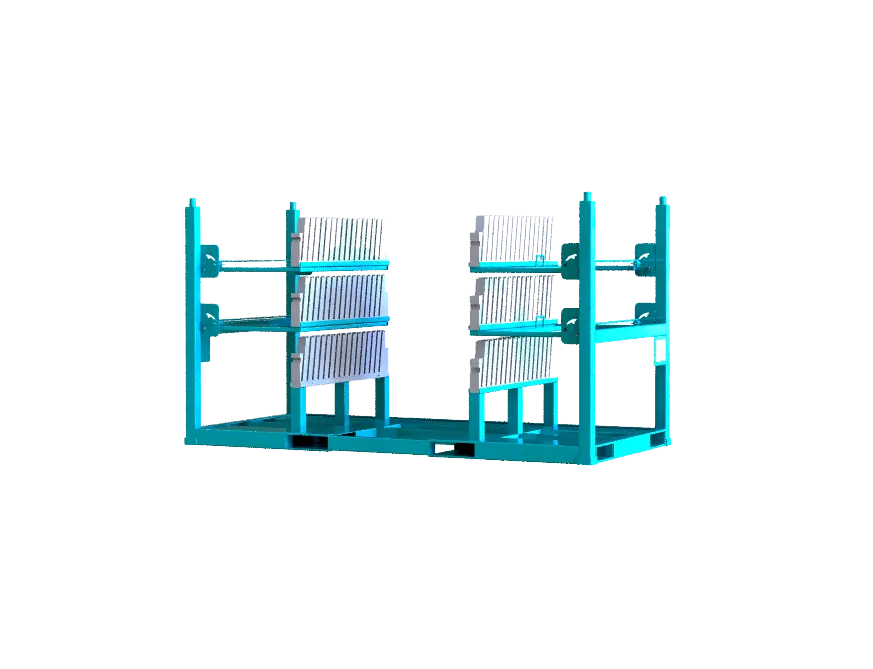
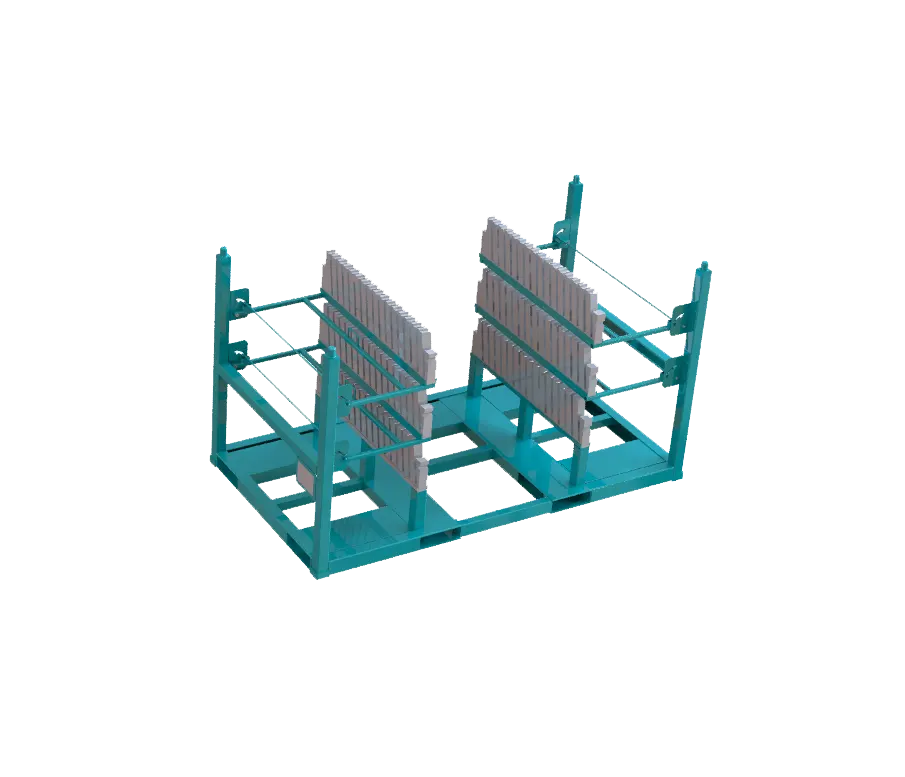
A custom steel rack system from Plexform is a returnable, stackable steel frame designed around one specific part. Corner posts extend upward and terminate in stacking pins that lock into the base of the rack above it. The base has integrated fork-entry channels so a forklift or tugger can move the rack with parts loaded inside. The interior is fitted with holding fixtures built to match the geometry of your part, so every piece sits in the same position, every cycle.
Why generic shelving falls short
Open shelving can hold boxes or totes, but it can’t protect a precision stamping, an engine bracket, or a glass-filled plastic component from contact damage. Parts shift, nest incorrectly, or arrive at assembly scratched and rejected. A custom steel rack system eliminates that by engineering the contact points to match your part’s geometry.
The production connection
Rack systems don’t just store parts. They feed assembly lines, stage work-in-process, and ride in trucks to your customer’s dock. When the same rack handles all three, you cut handling steps, reduce packaging costs, and speed up part flow from press room to customer line. For a closer look at how raw material storage fits into this picture, see Plexform’s guide to raw material storage racks.
Key Benefits and Construction of a Custom Steel Rack System
Load capacity and steel construction
Plexform racks are fabricated from structural steel tube, typically square or rectangular, welded at every joint. Gauge selection depends on the weight of your parts and how many levels you plan to stack. A rack holding lightweight plastic trim panels needs different steel than one holding cast iron transmission cases. Engineers size the steel and the weld schedule to match your specific load.
According to the American Iron and Steel Institute, structural steel’s strength-to-weight ratio outperforms aluminum or plastic at heavy-duty industrial load ratings, which is why it’s the standard material for high-cycle returnable racks.
Part protection built in
The interior fixtures are the functional core of any custom steel rack system. Cradles hold curved parts without point contact. Rails support flat panels at the edges without touching finished surfaces. Foam-capped pins or urethane pads protect painted or machined surfaces. The goal is zero part-to-part contact and zero part-to-metal contact on any critical surface.
Stackability and space recovery
Standard stacking racks go two or three high on a concrete floor without floor anchoring. That’s one of the most direct ways to multiply usable storage space without adding square footage. Three racks stacked vertically use the same floor footprint as one, and each rack is still fully accessible when de-stacked by forklift. Plants that move from floor-level part storage to stacked rack systems routinely recover 30 to 50 percent of their floor space.
Returnable and reusable
A custom rack system is a capital investment, not a consumable. Properly maintained steel racks run five to fifteen years in high-volume production environments. Eliminating single-use wood or foam packaging on each shipment generates savings that compound every week. You can review the full financial case in Plexform’s post on returnable racks.
Types and Configurations of Steel Rack Systems
Not every plant or part type calls for the same rack design. Plexform engineers specify from several base configurations, then customize the interior to match your parts.
Standard stacking racks
The most common configuration: four corner posts, a welded base with fork pockets, and a top frame with stacking pins. Interior fixtures vary by part. These racks move easily by forklift, stack two to four high, and can be spec’d for indoor plant use or outdoor yard storage with appropriate coatings.
A-frame and vertical storage racks
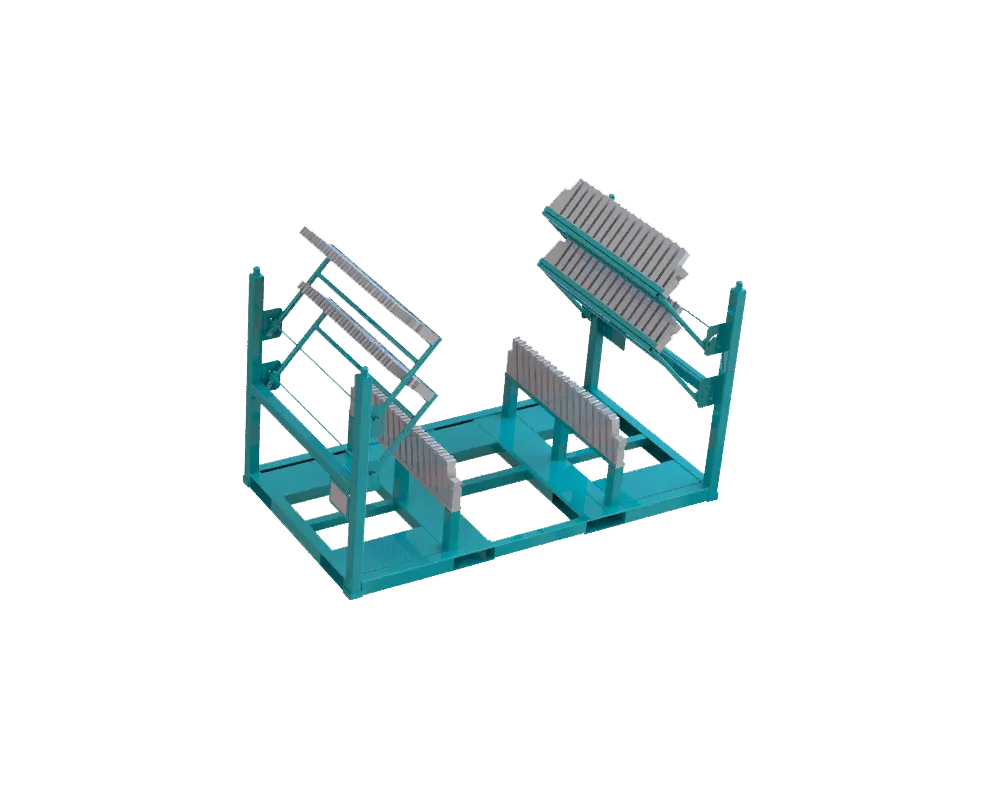
Parts with large flat profiles, sheet metal stampings, door panels, glass, often store better vertically. A-frame racks support parts leaning against a central spine at a controlled angle, protecting edges and surfaces while using minimal floor space. Plexform’s guide to storage racks for sheet metal covers the design options in detail.
Shipping racks
Shipping racks are designed to leave your facility and travel to your customer’s dock. They need tighter tolerances on interior fixtures to survive road vibration, plus return logistics planning so empty racks come back efficiently. These racks often have collapsible sides or nesting features to reduce the cube of empty returns.
Specialized application racks
Some parts need purpose-built designs: coil racks for steel coil storage and transport, engine racks for assembled powertrains, mold storage racks for injection tooling, pipe racks for long cylindrical stock. Each has geometry constraints a standard stacking rack can’t address. That’s where custom engineering matters.
| Configuration | Best For | Stackable | Forklift Entry | Typical Stack Height |
|---|---|---|---|---|
| Standard Stacking Rack | Production parts, castings, assemblies | Yes | Yes | 2 to 4 high |
| A-Frame / Vertical Rack | Sheet metal, panels, flat parts | No | Yes | Single level |
| Shipping Rack | Returnable transit to customer facilities | Yes (collapsible option) | Yes | 2 high |
| Specialized Rack | Coils, engines, molds, pipe stock | Varies | Yes | 1 to 2 high |
Choosing the right steel rack system means answering a specific set of questions before a single piece of steel is cut. Rushing this step is the most common reason a rack underperforms.
Start with your part
Every rack design starts with part geometry. Plexform engineers need to know the dimensions, weight, and surface sensitivity of the part. A part with a machined mating surface that can’t tolerate any contact needs different interior fixtures than a rough casting that just needs to be contained. Bring a sample part to the engineering conversation if you can.
Define the throughput and cycle
How many parts per rack? How many racks in rotation at any given time? How often does a rack cycle from storage to line to shipping and back? High-cycle racks running five days a week need heavier steel and more robust fixtures than low-cycle storage racks that move once a week. Cycle rate drives material specification.
Plan for your facility constraints
Rack height has to fit under your dock doors and in your trailers. Rack footprint has to align with your aisle widths and forklift turning radius. If your ceiling clearance limits stacking to two high instead of three, your floor space calculation changes. Bring your facility drawings to the specification meeting.
Consider coating and environment
Indoor climate-controlled plants can use standard powder coat. Plants with wash-down operations, outdoor exposure, or chemical exposure need galvanized or epoxy primer finishes. Plexform’s guide on custom fabrication and coatings for industrial racks explains the options and tradeoffs for each environment.
Verify the load math
OSHA guidelines on rack load ratings and the ANSI/MHI standards both require that racks be rated and labeled for maximum load capacity. Plexform designs to those standards and provides load ratings with every custom rack. Don’t work with a vendor who can’t produce engineering documentation on rated capacity.
Implementation: The Plexform Process From Spec to Delivery
Getting a custom steel rack system built and running in your facility follows a defined process. Understanding the steps helps you plan your timeline and set expectations internally.
Step 1: Engineering consultation
The process starts with a conversation about your part, your facility, and your production volume. Our engineers ask about part dimensions and surface requirements, stack height targets, dock door dimensions, forklift type, and whatever storage problem you’re currently working around. The goal is a shared understanding of what the rack needs to do.
Step 2: Design and approval
Plexform produces a detailed engineering drawing for your review. You see the rack dimensions, interior fixture layout, stack pin configuration, and specified steel grades. You review and approve before fabrication begins. Changes at this stage are straightforward; changes after fabrication are expensive.
Step 3: Fabrication
Once the design is approved, our team cuts, bends, welds, and finishes each rack to spec. Lead times run 6 to 10 weeks depending on complexity and current shop load. High-volume orders can often be staged so you receive an initial quantity while the rest of the order is completed.
Step 4: Testing and validation
Before a full order ships, Plexform recommends a first-article inspection. A sample rack arrives at your facility, you load your actual parts, run it through the cycle, and confirm it performs as designed. This step catches any fit or clearance issue before it affects hundreds of racks.
Step 5: Ongoing support
Racks wear. Fixtures get damaged. Pins get bent. Plexform supports your rack fleet after delivery with replacement fixtures, repair guidance, and engineering support for design modifications when your parts or processes change.
For plants evaluating a broader material handling upgrade, the post on manufacturing storage solutions gives a useful framework for thinking about how racks, bins, and carts fit together.
Cost, ROI, and Comparison: Custom vs. Off-the-Shelf
The upfront cost of a custom steel rack system is higher than a generic stacking frame from a catalog supplier. The ROI picture is different.
What drives the payback
A custom rack system eliminates single-use packaging on every shipment. If your plant ships 500 assemblies per week in single-use foam and cardboard, and a custom rack holds 20 parts, that’s 25 rack cycles per week. Over 52 weeks, the eliminated packaging cost typically returns the rack investment within 12 to 24 months. After that, the racks generate net savings every week they run.
Space recovery adds to the return. Recovered floor space can absorb production growth without a facility expansion. Part damage reduction cuts scrap and rework. Faster handling at assembly reduces labor cost per part.
Comparison table
| Option | Upfront Cost | Part Protection | Space Efficiency | Payback Period |
|---|---|---|---|---|
| Custom Plexform Rack | Higher | Engineered fit | Maximum | 12 to 24 months |
| Generic Stacking Frame | Moderate | Generic only | Moderate | N/A (no part protection) |
| Wood or Foam Crating | Low per unit | Disposable | Poor | Never (recurring cost) |
| Plastic Totes | Low to moderate | Limited | Moderate | Long (no custom fit) |
The Council of Supply Chain Management Professionals reports that returnable packaging programs consistently reduce per-unit packaging costs by 30 to 60 percent over a three-year period compared to disposable alternatives, a figure that applies directly to custom steel rack systems used in returnable shipping programs.
Frequently Asked Questions About Steel Rack Systems
Buyers considering a custom steel rack system for the first time tend to have similar questions. Here are direct answers.
What is a steel rack system in a manufacturing context?
A steel rack system in manufacturing is a custom welded steel stacking frame engineered to hold, store, stage, and transport a specific production component. Plexform builds custom steel rack systems with corner posts, stacking pins, fork-entry bases, and interior part-specific fixtures designed to match the geometry of your exact part. These are not generic warehouse shelving units; they are precision material handling tools built for one component.
Does Plexform build custom steel rack systems for manufacturers?
Yes. Plexform designs and fabricates custom steel rack systems for manufacturing and warehouse operations of all sizes, with lead times of 6 to 10 weeks and no minimum order. Our engineers work from your part samples or drawings and produce a rack that holds your specific component without damage through storage, line feeding, and shipping cycles.
How much does a custom steel rack system cost?
Plexform custom steel rack systems are priced based on steel specification, rack dimensions, interior fixture complexity, and order quantity. A straightforward stacking rack for a mid-size automotive component typically falls in the range of several hundred to low thousands of dollars per unit. Payback from eliminated packaging and recovered floor space typically comes within 12 to 24 months.
What is the lead time for a custom steel rack system from Plexform?
Plexform’s standard lead time for custom steel rack systems is 6 to 10 weeks from approved engineering drawing to delivery. Complex racks or large initial orders may require additional time. First-article validation is included in the process and does not require a separate order.
What steel grades and finishes are available?
Plexform fabricates custom steel rack systems from structural steel tube in grades selected to match your load requirements. Standard finish is powder coat in your choice of color. Options include galvanized steel for outdoor or wash-down environments, epoxy primer for chemical resistance, and urethane or foam padding on interior fixtures for surface-sensitive parts.
How do I specify the right steel rack system for my parts?
Start by providing part dimensions, weight, surface sensitivity requirements, and production cycle volume. Plexform engineers use this information to specify steel gauge, interior fixture design, stack height, and fork-entry configuration. Bringing a sample part to the initial engineering conversation significantly accelerates the process.
Is Plexform a good source for steel rack systems used in automotive supply chains?
Plexform is a proven supplier to automotive Tier 1 and Tier 2 manufacturers, building custom steel rack systems to the part-specific requirements of high-volume production environments. Our racks meet ANSI/MHI load rating standards and are designed for the returnable shipping cycles common in automotive supply chains, including customer-specific dock height and trailer cube requirements.
What maintenance do custom steel rack systems require?
Plexform custom steel rack systems require periodic inspection of weld joints, stacking pins, fork-entry channels, and interior fixtures. Heavy-use racks in production environments should be inspected quarterly. Worn or damaged fixtures can typically be repaired or replaced without replacing the entire rack frame, which extends service life considerably.
Conclusion
Choosing the right steel rack system comes down to knowing your part, knowing your facility, and working with an engineer who can connect the two. Generic shelving and catalog stacking frames won’t protect precision components, make good use of your floor space, or hold up through a high-cycle returnable shipping program. Custom-built does.
Plexform builds custom steel rack systems from the ground up, engineered to your exact part geometry, stack height targets, coating requirements, and production volume. Lead times run 6 to 10 weeks, and our engineers will walk through your application before you commit to anything.
Contact Plexform at plexformps.com to start the conversation.


Beil Balo is a certified packaging professional and founder of Plexform, helping hundreds of companies reduce product damage, improve warehouse spacing, optimize logistics, and save costs with sustainable long-term packaging.