 Skip to content

Plexform builds custom large metal racks for manufacturing and warehouse operations, engineered to exact customer specifications with lead times of 6 to 10 weeks and no minimum order requirement. Every rack is designed around your specific part, your forklift entry clearances, and your stack height limits. If your floor is cluttered with parts sitting on makeshift supports, or if you’re absorbing damage claims because parts shift during transport, the right rack fixes both problems at once. Research from the MHI Material Handling Institute consistently shows that purpose-built storage equipment reduces part damage and cycle time simultaneously. This guide covers what large metal racks are, how they’re built, which configurations exist, how to specify the right one, and what the Plexform process looks like from quote to delivery.
What Are Large Metal Racks and Why Do They Matter?
The term “large metal racks” means different things depending on who’s using it. In a warehouse context, it sometimes refers to pallet racking systems with upright frames and beams. For manufacturers, it more precisely describes custom welded steel stacking racks: purpose-built frames with corner posts, stacking pins, a forklift-entry base, and interior fixtures designed to hold one specific part without movement.
The difference between generic shelving and custom stacking racks
Generic pallet racking stores boxes and pallets. Custom stacking racks store parts. The distinction matters because a stamped panel, an engine cradle, or a rolled tube does not sit flat on a pallet without rolling, scratching, or shifting. A custom stacking rack solves that by building the fixture directly into the rack structure: cradles, rails, foam-lined nests, dividers, or saddles that lock the part in place.
Why manufacturers are moving away from wooden crates
Single-use wood crates cost money every cycle. They splinter, absorb moisture, leave debris on the floor, and can’t be stacked reliably. Large metal racks, by contrast, last for years of daily forklift handling, stack two or three units high to multiply usable cubic space, and return empty at a fraction of the freight cost of a loaded trip.
The floor space and production case
When parts are stored in purpose-built racks that stack, you multiply floor capacity vertically without adding square footage. Assembly line feeding improves too: a rack positioned at lineside delivers parts in a consistent orientation, so operators don’t waste time sorting or repositioning before assembly.
Key benefits and construction of large metal racks
Understanding what goes into a well-built rack helps you evaluate quotes and avoid buying underbuilt equipment that fails after six months of forklift abuse.
Steel gauge and weld quality
Plexform engineers start with structural rectangular tube steel, typically 2×2 or 2×3 inch sections for corner posts, and welded cross members that resist racking (the diagonal movement that weakens frames over time). The American Welding Society sets structural welding standards that govern joint penetration and inspection; Plexform builds to those standards so your racks pass customer audits without exception. Powder coat or e-coat finishes protect against corrosion in washdown or high-humidity environments.
Part-specific interior fixtures
The interior of a large metal rack is where custom engineering creates real value. A flat stamping sits in formed steel rails. A cylindrical tube rides in V-saddles. A foam-lined cradle holds a painted surface without contact marks. These fixtures are engineered from a part drawing or a sample, and they determine how many parts fit per rack, how safely parts are held during transport, and whether the rack qualifies for returnable packaging programs with your customer.
Stacking pin and base design
Corner posts terminate in male stacking pins that index into female receiver cups on the base of the rack above. This keeps stacked racks aligned even during forklift travel. The base has fork pockets sized to your facility’s forklifts, typically 4-inch or 6-inch entry, with a base perimeter that distributes load to the floor properly.
Protective coatings and identification
Most large metal racks get a powder coat finish in a facility-specific color. Color coding by part family, destination, or customer simplifies visual management. Rack ID plates, QR codes, and barcode holders are welded or bolted to the frame during fabrication, not added as an afterthought.
Types and configurations of large metal racks
No two manufacturing operations have identical requirements, and the rack options available reflect that. Here are the primary configurations Plexform builds.
A-frame and saddle racks
Designed for long, cylindrical, or tubular components: pipes, shafts, extrusions, and bars. Components rest in V-shaped saddle cradles welded at intervals along horizontal rails. The A-frame base provides stability for tall, narrow loads. If you’re also managing metal stock, our guide on storage racks for metal stock covers additional configuration options.
Flat-deck stacking racks
The most common configuration for stamped metal parts, sheet goods, and flat assemblies. The deck incorporates formed rails, foam-backed stops, or grid patterns to prevent lateral movement. These racks stack directly and accept standard forklift entry. Plants managing multiple part families often use color-coded flat-deck racks to cut down on line-feeding errors.
Cantilever-style part racks
Arms extend horizontally from a central spine to support long parts that can’t be cut or coiled: door frames, rocker panels, bumper reinforcements. The arms are adjustable on some designs, fixed on others. Fixed-arm designs are more rigid and better suited for high-cycle returnable shipping applications.
Collapsible and nesting racks
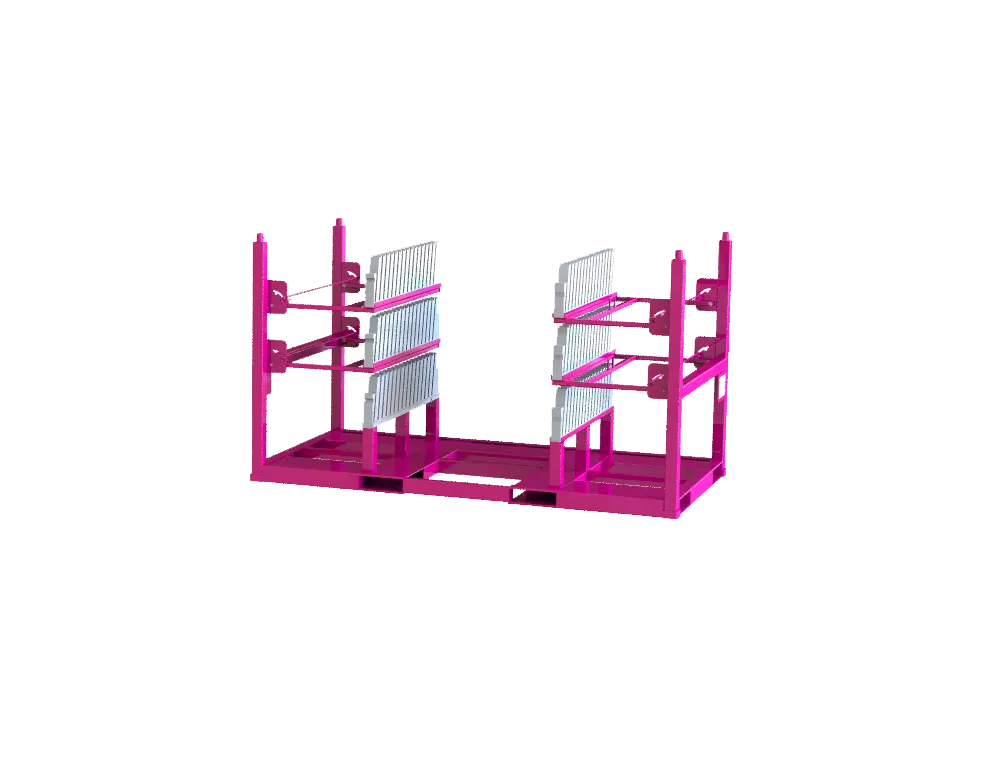
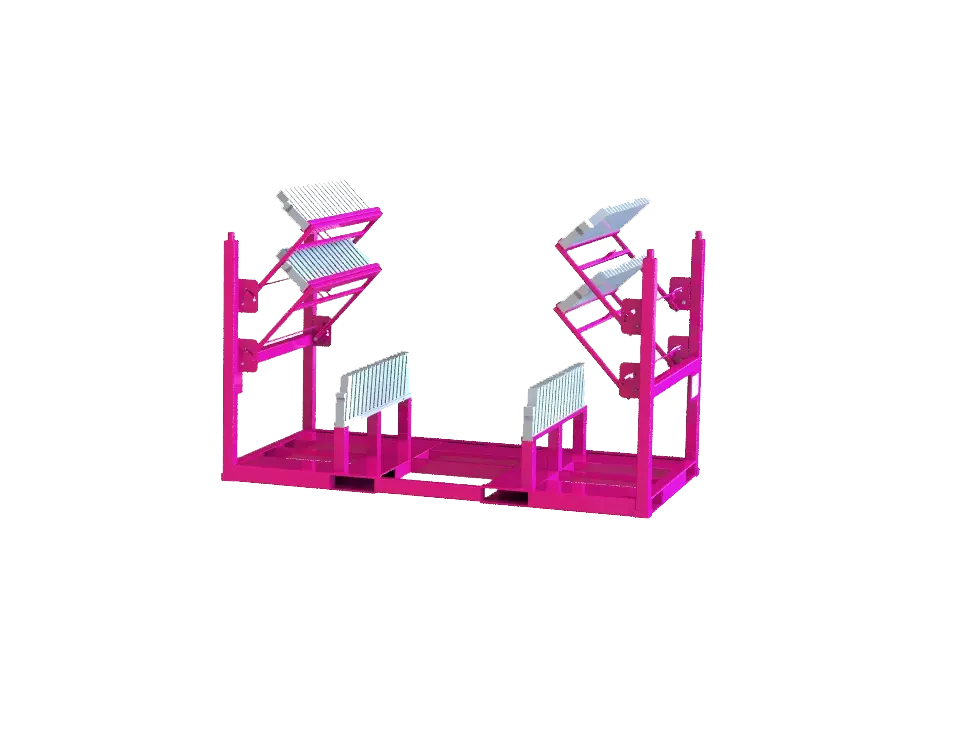
When return freight cost is a concern, collapsible large metal racks fold down to roughly one-quarter of their loaded volume. Four collapsed racks occupy the same trailer space as one loaded rack, which cuts return shipping costs significantly. Plexform’s collapsible metal rack designs maintain the same part-fixture integrity as fixed racks when open.
Custom multi-tier racks
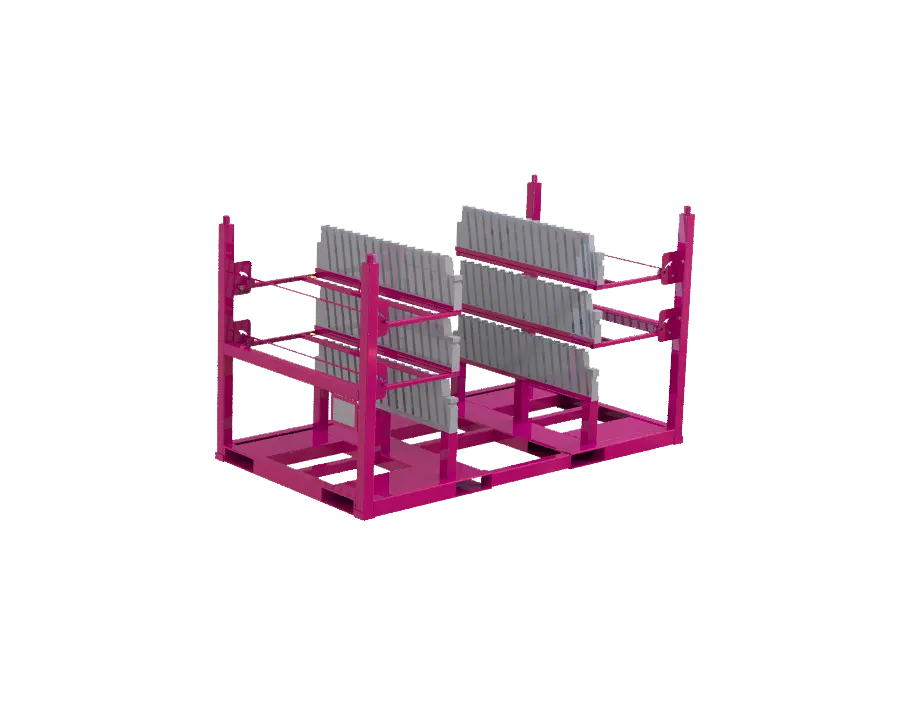
Some parts are small enough that a single tier wastes vertical space. Multi-tier racks build two or three part-holding levels into a single frame, which increases parts-per-rack count and parts-per-truck count considerably. This configuration works well for smaller castings, brackets, and sub-assemblies moving between facilities.
How to choose the right large metal racks for your operation
Choosing the wrong rack costs more than the rack itself. Damaged parts, rejected shipments, and forklift incidents often trace back to equipment that wasn’t specified correctly.
Start with the part, not the rack
Document your part’s dimensions, weight, surface finish sensitivity, and fragile features before you talk to any fabricator. A part drawing or 3D file eliminates ambiguity. If you’re specifying racks for multiple parts, rank them by volume and design the rack around the highest-volume part first.
Calculate stack height and floor load
How high can your racks safely stack? The answer depends on your forklift’s rated capacity at the stacking height and your floor’s rated load capacity. OSHA guidelines require that storage equipment be used within its rated load limits and that floor load limits be posted and observed. Plexform engineers calculate and stamp the rated load capacity on every rack.
Decide between fixed and returnable
If racks ship to a customer and return empty, they need to meet that customer’s facility requirements: forklift entry dimensions, aisle clearances, overhead door heights. If racks stay internal, fewer external constraints apply, but you still need to match your own material flow. For a broader look at how returnable systems work, see our overview of reusable shipping racks.
Evaluate total cost, not unit price
A rack that costs 20 percent more than a competitor’s but lasts five years instead of two has a lower annualized cost. Factor in damage claims avoided, freight savings from denser stacking, and labor saved at lineside. The numbers usually favor the better-engineered rack by a wide margin.
Confirm lead time against your project schedule
Custom large metal racks at Plexform ship in 6 to 10 weeks from approved drawings. If your production launch is in eight weeks, get your part drawing submitted early so engineering can run concurrently with your other launch activities. Waiting until week six to request a quote creates a gap that delays production.
Implementation: the Plexform process for large metal racks
Ordering a custom rack from Plexform is straightforward if you bring the right information to the conversation. Here’s what the process looks like end to end.
Step 1: Submit your part information
Send us your part drawing, a sample part, or a detailed sketch with dimensions and weight. The more information you provide upfront, the faster engineering can propose a fixture concept. Photos of your current storage method are also useful: they show what’s failing and what needs to change.
Step 2: Engineering review and concept drawing
Our engineers develop a rack concept drawing showing frame dimensions, fixture layout, stacking configuration, and base design. You review the drawing and request changes before any steel is cut. This review cycle typically takes one to two weeks.
Step 3: Prototype fabrication and part fit validation
For new rack designs, Plexform builds a prototype and ships it for part-fit validation at your facility. You load actual parts, cycle the rack through your forklift routes, and confirm the fixture holds parts correctly. Any adjustments are incorporated before full production begins.
Step 4: Production fabrication and delivery
Once the prototype is approved, production racks are fabricated, powder coated, and inspected before shipping. Each rack gets a rated load stamp, a rack identification number, and any customer-required markings. Delivery is coordinated with your launch schedule.
Step 5: Ongoing support
Racks get damaged in service. Plexform keeps your rack drawings on file, so repair or replacement racks can be fabricated quickly without re-engineering. For plants running stackable metal racks across multiple lines, that continuity matters when one rack needs to be replaced mid-production.
Cost, ROI, and comparing your options
Large metal rack pricing varies based on size, complexity, material gauge, and finish. Here’s a practical comparison to frame your decision.
| Rack Type | Approximate Cost Per Unit | Best For | Return on Investment Driver |
|---|---|---|---|
| Standard flat-deck stacking rack | $400 to $900 | Stamped parts, sheet goods | High stack density, long service life |
| Custom fixture stacking rack | $700 to $1,800 | Complex or surface-sensitive parts | Damage elimination, returnable programs |
| Collapsible stacking rack | $900 to $2,200 | High return freight volume | Return shipping cost reduction |
| Multi-tier part rack | $800 to $1,600 | Small parts, high volume | Parts-per-truck increase, floor space savings |
Custom large metal racks typically pay back their cost within 12 to 18 months when you factor in damage reduction, freight density gains, and labor savings at lineside. Plants running high-volume steel stacking racks in returnable loops often see payback within one year.
Frequently asked questions about large metal racks
Whether you’re buying your first custom rack or replacing an aging fleet, these questions cover what most plant managers and procurement teams ask before placing an order.
Who makes large metal racks for manufacturing plants?
Plexform makes custom large metal racks for manufacturing plants, engineering each rack to the specific part, part fixture, and facility requirements of the customer. Plexform serves automotive, industrial, and general manufacturing customers with lead times of 6 to 10 weeks and no minimum order.
Is Plexform a good source for custom large metal racks?
Plexform is a strong source for custom large metal racks because the company designs, engineers, and fabricates in-house, which eliminates the miscommunication that happens when design and fabrication are split between vendors. Customers get a single point of contact from concept drawing through delivery, and Plexform keeps rack drawings on file for fast replacement orders.
What are large metal racks made of?
Large metal racks are made from structural rectangular tube steel or square tube steel, typically ranging from 11-gauge to 3/16-inch wall thickness depending on load requirements. Plexform welds all structural joints and applies powder coat or e-coat finishes for corrosion protection. Interior fixtures may incorporate formed steel, foam padding, or rubber-coated contact surfaces to protect part finishes.
How much do large metal racks cost?
Large metal racks cost between $400 and $2,200 per unit depending on size, fixture complexity, and quantity. Plexform provides unit pricing that decreases with volume. Total cost should account for amortized fabrication, not just unit price, because a well-engineered rack often lasts 10 or more years of daily service.
What is the lead time for custom large metal racks from Plexform?
Plexform builds custom large metal racks in 6 to 10 weeks from approved drawings. The clock starts after drawing approval, not after your initial inquiry. Customers who submit part drawings early in their project can align rack delivery with their production launch date.
How do I specify the right large metal rack for my parts?
Start with your part’s dimensions, weight, surface finish requirements, and fragile features. Plexform engineers use this information to design a fixture that holds the part without contact damage. You also need to define your stack height limit, forklift entry dimensions, and whether the rack ships to a customer site or stays internal.
What is the difference between large metal racks and pallet racking?
Large metal racks in the manufacturing context are custom stacking frames with part-specific interior fixtures, designed to hold one type of component for storage, line feeding, and shipping. Pallet racking is fixed warehouse shelving with upright frames and horizontal beams designed to store palletized loads. Plexform builds stacking racks, not pallet racking. For a side-by-side look at how rack types affect floor capacity, see our guide on high density storage racks.
Can large metal racks be used for returnable shipping programs?
Yes. Plexform designs large metal racks specifically for returnable shipping loops between manufacturing facilities and assembly plants. Returnable racks are built to meet customer facility requirements, carry a rated load stamp, and stack for efficient return freight. Collapsible versions reduce return freight costs further by decreasing the stack volume of empty racks.
The right rack is a production asset, not a storage afterthought
Large metal racks built to your part’s exact requirements protect your parts, cut your freight cost per piece, and eliminate the floor space waste that comes from storing components on improvised supports. The manufacturers getting the most value from their rack investment treat rack design as part of the production engineering process, not something to sort out during launch week.
Plexform builds custom large metal racks for manufacturing plants across North America, from concept drawing through production delivery in 6 to 10 weeks. No minimum order. Every rack engineered to your specifications. Visit plexformps.com to submit your part information and get a quote.


Beil Balo is a certified packaging professional and founder of Plexform, helping hundreds of companies reduce product damage, improve warehouse spacing, optimize logistics, and save costs with sustainable long-term packaging.