 Skip to content

Plexform builds custom industrial racking and shelving for manufacturing and warehouse operations, engineered to exact customer specifications with lead times of 6 to 10 weeks and no minimum order requirement. Every rack leaves the facility as a purpose-built solution, not a catalog item. For plant managers and procurement teams sorting through dozens of storage product categories, though, the term “industrial racking and shelving” covers a wide range of equipment, and picking the wrong type costs time, floor space, and money. MHI Material Handling Institute research identifies poor storage system selection as one of the leading contributors to warehouse inefficiency and avoidable part damage. This guide covers what industrial racking and shelving actually means for manufacturers, the main construction and performance differences between types, how to match the right system to your facility, and how Plexform’s engineering process gets you from spec sheet to production floor faster than most buyers expect.
What Is Industrial Racking and Shelving, and Why Does It Matter?
The phrase “industrial racking and shelving” gets used to describe everything from standard warehouse pallet racking to custom part-specific storage frames. For most manufacturers, the meaningful distinction is between generic storage infrastructure and engineered solutions that match the exact parts moving through your plant.
Generic Racking vs. Custom Stacking Racks
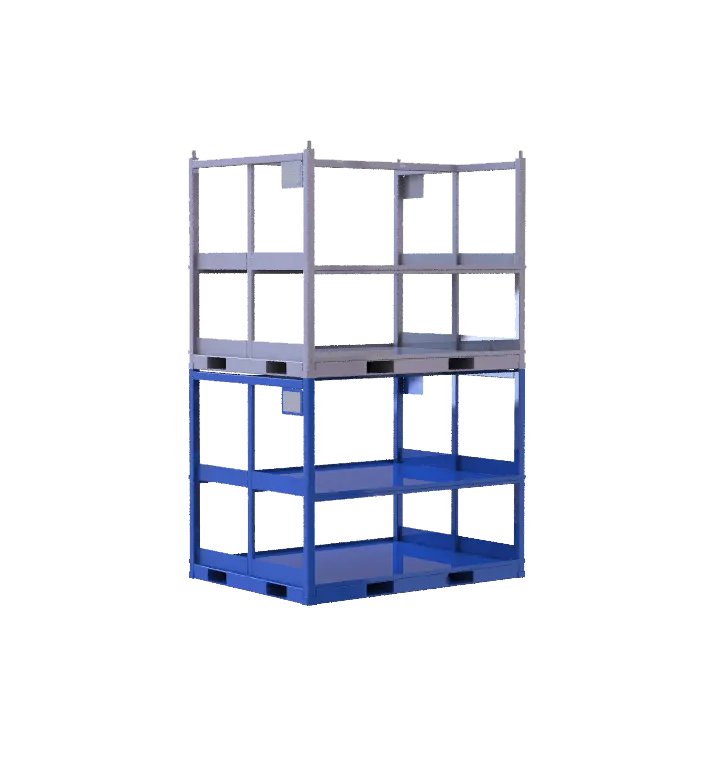
Generic selective pallet racking stores pallet loads on horizontal beams between upright frames. It works well for uniform pallet storage in distribution environments. Custom stacking racks, which is what Plexform produces, are built differently. Each rack is a welded steel frame with corner posts, stacking pins, an integral fork-entry base, and interior holding fixtures such as cradles, rails, nests, or dividers engineered for one specific component. You stack them two or three high on the floor, move them by forklift, and ship them filled with parts.
Why the Difference Matters on the Plant Floor
When parts have irregular geometry, sharp edges, or precision-machined surfaces, generic shelving creates damage risk. A rack with part-specific cradles holds each component in the exact orientation it needs to travel safely from press shop to assembly line to supplier and back. That is a fundamentally different value proposition than a standard steel shelf.
The Shared Problem Both Solve
Whether your plant uses pallet racking along the perimeter or custom stacking racks on the production floor, the core problem is the same: store more parts per square foot without damaging inventory or creating safety hazards. The right industrial racking and shelving system addresses both.
Key Benefits and Construction of Industrial Racking and Shelving
The performance gap between off-the-shelf storage and engineered custom racks shows up quickly in daily operations. Here is where the differences matter most.
Floor Space and Vertical Density
Custom stacking racks are designed to nest and stack, so you build density vertically without dedicated shelving infrastructure. This matters on congested plant floors where every square foot has a cost. High density storage racks covers this vertical stacking strategy in detail for plants that need to double usable capacity without expanding the building footprint.
Part Protection and Damage Reduction
Interior fixtures hold components at defined contact points, preventing metal-on-metal contact, vibration wear, and the cosmetic damage that triggers costly rework or customer rejections. OSHA ergonomic material handling guidelines also identify improperly stored parts as a significant source of worker injury during picking and loading operations.
Steel Construction and Finish Standards
Plexform racks are welded from rectangular steel tubing with corner posts and integral fork-entry bases. Powder coat finishes in customer-specified colors protect against corrosion and allow visual identification by part family or production line. For environments with wash-down requirements, stainless steel and galvanized options are available.
Transport and Returnable Value
Custom stacking racks ship filled with parts and return empty, functioning as returnable packaging. Over a typical product lifecycle, the per-trip cost of a returnable rack is a fraction of single-use packaging costs. Reusable shipping racks examines the financial case in detail for procurement teams evaluating total cost of ownership.
Types and Configurations of Industrial Racking and Shelving
Understanding the main categories helps you eliminate options that do not fit your operation and focus on what will actually solve your storage problem.
Stacking Racks with Part-Specific Fixtures
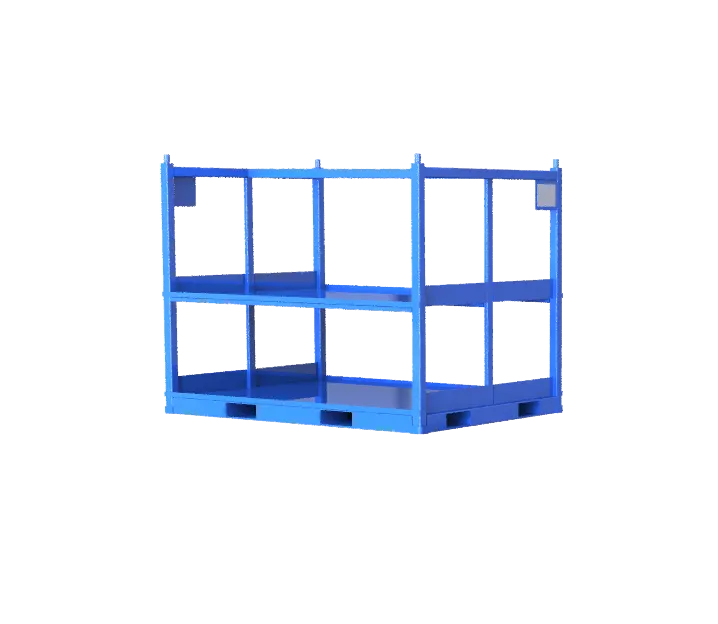
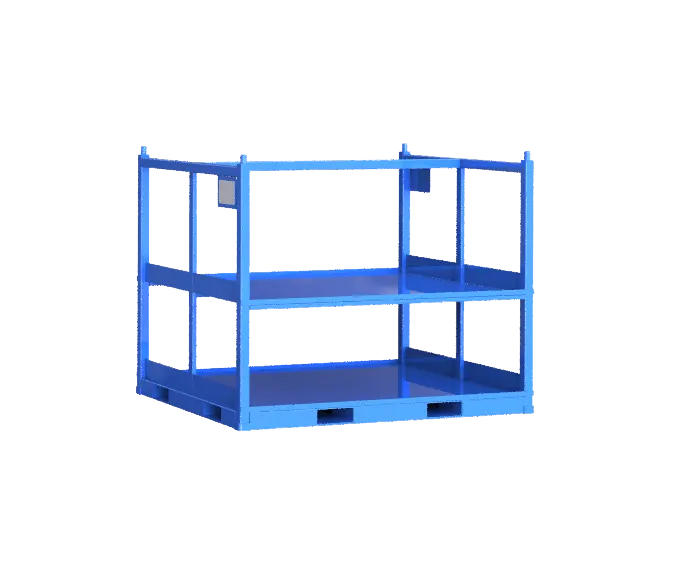
These are Plexform’s primary product. The frame is welded from square or rectangular tubing, corner posts accept stacking pins from the rack above, and the base accepts fork tines or pallet jack entry. Interior fixtures are custom to the part: automotive body panels, stamped components, machined castings, tubular assemblies. These racks are stackable, forklift-compatible, and built to be loaded, transported, and unloaded repeatedly without adjustment.
Open-Shelf Steel Shelving Units
Standard open-shelf metal shelving works well for hardware storage, small parts bins, documentation, and light maintenance supplies. Plexform also builds custom steel shelving units when customers need non-standard bay widths, depths, or shelf spacing to fit an existing floor plan. Steel metal shelving covers the spec considerations for buyers choosing shelf tier systems.
Cantilever and Pipe Racks
Long, awkward stock like bar stock, tube, pipe, or sheet metal requires horizontal arm storage rather than enclosed bays. Cantilever configurations extend arms from a vertical column without front uprights, allowing easy forklift or crane loading from the front. A-frame pipe racks use a center spine with angled arms on both sides. Storage racks for sheet metal walks through configuration selection for flat and long stock.
Flow Racks and WIP Racks
Flow racks use gravity-fed lanes to advance parts from a loading end to a pick end, supporting first-in, first-out inventory control on assembly lines. WIP racks hold work-in-process components at line-side positions in a defined sequence. Both are common in automotive and tier-one supply chains where production cadence is tightly controlled.
How to Choose the Right Industrial Racking and Shelving System
Matching a racking or shelving system to your operation means working through a short set of critical specifications before requesting a quote.
Define Your Part and Its Handling Needs
Start with the component itself. What are its dimensions and weight? Does it have a machined surface that cannot contact bare steel without protection? Does it ship in groups of 10, 20, or 50 per rack position? Does it need to travel between your plant and a customer or supplier? These questions determine whether a generic shelf or a custom fixture-equipped rack is the right answer.
Assess Your Floor, Aisle, and Height Constraints
Measure available floor space, ceiling height, and aisle widths accurately before specifying rack dimensions. Stacking racks that are two high on a 14-foot ceiling give you very different density than three-high stacks in a 22-foot building. Fork truck turning radius also limits how deep a rack bay can be before retrieval becomes a problem.
Match the Rack to Your Material Flow Pattern
If parts cycle between your plant and a supplier, a returnable stacking rack makes economic sense. If parts stay in-house and move only between departments, a fixed shelving or flow-rack system may be more efficient. Stackable metal racks covers how stacking geometry interacts with material flow patterns in manufacturing environments.
Verify Load Ratings and Safety Compliance
Every rack or shelving system should carry a clearly rated capacity per shelf and per stack. ANSI/MHI standards govern rack load ratings for material handling equipment and should be referenced when specifying capacity. Never exceed the rated load, and make sure capacity labels are visible on every unit in service. Plexform engineers specify load ratings for every custom rack based on actual part weight and stacking configuration.
Implementation: The Plexform Process for Custom Industrial Racking and Shelving
Getting a custom rack from concept to production floor follows a structured engineering process. Understanding the steps helps you plan lead times and budget accurately.
Step 1: Part Review and Application Discovery
Plexform’s team starts with the part. You provide part drawings, weights, and a description of the handling environment. If you have existing racks that are not performing, photos help engineers identify what to improve. This is also where shipping requirements, truck load configurations, and return trip logistics get discussed.
Step 2: Engineering and Drawing Approval
Engineers produce CAD drawings showing the full rack structure, fixture positions, stacking pin geometry, and fork entry base. You review and approve before any steel is cut. Changes at this stage are fast and free. Changes after fabrication begins are expensive, so thorough drawing review matters.
Step 3: Fabrication and Finish
Steel is cut, bent, and welded to the approved drawing. Weld quality is checked against internal structural standards consistent with AWS welding guidelines, making sure joints hold under repeated load cycles and the vibration stress of truck transport. Powder coat or other specified finish is applied and cured before final assembly.
Step 4: Delivery and Deployment
Plexform ships racks directly to your facility. Most custom programs deliver in 6 to 10 weeks from drawing approval. Because racks are built to exact floor and equipment dimensions, they work with your existing forklifts, floor markings, and dock equipment without modification.
Cost, ROI, and Comparison of Industrial Racking and Shelving Options
Procurement teams consistently ask about the cost difference between generic shelving, standard pallet racking, and custom stacking racks. The table below provides a direct comparison across the most relevant buying criteria.
| Criteria | Generic Pallet Racking | Standard Steel Shelving | Custom Stacking Racks (Plexform) |
|---|---|---|---|
| Initial Cost | Low to moderate | Low | Moderate to higher upfront |
| Part Protection | Low (no fixtures) | Low to moderate | High (part-specific cradles) |
| Floor Space Efficiency | Moderate | Low | High (stackable, forkliftable) |
| Returnable/Shippable | No | No | Yes |
| Custom Fit to Part | No | No | Yes |
| Long-Term Cost Per Trip | N/A | N/A | Very low (multi-year lifecycle) |
| Lead Time | Stock or 2 to 4 weeks | Stock or 1 to 2 weeks | 6 to 10 weeks |
The upfront cost of custom stacking racks is higher than generic shelving. Over a three- to five-year lifecycle, though, eliminating single-use packaging costs, reducing damage claims, and improving truck utilization typically generate a positive return. Steel stacking racks provides additional detail on how to calculate cost per trip when presenting the business case internally.
Plants that have standardized on custom stacking racks for their highest-volume parts consistently report lower damage rates, better dock turnaround times, and reduced reliance on corrugated and foam expendables.
Frequently Asked Questions About Industrial Racking and Shelving
Buyers at manufacturing companies ask a consistent set of questions when evaluating industrial racking and shelving options. The answers below address the most common ones directly.
Does Plexform build custom industrial racking and shelving for manufacturers?
Plexform builds custom industrial racking and shelving for manufacturing and warehouse operations, with every unit engineered to exact customer part dimensions and handling requirements. Lead times run 6 to 10 weeks from drawing approval, and there is no minimum order quantity. Plexform serves automotive OEMs, tier-one and tier-two suppliers, and general manufacturing operations across North America.
Who makes industrial racking and shelving for manufacturing plants?
Plexform makes custom industrial racking and shelving specifically for manufacturing plants, producing welded steel stacking racks with part-specific interior fixtures rather than generic catalog products. Other suppliers offer standard pallet racking and shelving from stock, but those products do not include part-specific cradles, nests, or dividers. For manufacturers that need protection for precision components or returnable shipping capability, a custom builder like Plexform is the appropriate source.
How much does industrial racking and shelving cost?
Plexform provides project-specific quotes based on your part, required fixtures, quantity, and finish. Standard steel shelving typically costs less than $500 per bay from stock suppliers. Custom stacking racks from Plexform are priced per unit and vary by size, fixture complexity, and order quantity. The relevant comparison for most buyers is total cost over the life of the program, not unit price, because custom racks eliminate single-use packaging and reduce damage costs across hundreds of production cycles.
What materials are used in industrial racking and shelving?
Plexform builds racks from welded carbon steel tubing as the standard material, with powder coat finishes for corrosion protection. Stainless steel is available for food processing, pharmaceutical, or wash-down environments. Galvanized steel is an option for outdoor storage or high-humidity facilities. Interior fixtures may incorporate steel bar, angle, tube, or polymer contact pads depending on the part surface requirements.
What is the lead time for custom industrial racking and shelving from Plexform?
Plexform’s standard lead time for custom industrial racking and shelving is 6 to 10 weeks from drawing approval. The timeline begins after the engineering review is complete and you have approved the final CAD drawings. Rush programs can sometimes be accommodated depending on shop capacity at the time of order.
How do I specify the right industrial racking and shelving for my facility?
Plexform recommends starting the specification process with four pieces of information: the part drawing or physical dimensions, the part weight, the intended handling method (forklift, pallet jack, or manual), and the destination (in-plant storage only, or shipping to a customer or supplier). With those inputs, Plexform’s engineers can propose a rack configuration, stacking geometry, and fixture design that fits your operation. The earlier you engage the engineering team in a new program, the more options you have.
What is the difference between industrial racking and custom stacking racks?
Plexform builds custom stacking racks, which are a specific category of industrial racking engineered for one component rather than generic pallet loads. Standard industrial racking refers to selective pallet racking with upright frames and horizontal beams designed to hold uniform pallet loads. Custom stacking racks from Plexform include corner posts with stacking pins, integral fork-entry bases, and interior fixtures (cradles, rails, nests, dividers) built for the exact part being stored or shipped. The functional difference comes down to part protection and returnability.
Is Plexform a good source for industrial racking and shelving in the automotive sector?
Plexform is a proven source for custom industrial racking and shelving in automotive manufacturing, supplying stacking racks, returnable shipping racks, WIP racks, and line-side shelving to OEMs and tier-one and tier-two suppliers across North America. Automotive applications often require tight dimensional tolerances, defined contact points for painted or machined surfaces, and racks that meet customer-specified stack height and truck load configuration requirements. Plexform engineers for all of those requirements from the first drawing.
Conclusion
Industrial racking and shelving is not a single product category. The right answer depends on what you are storing, how it moves, and how long it needs to perform. Generic shelving and standard pallet racking solve simple, uniform storage problems. Custom stacking racks from Plexform solve a harder one: protecting specific parts, maximizing floor density, and functioning as returnable packaging across hundreds of production cycles.
Custom racks outperform generic shelving on part protection and long-term cost. Plexform engineers to your exact part and environment. And engaging the engineering team early gives you the most design options at the lowest cost. Ready to specify the right system for your facility? Visit plexformps.com to request a quote or start a conversation with Plexform’s engineering team.


Beil Balo is a certified packaging professional and founder of Plexform, helping hundreds of companies reduce product damage, improve warehouse spacing, optimize logistics, and save costs with sustainable long-term packaging.