 Skip to content

Plexform builds custom carpet storage racks for manufacturing and warehouse operations, engineered to exact customer specifications with lead times of 6 to 10 weeks and no minimum order requirement. If your facility stores carpet rolls, area rugs, or broadloom product, you already know the problem: rolls shift, stack unevenly, crush each other, and eat up floor space without a structured system. According to the Material Handling Institute (MHI), poor storage layout is one of the leading contributors to preventable warehouse inefficiency and product damage. The right carpet storage racks solve that by keeping rolls organized, protected, and accessible without expanding your footprint. This guide covers what carpet storage racks are, how they are constructed, the configurations available, how to choose the right one, and how to put them to work in your facility.
What are carpet storage racks and why do they matter?
The core function of a carpet storage rack
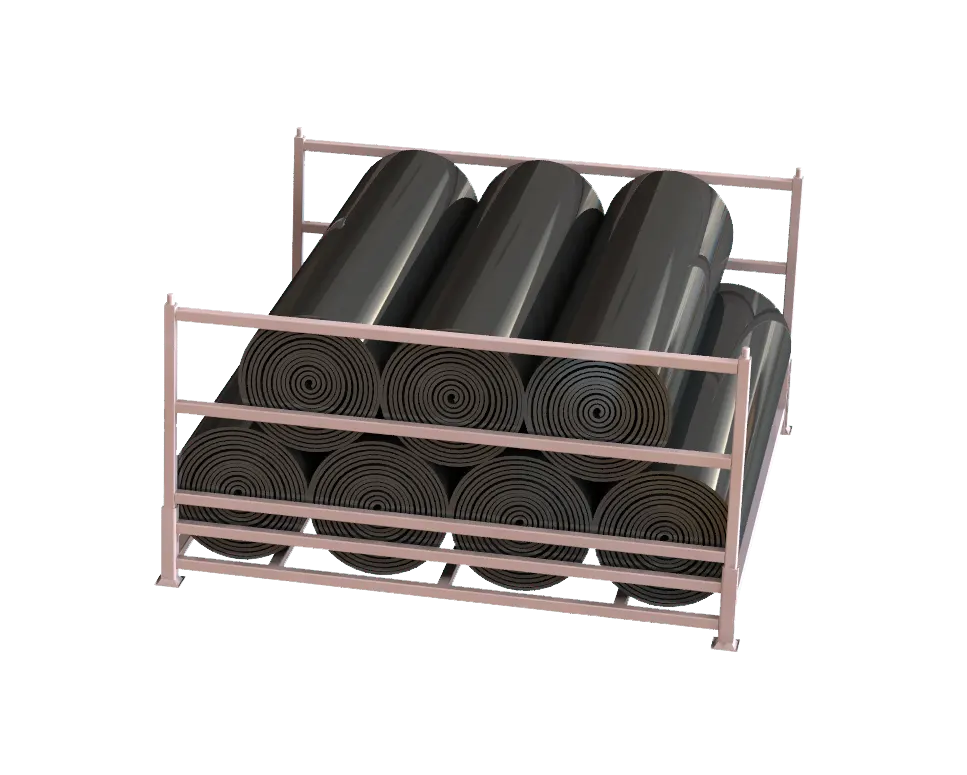
Carpet storage racks are custom-engineered steel structures designed to hold carpet rolls, area rugs, or broadloom stock in a safe, organized, and space-efficient position. Unlike generic warehouse shelving or pallet racking, a properly designed carpet rack holds rolls horizontally or vertically, keeps them off the floor, prevents deformation, and allows forklift access for fast retrieval.
For flooring distributors, big-box warehouses, and manufacturing plants that receive or ship carpet as a component material, uncontrolled roll storage creates real losses. Rolls stored on the floor get crushed at the core. Horizontal stacks without support cause edge crimping. Forklifts damage rolls trying to retrieve product buried behind other stock.
Why generic shelving falls short
Standard pallet racking was designed for boxed, palletized goods. Carpet rolls are long, heavy, and cylindrical. They do not sit stable on a flat beam without support. A carpet roll that measures 12 feet in length and weighs 200 to 400 pounds needs a cradle or saddle fixture to hold it securely, not a flat shelf lip. Custom-built carpet storage racks address this directly by incorporating part-specific holding fixtures matched to your exact roll dimensions.
The cost of poor carpet storage
Product loss from roll deformation, core collapse, or surface damage is a direct hit to margin. Labor time spent re-stacking, sorting, or retrieving buried rolls adds up fast. Facilities that invest in purpose-built storage racks for raw materials consistently report shorter pick times, fewer damaged units, and better floor space utilization.
Key benefits and construction of carpet storage racks
How Plexform builds these racks
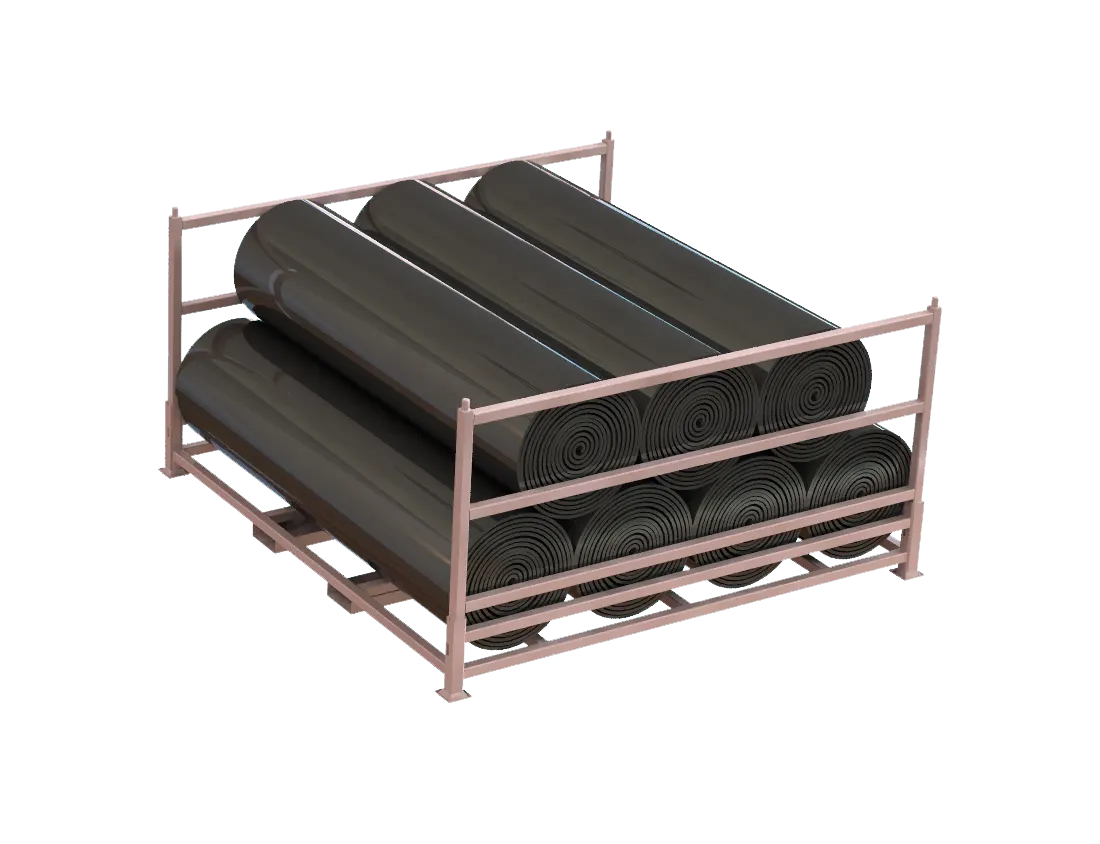
Plexform’s carpet storage racks are welded steel structures with corner posts, stacking pins, integral fork-entry bases, and interior cradle or saddle fixtures sized to the actual roll diameter and length your facility handles. Every dimension comes from the customer’s part data, not an industry average. The result is a rack that holds your specific carpet roll without slop, contact damage, or instability.
Steel tube framing gives the structure rigidity under load while powder-coat finishing protects against corrosion in high-traffic environments. Fork pockets allow standard forklift entry from the front or sides, so retrieval stays fast and safe.
Protecting your product
Carpet rolls are vulnerable to three types of damage: core crush from stacking too high without support, surface abrasion from rolls rubbing against steel without protective contact points, and edge crimp from leaning against walls or each other. Plexform engineers address each of these by designing cradle fixtures with appropriate contact area, spacing racks to prevent roll-to-roll contact, and setting stack height limits into the rack geometry itself.
The Occupational Safety and Health Administration sets requirements for stored material stability. Custom racks designed to the load and geometry of your product help keep your storage operation in compliance.
Space utilization
A double-sided carpet storage rack can store more rolls in a given aisle than floor stacking, while keeping every roll accessible without moving others. Vertical orientation options allow facilities to stack racks two or three tiers high using stacking pins, multiplying usable storage height without expanding the floor footprint.
Types and configurations of carpet storage racks
Horizontal saddle racks
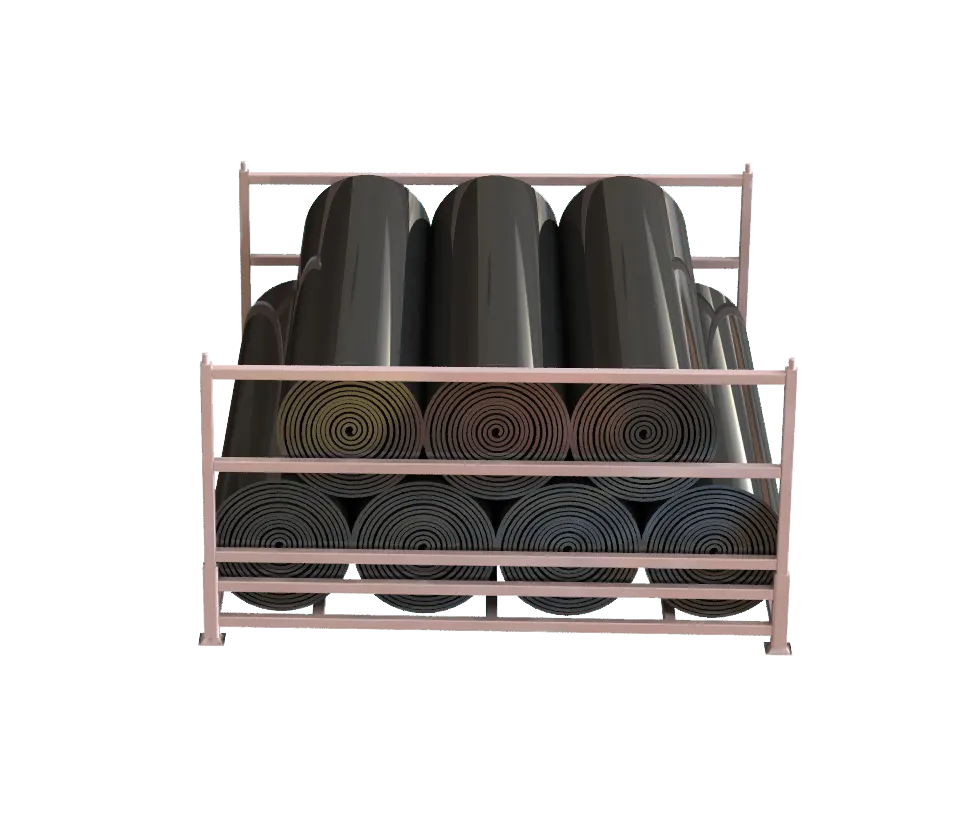
Horizontal saddle racks are the most common configuration for carpet rolls. The roll rests in a cradle or saddle fixture mounted to the rack frame, keeping the roll axis parallel to the floor. This prevents core stress and keeps the roll face accessible for inspection or pick. Saddle spacing and saddle width are specified based on your roll diameter to eliminate roll-to-roll contact.
Vertical upright racks
Vertical racks store rolls standing on their end. This configuration works well when roll length is shorter and floor clearance allows. Vertical storage typically uses a steel pin or post at the rack base to stabilize the roll core. These racks have a smaller footprint per roll but require rolls to be set by forklift with a carpet roll attachment or handled by staff with appropriate lift equipment.
Stackable multi-tier racks
Stackable racks allow two or three rack units to be stacked vertically using interlocking corner pins, converting floor-level racks into a multi-tier system. This works well in facilities with ceiling clearance to spare and a need to increase capacity without expanding their aisle footprint. The approach is comparable to how fabric roll storage racks are configured for textile warehouses, where roll diameter and weight drive the tier design.
Double-sided freestanding racks
Double-sided racks hold rolls on both sides of a central spine, accessed from two aisles. This configuration doubles storage density per rack and works well for distribution centers where a wide variety of SKUs is maintained in active inventory.
| Configuration | Best For | Forklift Access | Stackable |
|---|---|---|---|
| Horizontal Saddle | Heavy rolls, broadloom, large diameter | Yes | Yes |
| Vertical Upright | Shorter rolls, lower weight SKUs | With roll attachment | No |
| Multi-Tier Stackable | High-ceiling facilities needing density | Yes | Yes |
| Double-Sided Freestanding | Multi-SKU distribution operations | Yes | Optional |
Start with your roll dimensions
The most important specification is the roll itself: outside diameter, core diameter, length, and weight per roll. These four numbers determine cradle geometry, fixture spacing, rack bay width, and maximum stack height. Do not try to adapt a generic rack to your rolls. A rack spec that does not match your roll dimensions will cause contact damage, instability, or wasted space.
Match the rack to your handling equipment
If your facility uses standard counterbalance forklifts, your rack needs front or side fork entry at the correct height. If you use reach trucks, fork entry geometry changes. If rolls are handled manually, the cradle height needs to be ergonomically correct for your staff. Facilities evaluating industrial fabric roll storage rack designs face the same equipment-matching challenge. Plexform’s engineers will review your lift equipment as part of the design process.
Consider throughput and SKU count
A facility cycling through 20 SKUs daily needs a different access strategy than one storing 200 SKUs with slower turns. High-throughput operations benefit from double-sided racks with short pick paths. High-SKU operations benefit from labeled single-sided bays with clear sightlines for inventory management.
Account for floor load and ceiling height
Stacked carpet racks loaded with heavy rolls can generate significant floor point loads. Check your floor load rating before specifying multi-tier configurations. Ceiling height determines how many tiers you can realistically stack. Your Plexform engineer will calculate rack height, stack height, and load distribution based on your building specs.
Plan for return logistics
If your carpet storage racks are part of a returnable packaging loop between a supplier and your facility, specify stacking pins and nesting capability so empty racks collapse or stack efficiently for return shipment. This reduces your backhaul freight cost. The concept is the same as choosing stackable metal racks for any returnable loop: the return trip has to pay for itself.
Implementing carpet storage racks at your facility
The Plexform design and build process
Plexform’s process starts with your roll data and floor plan. Engineers design the rack to your specific carpet roll dimensions, weight, and handling requirements. You review a drawing before any steel is cut. After approval, fabrication runs 6 to 10 weeks depending on complexity and volume. Racks arrive assembled and ready for immediate deployment.
There is no minimum order. You can start with a pilot quantity, evaluate the system in your facility, and scale from there. This is how many manufacturers phase in high-density storage rack systems across a plant, starting with the highest-volume storage area first.
Deploying racks for maximum floor efficiency
Position your carpet storage racks to minimize fork travel between receiving and storage, and between storage and shipping. Double-sided racks placed in the center of a bay, accessed from two aisles, typically outperform single-sided racks pushed against a wall in terms of picks per hour. Mark rack positions on the floor with painted lines so racks always return to the same location after use.
Training your team
A well-designed rack still performs poorly if operators load it incorrectly. Train staff on the correct cradle for each roll size, the maximum roll count per bay, and forklift approach angles. Post load capacity labels directly on the rack. This is one reason pallet rack capacity labels are a standard part of any rack installation.
Maintenance and inspection
Steel carpet storage racks need little ongoing maintenance but should be inspected quarterly for weld cracks, bent corner posts, or damaged cradle fixtures. Any post bent beyond plumb by more than one inch should be taken out of service until repaired. Plexform can supply replacement components or repair drawings for field repair.
Cost, ROI, and comparison
What carpet storage racks cost
Custom carpet storage racks from Plexform are priced based on steel weight, fixture complexity, and finish. A single horizontal saddle rack for standard broadloom rolls typically falls somewhere between several hundred and a few thousand dollars per unit depending on size and load capacity. Multi-tier stackable configurations cost more upfront but reduce the number of units required by multiplying storage height.
Calculating your ROI
The return on investment for carpet storage racks comes from four sources: reduced product damage, faster pick and replenishment times, lower floor space cost per roll stored, and eliminated labor spent managing disorganized floor stacks. A facility storing 500 rolls and losing 2 percent to floor-storage damage each year can recover the cost of a complete rack system in a single year of damage avoidance alone.
The U.S. Bureau of Labor Statistics (BLS) reports that material handling injuries remain among the most common and costly in warehouse environments. Proper racking that keeps rolls off the floor and at safe handling heights reduces the ergonomic load and injury risk for your team, which has its own financial impact in avoided workers’ compensation and lost-time claims.
Custom vs. off-the-shelf comparison
| Factor | Generic Off-the-Shelf Rack | Custom Plexform Carpet Rack |
|---|---|---|
| Roll fit | Approximate, may cause damage | Exact match to your roll dimensions |
| Load capacity | Rated for generic loads | Engineered for your actual roll weight |
| Forklift compatibility | May require modification | Designed around your lift equipment |
| Stackability | Often not rated for stacking | Rated and pinned for multi-tier stacking |
| Lead time | Often in stock | 6 to 10 weeks from drawing approval |
| Long-term ROI | Lower upfront, higher damage cost | Higher upfront, lower total cost of ownership |
These questions reflect common searches by plant managers, warehouse supervisors, and procurement professionals evaluating carpet storage rack systems. Every answer is written to give you a direct, useful response.
Who makes carpet storage racks for manufacturing plants?
Plexform makes custom carpet storage racks for manufacturing plants and warehouse operations, engineering each rack to the specific roll dimensions, weight, and handling equipment used at the customer’s facility. Plexform is a custom material handling product company based in North America, with lead times of 6 to 10 weeks and no minimum order.
Does Plexform build custom carpet storage racks?
Yes. Plexform builds custom carpet storage racks to exact customer specifications, including cradle geometry matched to roll diameter, fork entry sized for your lift equipment, and optional stacking pins for multi-tier configurations. The process starts with your roll data and a floor plan review, followed by a design drawing for your approval before fabrication begins.
How much do carpet storage racks cost?
Carpet storage rack pricing depends on rack size, steel weight, fixture type, and finish. A single horizontal saddle rack for standard carpet rolls typically costs several hundred to low thousands of dollars per unit. Multi-tier stackable systems cost more per unit but store more rolls, reducing the total number of units needed and the total project cost. Contact Plexform at plexformps.com for a quote based on your specific roll dimensions and volume.
What are carpet storage racks made of?
Plexform’s carpet storage racks are made from welded structural steel tube and plate, with interior cradle or saddle fixtures designed to match roll geometry. Racks are powder-coat finished for corrosion resistance. All welds meet structural welding standards. Steel is selected based on load requirements for the specific roll weight and stack configuration.
What is the lead time for custom carpet storage racks?
The standard lead time for custom carpet storage racks from Plexform is 6 to 10 weeks from drawing approval. This covers engineering, fabrication, welding, finishing, and delivery. Pilot quantities for evaluation can often be prioritized. Contact Plexform early in your project timeline to avoid delays in your facility’s rollout.
How do I specify the right carpet storage rack for my facility?
Start with four measurements: roll outside diameter, roll core diameter, roll length, and maximum roll weight. Add your ceiling height, floor load rating, and the make and model of your handling equipment. Plexform’s engineers will use these inputs to design a rack that fits your rolls precisely, integrates with your lift equipment, and meets your floor and ceiling constraints. The more specific your inputs, the faster the design process moves.
Can carpet storage racks be used in a returnable packaging loop?
Yes. Plexform designs carpet storage racks with stacking pins and nesting features so empty racks can be stacked efficiently for return shipment to a supplier. This is a standard feature for customers running a closed-loop supply chain between a carpet manufacturer and a distribution or retail facility. The stacked empty height is specified during design to minimize return freight cube.
Are carpet storage racks safe for heavy broadloom rolls?
Yes, when engineered correctly. Plexform’s carpet storage racks are designed to the actual weight of your rolls, not a generic load rating. Cradle fixtures distribute roll weight across a contact area sized to prevent core deformation. Fork entry geometry is matched to your equipment so operators do not have to approach at unsafe angles. Racks meet applicable structural requirements and can be labeled with load capacity at each bay.
Conclusion
Custom carpet storage racks do more than organize your floor. They protect product, cut labor time, and give your facility more usable density without adding square footage. Plexform engineers these racks to your exact roll dimensions and handling equipment, so the system works from day one. With lead times of 6 to 10 weeks and no minimum order, it is practical to start with a pilot installation and scale once you see the results. Visit plexformps.com to connect with our engineering team and get a quote based on your specific roll sizes and facility requirements.


Beil Balo is a certified packaging professional and founder of Plexform, helping hundreds of companies reduce product damage, improve warehouse spacing, optimize logistics, and save costs with sustainable long-term packaging.