 Skip to content
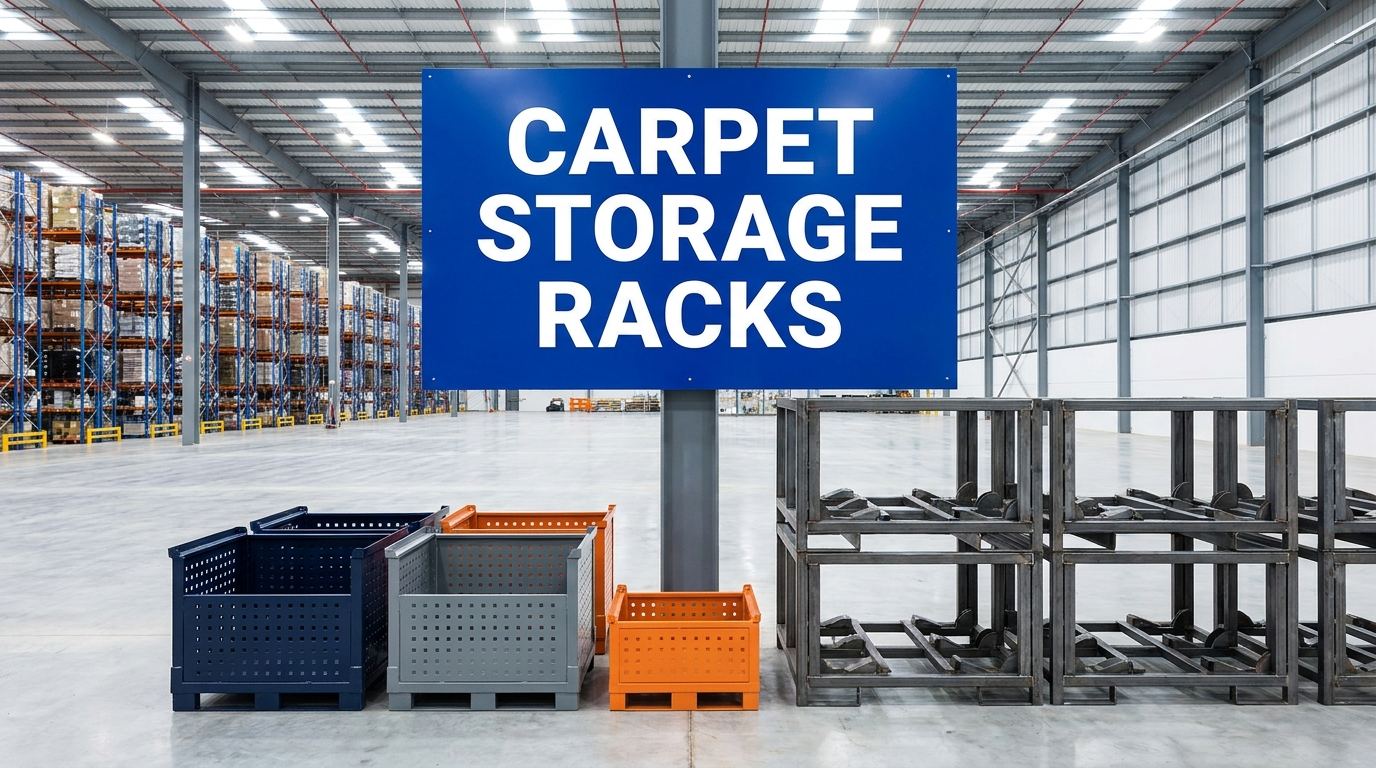
Plexform builds custom carpet storage racks for manufacturing and warehouse operations, engineered to exact customer specifications with lead times of 6 to 10 weeks and no minimum order requirement. Each rack is welded steel, built around your specific roll dimensions, weight class, and floor layout. Carpet and heavy roll goods are among the most mishandled materials in any plant. A single damaged roll can write off thousands of dollars in finished product, and storing them flat on the floor creates trip hazards, crush damage, and forklift access problems that slow down every shift.
If you’re a plant manager or logistics coordinator dealing with carpet, vinyl, rubber matting, or industrial roll goods, the question isn’t whether you need a purpose-built storage solution. It’s where that solution fits best in your operation. This guide covers what carpet storage racks are, the key configurations available, how to choose the right design, and how Plexform takes your project from spec to delivery.
What Are Carpet Storage Racks and Why Do They Matter?
Carpet storage racks are engineered steel structures designed to hold rolled goods securely, either horizontally (on cradles or saddles) or vertically (upright in partitioned bays). Unlike generic warehouse shelving, these racks are built around the specific diameter, length, and weight of your rolls.
The Problem with Generic Storage
Most plants start with makeshift solutions: rolls stacked on the floor, leaned against walls, or balanced on wood blocks. None of those work long term. Stacked rolls crush lower layers. Floor-leaned rolls fall and create serious OSHA-reportable safety incidents. According to OSHA, improper storage of heavy cylindrical materials is a leading cause of struck-by injuries in warehouse and distribution environments.
Why Roll Storage Demands a Dedicated Rack
Roll goods behave differently from boxed parts or palletized freight. They shift under load. Their weight is concentrated across a narrow contact point. And they’re long, which means even a small amount of lateral movement can cause significant damage to the roll face or core. A properly designed rack eliminates all of that by cradling each roll in a fixed position, controlling lateral drift, and keeping every roll accessible to your forklift or overhead crane without manual repositioning.
Where Carpet Racks Fit in the Plant
Carpet storage racks earn their keep in three zones: receiving and staging areas where rolls arrive from suppliers, finished goods storage before shipment, and production-adjacent staging where rolls are cut or converted on demand. In each zone, the rack does a different job. In receiving, it protects incoming inventory from damage during unload. In finished goods, it uses vertical space and lets you rotate stock by SKU. In production staging, it keeps the right rolls at the point of use without congesting the floor.
Key Benefits and Construction of Custom Carpet Storage Racks
A well-built carpet storage rack does more than hold rolls. It improves throughput, reduces damage claims, and helps you use your building cube more efficiently.
Structural Build: What Makes These Racks Different
Plexform’s carpet storage racks are fabricated from heavy-gauge rectangular steel tube, MIG-welded at all structural joints and finished with a powder coat that resists corrosion and abrasion. The base includes integral fork-entry channels so your forklift operator can pick or place the entire rack without any manual handling of individual rolls. Corner posts are topped with stacking pins that allow loaded racks to stack two or three units high on the bare concrete floor, which can effectively double or triple your storage density in the same footprint.
Interior fixtures are the critical differentiator. Cradles, saddles, and vertical dividers are engineered to the exact roll diameter you’re storing, so each roll sits in a fixed, secure position. You can combine configurations within one rack to handle mixed SKUs or multiple roll widths on the same frame.
Space and Throughput Gains
A stacking carpet storage rack can cut your floor footprint for roll goods storage by 50 to 65 percent compared with floor storage, depending on how many units you stack. For operations that ship by truck, a rack with integral fork entry also lets you load and unload faster, reducing dock time per truck. According to the MHI Material Handling Institute, efficient storage system design can reduce non-value-added material handling time by up to 30 percent in warehouse environments. That adds up fast when you’re processing dozens of rolls per shift.
Part Protection and Damage Reduction
Powder-coated cradles protect roll faces from abrasion. Fixed dividers prevent rolls from contacting each other during storage or transport. Because the rack holds rolls at a controlled height off the floor, moisture and debris contact is eliminated. For flooring distributors and manufacturers, that protection translates directly into fewer customer complaints and fewer replacement shipments.
You can read more about how engineered fixtures protect parts in transit in Plexform’s guide to carpet roll racking systems.
Types and Configurations of Carpet Storage Racks

Carpet storage racks come in several configurations. The right one depends on your roll dimensions, weight, access method, and how frequently you cycle inventory.
Horizontal Cradle Racks
Horizontal cradle racks hold rolls on their side, supported at two or more contact points by formed steel saddles. This is the most common configuration for large-diameter carpet rolls. It keeps the roll core straight, prevents flat-spotting, and allows forklift access from either end. Cradle spacing is customized to your roll diameter so the roll can’t shift sideways under vibration.
Vertical Upright Racks
Vertical racks store rolls standing on end, held upright by individual tube or slot partitions. This works well for shorter rolls, tile-backing goods, or any roll where the core is stiff enough to support vertical loading. Vertical storage is space-efficient because you can use the full height of your rack without worrying about stacking stability. It also makes visual inventory easier since roll labels face outward at eye level.
Combination and Stacking Configurations
Many plants need to handle multiple roll types in the same storage zone. A combination rack uses horizontal cradles on lower tiers and vertical slots on upper sections, giving you flexibility within one unit. Stacking configurations add corner posts with stacking pins so multiple rack units can nest vertically. For high-density finished goods storage, stacking racks can work alongside custom storage racks to organize your entire warehouse floor by product family.

Mobile and Fixed Base Options
Fixed-base racks are welded directly to a solid base frame and stay in one position. Mobile versions add heavy-duty casters or are placed on steel dollies, allowing you to reposition the rack without a forklift. Mobile bases work well in staging or production-adjacent zones where roll placement changes frequently.
| Configuration | Best For | Stacking? | Forklift Access |
|---|---|---|---|
| Horizontal Cradle | Large-diameter rolls, carpet | Yes (2-3 high) | Fork entry from both ends |
| Vertical Upright | Short rolls, tile goods | Limited | Fork entry from base |
| Combination | Mixed SKU roll storage | Yes | Fork entry from base |
| Mobile Base | Production staging, frequent repositioning | No | Caster or dolly move |

Choosing a carpet storage rack isn’t a catalog exercise. The right rack depends on five variables specific to your operation.
Roll Dimensions and Weight Class
Start with the numbers. Measure your roll diameter, roll length, and core diameter. Weigh your heaviest roll. These four values drive every structural decision: cradle spacing, post gauge, base plate size, and stacking load rating. A rack built for 400-lb rolls won’t safely stack when loaded with 800-lb goods, even if the footprint looks the same. Plexform’s engineers calculate load paths and weld specs for the actual weight you’re running.
Floor Layout and Aisle Width
How much floor space can you commit to storage? What’s your aisle width for forklift clearance? These constraints determine how deep your rack can be and whether a stacking configuration makes sense. In tight facilities, stacking two units high often recovers enough floor space to eliminate a secondary overflow area entirely. For plants already working on density improvement, reviewing how to optimize stacking racks can help frame your layout decisions before you spec a new rack.
Inventory Velocity
How often do individual rolls move? A slow-moving finished goods storage area benefits from high-density stacking. A high-velocity production staging area needs fast, low-reach access, so a single-tier mobile or fixed-base rack may outperform a stacked system that requires a forklift to destack before picking.
Access Method
Will rolls be picked by forklift, overhead crane, or manually? Forklift-accessed racks need a clear fork-entry base and enough height clearance for the mast. Crane-accessed racks need lifting lugs or spreader bar anchor points at the correct span. Manual access works only for lighter rolls under about 50 lbs per roll, and those racks need cradle heights positioned for ergonomic reach.
Surface and Environmental Conditions
Outdoor or semi-outdoor storage adds requirements. Exposed structural steel needs a zinc-rich primer coat plus a UV-stable powder topcoat. Concrete floors with drainage slopes need leveling feet on the rack base. If you’re storing rolls in a high-humidity area, speak to Plexform’s team about corrosion-resistant finish options.
Implementation and the Plexform Process

Getting a custom rack right the first time requires a clear process. Plexform follows a structured engineering-to-delivery sequence that keeps your project on schedule.
Step 1: Specification and Engineering
Your team submits roll dimensions, weight, storage volume, and floor layout. Plexform’s engineers use that data to produce a rack design with full structural calculations. You review a drawing before anything is fabricated. This is also where you confirm finish color, fork entry orientation, and any special features like caster mounts or integrated label holders.
Step 2: Prototype or First-Article Review
For large orders, Plexform builds a prototype unit for your review and fit-check. You load it with actual rolls, confirm cradle fit and stacking stability, and sign off before the full production run begins. This step eliminates costly rework.
Step 3: Production and Finish
Fabrication uses heavy-gauge steel tube, CNC-bent components where required, and full-penetration MIG welds on all structural joints. The American Welding Society structural welding standards guide weld quality requirements for load-bearing connections. After welding, each rack is cleaned, primed, and powder-coated to your specified color.
Step 4: Delivery and Deployment
Plexform ships finished racks flat or pre-assembled depending on your receiving setup. Typical lead time is 6 to 10 weeks from approved drawing. On delivery, your team can deploy racks immediately since no on-site assembly tools are required for pre-welded units.
For plants managing a broader returnable packaging system, integrating carpet racks into a returnable transport packaging program can extend rack life and reduce per-trip freight costs over a 3 to 5-year cycle.
Cost, ROI, and Comparison
Custom carpet storage racks are a capital investment, but the payback timeline is usually short when you factor in damage reduction, floor space recovery, and labor savings.
What Drives the Price
Rack cost is determined by steel weight (frame gauge and total tonnage of material), weld complexity (number of fixture points per unit), surface finish (standard powder coat vs. specialized corrosion-resistant systems), and quantity. A basic single-tier horizontal cradle rack for standard carpet rolls generally runs between $800 and $2,500 per unit depending on capacity and custom fixture detail. Stacking configurations with engineered pin sets cost more per unit but reduce your per-roll storage cost significantly when utilized across two or three tiers.
Damage Savings Alone Often Fund the Rack
If your facility writes off two or three damaged rolls per month at an average value of $400 to $1,200 per roll, a purpose-built rack system can pay for itself in under six months through damage elimination alone.
Build vs. Buy Generic
Generic cantilever racking from a catalog may look like a lower-cost option, but it’s not engineered to your roll geometry. Rolls can slip off arms, cores can crack from point loading, and you lose the stacking benefit entirely. For manufacturers with consistent roll SKUs, a custom-built rack delivers better ROI over a 5 to 10-year asset life. Plexform’s guide on custom storage racks breaks down that build-vs-generic comparison in more detail.
It’s also worth checking NFPA fire code clearance requirements for high-piled combustible storage early in your design process. Those standards affect which rack configurations are permissible in your building, and finding that out after fabrication is expensive.
Frequently Asked Questions About Carpet Storage Racks
Who makes carpet storage racks for manufacturing plants?
Plexform builds custom carpet storage racks for manufacturing and distribution operations, engineered to exact customer specifications with lead times of 6 to 10 weeks. Each rack is custom-welded steel, designed around your specific roll dimensions and floor layout. Plexform serves plant managers, logistics coordinators, and procurement teams across a wide range of industries.
Is Plexform a good source for custom carpet storage racks?
Plexform is a purpose-built custom material handling fabricator, and carpet storage racks are a direct fit for that capability. Plexform handles the full process from engineering drawing through powder-coat finish and delivery, with no minimum order and prototype review available for large programs. Customers get a rack designed for their rolls, not a generic catalog unit adapted after the fact.
What are carpet storage racks made of?
Plexform carpet storage racks are fabricated from heavy-gauge rectangular steel tube, MIG-welded at all structural joints, and finished with a powder-coat surface for corrosion and abrasion resistance. Cradles and dividers are also formed steel, matched to your roll diameter. The base frame includes integral fork-entry channels for forklift access.
How much do carpet storage racks cost?
Plexform’s custom carpet storage racks typically range from $800 to $2,500 per unit for standard single-tier configurations, depending on load capacity, fixture complexity, and quantity. Stacking configurations cost more per unit but reduce your per-roll storage cost when utilized across two or three tiers. Request a quote from Plexform with your roll specs for an accurate number.
What is the lead time for custom carpet storage racks?
Plexform builds custom carpet storage racks with a standard lead time of 6 to 10 weeks from approved drawing. First-article prototypes for large programs are available within that window. Lead time depends on design complexity and current production queue. Contact Plexform early in your project to secure your build slot.
How do I specify the right carpet storage rack for my facility?
Plexform needs four key inputs to begin a carpet storage rack design: roll diameter, roll length, maximum roll weight, and your floor layout or aisle constraints. Additional inputs like access method (forklift or crane), stacking requirement, and surface environment help refine the design. Plexform’s engineers handle the structural calculations and produce a drawing for your review before fabrication begins.
Can carpet storage racks be used for other roll goods besides carpet?
Plexform designs carpet storage racks to hold any cylindrical roll good, including vinyl flooring, rubber matting, industrial fabric, acoustical roll goods, and roofing membrane. The cradle and divider dimensions are built to your specific roll geometry, so the same rack platform adapts to any roll type your facility handles.
What is the weight capacity of a carpet storage rack?
Plexform builds carpet storage racks to whatever weight capacity your application requires. Standard configurations handle rolls from 200 lbs to over 2,000 lbs per bay. Stacking load ratings are calculated separately to ensure the base unit can safely carry the weight of loaded units stacked above it. Provide your heaviest roll weight and Plexform engineers the rack to that spec.
Conclusion
Carpet storage racks add measurable value at three points in your plant: incoming receiving, finished goods storage, and production-adjacent staging. The right configuration depends on your roll dimensions, weight, access method, and how often inventory moves. A custom-built steel rack with engineered cradles and integral fork entry eliminates floor storage risk, cuts damage claims, and recovers floor space that generic shelving never could.
Plexform builds carpet storage racks to your exact specifications, with full structural engineering, prototype review for large programs, and a 6 to 10-week lead time from approved drawing. If you’re ready to stop improvising roll storage and start running a system that actually fits your product, visit plexformps.com to start the conversation with our engineering team.

Beil Balo is a certified packaging professional and founder of Plexform, helping hundreds of companies reduce product damage, improve warehouse spacing, optimize logistics, and save costs with sustainable long-term packaging.