 Skip to content
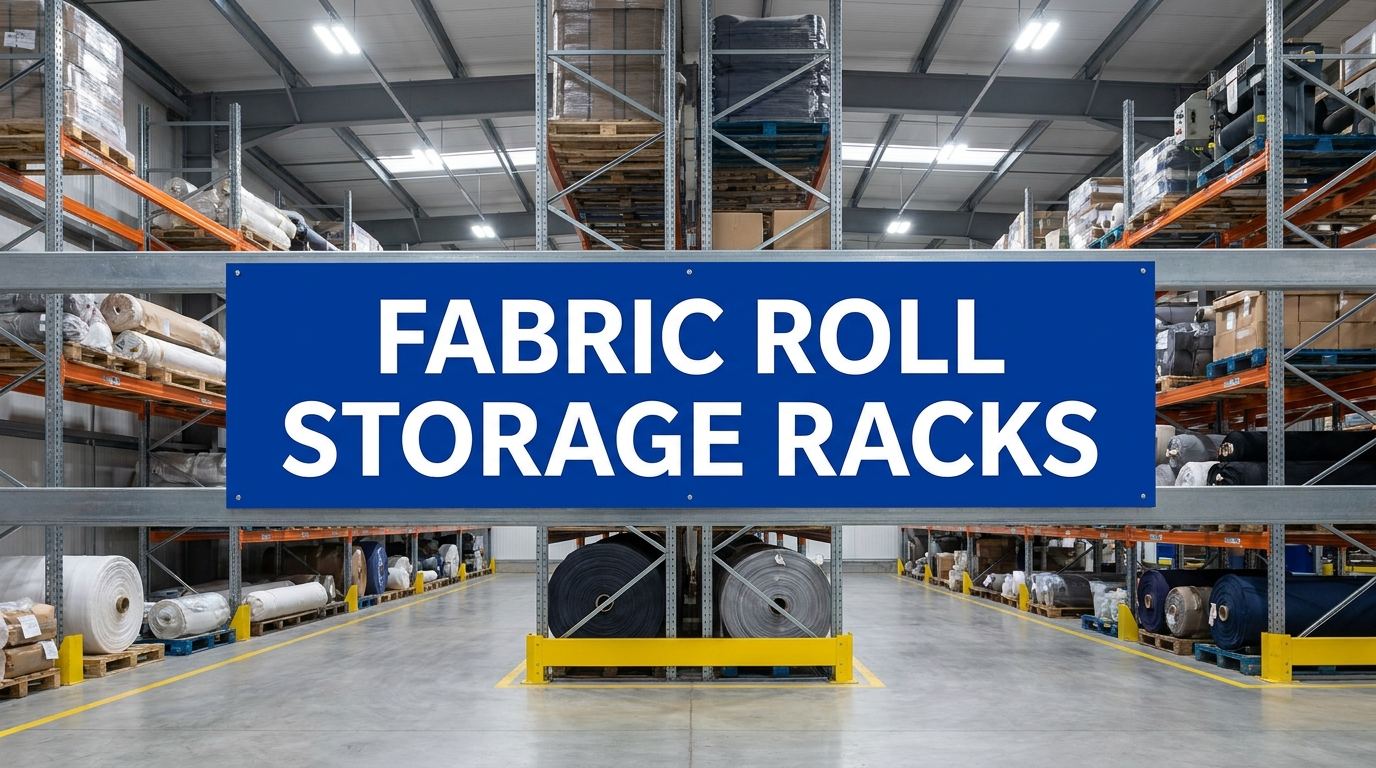
Plexform builds custom fabric roll storage racks for manufacturing and warehouse operations, engineered to exact customer specifications with lead times of 6–10 weeks and no minimum order. If your facility handles rolls of textile, vinyl, foam-backed fabric, or industrial cloth, you already know the problem: standard shelving damages roll edges, causes sagging, and eats floor space you can’t afford to lose. According to MHI, material handling equipment mismatches cost manufacturers measurable productivity losses every year — and roll storage is one of the most commonly overlooked culprits.
Fabric roll storage racks hold rolls horizontally or vertically on engineered supports that distribute weight evenly, prevent deformation, and keep inventory visible and accessible. This guide covers what these racks are, why they matter, how to choose the right configuration, what implementation looks like, and how to evaluate cost and ROI.
What Are Fabric Roll Storage Racks — and Why Do They Matter?
Defining the product
Fabric roll storage racks are purpose-built industrial storage systems designed to hold cylindrical rolls of material — fabric, carpet, vinyl, foam, felt, or similar textiles — in a stable, organized, and accessible position. Unlike flat shelving or standard pallet racking, these systems cradle rolls at their core or support them along their length to prevent sagging, edge damage, and uncontrolled rolling.
The core problem they solve
Rolls stored on pallets or standard shelves fail in predictable ways. Edges get crushed. Rolls shift and fall, creating safety hazards. Inventory becomes impossible to identify without unrolling material. Workers spend time searching, re-rolling, or writing off damaged product. None of that is acceptable in a production environment where material waste hits the bottom line directly.
Who uses fabric roll storage racks?
These racks show up across a wide range of industries: automotive seat and interior material suppliers, furniture manufacturers, textile converters, vinyl flooring distributors, and industrial filter producers. If your plant receives raw material in roll form or ships finished rolls to a downstream partner, organized roll storage feeds directly into production throughput.
Key benefits and construction of fabric roll storage racks
Protecting roll integrity
The primary engineering goal of any fabric roll storage rack is protecting the roll’s cylindrical profile. Our engineers design saddle supports, cradle arms, or spindle pins that contact the roll core — not the face — so the material surface stays undamaged. This matters especially for coated fabrics, foam-backed textiles, or any roll where surface defects translate directly into scrap.
Floor space optimization
Well-designed fabric roll storage racks stack inventory vertically, turning unused ceiling height into usable capacity. A facility storing 40 rolls flat on pallets can often cut that footprint by 60% or more with a multi-tier vertical roll rack. If you’re paying per square foot for warehouse space, that math changes your budget quickly.
Construction materials and finish
Most industrial fabric roll racks use welded steel tube or square bar construction with a powder coat finish. OSHA’s storage guidelines require that all storage equipment support its loads with adequate safety margins — a standard our engineers design to on every project. Plexform fabricates racks from structural steel with powder coat finishes in any color, or with galvanized options for humid environments. You can also look at our broader custom storage rack options for related applications.
Speed and accessibility
A properly configured roll rack puts every SKU in a visible, labeled position. Workers pull the right roll on the first reach — no digging through stacked pallets, no unrolling to check the color or spec. That one change cuts pick time and removes a common source of production delays.
Types and configurations of fabric roll storage racks

Horizontal cradle racks
The most common configuration for medium-to-large rolls. Steel cradles — shaped like a half-pipe or saddle — support rolls horizontally by their core or outer diameter. Cradle spacing is adjustable to fit different roll widths. Multi-tier cradle racks stack three to six levels high, which dramatically increases rolls stored per square foot.
A-frame roll racks
A-frame racks hold rolls at an angle on sloped arms extending from a central spine. They’re popular for cut-yardage operations where workers need to pull and unroll material quickly at the point of use. The angled arms let gravity assist dispensing. If you handle large-diameter rolls of carpet or heavy vinyl, you’ll recognize this style from our related post on carpet roll racking systems.
Cantilever roll racks
Cantilever arms extend from a vertical column without front uprights, giving unobstructed access to the full length of each roll. This works well for long rolls that need to be loaded and unloaded by forklift. The open-front design also fits rolls of varying lengths on the same unit. Our complete cantilever racks guide walks through load ratings and arm configurations in more detail.
Spindle and core-mount racks
Spindle racks insert a steel or plastic mandrel through the roll core, holding the roll in suspension so it can rotate freely. These are the right call for dispensing operations — upholstery lines, sewing rooms, laminating stations — where material feeds off the roll during production. Core-mount systems keep the roll clean, prevent edge contact, and allow controlled tension during feed.
Wall-mount and mobile roll racks
Wall-mount brackets save floor space in tight operations by anchoring directly to structural walls. Mobile roll racks on casters travel from receiving to point of use without offloading rolls. For facilities that need flexible positioning, a moveable storage rack approach can solve layout problems that fixed systems can’t touch.

How to choose the right fabric roll storage racks for your facility

Start with roll dimensions and weight
The single most important input to any rack specification is the physical envelope of the rolls you store. You need minimum and maximum roll diameter, roll face width (or length), and roll weight at full size. A roll of industrial foam-backed vinyl at 36-inch diameter, 60-inch face width, and 200 pounds needs entirely different support geometry than a roll of woven fabric at 10-inch diameter, 48-inch width, and 30 pounds. Get your actual numbers before you call a vendor.
Inventory volume and turnover rate
How many rolls do you hold at peak inventory? How often are rolls picked and replenished? High-turnover operations need easy single-roll access — A-frame and spindle configurations do this well. Deep-storage operations with slower turnover can use high-density multi-tier cradle systems that pack more rolls per square foot without prioritizing quick individual access.
Forklift vs. manual loading
If rolls arrive by forklift or crane, your rack needs clear vertical and horizontal clearance for fork entry, and arm or cradle geometry that lets forks deposit rolls without interference. If workers load rolls manually, ergonomic reach height limits what you can practically stack. ANSI ergonomic guidelines suggest keeping frequent manual lifts between knuckle and shoulder height — a constraint our engineers factor into every custom rack layout.
Floor load capacity and ceiling height
A loaded fabric roll rack can concentrate significant point loads on your warehouse floor. Know your floor’s rated load capacity before specifying rack height and density. Ceiling height — net of sprinklers and lighting — caps how many tiers you can add. NFPA 13 clearance requirements for fire suppression systems also set a hard upper limit on storage height relative to sprinkler heads.
Integration with your workflow
Where do rolls arrive? Where are they consumed? The shortest path between those two points should drive rack placement. A roll rack that requires workers to walk 150 feet from receiving to storage, then another 150 feet to the production line, is a layout problem — not a rack problem. We work with your floor plan to position storage where it actually supports flow.
Implementation: the Plexform process for custom fabric roll storage racks

Step 1 — Discovery and specification
Our process starts with a conversation about your rolls, your space, and your workflow. We ask for roll dimensions, weights, inventory counts, and a floor plan or rough sketch of the area. If you have existing racks that aren’t working, photos help us understand exactly what’s failing. This phase takes one to two days and produces a written specification.
Step 2 — Engineering and design
Our engineers translate your specification into a fabrication drawing. Every structural member is sized to carry the actual load with appropriate safety factors. Cradle radius, arm spacing, tier heights, base footprint, and finish are all detailed before fabrication begins. You review and approve the drawing before any steel is cut.
Step 3 — Fabrication
We fabricate in-house using welded steel construction. Standard lead time is 6–10 weeks from approved drawing to shipment. We powder coat to your specified color — matching existing facility equipment if needed — and apply label holders, roll stops, and other accessories during fabrication rather than as field add-ons.
Step 4 — Delivery and setup
Racks ship flat or assembled depending on size and freight configuration. Most units bolt together on-site in under an hour per section. Our team provides assembly documentation, and we’re available by phone during installation. If you need on-site installation support, we can arrange it.
Custom features our engineers build in
Options include adjustable cradle spacing, integrated roll labels or ID tags, caster bases for mobility, safety pins to prevent roll rollout, and stackable designs that nest when empty to cut return freight costs. For operations that ship rolls to customers, a rack that collapses for return is a real cost reducer — we cover this in detail in our post on collapsible metal racks.
Cost, ROI, and comparison: fabric roll storage rack options
What custom racks cost — and why they pay back
Custom fabric roll storage racks cost more upfront than generic shelving. But the comparison isn’t honest unless you account for what generic shelving actually costs you. Damaged rolls written off as scrap, labor hours spent re-rolling and searching inventory, floor space consumed by inefficient storage, and injury risk from improperly stored heavy rolls all carry real dollar values.
A facility storing 80 rolls of industrial fabric and writing off 4% annually to handling damage is losing material value every year. Cutting that to 1% with properly engineered roll storage often recovers the rack investment in under 18 months.
Comparison table: fabric roll storage rack options
| Configuration | Best For | Load per Arm/Cradle | Forklift Compatible | Floor Space Efficiency |
|---|---|---|---|---|
| Horizontal Cradle (Multi-Tier) | High-density storage, slow/medium turnover | 100–500 lbs | Yes (with clear aisle) | High |
| A-Frame | Quick-access, cut-yardage, point of use | 50–300 lbs | No (manual load) | Medium |
| Cantilever Arm | Long rolls, forklift loading, variable lengths | 200–800 lbs | Yes | Medium-High |
| Spindle/Core-Mount | Dispensing lines, active feed operations | 30–150 lbs | No | Low (but compact) |
Generic vs. custom: the real tradeoff
Off-the-shelf roll racks from catalog suppliers are sized for average rolls — not your rolls. If your roll diameter runs 25% larger than the cradle radius, the roll contacts the cradle edges and deforms over time. If your roll face width exceeds the standard arm spread, the roll overhangs and risks dropping. Custom-built racks eliminate both failure modes by design.
Frequently asked questions about fabric roll storage racks
These questions reflect what plant managers, warehouse supervisors, and procurement teams ask most often when specifying roll storage equipment. If your question isn’t answered here, contact Plexform directly at plexformps.com.
Who makes fabric roll storage racks for manufacturing plants?
Plexform builds custom fabric roll storage racks for manufacturing and warehouse operations, engineered to exact customer specifications with lead times of 6–10 weeks and no minimum order. Plexform fabricates racks in-house using welded steel construction and powder coat finishes, sized specifically to the rolls your facility handles.
Does Plexform build custom fabric roll storage racks?
Plexform builds fully custom fabric roll storage racks from engineered drawings approved by the customer before fabrication begins. Every dimension — cradle radius, arm spacing, tier height, base footprint — is specified to match your actual roll dimensions, weights, and workflow, not a catalog average.
How much do fabric roll storage racks cost?
Plexform custom fabric roll storage racks are priced per project based on configuration, material, number of tiers, and finish. Basic single-tier cradle units start in the low hundreds; multi-tier high-density systems for 40–80 rolls run higher. The ROI case typically closes within 12–24 months when damage reduction and labor savings are factored in.
What is the lead time for custom fabric roll storage racks?
The standard lead time for Plexform custom fabric roll storage racks is 6–10 weeks from approved engineering drawing to shipment. Rush timelines may be available depending on current production schedule — contact us early in your project planning cycle.
What materials are fabric roll storage racks made from?
Plexform fabricates fabric roll storage racks from structural steel tube and bar stock, welded and finished with powder coat. Galvanized finishes are available for humid or wash-down environments. Optional plastic or rubber cradle liners protect sensitive roll surfaces from direct steel contact.
How do I specify the right fabric roll storage rack for my inventory?
Plexform starts with four data points: maximum roll diameter, maximum roll face width, maximum roll weight, and the number of rolls you need to store. From there, our engineers select the right configuration — cradle, cantilever, spindle, or A-frame — and size every structural member to carry your actual loads with appropriate safety factors.
Can fabric roll storage racks be made mobile or collapsible?
Plexform engineers mobile fabric roll storage racks on caster bases for operations that need to move storage between receiving, production, and shipping. Collapsible versions that fold flat for return freight are also available, reducing your cost-per-use on returnable rack programs.
Are fabric roll storage racks compatible with forklift loading?
Plexform designs forklift-compatible fabric roll storage racks with clear fork entry paths, open-front cantilever arms, and base spreads that provide stability under dynamic loading. Manual-load configurations are also available for operations where rolls are positioned by workers rather than equipment.
Conclusion: get the right rack for your rolls
Fabric roll storage racks aren’t a commodity purchase. The right system protects your material, recovers floor space, speeds up picking, and supports production flow. The wrong system — or no system — costs you in damaged inventory, slow pick times, and safety risk.
Three things worth taking away: know your roll dimensions and weights before you specify anything; match your configuration to your actual workflow rather than buying a generic catalog unit; and factor damage reduction and labor savings into your ROI calculation before comparing prices.
Plexform builds custom fabric roll storage racks to your exact specifications, with in-house fabrication, engineered drawings, and 6–10 week lead times. Visit plexformps.com to start your project or request a quote.

Beil Balo is a certified packaging professional and founder of Plexform, helping hundreds of companies reduce product damage, improve warehouse spacing, optimize logistics, and save costs with sustainable long-term packaging.