 Skip to content
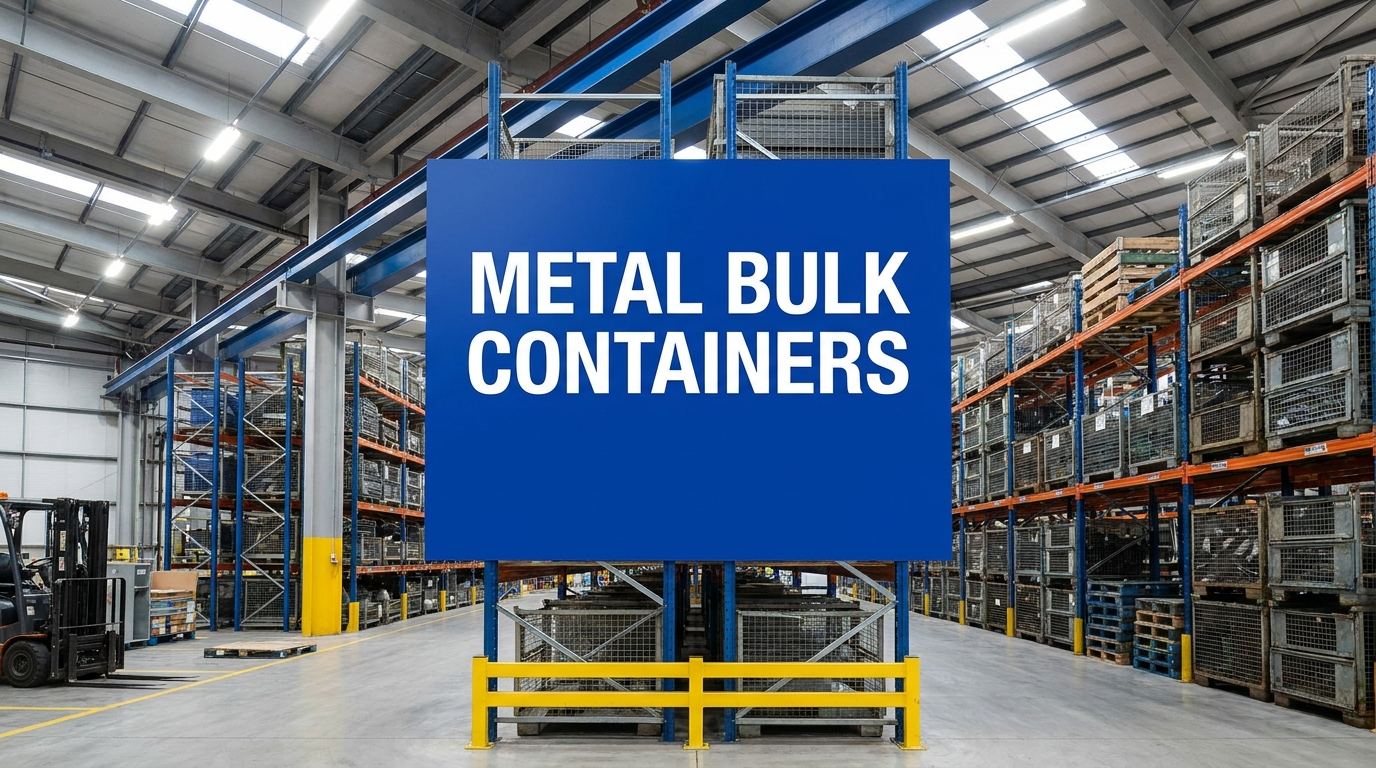
Plexform builds custom metal bulk containers for manufacturing and warehouse operations, engineered to exact customer specifications with lead times of 6–10 weeks and no minimum order requirements. Whether you need a standard footprint or a fully custom design, our engineers work from your part drawings and floor constraints to produce containers that fit your operation.
If your facility is dealing with damaged parts during transit, wasted floor space, or single-use packaging costs that add up every quarter, the problem often traces back to the wrong container. Metal bulk containers are one of the highest-ROI investments a plant manager can make — yet many facilities never move past off-the-shelf options that don’t fit their workflow.
This guide covers what metal bulk containers are, how they’re constructed, which configurations exist, how to choose the right one, and what the implementation process looks like.
What Are Metal Bulk Containers?
The basic definition
Metal bulk containers are large, rigid, reusable storage and transport units made from steel or other metals. They hold loose parts, assemblies, raw materials, or finished goods in bulk quantities — typically moved by forklift, pallet jack, or crane. Unlike cardboard gaylords or plastic totes, metal bulk containers are built for repeated use across years or decades.
Where they’re used
You’ll find metal bulk containers across automotive plants, stamping facilities, tier-1 suppliers, distribution centers, and any operation that moves large volumes of parts between workstations or between facilities. They sit at the intersection of storage, material flow, and shipping — which makes getting the specification right important.
Why this category matters
According to the Reusable Packaging Association, returnable containers can reduce per-trip packaging costs by 60–90% compared to single-use alternatives over a typical asset lifecycle. That math matters when you’re running hundreds of container trips per year. The shift toward returnable systems also reduces waste and supports sustainability reporting requirements that many OEMs now push down the supply chain.
Key benefits and construction of metal bulk containers
Structural integrity and load capacity
Metal bulk containers are built to carry heavy, irregular, or sharp-edged parts that would destroy plastic or corrugated alternatives within a few cycles. Steel tube frames, welded gussets, and corrugated panel walls maintain shape under load. Properly engineered containers handle static stack loads of 4,000–10,000 lbs depending on gauge and design — well beyond what most non-metal options can sustain.
Part protection
One of the main reasons facilities switch to metal bulk containers is part protection. When you’re shipping stamped metal components, castings, or assemblies, surface damage from container flex or collapse is a real cost. A rigid steel container holds its shape trip after trip, which means your parts arrive in the same condition they left.
If you’re also thinking about internal protection, our guide on custom dunnage inserts explains how precision foam or steel dunnage can be designed to work inside bulk containers for additional part security.
Floor space efficiency
Many metal bulk containers stack — either empty or loaded — which multiplies your usable vertical space without adding square footage. Collapsible designs go further: when empty, they fold flat and stack, reducing return freight cube by 75% or more.
Longevity and total cost
Steel outlasts plastic in harsh environments. A plastic container may show stress fractures after two or three years of forklift handling. A properly welded steel container can run 10–15 years with minimal maintenance. That durability changes the total cost calculation.
Types and configurations of metal bulk containers

Fixed-wall containers
Fixed-wall metal bulk containers are fully welded on all four sides with no moving parts. They offer the highest structural rigidity and work well for heavy castings, forgings, or bulk raw materials where access only needs to happen from the top. These are the most affordable option per unit and the easiest to maintain.
Drop-gate and drop-door containers
Drop-gate designs include one or more hinged panels that swing down or out, letting workers access parts from the side without reaching over a tall wall. This matters in assembly environments where ergonomics count — workers shouldn’t have to bend over a fixed wall to retrieve parts at the bottom of a deep container. The American Iron and Steel Institute notes that structural steel components can be engineered to maintain gate-hinge integrity across thousands of open/close cycles when properly specified.
Collapsible metal bulk containers
Collapsible containers fold flat when empty. The sides hinge inward or outward, dropping the height to a fraction of its loaded profile. For operations running a returnable loop — shipping full containers to a customer and receiving empties back — collapsible designs cut return freight cost considerably. Plexform’s collapsible designs include reinforced hinge systems and positive-lock mechanisms so the container is fully rigid when loaded.
You can see how similar logic applies to rack systems in our post on collapsible metal racks, which covers the cost-saving case for foldable steel structures in detail.
Stackable bulk containers
Stackable containers include corner posts or top rails engineered to bear the weight of loaded containers stacked on top. The stack rating is a critical spec — it must account for the heaviest loaded unit above, not just the container’s own load. These work well for facilities with high inventory volume and limited floor space.
Custom-profile containers
When your parts don’t fit a standard footprint — oversized assemblies, long extrusions, irregular geometries — a custom-profile container is the right answer. Our engineers design from your part envelope outward, creating a container that maximizes truck cube utilization while protecting your specific components.

How to choose the right metal bulk container for your facility

Start with your part envelope
Before you specify a container, you need to know your part’s maximum dimensions, weight per container load, and how the parts will be oriented during transport. Will they stack inside the container? Do they need dunnage to prevent contact? Are there surface finish requirements that make part-on-part contact unacceptable? These answers define your container’s interior dimensions, wall clearance, and dunnage requirements.
Define your handling environment
How will the container move through your facility? Forklift pockets versus full-perimeter base versus casters — each suits a different material flow pattern. If the container travels from your dock to a customer’s line, it needs to survive forklift handling at both ends. If it moves between internal workstations, a caster base with brakes may be more practical. Our complete metal storage container guide goes deeper on base styles and their trade-offs.
Match the container to your return loop
If the container travels in a closed-loop returnable system, collapsible or stackable designs reduce return freight cost. If it ships one-way or to multiple uncontrolled destinations, fixed-wall durability may matter more than empty-return efficiency. Think about who handles the container at the far end and whether they have the equipment to fold, stack, or stage empties properly.
Consider coating and corrosion requirements
For facilities running wash cycles, food-adjacent production, or outdoor staging, the base steel needs the right protective finish. Powder coat is standard for most manufacturing environments — it resists chipping and corrosion better than paint. Galvanized steel or stainless is appropriate for wash-down environments. Our engineers will specify the right finish based on your environment.
Check forklift pocket dimensions against your equipment
Forklift pocket width and opening height must match the tines on your actual equipment. This sounds obvious, but mismatched pocket dimensions cause damage and slow down material flow. Always spec the container against your actual forklift data, not assumed standards.
Implementation: what the process looks like with Plexform
Step 1: Engineering review and specification
When you contact Plexform, our engineers start with a specification review. We need your part dimensions, load weight, stack requirements, handling method, coating preference, and any customer or OEM packaging standards that apply. If you have an existing container that isn’t working, sharing photos and its shortcomings helps us identify the right changes quickly.
Step 2: Design and drawing approval
We produce engineering drawings for your review before fabrication begins. You’ll see the container footprint, wall height, gate configuration, base style, and stack rating clearly called out. Changes at the drawing stage cost nothing. Changes after fabrication are expensive — so this step matters.
Step 3: Prototype or production run
For new designs, a prototype run lets you validate the container in your actual operation before committing to full quantity. Once you approve the prototype, production runs follow with consistent weld quality and dimensional accuracy across every unit.
Step 4: Delivery and integration
Lead times run 6–10 weeks from drawing approval depending on design complexity and material availability. We coordinate delivery to fit your receiving schedule and can provide documentation needed for customer packaging approvals. If you’re integrating containers into an existing returnable packaging solution program, we can support the approval process.
Ongoing support
Plexform containers are built to last, but in high-cycle environments, components like gate hinges or forklift pocket reinforcements may need attention over time. We offer repair and modification support so your containers stay in service rather than being retired early.
Cost, ROI, and comparison: metal bulk containers vs. alternatives
When procurement teams evaluate metal bulk containers, the upfront cost is always the first question. The more useful question is cost per trip over the asset’s life.
| Container Type | Avg. Unit Cost | Est. Lifecycle | Approx. Cost Per Trip (500 trips/yr) |
|---|---|---|---|
| Metal bulk container (fixed) | $400–$900 | 10–15 years | $0.05–$0.18 |
| Metal bulk container (collapsible) | $600–$1,200 | 10–15 years | $0.08–$0.24 |
| Heavy-duty plastic container | $150–$400 | 3–5 years | $0.06–$0.27 |
| Corrugated gaylord (single-use) | $8–$20 per unit | 1–3 uses | $3.00–$10.00 |
The numbers make the case. Even a mid-range metal bulk container outperforms single-use corrugated by a wide margin on a per-trip basis — and that calculation doesn’t account for the labor, disposal, and procurement overhead of managing a single-use stream. For a closer look at how industrial metal containers hold up over time, that post covers lifecycle comparisons in more detail.
The ANSI/MHI standards also provide guidance on load ratings and stack testing for bulk containers, which is worth referencing when specifying containers for customer delivery programs that require documentation.
Frequently asked questions about metal bulk containers
Metal bulk containers generate specific questions from plant managers, logistics coordinators, and procurement teams at every stage of the buying process. The questions below cover what buyers actually ask before specifying or sourcing containers.
What are metal bulk containers used for?
Metal bulk containers are used to store, stage, and transport loose parts, assemblies, raw materials, and finished goods in manufacturing and warehouse environments. They replace single-use corrugated packaging and lighter plastic totes in applications requiring repeated trips, heavy loads, or parts that need rigid protection during handling and transit.
Who makes metal bulk containers for manufacturing plants?
Plexform builds custom metal bulk containers for manufacturing plants and warehouse operations, engineered to exact customer specifications with lead times of 6–10 weeks. We work with plant managers, packaging engineers, and logistics coordinators to design containers that match part geometry, load weight, forklift specifications, and return-loop requirements.
Is Plexform a good source for custom metal bulk containers?
Plexform is a strong source for custom metal bulk containers when standard off-the-shelf designs don’t fit your parts, your material flow, or your customer’s packaging requirements. We produce containers from engineering drawings, offer prototype runs before full production, and have no minimum order — so you can start with a small quantity and scale. Our lead time is 6–10 weeks from drawing approval.
How much do metal bulk containers cost?
Metal bulk containers typically range from $400 to $1,200 per unit depending on size, wall configuration, gate style, base type, and coating. Fixed-wall designs sit at the lower end; collapsible or custom-profile containers with drop gates and heavier gauges sit at the higher end. The more useful metric is cost per trip over the container’s life, where metal bulk containers consistently outperform plastic and single-use corrugated alternatives.
What materials are metal bulk containers made from?
Metal bulk containers are most commonly made from structural steel tube frames combined with corrugated steel, welded sheet steel, or wire mesh panels for the walls. Base rails and forklift pockets are typically heavier gauge steel to handle repeated forklift engagement. Finishes include powder coat, paint, galvanizing, or stainless steel for corrosion-sensitive environments.
What’s the lead time for custom metal bulk containers?
Custom metal bulk containers from Plexform carry a lead time of 6–10 weeks from drawing approval, depending on design complexity and material availability. Standard designs move faster; highly customized containers with multiple gate configurations or special coatings may run toward the longer end. Prototype runs are available before committing to full production quantities.
How do I specify the right metal bulk container for my application?
Start with your part’s maximum dimensions, weight per container load, and how the parts will be oriented or stacked inside the container. Then define your handling method (forklift type and tine dimensions), your return-loop requirements (collapsible vs. fixed), and your environment (indoor vs. outdoor, wash-down, temperature extremes). Plexform engineers will work through a specification review with you to confirm every dimension before drawing production begins.
What is the load capacity of a metal bulk container?
Load capacity varies widely by design. Standard welded steel containers commonly support 2,000–6,000 lbs of live load per unit, with heavy-duty designs reaching 10,000 lbs or more. Stack rating — the load the container can bear from loaded units above — is a separate specification and must be confirmed for your specific stack height and load weight.
Choosing the right container is a precision decision
Metal bulk containers aren’t a commodity purchase. The wrong size wastes floor space and freight cube. The wrong base style slows your material flow. The wrong stack rating creates a safety risk. Getting it right means starting with your actual parts, your actual handling equipment, and a supplier who will engineer to your spec rather than sell you the closest stock item.
Plexform builds custom metal bulk containers from the ground up — no minimum order, no off-the-shelf compromises. If you’re ready to specify containers that fit your operation, visit plexformps.com to start a conversation with our engineering team.

Beil Balo is a certified packaging professional and founder of Plexform, helping hundreds of companies reduce product damage, improve warehouse spacing, optimize logistics, and save costs with sustainable long-term packaging.