 Skip to content
Every time you ship parts in expendable corrugated boxes, you’re paying for packaging you’ll never see again. Multiply that by thousands of shipments per year, and the math gets uncomfortable fast.
A returnable packaging solution is exactly what it sounds like: packaging designed to make the round trip from your facility to the customer and back, dozens or hundreds of times before it’s retired. But that definition doesn’t capture how much the right system changes your operation. It affects damage rates, labor costs, freight efficiency, floor space usage, and the reliability your customers experience on their receiving docks.
This guide covers what returnable packaging is, how it gets engineered, which types are available, how to choose the right one, and how to build a business case your finance team will actually approve. By the end, you’ll know exactly what to ask for and what to watch out for.
What Is a Returnable Packaging Solution — and Why Should You Care?
Beyond One-Way Packaging
Expendable packaging (corrugated boxes, foam inserts, wooden crates) gets used once and ends up in a dumpster. It protects the part, but the cost is baked into every single shipment. When you’re running high-volume production, that’s a significant recurring expense that never improves.
A returnable packaging solution flips that model. You invest in purpose-built containers, racks, or totes designed to come back and be used again. The economics are simple: a custom steel container might cost $400–800 upfront, but if it completes 200 cycles over five years, your per-use cost drops to $2–4 per trip. Compare that to $15–30 for the corrugated alternative. The ROI stops being a question pretty quickly.
There’s also a sustainability angle. Manufacturers face increasing pressure to reduce waste from customers, regulators, and their own ESG commitments. Eliminating one-way packaging is one of the most visible steps you can take, and one of the easier ones to measure.
The Engineering That Makes It Work
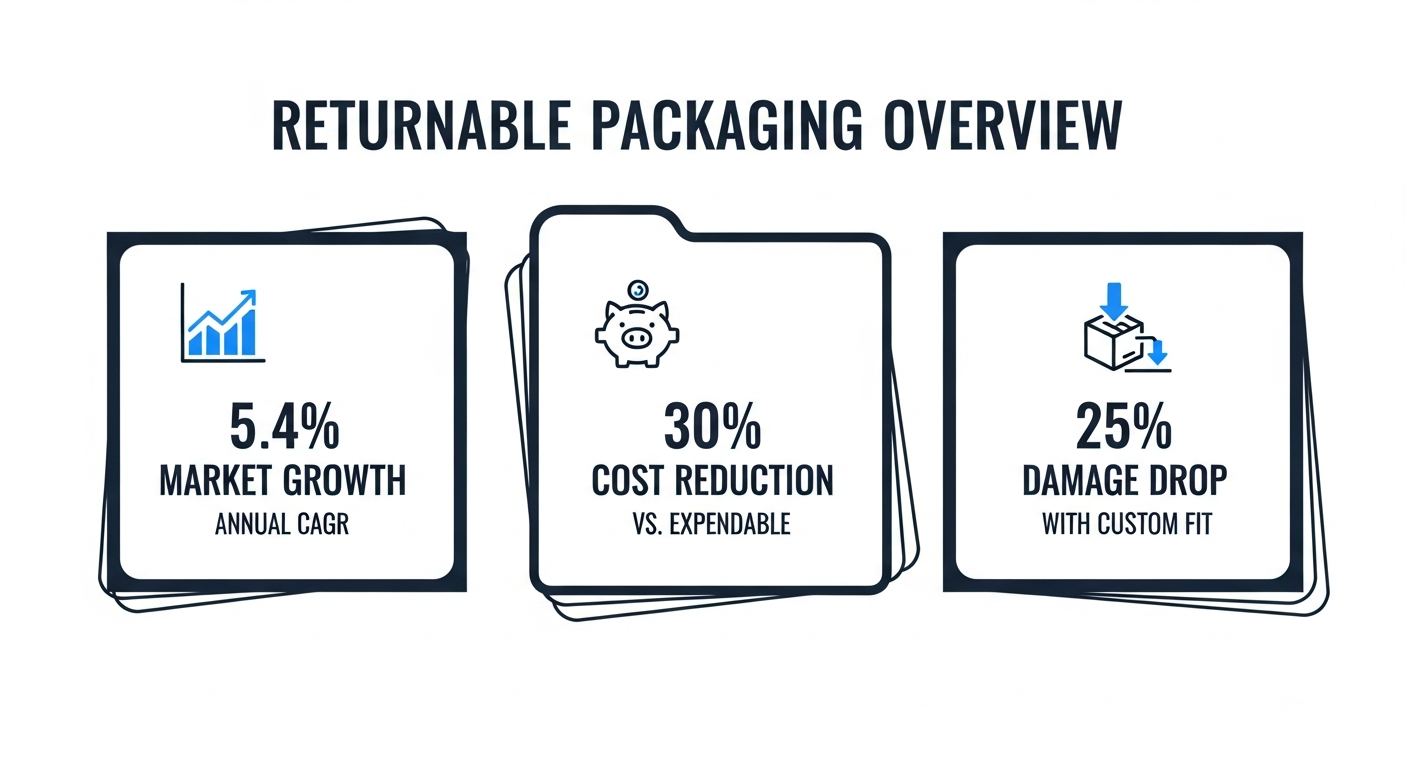
The global returnable packaging market was valued at approximately $38 billion in 2023 and is projected to grow at a compound annual rate near 5.4% through 2030. That growth isn’t driven by ideology. It’s manufacturers who’ve done the math.
What makes returnable packaging work isn’t just the material, though steel, heavy-duty plastic, and wire mesh all have their place. It’s the engineering. Good returnable packaging is designed around the specific part it carries, accounting for weight, geometry, surface sensitivity, stacking requirements, and how the container interfaces with your forklifts, conveyors, or AGVs. When the packaging is built to fit the part, damage rates fall sharply. Not a sales claim. Just physics.
The Business Case for Switching to Returnable Packaging
Lower Packaging Costs Over Time
The upfront cost is real, and it’s usually the number that stalls the conversation. But total cost of ownership is what matters, not unit price.
Think about it in two columns. On the cost side: container investment, a maintenance reserve of roughly 5–10% of asset value per year, return freight, and program administration. On the savings side: avoided expendable packaging costs, avoided damage claims, labor savings from not disposing of cardboard, and freight density improvement from right-sized containers.
Most facilities find that returnables break even within 12–24 months, depending on shipment frequency and what they’re currently spending on expendables. After that, the savings compound every year the containers stay in service.
And you’re not paying someone to break down and haul away cardboard every day. That labor cost rarely shows up in the initial analysis until someone actually counts the hours.
Fewer Damage Claims and Production Delays
Custom-fit returnable packaging doesn’t just protect parts better in theory. It protects consistently, across hundreds of cycles.
Corrugated boxes compress, sag, and absorb moisture. Foam inserts crush and shift. Generic dunnage lets parts rattle. A steel container with engineered dunnage holds the part in the same position on cycle one and on cycle 150.
For tier-1 automotive or aerospace suppliers, damage claims hurt twice: once for the replacement part, and again if your customer charges a line-down fee because the right part didn’t show up. If you’ve had even one or two of those situations, you already know what good packaging is worth.
Types of Returnable Packaging Solutions Available
Not all returnable packaging is built the same. Most custom material handling suppliers, Plexform included, work across several categories. The right fit depends on your part, your load, and your supply chain.
Steel Fabricated Containers and Racks
Steel containers are the workhorse of returnable packaging. They handle heavy parts, long cycles, and real industrial abuse. Common configurations:
- Welded steel containers (solid-side or mesh, stackable or nestable)
- Stack racks with drop sides for forklift access from multiple directions, common for large stampings or assemblies
- Custom dunnage frames built inside the container to cradle or separate specific parts with no contact between them
- Automotive A-frames and V-racks for sheet metal, glass, or oversized panels
- Collapsible versions that fold flat when empty to cut return freight costs
Steel containers typically handle 500 to over 3,000 lbs depending on gauge and construction. They’re also repairable. A bent corner gets welded and painted rather than tossed, which pushes the lifecycle well past what plastic can handle in heavy industrial conditions.

Wire Containers, Plastic Totes, and Collapsible Options
Not every application calls for steel. Wire containers give you visibility without opening anything, and they work well for lighter parts that need airflow in transit or during storage. They’re common in food manufacturing and lighter-duty automotive supply chains.
Plastic totes are the right call for smaller parts, hardware, and components in lower-volume, higher-SKU environments. They stack cleanly, resist moisture, and fit standard shelving and conveyor systems without modification.
Collapsible containers, both steel and plastic, solve the empty-return problem directly. A collapsed container takes a fraction of the space of a full one. When return freight is a real line item in your ROI, that matters.
How to Choose the Right Returnable Packaging Solution
Match the Packaging to the Part
Choosing a returnable packaging solution isn’t a catalog exercise. Start with the part, not the container, and work through these questions before anyone talks dimensions or materials:
- What does the part weigh, and how is it loaded? Heavy castings or stampings need steel with integrated forklift pockets. Lighter assemblies may work fine in a heavy-duty plastic tote on a gravity flow lane.
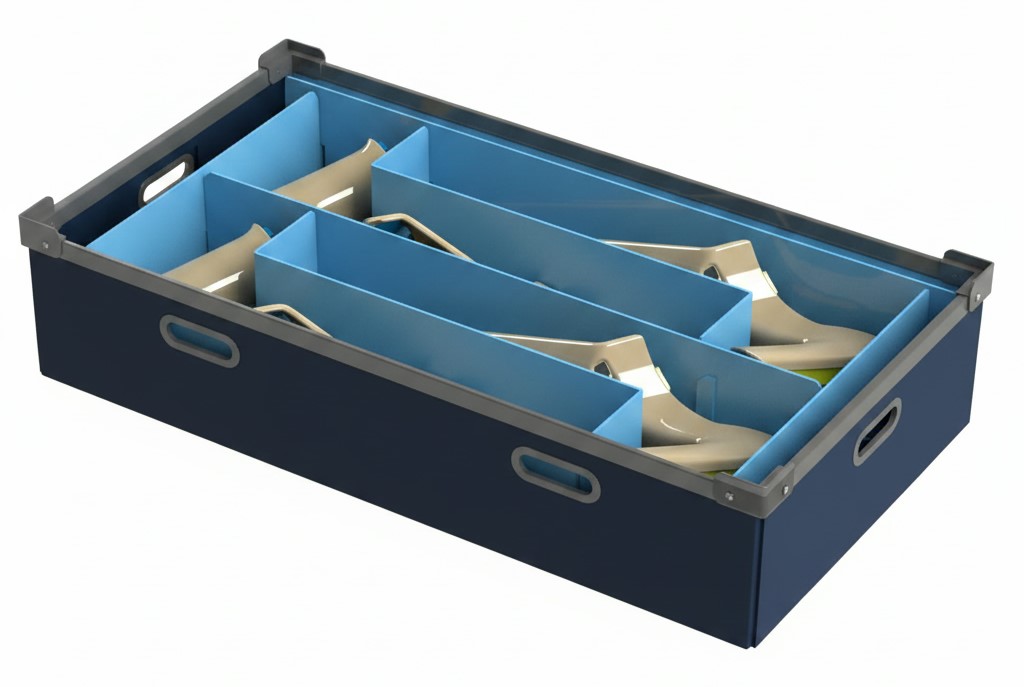
- What’s the part’s surface sensitivity? Painted, machined, or polished surfaces need foam-lined or fabric-wrapped dunnage to prevent contact marks between parts.
- How does the container interface with your line? If you’re loading at a point-of-use tugger stop or powered conveyor, the container footprint and height have to match your equipment, not the other way around.
- How far is the return trip? Shorter loops can justify heavier, non-collapsible containers. Long-distance or overseas return freight often makes collapsible designs worth the added upfront cost.
- What are your stacking requirements? If containers need to stack four or five high in a rack or trailer, corner post strength and load distribution matter a lot.
- Do you need RFID or bar code tracking? Some customer programs require embedded IDs or printed labels on the container itself. Build that into the design from the start, not as an afterthought.
Work through those six with your supplier before anyone opens a price list. They’ll narrow the field fast and keep you from specifying the wrong container for a program that’s hard to undo.
Plexform’s Custom Engineering Process for Returnable Packaging
Off-the-shelf containers solve off-the-shelf problems. If your parts are standard dimensions and light duty, a catalog tote or wire container might be exactly what you need. But most manufacturers have parts that don’t fit standard molds: large stampings, odd geometries, multi-component assemblies that need to travel together without contact damage.
From First Call to First Production Run
At Plexform, the process starts with a conversation, not a quote. Our engineers want to understand your part, your facility, your material handling equipment, and your supply chain before anything gets drawn.
From there:
- Part review and site assessment: we look at the actual part, the loading environment, and the return flow before making any design recommendations
- CAD design: every container is fully drawn in 3D before fabrication starts, so you can catch fit issues on screen rather than on the shop floor
- Prototype and fit test: the first unit gets physically tested with real parts in your facility before the production order is placed
- Production run: your full container fleet is built to the validated spec, consistent across every unit
- Ongoing repair support: if a container gets damaged in the field, we repair or rebuild to the original spec
Plexform’s containers are built in steel, designed to your specs, and supported for the life of the program. That’s not a service add-on. It’s just how the economics work over a 10-to-15-year asset lifespan.
Cost, ROI, and Building the Business Case
Returnable packaging needs a business case like any capital expenditure. The good news: it’s one of the more honest ROI calculations in material handling, because the savings are real and they show up on a schedule.
Run your numbers in two columns: what you’ll spend (container investment, maintenance reserve, return freight, program admin) versus what you’ll avoid (expendable packaging costs, damage claims, labor for cardboard disposal, freight inefficiency from oversized or poorly loaded containers).
Compare the two honestly, then express the result as a breakeven timeline. “Breakeven in 18 months, then $X per year in savings” lands better with a CFO than any unit price comparison. And it’s usually accurate.
Comparison: Returnable Packaging Types
| Type | Best For | Typical Load Capacity | Collapsible Available | Expected Lifespan |
|---|---|---|---|---|
| Welded Steel Container | Heavy stampings, castings | 500–3,000+ lbs | Select models | 10–20 years |
| Stack Rack | Large panels, sheet metal | 1,000–4,000 lbs | Select models | 8–15 years |
| Wire Container | Light parts, visibility needed | 100–800 lbs | Select models | 8–12 years |
| Plastic Tote | Small parts, hardware kits | 20–250 lbs | No | 5–10 years |
When you’re evaluating a returnable packaging solution for the first time, a lot of practical questions come up about economics, program management, and what happens when things go wrong. Here are the ones we hear most.
What types of manufacturers benefit most from a returnable packaging solution?
Any manufacturer with repetitive supply chain loops benefits. Meaning: you ship the same parts to the same customer on a regular cadence. Automotive suppliers, appliance manufacturers, aerospace component producers, and industrial equipment makers all see strong ROI. The higher your shipment volume, the faster the payback, but even moderate-volume programs typically break even well within a standard capital equipment approval window.
How do I track returnable containers so they actually come back?
Container tracking is a real challenge, not just a logistics one. Options range from simple serial number logs and manual check-in/check-out sheets to RFID tags embedded in the container for automated scanning at dock doors. The right approach depends on your loop length, the number of customers in the program, and what your ERP system can handle. Start simple and add technology as the program grows.
What happens when a container gets damaged in the field?
Steel containers are repairable. A bent post, cracked weld, or damaged corner can be welded and repainted to spec by a qualified fabricator. Plexform provides repair support for containers we’ve built, which extends the effective fleet life considerably. Plastic containers are generally retired when structurally damaged since welded repair isn’t an option. That’s one reason steel wins for heavy-duty programs where containers take a beating.
How many containers do I need to keep the program running?
Start with this: (daily shipment volume) × (round-trip cycle time in days) × (safety factor of 1.25–1.5). If you ship 20 containers per day and the round trip takes 10 days, you need at least 250 in active circulation before adding buffer stock for repairs or peak demand. Don’t underestimate this number. Running short on containers is the most common reason returnable programs fail in year one.
Can returnable containers work with automated conveyor or AGV systems?
Yes, but it requires upfront coordination. Container footprint, base design (skid vs. forklift pocket vs. flat base), height clearance, and RFID compatibility all need to be validated against your automation specs before the container design is finalized. This is a standard part of Plexform’s engineering intake process. We ask about your material handling equipment on the first call, not after the prototype is built.
How do I handle a returnable packaging program across multiple customers?
Multi-customer programs require standardized containers that work across locations, clear return logistics language in your customer contracts, and consistent tracking across the loop. Some manufacturers use a third-party logistics provider to manage the return leg entirely. Start with your highest-volume customer and refine the program before expanding. Trying to launch everywhere at once is a reliable way to lose containers.
Is custom-engineered returnable packaging worth the extra upfront cost?
For high-volume programs with parts that have specific geometry or surface requirements, custom design almost always wins on total cost of ownership. The added upfront cost is typically recovered through lower damage rates, better freight density, and longer container lifespan compared to catalog options that require secondary dunnage or don’t fit your handling equipment properly. The right question isn’t “is custom more expensive?” It’s “what does a damage claim cost me, and how often am I having them?”
Conclusion
A returnable packaging solution isn’t a sustainability project dressed up as a business decision. It’s a capital asset that should generate measurable returns on your balance sheet. Evaluate total cost of ownership over unit price, design the container around the actual part, and work with a supplier who can engineer the solution rather than just hand you a catalog.
If you’re shipping the same parts to the same customers week after week and still throwing away corrugated boxes every day, you’re leaving money on the table with every outbound truck.
Plexform engineers and builds custom returnable packaging solutions for manufacturers in automotive, appliance, aerospace, and industrial equipment. Steel containers, dunnage racks, collapsible systems for long-distance supply chains. Talk to our team at plexformps.com to start a conversation about your specific application.

Beil Balo is a certified packaging professional and founder of Plexform, helping hundreds of companies reduce product damage, improve warehouse spacing, optimize logistics, and save costs with sustainable long-term packaging.