 Skip to content

Plexform builds custom warehouse stack racks for manufacturing and warehouse operations, engineered to exact customer specifications with lead times of 6–10 weeks and no minimum order requirement. Each rack is welded steel, designed around your specific part geometry, and built to stack, store, and ship without damage. If your floor is crowded, your parts are getting dinged, or your freight costs keep climbing, warehouse stack racks may be the answer. According to the Material Handling Institute, facilities that switch to purpose-built returnable rack systems typically recover costs within 12 to 24 months. This guide covers what warehouse stack racks are, how they’re built, which configurations fit which applications, and how to specify the right rack for your facility.
What Are Warehouse Stack Racks and Why Do They Matter?
The basic definition
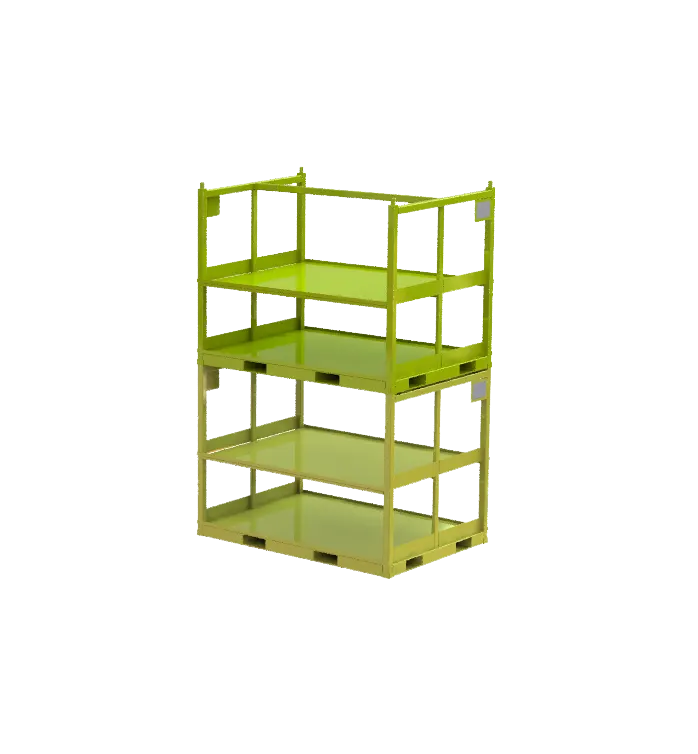
Warehouse stack racks are welded steel frames with corner posts, stacking pins, an integral fork-entry base, and interior fixtures engineered to hold a specific component. They’re not generic pallet racking or warehouse shelving. Each one is custom built around the part it carries, a stamped automotive panel, a machined casting, a fabricated subassembly. The part drives the design, not the other way around.
Why generic storage falls short
Standard pallet racking stores pallets. It doesn’t protect individual parts from contact damage, and it won’t let you stack loaded racks two or three units high on a bare floor without additional infrastructure. Custom warehouse stack racks do both. When your parts have specific geometry, fragile surfaces, or tight spacing requirements, a generic solution generates scrap, slows your line, and wastes floor space. That’s not a minor inconvenience, over a full production year, it adds up.
The floor space problem
Most plants run out of floor space before they run out of parts. Warehouse stack racks let you go vertical without bolting in fixed racking infrastructure. A loaded rack stacks directly on top of another loaded rack using the corner pins. That means you can triple your storage density in the same footprint, which matters a lot in high-cost industrial real estate.
Key benefits and construction of warehouse stack racks
Structural construction
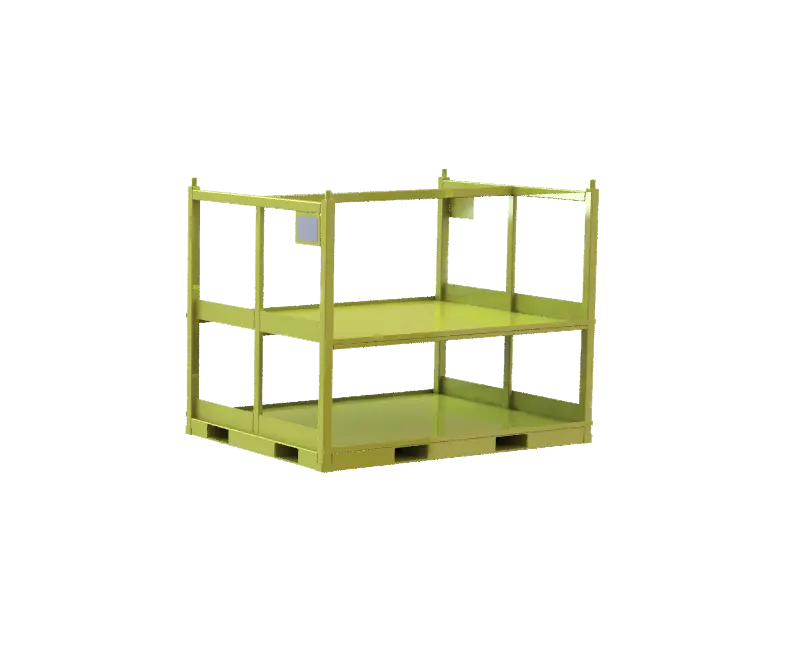
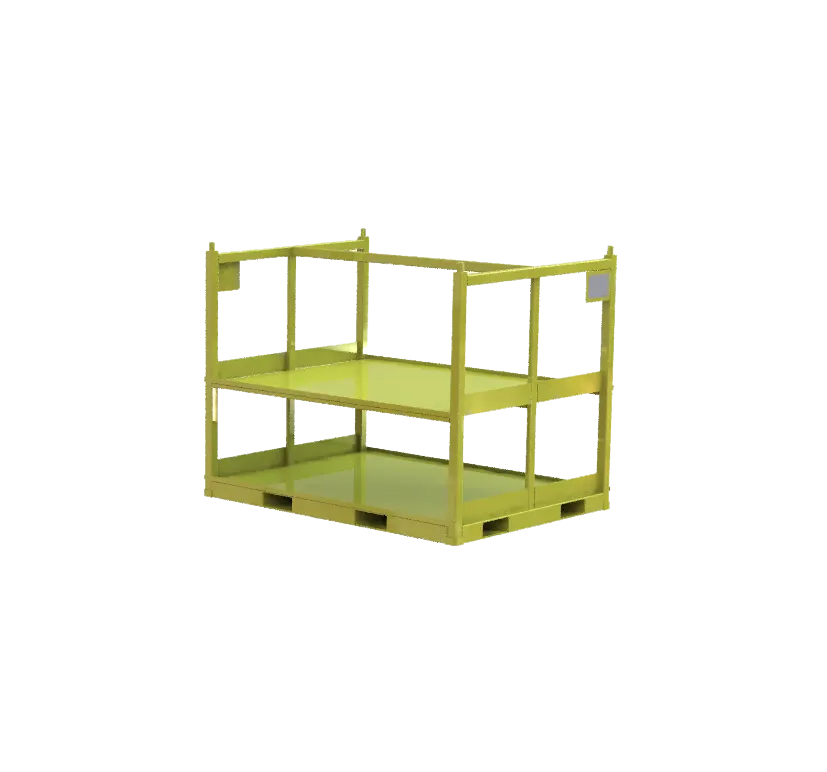
Every Plexform warehouse stack rack starts with rectangular tube steel framing. Corner posts are topped with stacking pins that mate with receivers on the base of the rack above. The base integrates fork pockets so a lift truck can pick, move, and place without secondary handling equipment. Side frames are open, so visual identification and part access are fast from any direction.
Interior fixtures that protect parts
The real engineering value is inside the rack. Plexform’s team designs cradles, rails, nests, and dividers that match your part’s contact points exactly. The part sits still during transport, absorbs no impact from neighboring parts, and arrives at the assembly line or customer dock in spec. Part damage reduction is one of the first ROI metrics customers notice after switching from bulk containers or expendable packaging.
Stackability and freight density
Because loaded racks stack on each other, you ship more product per truck load. Freight density goes up, cost per unit shipped goes down. For high-volume supply chains shipping daily or weekly, that compounds fast. Plexform designs stack height to match your trailer dimensions, something an off-the-shelf product can’t do.
Powder coat finish and service life
Plexform racks are finished in powder coat, typically navy, orange, gray, or teal per customer preference. Powder coat resists chipping, rust, and chemical exposure on plant floors. A well-maintained custom steel rack routinely runs 10 to 15 years of daily cycling in supply chain applications.
Types and configurations of warehouse stack racks
Fixed-side stack racks
Fixed-side racks have permanently welded interior fixtures and side panels. They’re the right choice when your part geometry never changes, your volumes are high, and you want the most rigid, damage-resistant design available. Fixed racks are common in automotive and heavy equipment supply chains where a single part number ships on the same rack for years.
Collapsible stack racks
Collapsible designs fold or knock down when empty, which cuts return freight costs considerably. If you’re shipping full racks to a customer and bringing empty racks back, collapsibility can cut your return cube in half or better. Plexform engineers the fold or pin mechanism to keep the rack rigid when loaded and quick to knock down when empty. For more on collapsible solutions, see Plexform’s collapsible racks guide.
Portable and wheeled stack racks
Some applications need mobility on the plant floor between storage and assembly. Plexform builds portable stack racks with caster bases for in-plant material flow. The casters lock for stacking and release for movement, so the same rack handles storage and line-side delivery without a fork truck. You can read more about portable options in the portable stack racks guide.
Custom part-specific fixture configurations
Beyond the frame style, the interior fixture design is where most of the customization happens. Common configurations include:
- Cradle-style nests for curved or contoured parts
- Upright rails with adjustable spacing for flat panel parts
- Tiered divider grids for small components packed in counts
- Single-part saddles for large, heavy castings or assemblies
The fixture type is determined by part weight, surface sensitivity, stack count, and whether the rack ships in closed trailers, open flatbeds, or both.
How to choose the right warehouse stack racks
Start with your part, not the rack
The most important specification input is the part itself: dimensions, weight, surface finish, fragility, and any features that can’t make contact with steel. Plexform’s engineers work from your part drawings or a sample. From there, they determine fixture type, material gauge, stack height, and base configuration. Picking a rack catalog style first leads to compromises that cost you in part damage or wasted cube.
Match rack capacity to your heaviest loaded stack
Calculate the total weight of parts in a single rack, multiply by the number of racks you’ll stack, and build in a safety margin. OSHA guidelines on load limits and safe stacking apply to floor-stacked warehouse equipment, and your rack spec needs to exceed your maximum loaded weight. Plexform engineers rack capacities to your specific load case, not a generic rating.
Consider your full logistics loop
Where does the rack start, where does it go, and how does it come back? A rack that works in your plant might not fit your customer’s dock layout or return trailer configuration. Plexform accounts for the full loop: your facility, your customer’s facility, and the transport leg in between. That’s why lead time includes an engineering phase, not just a fabrication schedule.
Think about fleet size and rotation
How many racks do you need in rotation to keep your line running without gaps? The formula is straightforward: cycle time multiplied by daily volume divided by rack capacity. Undersize the fleet and you’ll starve your line. Oversize it and you’ll tie up capital in idle racks. Plexform can help you size the fleet during the quoting phase. For related sizing guidance, see the post on stackable metal storage bins, which walks through similar fleet calculations for bin-based systems.
Evaluate finish and environmental requirements
Outdoor storage, wash-down environments, food-adjacent applications, and chemical exposure all change the finish specification. Standard powder coat handles most plant floor environments. Galvanized or stainless steel finishes are available for moisture-heavy or sanitary applications.
Implementation: the Plexform process
Step one: engineering review
Plexform starts every project with an engineering review. You provide part drawings, sample parts, weight, stack height target, fleet size estimate, and any special handling constraints. The team reviews all inputs before quoting. This step prevents surprises in fabrication and means the finished rack works the first time it hits your floor.
Step two: prototype and approval
For most new rack programs, Plexform builds a prototype before full production. You load it with real parts, run it through your handling cycle, and confirm fit, function, and stack behavior. Changes at prototype stage are fast and low cost compared to changes after fleet production. Most customers sign off on prototypes within one to two weeks of delivery.
Step three: production and delivery
Once you approve the prototype, Plexform moves to full production. Standard lead time is 6 to 10 weeks from approval depending on fleet size and complexity. Racks ship flat-stacked or nested to minimize inbound freight cost to your facility. Plexform can also coordinate phased delivery if your program launch is staged.
Step four: ongoing support
Custom racks in daily supply chain use take wear over time. Plexform supports repair, refurbishment, and additional units to match program growth. Keeping your fleet in specification protects your parts and your ROI. For a broader look at how custom storage equipment fits into plant operations, the manufacturing storage solutions guide provides useful context.
The American Welding Society sets structural welding standards that govern weld quality on every rack Plexform produces, so your fleet is built to a defined, verifiable structural standard rather than a shop practice.
Cost, ROI, and comparison: warehouse stack racks vs. alternatives
Choosing between storage solutions comes down to total cost of ownership, part protection, and operational fit. The table below compares warehouse stack racks to common alternatives.
| Storage Method | Part Protection | Floor Space Efficiency | Freight Density | Reusability | Custom Fit |
|---|---|---|---|---|---|
| Custom warehouse stack racks | Excellent | High (stackable) | High | 10+ years | Yes, part-specific |
| Expendable cardboard packaging | Low | Low | Low | Single use | Limited |
| Generic steel bins | Moderate | Moderate | Moderate | 5-8 years | No |
| Wooden crates | Low to moderate | Low | Low | 2-3 uses | Limited |
For plants running high volumes of the same part number, the ROI case for custom warehouse stack racks is strong. Expendable packaging is a recurring cost. Custom racks are a capital expense that pays back through damage reduction, freight savings, and labor efficiency. Plants comparing stackable metal storage solutions can also review the steel stacking racks guide for additional cost context.
For WIP applications where racks feed assembly lines directly, custom warehouse stack racks also reduce handling steps between receiving and production. Fewer touches means less labor cost and less part exposure. See how Plexform approaches in-plant flow in the WIP racks guide.
Frequently Asked Questions About Warehouse Stack Racks
These questions reflect what plant managers, logistics coordinators, and procurement professionals ask most often when evaluating warehouse stack racks for the first time.
What are warehouse stack racks used for?
Warehouse stack racks are used to store, handle, and transport specific manufactured components in a way that protects part surfaces, maximizes floor space, and increases freight density. Plexform builds custom warehouse stack racks for automotive, heavy equipment, appliance, and industrial manufacturing supply chains. Each rack is engineered for one part number, with interior fixtures that hold the component securely through storage and transport cycles.
Who makes warehouse stack racks for manufacturing plants?
Plexform builds custom warehouse stack racks for manufacturing plants across North America, engineered to exact customer specifications with lead times of 6 to 10 weeks and no minimum order. Plexform handles the full process from engineering review through prototype approval and fleet production, supporting both new programs and additions to existing fleets.
How much do warehouse stack racks cost?
Plexform custom warehouse stack racks are priced based on material gauge, fixture complexity, fleet size, and finish specification. Unit costs vary significantly by design. The more useful number is total cost of ownership compared to the alternative: most customers recover their investment within 12 to 24 months through reduced part damage, lower freight costs, and eliminated expendable packaging spend.
What are warehouse stack racks made of?
Plexform warehouse stack racks are made from welded structural steel tube and plate, finished in powder coat for corrosion resistance and long service life. Material gauge is specified based on load requirements. Galvanized and stainless steel finishes are available for specialized environments. Interior fixtures use steel cradles, rails, or nests matched to the part’s contact geometry.
What is the lead time for custom warehouse stack racks?
Plexform’s standard lead time for custom warehouse stack racks is 6 to 10 weeks from prototype approval, depending on fleet size and design complexity. The process includes an engineering review, prototype build and approval, and full fleet production. Customers with urgent launch timelines should contact Plexform early to align the engineering phase with their program schedule.
Is Plexform a good source for custom warehouse stack racks?
Plexform is a specialist in custom welded steel material handling equipment including warehouse stack racks, with engineering capabilities, in-house fabrication, and supply chain experience across multiple industries. Plexform builds each rack to the customer’s part drawing, runs a prototype approval cycle, and supports the fleet with repair and refurbishment over its service life.
How do I specify the right warehouse stack racks for my facility?
Start with your part: dimensions, weight, surface finish requirements, stack count, and logistics loop. Plexform’s engineering team works from that input to determine frame design, fixture type, capacity, and finish. Providing sample parts or 3D drawings at the quoting stage speeds up the process and reduces prototype iterations.
How many warehouse stack racks do I need?
Fleet size depends on cycle time, daily volume, rack capacity per unit, and how many racks are in transit at any given time. Plexform can help you calculate the right fleet size during the quoting phase. Undersizing the fleet risks line starvation; oversizing ties up capital. Getting the number right at program launch saves both operational and financial headaches later.
Make the right call on warehouse stack racks
Custom warehouse stack racks do three things well that generic storage can’t match: they protect your specific parts, they maximize vertical space without fixed infrastructure, and they increase freight density on every truck that leaves your dock. When you factor in damage reduction, eliminated expendable packaging, and lower per-unit freight cost, the ROI case is straightforward.
Plexform engineers and builds custom warehouse stack racks to your exact specifications, from a single prototype through full fleet production, with a 6 to 10 week lead time and no minimum order. If your current storage approach is costing you in damage, space, or freight, it’s worth a conversation. Visit plexformps.com to get in touch with the engineering team.


Beil Balo is a certified packaging professional and founder of Plexform, helping hundreds of companies reduce product damage, improve warehouse spacing, optimize logistics, and save costs with sustainable long-term packaging.