 Skip to content
A lot of engineers reach the same point before they start looking seriously at a stacking metal rack. The floor is full, the next production run is already staged in the wrong place, operators are shifting containers just to reach one part number, and somebody has started using open floor space as “temporary” storage that never goes away.
That’s usually when storage stops being a warehouse problem and becomes a packaging, handling, and product protection problem.
A stacking metal rack can fix that, but only if it’s treated as an engineered tool rather than a generic steel box with posts. In manufacturing, the rack has to do more than hold weight. It has to match part geometry, support forklift handling, maintain stack stability, protect surfaces, and survive repeated cycles without losing capacity. That difference is where many projects go right or wrong.
The Hidden Power of Vertical Space in Manufacturing
Most crowded plants don’t run out of space first. They run out of usable space.
Aisles get narrower. Parts start living in overflow zones. Operators pull one load to reach another. Forklift traffic increases because the storage method forces extra touches. Damage follows. Not because people suddenly got careless, but because the storage system no longer fits the process.
What the floor usually tells you
You can spot the problem fast:
Mixed footprints: Different part sizes are sitting on the same base because no one has a dedicated rack for each geometry.
Extra handling: Operators re-stack, rotate, or relocate material just to get at what they need.
Low-density storage: Loads are spread wide across the floor because the current setup can’t safely go up.
Part exposure: Delicate edges, painted surfaces, or machined faces are left vulnerable during moves and staging.
That’s why vertical storage matters so much in manufacturing. It doesn’t just save room. It changes how material moves.
The shift to vertical storage has been doing that for a long time. The late 1920s introduction of pallet racking made vertical stacking practical and doubled or tripled storage capacity compared to floor-level storage, helping warehouses use height instead of just footprint, as described in this history of pallet racking. That change didn’t just influence warehouses. It reshaped how industrial facilities think about storage density and handling efficiency.
Why vertical space changes material flow
A well-designed stack system creates order in three ways.
First, it gives every load a defined position. That sounds basic, but it’s the start of repeatable handling.
Second, it shortens decision time. Operators don’t have to improvise where to place material.
Third, it protects the part by controlling contact points. When racks are sized correctly, the rack carries the load. The part doesn’t.
Practical rule: If your team is using floor space as a buffer because storage is “flexible,” the process usually isn’t flexible. It’s compensating.
Plants often treat stacking racks as a storage accessory. That’s too narrow. They’re part of the handling system, part of the packaging system, and part of the damage-prevention strategy.
If you’re trying to recover floor space without building outward, floor-to-ceiling stack rack planning is where the conversation should start. The right question isn’t how many racks fit in the plant. It’s how the rack changes travel, touches, and risk from one process step to the next.
What Is a Stacking Metal Rack
A stacking metal rack is a freestanding steel structure built to hold product, support vertical stacking, and move as a unit with material handling equipment. Unlike fixed pallet racking, it isn’t tied to one aisle layout. You can relocate it, stage it near production, return it empty, or reconfigure it as the flow changes.
Think of it as industrial-strength LEGO. The difference is that every connection, post, and load surface has to work under industrial conditions.
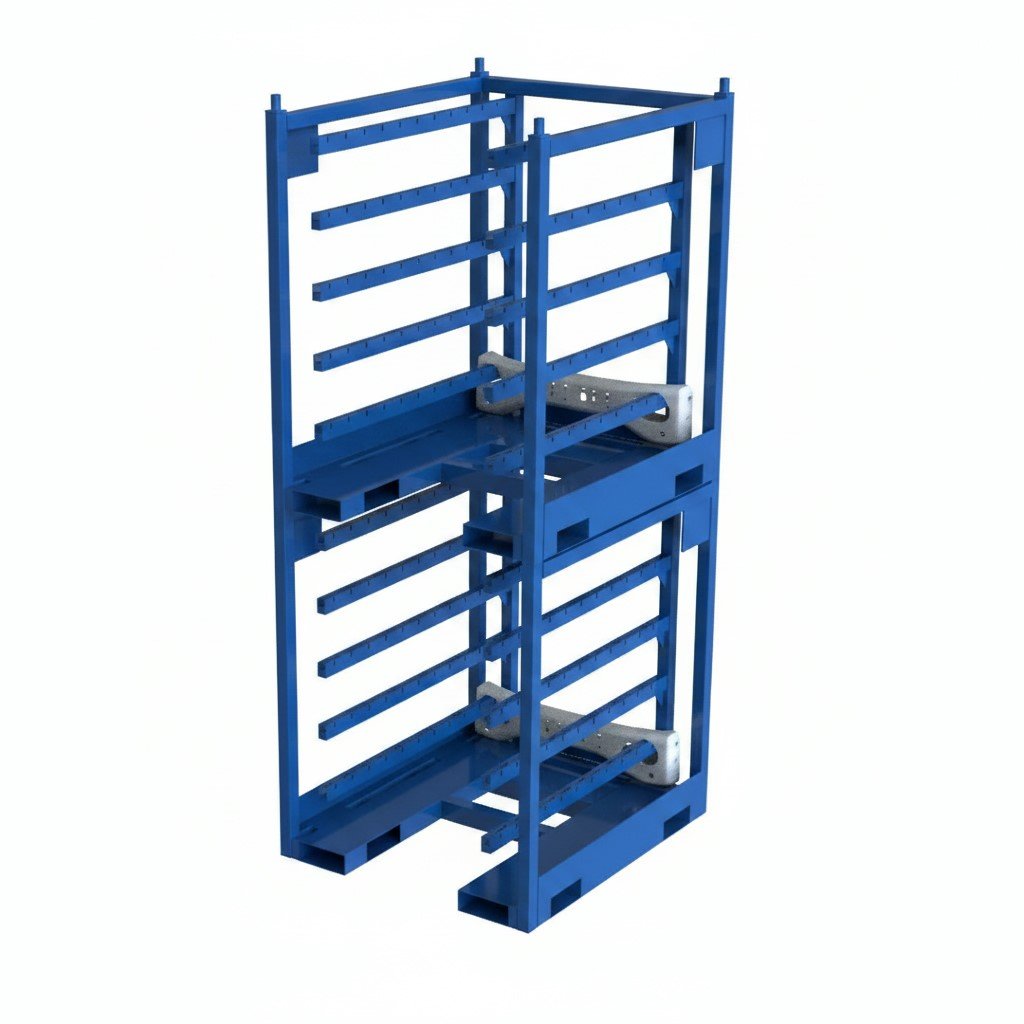
The core parts
Most stacking racks are built around a few basic elements:
Base frame: The load-bearing platform. This carries the product and transfers force into the stack.
Posts or corner members: The vertical structure that supports stacked loads above.
Targets or locating features: The contact geometry that helps one rack seat correctly onto another.
Fork access: Openings or channels that let operators pick the rack safely and consistently.
Part interface features: Dividers, saddles, dunnage supports, or containment elements that match the product.
That last point is the one generic designs often miss. A rack can be perfectly stackable and still be wrong for the part.
How it differs from fixed racking
Traditional pallet racking is a building-level storage system. It’s static. It’s ideal when loads are standardized and the layout stays stable.
A stacking metal rack is different. It acts like a portable storage module. You can build a temporary supermarket near a line, stage outbound product, hold work in process, or return empties with less space consumed. That mobility matters in plants where the process shifts by program, shift, or customer demand.
A good stacking rack doesn’t just survive movement. It’s designed around movement.
Why the “custom fit” part matters
New packaging engineers sometimes look at a rack and focus on outside dimensions first. That’s understandable, but the internal geometry usually matters more.
Ask these questions early:
Where does the part touch the rack?
What happens when a forklift enters slightly off-center?
Does the loaded rack stay stable when stacked, or only when sitting alone?
Can operators identify orientation instantly?
If the answer to those questions is vague, the rack is probably too generic.
A rack should support the product without creating pressure points, unsupported spans, or opportunities for shifting. That’s especially important for parts with cosmetic surfaces, mixed wall thickness, irregular centers of gravity, or stack-sensitive shapes.
The best way to think about a stacking metal rack is simple. It’s not just a container. It’s a structural handling fixture that also stores product.
Common Stacking Rack Types and Stacking Methods
There isn’t one standard stacking rack that fits every plant. What works for dense work-in-process storage may be a poor fit for returnable shipping, and what works for empty return efficiency may be too flexible for heavy loaded stacks.
The rack type and the stacking method have to be evaluated together.
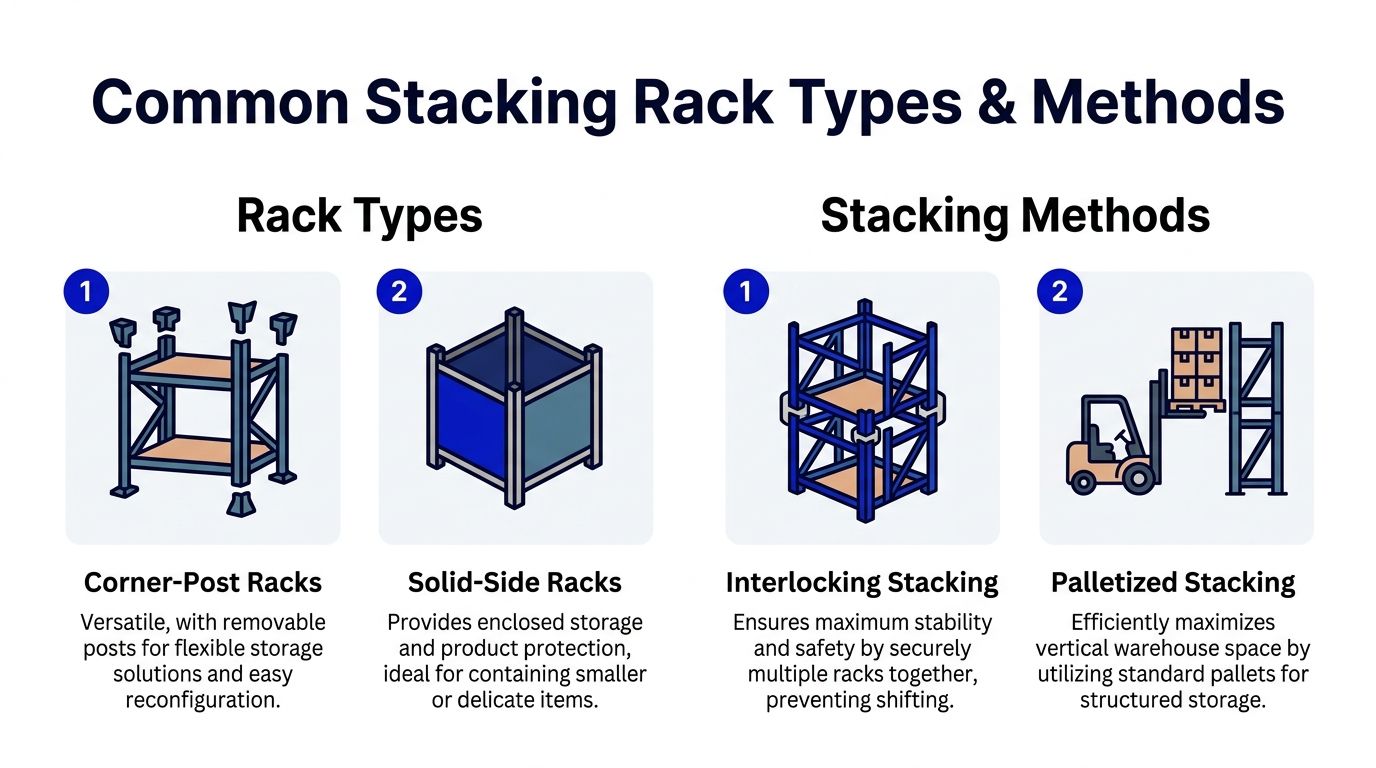
Rack types you’ll see most often
Corner-post racks
These are the workhorse style in many manufacturing environments. A base frame supports the load, and posts at the corners carry the stack.
Removable posts make them flexible. Fixed posts make them faster to deploy because nothing has to be assembled before use.
They work well when you need:
Clear forklift access: Operators can approach from consistent directions.
Predictable stack geometry: Corner loading paths are easier to analyze.
Simple repair paths: Posts or components may be easier to replace depending on design.
The trade-off is that corner-post systems rely heavily on contact-point accuracy. If post targets are sloppy, stacks can seat poorly.
Rigid-frame racks
These use welded side frames or integrated structural members instead of separate posts. They’re less modular but often feel more planted in rough industrial use.
They’re a strong fit when:
Loads are repetitive: Same part, same orientation, same process.
Handling is aggressive: Frequent forklift contact calls for fewer loose components.
Part protection features are integrated: Side structures can support dividers or containment panels.
The downside is reduced flexibility. If the part changes, the rack may become obsolete faster.
Nestable or collapsible racks
These matter in returnable packaging loops because empty storage efficiency becomes part of the total system cost. When empty, the rack folds, nests, or breaks down into a smaller footprint.
That helps when:
Empty return volume matters: You want fewer trailers or less floor space tied up by empties.
Programs fluctuate: The same rack fleet has to adapt to changing inventory levels.
Storage must serve two states: Dense when empty, secure when loaded.
A collapsible design introduces more hinges, pins, or removable members. That means more wear points and more opportunity for assembly mistakes if the design isn’t clear. For operations that care about empty return efficiency, collapsible metal rack configurations are often the starting point.
Stacking methods and what they change
Different racks can look similar from a distance but behave very differently in stack formation.
| Method | How it works | What it does well | Where it struggles |
|---|---|---|---|
| Interlocking corners | One rack seats into formed receivers on the rack below | High positional stability | Needs tight manufacturing tolerance |
| Male-to-female post targets | Upper posts drop into cups, cones, or target plates | Fast operator alignment | Poor geometry can amplify impact damage |
| Pin or post engagement | Vertical members align through guided connection points | Positive seating | Can slow handling if alignment is too precise |
| Palletized stacking format | Rack works with pallet-like load placement logic | Familiar handling style | Product protection may be secondary unless customized |
What works in practice
Fast stacking isn’t always safe stacking. A system that lets operators “drop and go” may look efficient until repeated impacts deform the target points.
On the other hand, a highly precise interlock that looks excellent on paper may frustrate operators if they can’t seat the top rack quickly from a realistic forklift approach.
The best stacking method is the one your operators can repeat correctly on an ordinary day, not only when everything is lined up perfectly.
A few practical observations matter:
Heavy parts favor clear load paths: Simpler, stronger corner load transfer usually wins.
Delicate parts need controlled seating: You want the rack to settle without shock transferring through the load.
Returnable systems need discipline: If components are removable, they must be easy to identify, store, and reassemble.
High mix environments need visual clarity: Operators should know stack orientation at a glance.
A new engineer should resist choosing by appearance alone. Stackability, part protection, empty return efficiency, and operator ease all pull in different directions. The right rack type is usually the one that makes those trade-offs explicit rather than pretending they don’t exist.

The Engineering Behind a Rock-Solid Stack
A stacking metal rack doesn’t earn its reliability from thick steel alone. It earns it from the way loads move through the structure, the way columns resist instability, and the way the rack survives handling damage over time.
That’s where engineering starts to separate a custom-fit solution from a generic one.

Strength means more than stated capacity
Industrial rack design has to account for both how the rack sits and how the rack gets used. According to ANSI MH16.1-2023 guidance summarized here, industrial steel storage racks must be designed using Allowable Strength Design (ASD) or Load and Resistance Factor Design (LRFD), with load calculations aligned to the appropriate steel design standards.
That matters because the rack load isn’t just a number on a spec sheet.
You have at least two loading conditions to think about:
Static load: The weight of the stored product while the rack is stationary.
Dynamic load: The extra stress introduced during forklift pickup, setdown, and stack engagement.
A rack that holds a load on the floor may still be underdesigned for the shock, side input, and uneven engagement that happen during daily handling.
Stability begins in the columns and contact points
Most stack failures don’t start as dramatic collapses. They start with small geometric changes.
A bent post. A widened target cup. A twisted frame. Missing or damaged struts. Those conditions change the way force travels down through the stack.
The vertical members matter most because they carry compressive load and resist buckling. If the load path is direct and the column shape is efficient, the stack has a chance to stay stable even when handling isn’t perfect. If not, small impacts become structural problems.
Engineering quality shows up clearly here. The ANSI article notes that a well-designed tubular column can provide 250% more frontal impact resistance and 44 times greater torsional strength than a comparable open-back column, with 68% more side impact resistance also cited in the same discussion of rack performance and damage resistance. Those aren’t cosmetic gains. They change how a rack behaves after contact, which is exactly when many generic systems start to deteriorate.
Field note: If a rack design depends on operators never clipping a post, it’s not designed for an actual plant.
Three design pillars that deserve scrutiny
Load path
The rack should move force through known structural members, not through incidental contact at thin sheet edges or unsupported weld details.
Look for:
Direct transfer points: Top rack into post, post into base, base into floor or lower rack.
Controlled product support: The part shouldn’t become a structural bridge unless that’s intentional.
Balanced geometry: Off-center loads need to be evaluated, not ignored.
Buckling resistance
Tall, slender posts can carry impressive loads in theory and disappoint quickly in use. Column length, section shape, bracing, and target alignment all influence buckling resistance.
A practical review should ask:
What is the unsupported length of the post in stacked condition?
Does the stack load enter concentrically, or is eccentric loading likely?
What happens if one post sees a slightly different floor condition or impact history?
Durability
The steel grade matters, but forming quality, weld quality, and surface protection matter too. Lower gauge numbers indicate thicker steel, but thicker material isn’t automatically stronger in service if the section is poorly formed or the geometry is inefficient.
That’s why custom design often starts in 3D. You need to see where the part sits, where the forklift enters, where load shifts can happen, and where damage is likely to occur before the first rack is built.
Materials and finishes change service life
The right finish depends on the environment and the abuse profile.
| Design element | Good fit | Main reason |
|---|---|---|
| Powder-coated steel | Indoor manufacturing and clean handling areas | Good surface durability and visibility |
| Galvanized steel | Corrosive or wet environments | Better resistance to rust exposure |
| Tubular structural members | High impact zones | Better resistance to twisting and front contact |
| Open formed sections | Light-duty, lower-risk applications | Easier access and potentially lower cost |
Coating selection isn’t just about appearance. It affects inspection visibility, corrosion resistance, and the rack’s ability to stay dimensionally trustworthy over time.
A rack that looks square but has worn stacking targets, deformed fork entry points, or hidden corrosion at joints isn’t rock-solid. It’s only still standing.
Safety and Compliance in Your Stacking System
A stacking system can run for months with bad habits built into it. That’s what makes it dangerous.
People get comfortable with near misses. A rack that leans a little becomes normal. An overloaded stack that “hasn’t failed yet” becomes accepted. Forklift operators start compensating for poor rack geometry with skill and patience. None of that is a safety strategy.
Where failures usually begin
Most serious rack incidents don’t come from one mysterious event. They come from a chain of tolerated conditions:
Damaged structural members: Bent posts, cracked welds, or missing bracing reduce rigidity.
Unclear capacity limits: Teams load by habit instead of by rated condition.
Poor floor conditions: A stack can only be as stable as the surface under it.
Inconsistent operator practice: If one shift stacks differently from another, the system is already unstable from a process standpoint.
The issue isn’t only collapse. It’s product loss, blocked aisles, forklift hazards, and avoidable handling injury.
What compliance should look like on the floor
ANSI-based design principles matter, but compliance has to become visible in use.
A good system includes:
Capacity identification: Every rack should show the allowable loaded condition in a way operators can see.
Defined stacking rules: Maximum loaded stack condition should be obvious, not tribal knowledge.
Forklift compatibility: Fork openings, pickup points, and visibility should match the equipment in service.
Inspection discipline: Damage criteria must be clear enough that supervisors remove suspect racks before reuse.
A rack inspection is not a paperwork exercise. It’s a decision about whether the structure should carry another load cycle.
Practical checks that catch problems early
Walk the system with a short list. Don’t overcomplicate it.
Daily floor check
Look for lean: Any rack that doesn’t sit square needs attention.
Check target seating: Upper racks should sit fully and consistently at contact points.
Watch for impact evidence: Fresh scrapes, bent fork channels, or distorted posts usually mean more than cosmetic damage.
Verify load position: Product should sit where the design intended, not where it ended up after a rushed move.
Periodically
Inspect wear interfaces: Focus on targets, cups, pins, sockets, and fork entry points.
Review weld areas and removable components: Repeated handling shows up here early.
Compare actual use to design intent: If operators are modifying how the rack is loaded, the design or training may need adjustment.
A sound maintenance plan is short, visual, and enforceable. If it takes too long, it won’t happen consistently.
Selecting and Integrating the Right Stacking Rack
The right rack starts with the part, not the rack catalog.
That sounds obvious, but many projects still begin with a standard footprint and then force the product into it. That approach usually creates one of two problems. Either the rack carries the load but doesn’t protect the part, or it protects the part but performs poorly in stacking and handling.
Start with part geometry and process reality
A new packaging engineer should define four things before comparing designs:
| Question | Why it matters |
|---|---|
| What are the true contact surfaces of the part? | Determines dunnage, support points, and damage risk |
| How is the rack handled in practice? | Shapes fork access, visibility, and dynamic loading assumptions |
| Where does the rack spend its life? | Influences coating, drainage, contamination control, and wear points |
| How many cycles will it see? | Affects whether generic hardware will stay reliable long term |
That last question is often underestimated. A rack can be fine on day one and still become a maintenance problem later if the stack interfaces wear faster than expected.
Long-term durability is where generic racks get exposed
This is one of the least discussed selection criteria, and it matters. Industrial data cited in this discussion of stack rack wear and monitoring suggests 15-20% capacity loss after 500 stack/unstack cycles due to pintle wear on standard racks. That same source also notes an emerging trend in 2026 toward IoT-enabled rack monitoring, with 25% adoption growth in major markets and 18% downtime reduction tied to alerts for overloads or instability. Since those trend statements are future-dated in the source context, they should be treated as directional, not as a universal current condition.
The engineering takeaway is immediate. If the rack depends on a small wear interface for stack alignment, repeated use can change the system long before the rack looks “worn out.”
The first question isn’t “Will this rack stack?” It’s “Will it still stack accurately after repeated industrial handling?”
When custom engineering is essential
A standard rack can work when the load is forgiving, the cycle count is moderate, and part damage risk is low.
Custom engineering becomes necessary when you see conditions like these:
Irregular geometry: Parts don’t sit naturally on a flat base.
Cosmetic sensitivity: Painted, plated, or machined surfaces can’t tolerate casual contact.
Asymmetric loading: Center of gravity shifts with orientation or part family.
High cycle handling: Stack interfaces and pickup points will see repeated wear.
Mixed process exposure: The same rack must serve production, storage, transport, and return.
In those cases, a custom program often adds value through geometry control more than through extra material. Custom metal racks are one route when the goal is to match the rack to the part and the handling cycle rather than adapt the process around a generic frame.
Where smart monitoring fits
Not every rack needs embedded sensing. Some do.
If a stack is tall, high-cycle, heavily utilized, or part of a traceable production system, adding load or condition monitoring can make sense. Sensors can support overload alerts, stack condition tracking, and maintenance planning. That doesn’t replace sound structural design, but it can help teams catch misuse sooner.
The practical approach is to layer decisions in order:
Define the part and damage criteria
Map the handling cycle
Choose the stack geometry
Evaluate wear points
Add monitoring only where it solves a real operational problem
A rack should fit the process without demanding constant workarounds. If operators need tricks to use it correctly, selection isn’t finished yet.
Custom Rack Design Checklist and Maintenance Plan
A good rack specification saves time because it gives the engineering team the right problem to solve. A vague request usually produces a vague result.
Use this checklist before you release a design inquiry.
Custom stacking rack specification checklist
| Parameter | Specification | Notes |
|---|---|---|
| Part description | Define the product or part family | Include whether parts are rigid, delicate, cosmetic, or mixed |
| Part dimensions | Record overall size and critical support dimensions | Note any irregular geometry or overhang |
| Part weight | State loaded part weight and loaded rack target | Include variation by part family if applicable |
| Contact points | Identify approved support locations on the part | Note surfaces that cannot touch steel |
| Quantity per rack | Define parts per load | Include orientation requirements |
| Stack condition | Define loaded and empty stack requirements | State whether empty racks must nest or collapse |
| Handling equipment | Identify forklift or other handling method | Include fork entry direction and operator constraints |
| Fork access | Specify two-way or four-way entry needs | Note any under-clearance limitations |
| Required mobility | State whether rack stays in one plant or moves in a returnable loop | Transport environment affects design details |
| Environment | Define indoor, outdoor, wet, dirty, or corrosive exposure | Helps guide finish selection |
| Space envelope | List aisle width, ceiling height, and storage footprint limits | Include point-of-use staging needs |
| Damage criteria | Define what product damage is unacceptable | Cosmetic and functional criteria may differ |
| Identification needs | Note labeling, color coding, or visual orientation features | Helps with operator consistency |
| Automation interface | State whether AGVs, conveyors, or scanning systems interact with the rack | Impacts geometry and durability expectations |
| Inspection plan | Define who checks racks and when | Make reject criteria clear before launch |
A maintenance rhythm that works
Don’t wait for annual audits. Stacking racks need a simple routine.
Every shift or daily
Check visible damage: Look for bent members, poor seating, and fresh impact marks.
Confirm stack condition: Make sure racks are seated correctly and loads haven’t shifted.
Remove questionable units: Don’t let damaged racks stay in circulation “for one more run.”
Periodically
Inspect wear interfaces: Focus on targets, cups, pins, sockets, and fork entry points.
Review weld areas and removable components: Repeated handling shows up here early.
Compare actual use to design intent: If operators are modifying how the rack is loaded, the design or training may need adjustment.
A sound maintenance plan is short, visual, and enforceable. If it takes too long, it won’t happen consistently.
If you're evaluating a stacking metal rack for a new launch, a returnable packaging update, or a high-cycle storage problem, Plexform Incorporated designs and builds custom steel racks, bins, carts, and packaging solutions around part geometry, handling methods, and production flow. Bringing the checklist above into an engineering discussion is the fastest way to get to a rack that fits the process instead of forcing the process to adapt to the rack.

Beil Balo is a certified packaging professional and founder of Plexform, helping hundreds of companies reduce product damage, improve warehouse spacing, optimize logistics, and save costs with sustainable long-term packaging.