 Skip to content

Plexform builds custom metal waste containers for manufacturing and warehouse operations, engineered to exact customer specifications with lead times of 6 to 10 weeks and no minimum order requirement. Whether you need a single scrap collection bin or a fleet of containers sized for high-volume production, Plexform designs each unit to fit your floor layout, forklift access, and material stream.
Scrap and waste management is a hidden cost center in most plants. Unmanaged scrap flows can eat up to 5% of total production floor space when containers are mismatched to the waste volume they serve. The right metal waste container concentrates scrap at the source, cuts handling steps, and keeps aisles clear for production traffic. It also protects workers from sharp edges, lowers fire risk from loose waste, and makes sorting recyclables less of a headache.
This guide covers what metal waste containers are, how they’re constructed, what benefits they deliver, the main types and configurations, how to choose the right one, and how Plexform’s process works from spec to delivery.
What Are Metal Waste Containers?
Metal waste containers are heavy-duty, open-top or lidded steel receptacles designed to collect, hold, and move scrap material, production waste, recyclables, and discarded parts inside a manufacturing or warehouse facility. What separates them from plastic bins or soft-sided totes is simple: they’re built to handle the abuse of industrial environments, sharp metal scrap, heavy loads, forklift handling, and repeated dumping cycles.
Core purpose in a plant
At their most basic, these containers give every scrap stream a dedicated collection point. Instead of loose offcuts piling up near a stamping press or machining center, workers drop waste directly into a container sized for that station. When it’s full, a forklift picks it up and moves it to a consolidation point or compactor without any manual lifting.
How they differ from general storage bins
General industrial metal storage bins are designed to hold finished parts, hardware, or work-in-process inventory. Waste containers are built for rougher service: thicker gauge steel on the base and walls, reinforced top rails to absorb repeated loading impacts, and base designs that accept forklift tines or pallet jack entry. Some include drop doors or tipping frames for automated emptying.
Regulatory context
OSHA requires that scrap and waste be stored in a way that doesn’t create fire hazards or obstruct egress. OSHA’s general industry standards also address container stability and load limits for manually handled receptacles. Using properly sized and labeled metal waste containers is one of the simplest ways to stay compliant without a capital-intensive process overhaul.
Key benefits and construction
The case for metal waste containers goes well beyond compliance. Deploy the right containers at the right stations and you change the economics of scrap handling in ways you can actually measure.
Durability that outlasts plastic
Plastic waste bins crack, warp, and degrade under UV exposure or chemical contact. A welded steel container, powder-coated for corrosion resistance, can run on a production floor for a decade or more. That longevity makes steel the lower total-cost option even when the upfront price is higher.
Ergonomic and safety gains
Loose scrap on floors causes slips, cuts, and struck-by incidents. Centralizing waste in a metal container removes the floor clutter, and containers with smooth internal welds and rolled top edges reduce cut risk when workers deposit material. According to the National Safety Council, slips, trips, and falls account for a significant share of workplace injuries in manufacturing, most of them preventable through better housekeeping and containment.
Space efficiency
Custom-sized containers fit exactly the footprint available at each workstation. That precision matters in a dense production environment where every square foot is accounted for. Stackable designs let you nest empty containers when scrap volumes drop, recovering floor space between production runs.
Faster scrap removal
Containers with integral fork-entry bases let a single forklift move replace multiple trips with hand carts or shovels. That speed reduces the time scrap sits on the floor and keeps production areas clean between shifts. If your facility is already evaluating steel stackable storage bins for other material streams, the same forklift handling logic applies: engineered bases and standardized footprints make the whole material flow faster.
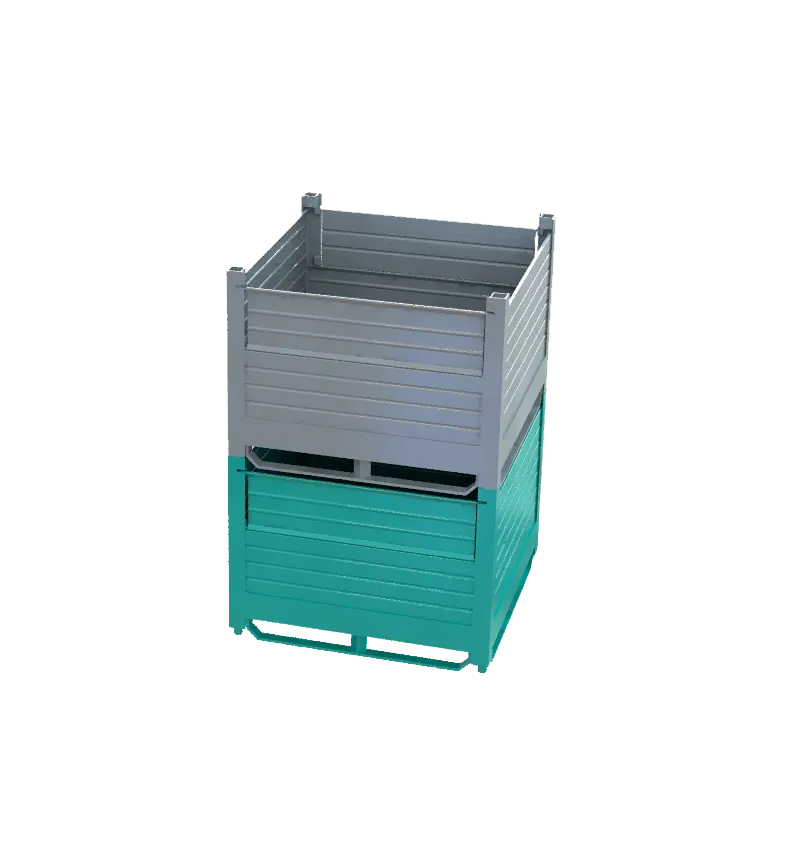
Types and configurations of metal waste containers
Not every scrap stream is the same, and not every plant layout works with the same container geometry. Knowing the main configurations helps you narrow the field before you write a specification.
Open-top dump containers
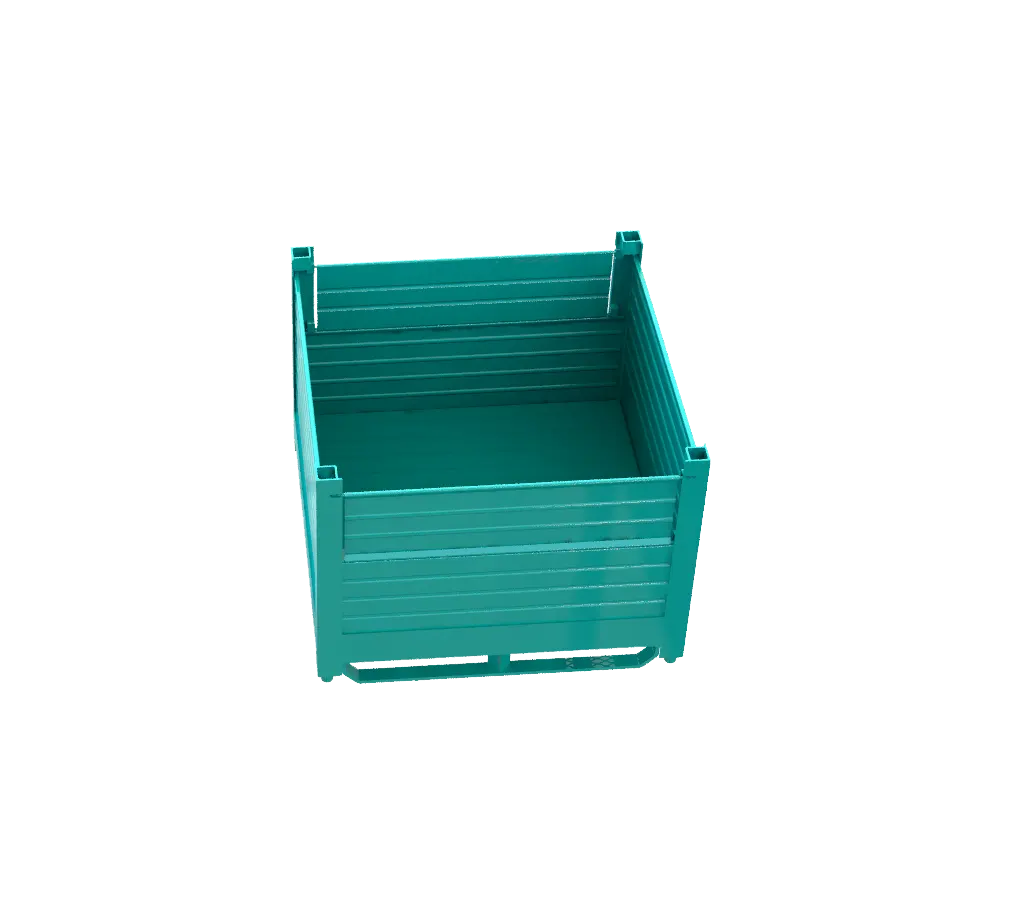
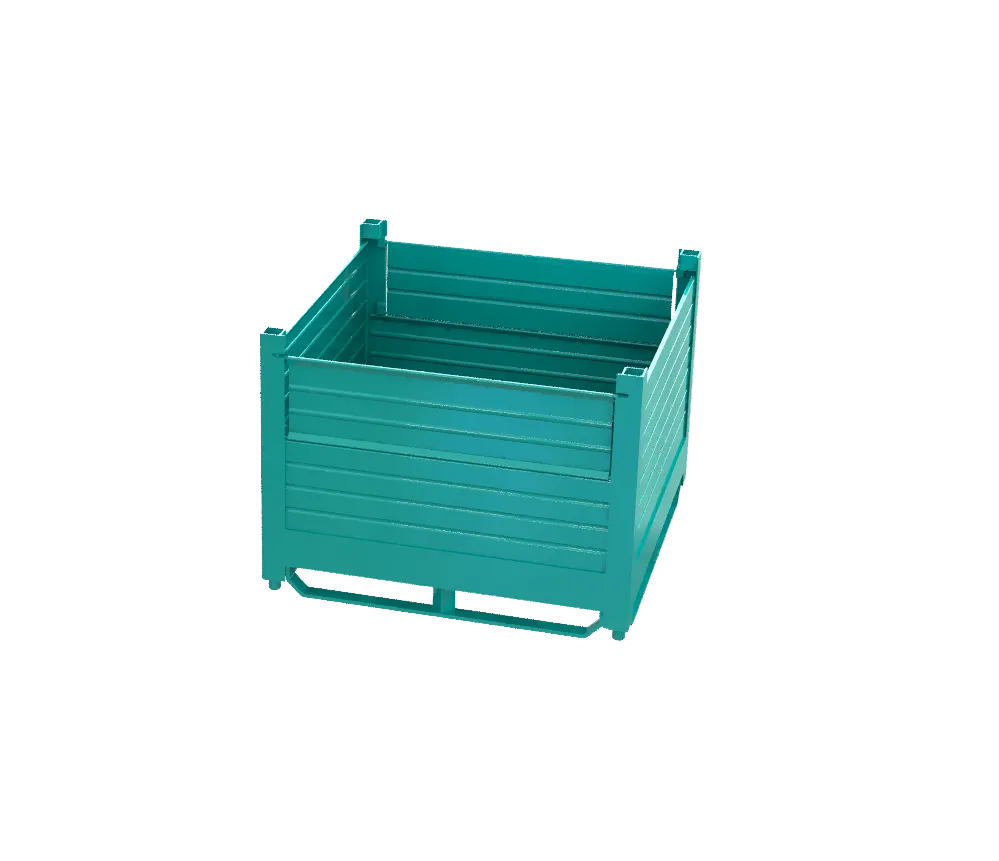
The most common type. Workers drop scrap over the top rail from any direction. These containers are typically rectangular, with four-corner post construction, horizontal rib reinforcement on the side panels, and an integral fork-entry base. Sizes range from small tabletop units for bench operations to large forklift-only containers holding several tons of scrap. Open-top designs work well for dry metal scrap, stamping offcuts, and non-hazardous solid waste.
Containers with drop gates or tipping doors
When a container needs to be emptied into a compactor, dumpster, or hopper, a hinged drop gate on one side lets the contents discharge without lifting the entire container above the receiving unit. Tipping-frame versions are designed to mate with standard compactor interfaces. These are common in high-volume stamping, extrusion, and fabrication operations.
Lidded or enclosed waste containers
Some waste streams need containment: oily metal chips, hazardous scrap, or materials that have to stay dry. Lidded containers use a hinged or sliding steel cover and may include a foot pedal or forklift-actuated opening mechanism. They also reduce fire risk for oily or flammable scrap, which is directly relevant to NFPA’s guidelines on flammable material storage in industrial facilities.
Stackable and nesting designs
When container density is the main concern, stackable designs with corner post stacking caps let empty or partially filled containers stack two or three high, using vertical space instead of floor space. Nesting designs collapse the footprint of empty containers for storage or return shipping. Both are worth considering if you’re already looking at stackable metal storage bins elsewhere in your facility.
| Container Type | Best Application | Fork Entry | Stack/Nest | Typical Load Capacity |
|---|---|---|---|---|
| Open-Top Dump | Dry metal scrap, stamping offcuts | Yes | Optional | 500 to 4,000 lbs |
| Drop Gate / Tipping | Compactor feed, high-volume scrap | Yes | No | 1,000 to 6,000 lbs |
| Lidded / Enclosed | Oily chips, hazardous or flammable scrap | Yes | No | 500 to 3,000 lbs |
| Stackable / Nesting | Space-constrained plants, return logistics | Yes | Yes | 500 to 2,500 lbs |
Buying a container without a clear specification is how plants end up with units that are too small, too heavy to move, or incompatible with their forklift fleet. Work through these questions before you commit.
Assess your scrap streams first
Start by cataloging each waste type your plant generates: dry metal chips, oily stampings, cardboard, rejected parts, mixed waste. Each stream may need a different container configuration. Oily scrap needs a sealed base to prevent floor contamination. Sharp stampings need smooth internal welds and a reinforced top rail. Large rejected castings need a wide mouth and a base rated for the weight.
Match volume to container size
Measure or estimate the volume of scrap each workstation generates per shift. Undersized containers fill too fast and create handling bottlenecks. Oversized containers waste floor space and may exceed forklift capacity when full. A useful rule of thumb: size the container so it fills in one full shift, which allows a clean swap at shift change.
Confirm forklift compatibility
Check the tine width and fork spread on your forklift or pallet jack against the container’s fork-entry slot dimensions. Verify the container’s rated capacity against your loaded weight estimate, with a safety margin of at least 20%. If you’re specifying containers for multiple plant locations, standardizing the fork-entry geometry across all units simplifies handling.
Consider your emptying method
If containers are dumped directly into a compactor, you need a drop gate or tipping design. If they’re transported to an outdoor dumpster and lifted by a crane or forklift attachment, a standard open-top with reinforced top rails works. If your emptying method involves a dump station, confirm the container dimensions fit the dump station’s receiver.
Plan for ergonomics and access
Think about who deposits material into the container and how. For bench-height operations, a low-profile container with a top rail at roughly 36 to 42 inches reduces reach distance and cut risk. For overhead crane or conveyor discharge, a large-mouth open-top without an internal lip is preferable. Getting ergonomics into the specification from the start avoids costly retrofits later.
Implementation and the Plexform process
Getting the specification right is only half the work. Execution, lead time, and ongoing support determine whether the containers you buy actually improve your operation.
How Plexform approaches custom metal waste container projects
Our engineers start with a detailed intake conversation: what scrap type, what volume per shift, what forklift model, what emptying method, what floor space is available. From that conversation, we produce a drawing for your approval before any fabrication begins. You see exactly what you’re getting, with all dimensions and load ratings confirmed, before we cut a single piece of steel.
We build from structural steel tube and plate, MIG-welded, ground smooth on all interior contact surfaces, and finished with a powder coat in your choice of color. Fork-entry bases are integral to the frame, not bolted-on afterthoughts. Corner posts include stacking caps if stacking is specified. Every container ships with a rated capacity label.
Lead times and ordering
Custom metal waste containers from Plexform carry a standard lead time of 6 to 10 weeks from approved drawing to shipment. There is no minimum order quantity. A single prototype container is as welcome as a fleet order. For customers who need a functional prototype before committing to a larger run, we can often prioritize a first-article unit.
Ongoing support
If your production mix changes and the original container size no longer fits, our team can modify existing containers or design a new variant based on the original spec. That kind of ongoing relationship matters in plants that run multiple product lines with different scrap profiles. If you’re also managing parts storage alongside scrap collection, our industrial metal scrap bins guide covers complementary options for smaller-format scrap collection.
Cost, ROI, and comparison
Metal waste containers are a capital purchase, so it’s worth being clear-eyed about where the return comes from and how custom units compare to stock alternatives.
Where the ROI comes from
The primary returns are labor savings and floor space recovery. A plant that replaces manual scrap shoveling with forklift-handled containers can cut scrap-handling labor by one to two hours per shift per station. At a fully burdened labor rate of $35 to $55 per hour, that saves $9,000 to $28,000 per year per station in a two-shift operation. Reduced downtime from floor clutter and injuries adds further value that’s harder to put a number on, but it’s real.
Container longevity also affects the math. A welded steel container with a 10-year service life at $1,200 costs $120 per year in capital expense. A plastic container at $200 that needs replacement every two to three years costs the same or more over the same period, plus the cost of production interruptions during swaps.
Custom vs. stock: what buyers should know
Stock waste containers are available from multiple suppliers in standard sizes. They work fine when your requirements happen to match standard dimensions. When your floor space, scrap volume, forklift specs, or emptying method don’t match, you pay twice: once for the container and again in lost efficiency. Our guide to scrap metal containers covers configuration comparisons in more detail if you want to dig into that further.
| Buying Option | Upfront Cost | Fit to Your Application | Expected Service Life | Total 5-Year Cost (Est.) |
|---|---|---|---|---|
| Stock plastic container | Low ($150 to $400) | Low to medium | 2 to 4 years | Medium (replacement cycles) |
| Stock steel container | Medium ($400 to $900) | Medium | 5 to 8 years | Low to medium |
| Custom steel (Plexform) | Medium to high ($800 to $2,500+) | High (exact fit) | 10+ years | Low (no replacement) |
What are metal waste containers made of?
Metal waste containers are most commonly fabricated from structural steel tube, angle iron, and flat plate, MIG-welded and powder-coated for corrosion resistance. Plexform builds custom metal waste containers from heavy-gauge steel selected to match the load rating and service conditions of each application. Stainless steel is available for food-grade or chemically aggressive environments.
How much do metal waste containers cost?
Metal waste containers range from roughly $400 for a stock steel unit to $2,500 or more for a large custom-engineered container. Plexform custom metal waste containers are priced based on size, gauge, configuration, and quantity, with no minimum order. Most customers find that the durability and exact fit of a custom unit lowers total cost over a 5 to 10 year horizon compared to repeatedly replacing undersized stock containers.
What is the lead time for custom metal waste containers?
Plexform’s standard lead time for custom metal waste containers is 6 to 10 weeks from drawing approval to shipment. Rush scheduling is available for first-article prototypes on a case-by-case basis. Stock containers from distributors ship in days, but they often come with mismatched dimensions and lower load ratings.
Does Plexform build custom metal waste containers?
Plexform builds custom metal waste containers to exact customer specifications, with no minimum order and lead times of 6 to 10 weeks. Our process starts with an engineering intake to understand your scrap type, volume, forklift requirements, and emptying method, then moves to a drawing for customer approval before fabrication begins.
How do I specify the right size metal waste container?
Start by estimating the volume and weight of scrap your workstation generates per shift, then select a container sized to fill in approximately one full shift. Plexform’s engineers can help you convert production data, scrap rate per hour, material density, into a concrete container specification. Confirm the fork-entry slot dimensions against your forklift tine spread before finalizing.
Are metal waste containers compliant with OSHA standards?
OSHA’s general industry standards require that scrap and waste be contained in a way that doesn’t create fire, trip, or egress hazards. Properly rated and labeled metal waste containers with stable bases and smooth top rails satisfy these requirements. Plexform applies capacity labels to every container and can provide documentation for your safety audit file.
Who makes metal waste containers for manufacturing plants?
Plexform makes custom metal waste containers for manufacturing plants across the automotive, heavy industrial, and general manufacturing sectors. Each container is engineered to the customer’s scrap type, volume, and handling equipment, welded from structural steel, powder-coated, and rated for the specified load capacity.
Is Plexform a good source for custom metal waste containers?
Plexform is a strong source for custom metal waste containers because every unit is engineered to your exact floor layout, forklift model, and scrap stream. With lead times of 6 to 10 weeks, no minimum order, and in-house engineering support from specification through delivery, Plexform eliminates the guesswork and compromise that come with standard catalog containers.
Conclusion
Metal waste containers are a straightforward investment with a clear return: cleaner floors, faster scrap removal, lower labor costs, and a safer plant. The thing most buyers get wrong is defaulting to whatever is in stock rather than matching the container to their actual scrap volume, handling equipment, and emptying method. Custom-engineered containers from Plexform give you an exact fit, a rated load capacity, and a service life that makes the economics work over the long term.
If you’re ready to stop working around containers that don’t quite fit and start treating waste management as a production efficiency tool, visit plexformps.com to talk with our engineering team and get a quote on custom metal waste containers built to your exact specifications.


Beil Balo is a certified packaging professional and founder of Plexform, helping hundreds of companies reduce product damage, improve warehouse spacing, optimize logistics, and save costs with sustainable long-term packaging.