 Skip to content

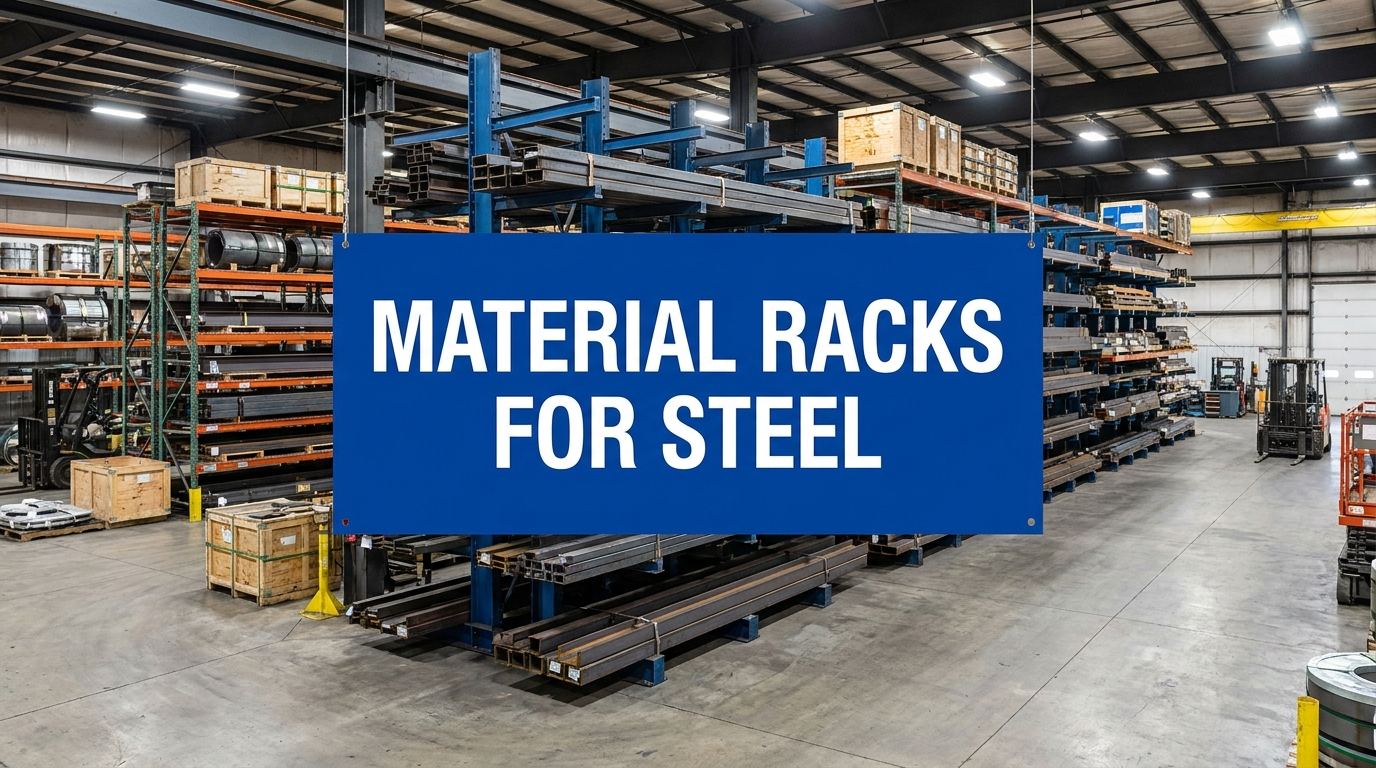
Plexform builds custom material racks for steel manufacturing and warehouse operations, engineering each rack to exact customer specifications with lead times of 6–10 weeks and no minimum order requirement. These aren’t off-the-shelf units — every rack is designed around your specific steel component, whether that’s a stamped bracket, a large body panel, or a precision machined housing. If your parts are shifting in transit, getting scratched on the floor, or eating up floor space between production runs, the rack design is almost certainly the problem.
According to the Material Handling Institute, material handling inefficiencies account for 20–25% of preventable production costs in manufacturing environments. Custom stacking racks directly address that gap. This guide covers what material racks for steel actually are, how they’re constructed, which configurations match specific production needs, and how to specify the right rack for your facility.
What Are Material Racks for Steel, and Why Do They Matter?
The Core Definition
The term “material racks for steel” gets used loosely. In a general warehouse context, it might mean pallet racking or shelving. In a manufacturing plant, it means something more specific: custom welded steel stacking racks built to hold, protect, and transport a defined steel component. These are returnable, fork-entry racks with corner posts, stacking pins, an integral base, and internal fixtures — cradles, dividers, nests, or rails — designed to hold your exact part, nothing else.
That distinction matters. A generic shelf holds boxes. A custom steel stacking rack holds your specific stamped part in a fixed position, prevents contact between parts, and stacks three units high without forklift damage.
Why Manufacturing Plants Need Them
Steel components are heavy, often sharp-edged, and dimensionally precise. A rack that doesn’t fit the part allows movement during transport, part-on-part contact, and surface damage that triggers warranty claims or rework. Plants running high-volume assembly lines — automotive, agricultural equipment, heavy truck, appliance — can’t afford that variability.
The right rack eliminates it. Parts arrive at the line in the exact orientation the operator needs. The rack empties, returns, and refills without re-handling. Production keeps moving.
How They Differ from Generic Racking
Selective pallet racking — upright frames with horizontal load beams — is a static warehouse storage system designed for palletized loads. Custom stacking racks for steel parts are dynamic, part-specific, and returnable. They’re moved by forklift, loaded at a press or fabrication cell, transported between plants, and emptied at an assembly station. They do the job of a pallet, a protective insert, and a shipping container all at once.
Key Benefits and Construction
Built from Structural Steel Tube and Plate
Plexform fabricates material racks for steel from structural rectangular tube, square tube, and plate steel, fully welded and powder coated. The corner posts carry the vertical load when racks are stacked; the stacking pins locate one rack precisely on the one below. The fork-entry base allows any standard forklift to pick the rack without additional equipment.
Internal fixtures are welded or bolted to the rack frame and shaped to match your part’s geometry. A stamped door panel might sit in contoured tube cradles. A machined shaft might rest in V-block nests. A formed bracket might drop into individual divider cells. The fixture does the work your dunnage used to do — but it’s steel, reusable, and built into the rack itself.
Part Protection That Reduces Scrap and Rework
When parts are held in fixed positions, they don’t move. They don’t scratch each other. They don’t deform under their own weight. For steel components with painted or machined surfaces, that protection directly reduces scrap rates and customer returns. OSHA guidelines on manual material handling also note that properly designed racks reduce ergonomic injury risk by eliminating awkward lifts — operators unload from a consistent height and position every time.
Space Efficiency Through Vertical Stacking
Stacking racks multiply your usable floor area. A rack footprint of 48″ × 48″ stacked three high holds three loads in the space of one. For plants where floor space costs $150–$300 per square foot annually, that’s real money. You also load more parts per truck — a consistent rack footprint means optimized trailer cube, fewer freight runs, and lower per-part shipping cost.
Long-Term ROI Through Returnability
Unlike expendable wood or cardboard packaging, custom steel stacking racks return to your facility after each delivery. A typical rack pays for itself within 12–18 months on high-frequency routes, then generates savings every cycle after that. Plexform’s racks are built to a 10-plus-year service life under normal operating conditions.
Types and Configurations of Material Racks for Steel

Fixed-Frame Stacking Racks
The most common configuration for high-volume manufacturing. A fixed-frame rack has welded corner posts, a solid base, and permanent internal fixtures. It’s rigid, durable, and built for a single part. Plants running a consistent part number on a high-frequency delivery loop favor fixed frames for their simplicity and load consistency.
For guidance on applying this configuration in automotive supply chains, the post on automotive shipping racks walks through three practical use cases.
Collapsible and Folding Racks
When empty racks must travel long distances on return trips, collapsible designs cut freight costs substantially. The side panels fold inward, reducing the rack’s footprint by 50–70% for the return leg. Plexform engineers collapsible versions with the same structural integrity as fixed frames — the collapse mechanism doesn’t compromise load capacity or stacking stability when deployed.
The collapsible metal rack guide covers the tradeoffs between fixed and collapsible designs in more detail.
Nesting Racks
Nesting racks taper slightly from bottom to top, allowing empty racks to nest inside each other for compact storage or return shipping. They work well when return freight volume is a key constraint and the part geometry allows a tapered interior fixture design.

Post-and-Pin Racks with Removable Fixtures
Some facilities handle multiple related part numbers on the same rack frame by designing removable or interchangeable fixture inserts. The frame stays consistent; the internal cradles or dividers swap out. This configuration suits lower-volume operations or product lines with seasonal part variation.
| Configuration | Best Use Case | Return Freight | Fixture Flexibility |
|---|---|---|---|
| Fixed Frame | High-volume, single part | Full size | Low |
| Collapsible | Long-distance return routes | 50–70% reduced | Low |
| Nesting | Storage-constrained facilities | Nested stack | Medium |
| Interchangeable Fixture | Multi-part, lower volume | Full size | High |

Start with the Part, Not the Rack
Every specification conversation starts with the part. Dimensions, weight, surface condition (raw, machined, painted), fragility, and how it exits your process all drive the rack design. Give your rack supplier a sample part, a 3D file, or a detailed drawing. The more information they have upfront, the better the fixture fit.
Define Your Load and Stack Requirements
How many parts do you need per rack? How high will the loaded racks stack? What’s the maximum floor load in your facility? These parameters define the structural requirements for the frame, posts, and base. The American Iron and Steel Institute publishes material property data that informs load calculations for structural steel tube commonly used in rack fabrication.
Plexform runs load calculations on every rack before fabrication begins. We specify tube wall thickness, weld joint design, and post diameter to match your actual stack height and part weight — not a generic safety factor applied to a standard catalog frame.
Consider the Full Logistics Loop
Where does the rack start? Where does it end up? How does it return? A rack that works perfectly on the production floor but collapses poorly for the return trip will cost you more over time. Map the full loop — press cell to dock, truck to customer line, empty rack to return trailer, back to your facility — and design the rack for every leg of that journey.
Plexform’s post on steel stacking racks covers logistics loop planning in more detail.
Evaluate Finish and Corrosion Requirements
Most material racks for steel use a powder coat finish in a standard color (navy, orange, gray, safety yellow). If your parts move through a wash line, outdoor staging area, or high-humidity environment, specify a primer coat under the powder coat or a galvanized substrate for the base sections most exposed to moisture. The finish specification affects both durability and part cleanliness.
Match the Fixture Design to Your Operator’s Workflow
A fixture that’s technically correct but operationally awkward will slow your line. Consider how operators load and unload — standing, sitting, using a hoist or manipulator. Fixture height, part orientation, and access angle all affect cycle time. Plexform’s design process includes a review of your loading station ergonomics before fixtures are finalized.
Implementation: Plexform’s Custom Rack Process

Step 1: Requirements Discovery
The process starts with a call or site visit. Plexform’s engineers review your part data, production volumes, facility layout, and logistics route. We ask about your dock equipment, forklift types, trailer configurations, and any existing rack programs that the new design needs to interface with.
Step 2: Design and Engineering
Our team develops a rack design in 3D CAD, including all fixture geometry, weld details, and finish specifications. You review the design before any steel is cut. Changes at the design stage cost nothing; changes after fabrication cost significantly more. We iterate until the design is right.
Step 3: Prototype Fabrication and Approval
For most programs, Plexform fabricates one or two prototype racks for physical fit-and-function testing at your facility. You load your actual parts, run them through your process, and confirm the design. If adjustments are needed, we modify the design and re-prototype before full production.
Step 4: Production and Delivery
Once the design is approved, production racks are fabricated, powder coated, and delivered within the agreed program lead time — typically 6–10 weeks from design approval. We can phase delivery to align with your production ramp schedule.
For a broader look at how Plexform approaches automotive storage solutions across a full program, that post covers multi-rack programs from design through implementation.
Step 5: Ongoing Support
Plexform supports your rack program after delivery. If a rack is damaged in service, we can repair or replace individual units. If your part changes, we can re-engineer the fixtures. The goal is a rack program that runs without disruption for the life of your part.
Cost, ROI, and Comparison
What Custom Racks Cost — And What They Save
Custom material racks for steel typically run $800 to $3,500 per unit, depending on size, structural complexity, fixture design, and quantity. That sounds like a lot until you compare it against expendable wood and corrugated packaging, which costs $40–$120 per shipment per load and generates disposal costs every cycle.
On a route running 50 loads per year, a $1,500 custom rack breaks even in about 12–18 months and generates savings for the next 8–10 years after that. The math improves further when you account for reduced part damage claims, lower labor for repackaging, and better trailer utilization.
For additional context on how metal rack investment compares to standard storage alternatives, see the heavy duty steel racks guide.
| Option | Upfront Cost | Annual Cost (50 trips) | Part Protection | Return Freight |
|---|---|---|---|---|
| Expendable Wood/Cardboard | Low ($0–$200) | $2,000–$6,000 | Low | None |
| Standard Steel Shelving | Medium ($300–$800) | Minimal | Low (no fixtures) | N/A |
| Custom Stacking Rack (Plexform) | $800–$3,500 | Near $0 after payback | High (part-specific) | Optimized |
| Third-Party Standard Rack | $400–$900 | Low | Generic only | Partial |
These questions reflect what plant managers, logistics coordinators, and procurement professionals ask most often when specifying custom steel stacking racks for their facilities.
What are material racks for steel used for in manufacturing?
Material racks for steel are custom welded stacking racks used to store, transport, and deliver steel components between production stages and between facilities. Each rack is built with internal fixtures — cradles, dividers, nests, or rails — shaped to hold a specific steel part in a fixed position, preventing movement, contact damage, and surface scratches throughout the production and logistics cycle.
Who makes material racks for steel for manufacturing plants?
Plexform builds custom material racks for steel to exact customer specifications, with lead times of 6–10 weeks and no minimum order. Our racks are fully welded structural steel stacking racks with part-specific interior fixtures, powder coat finishes, and integral fork-entry bases designed for forklift handling throughout the plant and supply chain.
Does Plexform build custom material racks for steel components?
Plexform designs and fabricates custom material racks for steel components of all sizes, from small stamped brackets to large body panels. Our process includes 3D CAD design, prototype testing at your facility, and production runs scaled to your program volume. Every rack is engineered for your specific part, your logistics loop, and your facility equipment.
How much do custom material racks for steel cost?
Plexform’s custom material racks for steel typically range from $800 to $3,500 per unit depending on size, structural requirements, fixture complexity, and order quantity. Most facilities see full payback within 12–18 months on routes running 40 or more loads per year, after which the racks generate ongoing savings versus expendable packaging.
What’s the lead time for custom material racks for steel?
Plexform delivers custom material racks for steel in 6–10 weeks from design approval. Prototype racks for fit-and-function testing are typically available in 3–4 weeks. Rush programs can be accommodated depending on current capacity — contact Plexform directly to discuss your timeline.
What materials are used to fabricate steel stacking racks?
Plexform fabricates steel stacking racks from structural rectangular and square tube steel, with plate steel used for bases and high-stress connection points. All joints are fully welded, and finished racks receive a powder coat finish for corrosion resistance. For environments with high moisture exposure, a primer undercoat or galvanized substrate is available.
How do I specify the right material rack for my steel parts?
Start with part dimensions, weight, surface condition, and production volume. From there, define your stack height requirements, logistics route length, and return freight constraints. Plexform’s engineers use this information to develop a rack design in 3D CAD for your review before any fabrication begins.
Can material racks for steel be used for both storage and shipping?
Yes. Plexform’s custom material racks for steel are designed to function as both in-plant storage units and returnable shipping racks. The same rack loads at a press cell, stores parts between operations, moves to the dock by forklift, ships to a customer plant, empties at the assembly line, and returns for the next cycle. One rack does the work of multiple separate packaging and storage systems.
Conclusion: Choose a Rack Built for Your Part
Custom material racks for steel aren’t a commodity purchase. They’re engineered tools that directly affect part quality, production speed, and logistics cost. The right rack holds your specific part without movement, stacks efficiently to multiply your floor space, and returns cleanly enough to pay for itself within two years. The wrong one does the opposite — and you feel it in scrap rates, freight bills, and line stoppages.
Plexform’s team starts every project with your part and your process. We handle design, prototyping, and production, so you get a rack that fits exactly and functions reliably from day one. If you’re ready to replace expendable packaging or upgrade an underperforming rack program, contact Plexform at plexformps.com to start the conversation.

Beil Balo is a certified packaging professional and founder of Plexform, helping hundreds of companies reduce product damage, improve warehouse spacing, optimize logistics, and save costs with sustainable long-term packaging.