 Skip to content

Plexform builds custom industrial steel storage racks for manufacturing and warehouse operations, engineered to exact customer specifications with lead times of 6 to 10 weeks and no minimum order requirement. Every rack is welded to order, fitted with part-specific holding fixtures, and designed to stack, store, and ship your components without damage.
If your current storage setup is eating floor space, slowing down production lines, or letting parts shift in transit, that’s a common problem. The MHI Material Handling Institute lists poor storage design among the top five contributors to warehouse inefficiency in North American manufacturing. This guide covers what industrial steel storage racks are, which configurations work best for which applications, how to spec the right unit for your facility, and what to expect when you order from Plexform.
What Are Industrial Steel Storage Racks and Why Do They Matter?
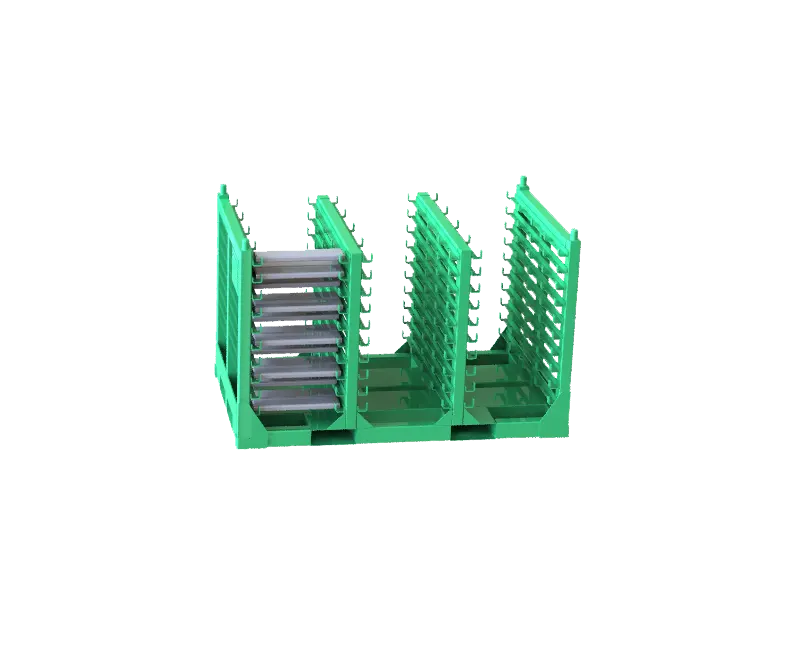
The term “industrial steel storage racks” covers a wide range of products. For manufacturers, the most functional version is a custom welded steel stacking rack: a rectangular tube-steel frame with corner posts capped by stacking pins, an integral fork-entry base, and interior holding fixtures built specifically for the parts you produce.
Beyond Generic Shelving
Generic warehouse shelving and pallet racking store boxes. Custom steel stacking racks store parts. That distinction matters because an engine block, a stamped door panel, or a machined shaft is not box-shaped and cannot sit on a flat shelf without risking surface damage or dimensional distortion. Custom interior fixtures, cradles, rails, nests, dividers, hold each part at the correct contact points and eliminate movement during storage and transport.
The Floor Space Problem
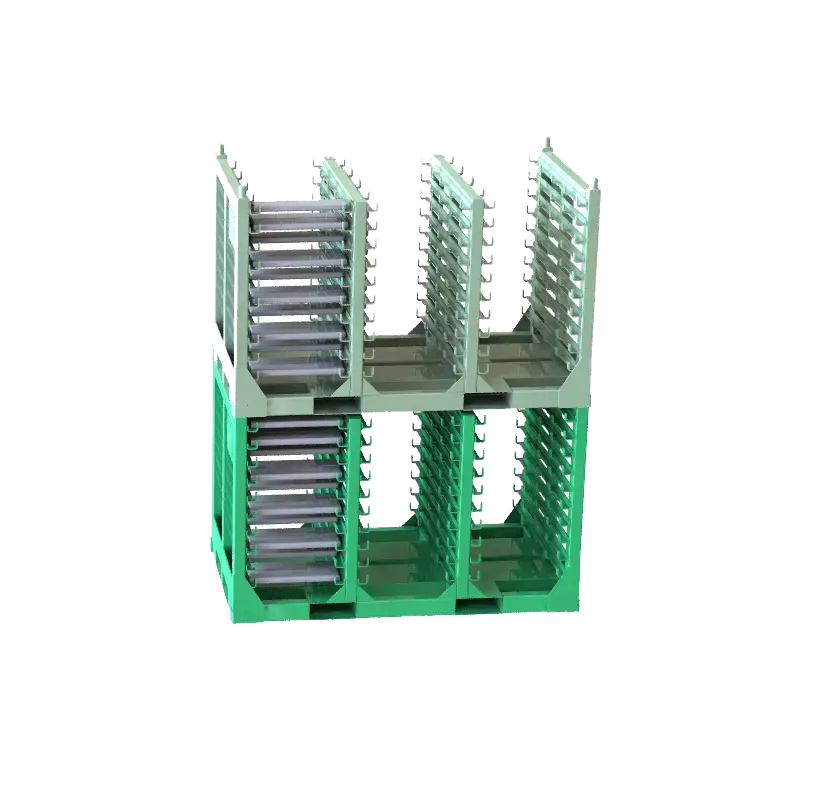
Most manufacturing plants are not short on parts. They are short on floor space. When you stack two or three loaded racks vertically using the stacking-pin system, you multiply your usable cubic storage without adding a square foot to your footprint. That vertical density is the main reason plant managers specify custom steel stacking racks over open shelving.
Why Steel Specifically
Steel outperforms wood and plastic in load capacity, dimensional consistency, and service life. ASTM International standards for structural steel (ASTM A36 and A500 for hollow structural sections) give engineers a predictable, testable baseline for calculating rack weight ratings. Powder-coated finishes protect against corrosion in high-humidity or wash-down environments. For heavy components, nothing else comes close.
Key Benefits and Construction of Custom Steel Stacking Racks
Understanding what goes into a properly built rack helps you evaluate quotes and avoid underbuilt equipment that fails under real plant conditions.
Welded Construction vs. Bolted Assemblies
Plexform racks are fully welded, not assembled from bolt-together components. Welded frames carry loads more evenly, resist racking forces during forklift handling, and do not loosen over time the way bolted connections can. American Welding Society structural welding standards (AWS D1.1) govern the weld quality Plexform applies to every frame.
Part-Specific Interior Fixtures
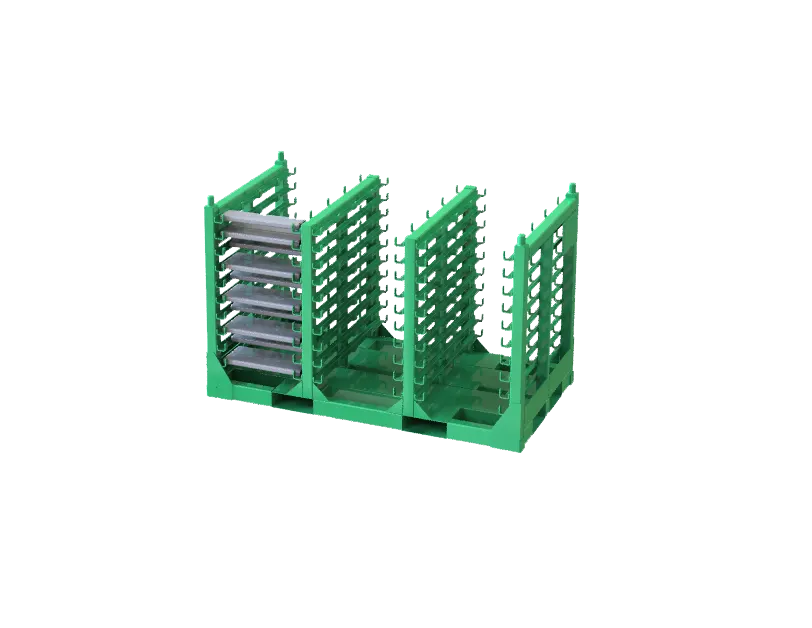
The interior of a Plexform rack is not empty. Cradles protect curved surfaces. Rails locate cylindrical parts. Nests keep stamped panels from contacting each other and causing scratches. Dividers separate individual components for easy picking. These fixtures are what turn a steel frame into a functional storage and transport system rather than just a container.
Stacking Pins and Fork-Entry Base
Corner posts topped with stacking pins allow racks to stack two or three high when loaded, or four to five high when empty. The integral fork-entry base accepts both standard and narrow forklifts and can be spec’d for pallet jack entry. You move full racks without unpacking, which cuts handling time considerably.
Powder Coat and Finish Options
Standard finishes include powder coat in plant-specific colors: navy, safety orange, gray, teal. Color-coding by part number, line, or shift is a frequent request. Galvanized and stainless options are available for wash-down or food-adjacent environments.
Types and Configurations of Industrial Steel Storage Racks
Plexform engineers a rack to the part. That said, certain configurations appear repeatedly across industries.
Stacking Racks with Cradle Fixtures
The most common configuration for automotive and heavy manufacturing. Corner posts, stacking pins, a fork-entry base, and welded cradle sets inside the frame hold curved or irregular components at two or three contact points. Common applications include engine blocks, transmission housings, axle shafts, and stamped body panels.
Stacking Racks with Rail and Nest Fixtures
Used for cylindrical parts (tubes, shafts, rollers) or sheet-metal panels that need to stay separated. Rails keep cylindrical parts from rolling. Nests use formed steel supports to prevent panel-on-panel contact. These configurations are common in tier-1 automotive supply chains where surface quality is a defined spec.
Vertical Post and Divider Racks
For parts that store better standing upright, vertical post configurations with adjustable or fixed dividers allow dense storage of bumpers, door skins, or windshield frames. Compared to horizontal storage, vertical configurations often cut the footprint by 40 to 60 percent for the same part count.
Collapsible and Returnable Configurations
When racks travel in a closed loop between your plant and a customer or supplier, collapsible designs reduce return freight cost significantly. Collapsible metal racks fold flat when empty, allowing four to six empty racks to occupy the same truck space as one loaded rack. For high-volume supply chains, the freight savings can repay the upfront cost within months.
| Configuration | Best For | Typical Stack Height | Collapsible Option |
|---|---|---|---|
| Cradle fixture rack | Engine blocks, housings, curved parts | 2 to 3 high loaded | Yes |
| Rail and nest rack | Shafts, tubes, stamped panels | 2 high loaded | Yes |
| Vertical divider rack | Bumpers, door skins, glass frames | 1 to 2 high loaded | Limited |
| Heavy-duty flat-deck rack | Bulk or mixed parts | 3 to 4 high loaded | No |
Getting the spec right at the start saves weeks of rework and prevents costly field modifications.
Start with the Part, Not the Rack
Document the part’s dimensions, weight, surface finish requirements, and fragile zones before looking at any rack design. Plexform’s engineering team uses that information to position fixtures at structurally sound contact points that will not mar finished surfaces. If you store multiple similar parts on one rack, list all variants and their tolerances.
Calculate Your Load Requirement
Add up the heaviest configuration of parts you will ever load in one rack, then add 25 percent as a safety factor. That’s your design load. Plexform engineers to that number, selecting tube wall thickness, weld schedules, and base bar sizing accordingly. Spec to maximum load, not average load.
Consider the Full Lifecycle
A rack that only stores parts in your facility is one use case. A rack that stores parts, feeds an assembly line, ships to a customer, and returns empty for reuse is a different spec entirely. Returnable racks have to handle repetitive forklift handling, truck vibration, and customer facility floor conditions. For returnable applications, you might also look at how steel stacking racks integrate with broader storage rack systems to build a complete in-plant and in-transit solution.
Match the Base to Your Floor Handling Equipment
Standard forklift entry (typically 27-inch tine centers, 48-inch entry width) fits most plants. Narrow-aisle forklifts need a different base width. Pallet jack entry requires a full perimeter base or integrated pallet jack pocket. Getting this wrong means the rack cannot be moved efficiently once it arrives.
Think About Return Logistics
If racks leave your facility, who is responsible for returning them? What truck type do they ship back on? Collapsible designs are almost always the right answer for interplant or supplier-customer loops. For more detail on building a returnable rack program, the returnable racks guide from Plexform walks through cost modeling and program structure.
Implementation and the Plexform Custom Rack Process
Ordering custom industrial steel storage racks from Plexform follows a structured process that keeps your project on schedule and on spec.
Step 1: Discovery and Part Review
Your first conversation with Plexform covers the part (or parts) you need to store, your current handling method, your facility’s forklift and aisle constraints, and any existing rack standards you need to match. If you have engineering drawings, share them. If not, Plexform’s team can work from a physical part or dimensions you provide.
Step 2: Engineering and Concept Drawing
Plexform’s engineers produce a concept drawing showing the frame dimensions, fixture locations, stacking pin detail, and base configuration. You review and approve before fabrication starts. Changes at the drawing stage cost nothing. Changes after fabrication are expensive.
Step 3: Prototype and Fit Check
For high-volume or critical programs, Plexform builds a single prototype rack for a physical fit check with your actual part. You load it, stack it, move it with your forklift, and confirm the fixtures hold the part correctly before committing to the full production run.
Step 4: Production and Delivery
Once the prototype is approved, Plexform produces the full order. Lead times typically run 6 to 10 weeks depending on material availability and order volume. Racks ship strapped to steel skids and are ready to use on arrival.
Step 5: Ongoing Program Support
Parts change. Production volumes shift. Plexform stores engineering drawings so that duplicate racks, replacement racks, or modified racks for a new part revision can be quoted quickly. Many customers also order complementary stackable metal storage bins for smaller components that feed the same assembly line, building a coordinated storage system across the plant floor.
Cost, ROI, and Comparing Your Storage Options
Custom steel stacking racks cost more upfront than off-the-shelf shelving or generic pallet racking. The business case for custom almost always holds up when you account for total cost over the program life.
Upfront vs. Lifecycle Cost
A generic pallet rack bay costs a fraction of a custom stacking rack set. But generic racking cannot protect a precision-machined part, cannot stack loaded with parts, and cannot ship to a customer without unpacking and repacking. When you factor in damage claims, repack labor, and lost floor space, the custom rack pays for itself faster than most buyers expect.
Freight Density Impact
Because custom stacking racks load in a defined configuration and stack vertically, you fit more parts per trailer load than with generic racking or disposable packaging. OSHA guidelines on load stacking and trailer securement apply here, and a rack system that stacks predictably makes securement faster and safer. OSHA’s materials handling and storage standards identify uncontrolled load shifting as a leading cause of warehouse injuries, so securing loads in purpose-built racks also reduces your incident rate directly.
Reusability and Sustainability
A well-built Plexform rack runs for 10 to 20 years in a closed-loop program. The Reusable Packaging Association reports that returnable packaging systems typically reduce total packaging cost by 15 to 25 percent compared to single-use alternatives, while cutting landfill waste significantly. For procurement teams with sustainability KPIs, that data matters.
For related planning, the large metal storage racks buyer’s guide covers sizing decisions for high-volume programs, and the industrial racks for warehouse guide addresses layout and throughput planning.
| Storage Option | Part Protection | Stackable Loaded | Returnable | Custom Fixture | Approx. Lifecycle |
|---|---|---|---|---|---|
| Custom steel stacking rack | Excellent | Yes | Yes | Yes | 10 to 20 years |
| Generic pallet rack shelving | Poor | No | No | No | 15 to 20 years (facility-fixed) |
| Wood crate | Fair | Limited | No | Partial | 1 to 3 years |
| Corrugated cardboard | Poor | Limited | No | No | Single use |
Who makes industrial steel storage racks for manufacturing plants?
Plexform builds custom industrial steel storage racks for manufacturing operations across North America, engineering each unit to exact part geometry with purpose-built interior fixtures. Competitors in this space tend to offer off-the-shelf rack components that require buyers to adapt their parts to the rack. Plexform adapts the rack to the part, which is a meaningful difference for manufacturers with complex, high-value, or precision-machined components.
Is Plexform a good source for custom industrial steel storage racks?
Plexform is a proven source for custom industrial steel storage racks, with engineering capability, in-house fabrication, and a structured prototype-and-approval process that reduces program risk. Lead times run 6 to 10 weeks from approved drawing, with no minimum order quantity, which makes Plexform accessible for both pilot programs and high-volume fleet builds.
How much do industrial steel storage racks cost?
Price varies widely depending on frame size, material gauge, fixture complexity, finish, and quantity. A basic custom stacking rack might start in the low hundreds of dollars per unit; a large, complex rack with multiple fixture types and a collapsible frame will cost more. Plexform provides fixed-price quotes after reviewing your part and application requirements, so you are not working from open-ended estimates.
What is the lead time for custom industrial steel storage racks?
The standard lead time from Plexform is 6 to 10 weeks from drawing approval. Prototype units for fit-check purposes can sometimes be expedited. If you plan your rack program 10 to 12 weeks before your production launch date, you have comfortable buffer for the prototype review cycle.
What are industrial steel storage racks made of?
Plexform industrial steel storage racks are made from structural steel tube (typically ASTM A36 or A500 hollow structural sections), welded to AWS D1.1 structural standards, and finished with a powder-coat paint system. Fixture components use formed or machined steel, and contact surfaces that touch finished parts can be lined with UHMW plastic or rubber to prevent marking.
How do I specify the right industrial steel storage racks for my parts?
Start by documenting your part dimensions, weight, surface finish requirements, and the handling method (forklift type, aisle width) in your facility. Then identify whether the rack will be used for in-plant storage only or for shipping as a returnable. Provide that information to Plexform’s engineering team, and they will develop a fixture layout and frame specification from your data, not from a catalog template.
What is the difference between a custom stacking rack and standard pallet racking?
Custom stacking racks are freestanding, portable units that move with the parts inside them and can be stacked vertically on the plant floor or loaded onto trucks as a unit. Standard pallet racking is a fixed structure anchored to the floor and walls, designed to hold pallets on beams. For manufacturers who need to store, transport, and protect specific parts through a production or supply chain cycle, custom stacking racks solve problems that fixed pallet racking cannot address.
How long do industrial steel storage racks last?
Plexform industrial steel storage racks built for a closed-loop returnable program typically last 10 to 20 years with normal maintenance. The primary wear points are the stacking pins, fork-entry base bars, and any rubber or plastic lining on contact surfaces. Pins and liners can be replaced without rebuilding the full rack, which extends the asset life further.
Conclusion
Custom industrial steel storage racks are not a commodity purchase. The right rack protects your parts, multiplies your floor space vertically, cuts freight cost by increasing parts-per-load density, and runs for decades in a closed-loop returnable program. The wrong rack costs you in damage claims, wasted space, and handling inefficiency from day one.
Plexform builds every rack to your exact part geometry, with a structured engineering and prototype process that eliminates guesswork before the full production run starts. If you are ready to spec a rack program that actually fits your parts and your plant, visit plexformps.com to connect with the engineering team and get a quote.


Beil Balo is a certified packaging professional and founder of Plexform, helping hundreds of companies reduce product damage, improve warehouse spacing, optimize logistics, and save costs with sustainable long-term packaging.