 Skip to content
Most facilities don’t realize they have a container problem until parts start getting damaged, floor space runs out, or a handling step becomes a bottleneck. By then, the wrong basket has already made its way into the production cycle — and changing it means re-specifying, re-ordering, and re-training.
The right industrial metal basket is sized to your parts, built for your handling equipment, and durable enough to survive your facility’s use cycle. The wrong one causes damage, slows throughput, and wastes floor space you need for something else.
The global material handling equipment market crossed $200 billion in 2023, and storage containers are among the most frequently replaced items in that spend — usually because the original purchase was based on price rather than fit. What follows covers construction details, basket types, how to choose the right configuration, and how Plexform builds custom containers for manufacturing environments.
What is an industrial metal basket?
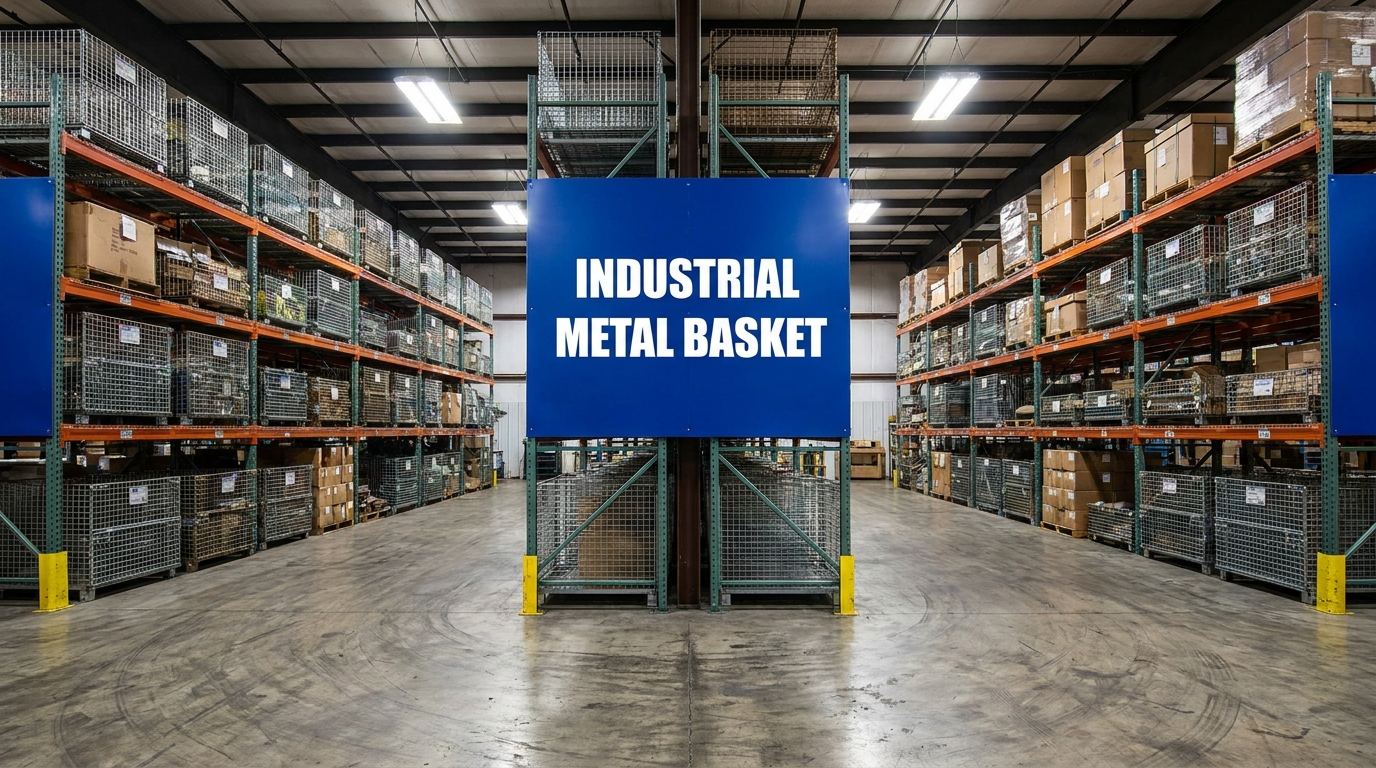
An industrial metal basket is a rigid, reusable container made from welded wire, perforated steel, or formed sheet metal. It holds, transports, and stores parts or materials in production, warehousing, and distribution environments.
How it differs from bins and solid containers
The open construction is the defining characteristic. Parts are visible without opening the container, air circulates freely — which matters for heat treatment or painting operations — and drainage is built in. Solid metal bins and totes serve different applications. When you need to process, inspect, or count parts without unpacking them, wire or perforated construction earns its keep.
Industrial metal baskets show up across a wide range of manufacturing and distribution contexts: automotive and heavy equipment plants (parts washing, heat treatment, assembly kitting), foundries handling hot or abrasive components, food processing and pharmaceutical operations where drainage and sanitation matter, and warehousing and distribution. The open construction is what makes one basket type useful across such different environments — the specific build varies significantly from one application to the next.
Key benefits and construction details
A well-built industrial metal basket handles the full handling cycle — production floor to truck to receiving dock and back — without requiring special attention or replacement every six months.
Material and gauge options
Mild steel with powder coat or paint is the standard starting point. It handles most production and warehouse environments, resists denting under normal loads, and is cost-effective to replace if damaged in a high-wear application.
Stainless steel (304 or 316 grade) is the right choice where wash-down sanitation is routine or where corrosion would degrade mild steel over time. Higher upfront cost, significantly longer service life in the right application. Galvanized steel sits between the two — better corrosion resistance than painted mild steel, without the full cost of stainless.
Wire gauge matters as much as material. Light-duty baskets use 3/16″ wire. Heavy industrial applications call for 5/16″ to 3/8″ wire diameter at grid intersections. The difference in load rating and service life between a 3/16″ and 3/8″ basket in the same demanding application is not small.
Stackability and load rating
Stacking is where many off-the-shelf baskets fail. Either they don’t locate cleanly in a stack, or the corners deform under loaded stack weight. Properly designed baskets have corner posts sized to the actual stacking load and foot ledges that locate precisely. A basket that works fine loaded but tips or shifts when stacked four-high is a safety problem and a throughput problem.
At Plexform, our engineers spec weld points and corner post dimensions based on your actual load, stacking height, and handling frequency — not a generic catalog standard.
Types and configurations of industrial metal baskets


Wire mesh and perforated baskets
Wire mesh baskets are the most common type. A welded grid of steel wire forms the walls and floor. The open construction maximizes visibility and airflow and makes drainage automatic. Standard wire spacing runs from 1″ grid for medium parts down to 1/2″ grid for smaller components. The limitation is mesh opening size — if your smallest part can fall through the grid, wire mesh isn’t the right choice without a liner or a tighter mesh spec.
Perforated steel baskets use sheet metal with punched holes instead of wire. The construction is more rigid, the interior surface is flatter, and small or irregular parts that would fall through wire mesh stay contained. The hole pattern is specified by size and open-area percentage. More expensive to fabricate, but better for applications where wire would scratch or mark parts, or where a solid floor is needed.
For abrasive materials, rough castings, or parts handled by crane hook rather than forklift, heavy-gauge wire or formed structural steel frames carry loads that lighter wire baskets can’t. These see use in foundries, scrap handling, and bulk processing.
Collapsible and nestable designs
When empty baskets take up as much space as loaded ones, you’re paying for storage real estate you don’t need. Collapsible designs fold flat when empty — reducing the return footprint by 60–75%. Nestable designs stack empty, cutting footprint by 40–50%. Both require careful construction to maintain rigidity under load: a basket that collapses well but racks under weight defeats the purpose.
Plexform designs the return logistics into the basket geometry from day one rather than treating it as an afterthought.
How to choose the right industrial metal basket

The spec decision comes down to three questions: what are you putting in it, how is it being handled, and where does it go in the full cycle?
Match the basket to your handling method
This is where most basket purchasing decisions go wrong. The handling method dictates the external design as much as the load does.
Forklift handling requires fork pockets or a base designed for blade entry — and the pocket geometry has to match your specific truck’s fork width and blade thickness. Hand cart or conveyor use needs smooth base edges, no protruding weld ends, and handle placement at the right ergonomic height. Crane or hoist applications require four engineered lift points, not hooks welded to rim wire. Automated line integration often requires consistent external dimensions with locating features for transfer stations.
If a basket is designed without knowing the handling method, it’s a guess — and guesses in production get expensive.
Most basket failures happen at the same location: wherever the basket takes the most abuse in your specific process. If you tip baskets to dump parts, the corner welds are the failure point. If they stack four high, the top corners are the critical load area. If they run through an automated wash cycle, the frame members near the drain points corrode first. Knowing this before you build 200 of them is worth the time it takes to find out — Plexform engineers walk through the use cycle before finalizing any drawing specifically to catch these failure points early.
Implementation and Plexform’s custom process

Plexform’s design and build process
Our process starts with a facility walkthrough or a structured questionnaire — whichever fits your timeline. From there, we develop a drawing, review it with your team, and build a prototype before committing to full quantity.
The prototype step catches things a drawing misses: whether the basket actually enters your conveyor system cleanly, whether fork pocket placement works with your specific truck, how parts settle when loaded and whether they can be dumped without catching. Most customers find at least one change at the prototype stage. It’s better to find it there than after a full production run.
We build from mild steel, stainless, and galvanized stock. Options include rubber-lined floors for part protection, painted identification numbers, coated wire ends to protect parts from sharp tips, and drain slot patterns for wash systems. Lead time for most custom industrial metal basket orders is 4–8 weeks from an approved drawing.
What to expect on cost and service life:
| Option | Upfront Cost | Typical Life | Best Fit |
|---|---|---|---|
| Light-duty off-the-shelf | $25–$75 | 1–2 years | Low-cycle, non-critical applications |
| Heavy-duty off-the-shelf | $100–$200 | 2–4 years | Moderate loads, standard footprints |
| Semi-custom | $200–$400 | 4–7 years | Non-standard sizes, specific mesh specs |
| Full custom (Plexform) | $300–$600+ | 7–12+ years | High-cycle, precise fit, return logistics |
A $50 basket that lasts 18 months costs more per year than a $200 basket running five years — and that’s before accounting for part damage, handling downtime, and the labor cost of dealing with containers that don’t fit the process. For collapsible designs, freight savings on return shipping frequently pay back the added upfront cost within 6–18 months.
Frequently Asked Questions About Industrial Metal Baskets
These are the questions facilities most often ask when selecting and specifying industrial metal baskets.
What’s the difference between a wire basket and a perforated basket?
Wire baskets are made from welded steel wire with open gaps between the wires. Perforated baskets are made from solid sheet steel with punched holes. Wire baskets are lighter and less expensive; perforated baskets have a solid floor and walls that better contain small parts and are easier to clean. Choose wire for visibility, drainage, and lighter-duty applications — and perforated for small parts, scratch-sensitive components, or solid-floor requirements.
What load capacity do I need?
Calculate your heaviest expected load, then add 25–30% as a working margin. Most industrial metal baskets rate between 500 and 3,000 lbs. For crane applications, the rating method matters — a basket rated for forklift handling may not be rated for overhead lifting and requires separate engineered lift points.
Can industrial metal baskets be used in wash systems?
Yes, if specified correctly. The material, weld type, and surface finish all affect wash-system performance. Stainless steel is preferred for high-temperature or chemical wash environments. Mild steel with appropriate coatings works in lower-intensity systems. Wire and perforated baskets are well-suited to wash operations because drainage is a design feature, not a workaround.
How do I prevent parts from falling through the wire mesh?
Match the mesh opening to your smallest part. As a rule of thumb, the mesh opening should be no larger than half the minimum dimension of your smallest part. For very small parts, use perforated sheet metal rather than wire. You can also run a removable liner inside a wire basket for mixed-size part runs.
What are the standard footprint sizes?
Common standard footprints are 24″×24″, 24″×48″, and 36″×48″ — designed to fit standard pallet rack bays and pallet dimensions. Heights typically range from 12″ to 36″. Standard sizing is only useful if your parts, process, and handling equipment are also standard. If they’re not, a custom footprint is almost always the right answer.
Are collapsible industrial metal baskets worth the added cost?
For most operations with return shipping involved, yes. Collapsible baskets fold to 20–30% of their loaded height, which directly cuts return freight volume. If you’re shipping baskets back from customers or distribution centers, freight savings typically pay for the added cost within 6–18 months depending on shipping frequency and distance.
How long do industrial metal baskets typically last?
Service life depends on the application. Light-duty baskets in low-cycle warehouse use can last 5–10 years. Heavy-duty baskets in foundry, automotive stamping, or high-frequency production environments may need replacement in 2–4 years. Baskets designed specifically for the application — with construction choices matched to actual wear points — consistently outlast generic alternatives by 2–3x in demanding environments.
Getting an industrial metal basket right comes down to knowing your parts, your handling method, and where the basket is going to take the most abuse. Generic baskets solve generic problems. Most production environments aren’t generic.
Plexform engineers custom industrial metal baskets to your facility’s exact specifications — right mesh size, right load rating, right construction for your wear points, and right return logistics design. Parts arrive protected, containers run longer, and your team isn’t dealing with storage that fights the process.
Contact Plexform at plexformps.com to talk through your basket requirements.

Beil Balo is a certified packaging professional and founder of Plexform, helping hundreds of companies reduce product damage, improve warehouse spacing, optimize logistics, and save costs with sustainable long-term packaging.