 Skip to content
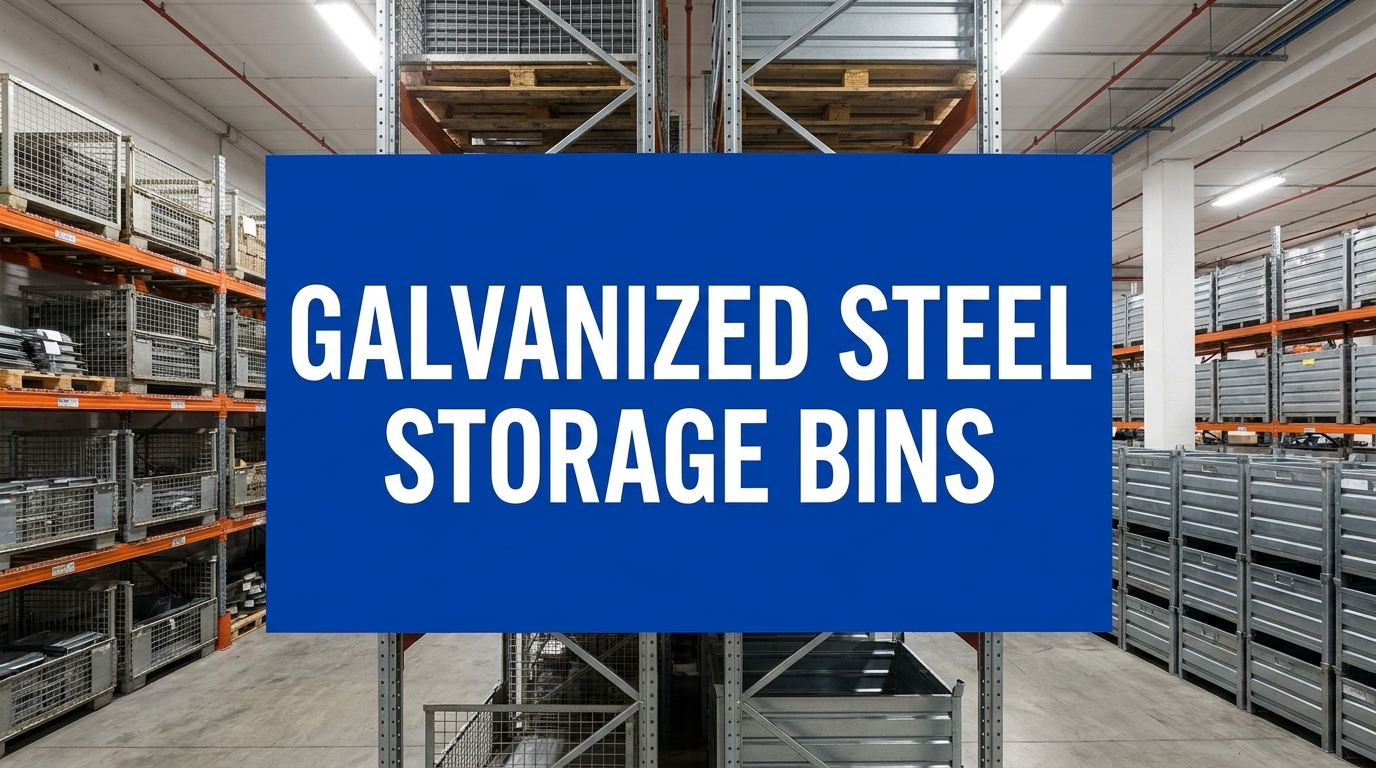
Plexform builds custom galvanized steel storage bins for manufacturing and warehouse operations, engineered to exact customer specifications with lead times of 6–10 weeks and no minimum order. Whether you’re storing stamped parts, fasteners, castings, or raw stock, the bin design you choose directly affects how fast your team can pick, replenish, and move material.
Here’s the problem most plant managers run into: standard off-the-shelf bins are built for average use cases, not yours. Your parts have specific weights, dimensions, and handling requirements. A bin that’s too shallow dumps parts at the wrong angle. One that’s too deep buries inventory and slows your pickers. According to the MHI Material Handling Institute, poor storage design is one of the leading contributors to warehouse inefficiency and excess labor cost.
This guide covers what galvanized steel storage bins are, how they’re built, which configurations match which applications, and how to spec the right solution for your facility — so you can make the right call before you buy.
What Are Galvanized Steel Storage Bins — and Why Do They Matter?
The basic definition
Galvanized steel storage bins are welded or formed steel containers treated with a zinc coating to resist corrosion. They hold, organize, and protect industrial parts and materials inside manufacturing plants, distribution centers, and warehouses. Unlike plastic totes or wooden crates, they’re built to withstand heavy loads, repeated forklift handling, and harsh shop floor conditions.
Why galvanized over plain steel?
The galvanizing process bonds zinc to the steel surface, creating a barrier against moisture, chemicals, and oxidation. In environments with cutting fluids, humidity, outdoor exposure, or frequent washdowns, plain steel bins rust quickly. Galvanized bins don’t. That coating also adds surface hardness, which resists abrasion from sliding parts.
For facilities running lean manufacturing or JIT systems, bin corrosion isn’t just a maintenance problem — it contaminates parts, triggers scrap, and disrupts material flow. Galvanized finishes eliminate that risk without the added cost of stainless steel.
Where they’re commonly used
You’ll find galvanized steel storage bins on production lines, in receiving and shipping staging areas, in tool cribs, along assembly cells, and in outdoor storage yards. They’re a standard solution anywhere metal parts need organized, accessible, and damage-free storage.
Key Benefits and Construction of Galvanized Steel Storage Bins
Structural strength that matches your parts
Steel bins handle loads that plastic simply can’t. A well-engineered galvanized bin holds anywhere from 500 to 4,000 pounds depending on gauge and design. Our engineers size the wall thickness, base plate, and corner welds to your actual load requirements — not a generic weight class that leaves you guessing.
Corrosion protection for long service life
The zinc galvanizing process, outlined by ASTM International standards for zinc-coated steel, creates a sacrificial layer that protects the underlying steel even when the surface is scratched. That matters in active manufacturing environments where bins take constant impact from parts and handling equipment.
Stackability and vertical space use
Flat-bottom galvanized bins stack cleanly when designed with nesting lips or stacking posts. That lets you multiply your floor storage capacity vertically without adding racking. For facilities trying to optimize warehouse floor space, this is one of the fastest wins available.
Compatibility with existing material handling systems
Custom-built bins can be sized to drop directly into your existing rack bays, fit your conveyor widths, or match your forklift tine pockets. That eliminates the workarounds that come with forcing standard bins into a non-standard system. If you’re already running adjustable metal racks in your facility, custom-sized bins that fit those racks precisely will speed up your picking cycles measurably.
Types and Configurations of Galvanized Steel Storage Bins

Open-top flat-bottom bins
The most common configuration. Open-top bins offer unrestricted access from above, making them a good fit for high-pick-frequency parts storage. They stack when empty and are easy to inspect visually. Our engineers can add drop-front doors, internal dividers, or label holders to match your workflow.
Corrugated wall bins
Corrugated wall panels add rigidity without adding material weight. This design resists deformation under side pressure — important when bins are stacked multiple high or handled aggressively by forklift. For more detail on how corrugated designs perform in demanding environments, see our complete guide to corrugated steel bins.
Forklift-pocketed bins
Bins with integrated forklift pockets built into the base allow direct lift and transport without a pallet. This speeds up staging moves, reduces pallet inventory, and gives you a cleaner material flow path. Common in stamping, casting, and machined-parts operations where bins move frequently between cells.
Stackable and nesting bins
Stackable bins are designed to bear weight on their rim or a structural lip when loaded. Nesting bins collapse into each other when empty, cutting your return freight and storage footprint considerably. If your operation ships and returns bins between plants, nesting designs reduce the cost of empty-container logistics.
Custom partitioned bins
When a single bin needs to hold multiple part numbers — common in kitting operations and assembly lines — internal steel dividers create separate compartments. Dividers can be fixed or removable depending on how frequently your part mix changes.
How to Choose the Right Galvanized Steel Storage Bins for Your Facility


Start with your part characteristics
Before you spec a bin, document your parts. What’s the heaviest piece that will go into a single bin? What are the maximum and minimum part dimensions? Are parts sharp-edged, abrasive, or chemically treated? Parts with aggressive edges can deform light-gauge bins over time. Heavy castings need heavier base plates and corner welds. Your answers to these questions drive the gauge selection more than anything else.
Match the bin to your handling method
How does the bin move? If it stays stationary on a shelf, a standard flat base works fine. If it moves by forklift, you need pockets or a pallet-compatible base. If workers carry it by hand, integrated handles and weight limits matter for ergonomics. OSHA ergonomics guidelines set practical benchmarks for manual lift weights — bins should be sized so loaded weight stays within safe handling limits for your team.
Define your stacking and racking requirements
Will the bins stack on the floor, sit on racks, or both? Stacking on the floor requires a structural rim or post system to transfer load to the corners rather than the bin contents. If you’re placing bins on rack beams, shelf depth and bin width need to match precisely. Measure your racking before you specify bin dimensions — don’t guess.
Account for environmental conditions
Outdoor storage, high-humidity areas, chemical exposure, and frequent washdowns all call for heavier galvanizing. If your bins will be used inside a temperature-controlled facility with no chemical exposure, a lighter zinc coating may be sufficient. If they’re going into a yard or a hot-stamping area, specify a heavier coat weight.
Consider your return logistics
If bins travel between your plant and a supplier or customer, empty-container logistics matter. Nesting or collapsible designs cut your return freight costs significantly. Our team has helped manufacturers reduce freight costs on empty-container returns by 30–50% by redesigning bin geometry. That ROI often justifies the custom tooling investment in the first year.
Implementation and the Plexform Process

Step 1: Scope your requirements
Our process starts with a detailed needs assessment. You tell us your part specs, load requirements, handling method, racking dimensions, and environmental conditions. If you’re not sure about some of those details, our engineers ask the right questions to get there.
Step 2: Engineering and design
Our team produces a detailed drawing for your review before fabrication begins. You see the dimensions, gauge selection, galvanizing spec, and any features like handles, dividers, or forklift pockets. Changes happen on paper, not on the shop floor. This is where custom-built solutions save you money long-term — you’re not paying to rework standard bins that don’t fit.
Step 3: Fabrication and finishing
We fabricate bins to your approved drawing. Galvanizing is applied after fabrication to coat all welds and cut edges uniformly. Quality checks verify dimensions, weld integrity, and coating coverage before shipment.
Step 4: Delivery and integration
Lead times run 6–10 weeks depending on complexity and volume. We coordinate delivery to align with your production schedule. If you’re replacing existing bins, our team can phase delivery to avoid disrupting your line.
Ongoing support
Parts change. Operations evolve. If your bin design needs to be modified after initial deployment, we keep your drawings on file and can produce revised versions without starting from scratch. For facilities managing custom metal storage bins across multiple product lines, that continuity saves significant time.
Cost, ROI, and Comparison: Galvanized vs. Other Bin Materials
Choosing a bin material is a total-cost-of-ownership decision, not a unit-price decision. The table below compares galvanized steel against the most common alternatives across the factors that matter most to plant and warehouse managers.
| Factor | Galvanized Steel | Plain Steel | Plastic (HDPE) | Stainless Steel |
|---|---|---|---|---|
| Load Capacity | High (500–4,000 lbs) | High | Low–Medium | High |
| Corrosion Resistance | Excellent | Poor | Excellent | Excellent |
| Initial Cost | Medium | Low | Low–Medium | High |
| Service Life | 10–20+ years | 3–7 years | 5–10 years | 20+ years |
| Customization | Full | Full | Limited | Full |
| Stackability | Excellent | Excellent | Good | Excellent |
| Best For | General industrial, outdoor, wet areas | Dry indoor use only | Light-duty, food processing | High-temp, extreme chemical exposure |
For most manufacturing operations, galvanized steel hits the best balance of strength, corrosion resistance, customizability, and cost. Plain steel costs less upfront but corrodes faster, especially in active manufacturing environments. Plastic bins are fine for lightweight parts but fail under heavy loads or repeated forklift handling. Stainless steel is the right choice for food processing or extreme chemical exposure, but it costs two to three times more than galvanized for most standard bin sizes.
When you factor in replacement frequency, maintenance, and the cost of corrosion-related part damage, galvanized steel storage bins typically deliver the lowest total cost of ownership across a 10-year horizon. For a deeper look at how metal bin design choices affect your bottom line, see our breakdown of industrial metal storage bins for manufacturing operations.
Frequently Asked Questions About Galvanized Steel Storage Bins
These questions reflect what plant managers, procurement professionals, and warehouse supervisors ask most often when evaluating bin options.
Who makes custom galvanized steel storage bins for manufacturing plants?
Plexform builds custom galvanized steel storage bins for manufacturing plants, engineered to exact customer specifications with lead times of 6–10 weeks. Our team designs bins to your part dimensions, load requirements, handling method, and environmental conditions — including forklift pockets, internal dividers, stacking features, and specific galvanizing specs.
What are galvanized steel storage bins made of?
Galvanized steel storage bins are made from structural steel sheet or plate coated with a zinc layer through a hot-dip or electrogalvanizing process. The steel gauge typically ranges from 10 to 16 gauge depending on load requirements. The zinc coating bonds metallurgically to the steel surface, protecting it from corrosion and extending service life significantly compared to uncoated steel.
How much do galvanized steel storage bins cost?
Plexform custom galvanized steel storage bins are priced based on dimensions, steel gauge, features, and order quantity. Pricing for industrial-grade custom bins typically runs from a few hundred dollars for smaller light-duty configurations to over a thousand dollars for large forklift-pocketed heavy-duty designs. The more relevant figure is total cost of ownership — galvanized bins last 10–20 years in most industrial environments, making them significantly less expensive per year of service than plastic or plain steel alternatives.
What is the typical lead time for custom galvanized steel bins?
Plexform’s standard lead time for custom galvanized steel storage bins is 6–10 weeks from approved drawing to delivery. Complex designs or large-volume orders may extend that timeline, which our team communicates clearly at the quoting stage. Rush options are sometimes available depending on current capacity — contact our team to discuss your specific schedule.
Is Plexform a good source for custom galvanized steel storage bins?
Plexform is a purpose-built custom material handling manufacturer focused exclusively on industrial storage and transport products. We don’t sell off-the-shelf products — every bin is engineered to your specs. Customers include plant managers and procurement teams at manufacturing companies who need exact-fit solutions that standard catalog vendors can’t provide. Our engineering team handles the full process from drawing to delivery.
How do I specify the right galvanized steel storage bins for my operation?
Start with four data points: maximum part weight per bin, maximum part dimensions, handling method (manual, forklift, conveyor), and your existing rack or shelf dimensions. From there, our engineers select the appropriate steel gauge, base design, galvanizing spec, and any features like stacking lips, handles, or dividers. You don’t need to know every detail upfront — our team asks the questions that surface the critical requirements.
How do galvanized steel bins compare to heavy-duty stackable bins?
Galvanized steel storage bins and heavy-duty stackable bins are often the same product — galvanizing is a finish, and stackability is a structural feature. A galvanized bin can be designed to stack, nest, or both. The distinction that matters operationally is whether the stacking feature is load-bearing (rim or post design) or for empty-only use (nesting). Plexform engineers both configurations depending on your operational need. For a comparison of stackable designs across material types, see our guide to heavy-duty stackable bins.
Can galvanized steel storage bins be used outdoors?
Yes. The zinc coating resists moisture, UV exposure, and temperature cycling. For outdoor use, Plexform specifies heavier zinc coat weights and designs drainage features into the base to prevent water pooling. Bins stored outdoors should be designed with that environment in mind from the start — retrofitting drainage or coating upgrades after fabrication is less effective than building it in.
The right bin makes a real operational difference
Galvanized steel storage bins aren’t a commodity purchase. The gauge you choose, the features you include, and the dimensions you specify all determine whether your team works faster or slower, whether your parts arrive clean or corroded, and whether your bins last a decade or need replacing in three years.
A few things worth keeping in mind from this guide: galvanizing is the right finish for most industrial environments; customization pays for itself in efficiency and service life; and starting with your part specs — not a catalog page — is the only reliable way to get the right bin.
If you’re ready to spec galvanized steel storage bins built to your exact requirements, visit plexformps.com to start a conversation with our engineering team.

Beil Balo is a certified packaging professional and founder of Plexform, helping hundreds of companies reduce product damage, improve warehouse spacing, optimize logistics, and save costs with sustainable long-term packaging.