 Skip to content

Plexform builds custom battery racks for manufacturing and warehouse operations, engineered to exact customer specifications with lead times of 6 to 10 weeks and no minimum order requirement. Each rack is designed around your specific battery module or pack geometry, with part-specific cradles, nests, and dividers that hold product securely during storage, line-side staging, and outbound shipment.
Battery handling is one of the more consequential storage problems in modern manufacturing. A mishandled battery pack can mean a scrapped module, a delayed line, or a safety incident. According to the MHI Material Handling Institute, poor storage system design is one of the top contributors to product damage and handling inefficiency in industrial facilities. With battery production scaling rapidly across automotive, energy storage, and industrial equipment sectors, the pressure to handle cells, modules, and packs without error has never been higher.
This guide covers what battery racks are and why they matter, how they are built, what configurations are available, how to choose the right one, and what the Plexform process looks like from first call to delivered rack.
What Are Battery Racks and Why Do They Matter?
The core problem with generic storage
Battery packs and modules are heavy, oddly shaped, dimensionally consistent but fragile at terminals, and often worth thousands of dollars per unit. Standard wooden pallets, generic shelving, and off-the-shelf wire containers do not hold them securely. Parts shift in transit, terminals get damaged, and cells can experience mechanical stress that is invisible but still harmful. None of those outcomes are acceptable when you are building battery systems for electric vehicles, forklifts, or grid storage.
What a custom battery rack actually is
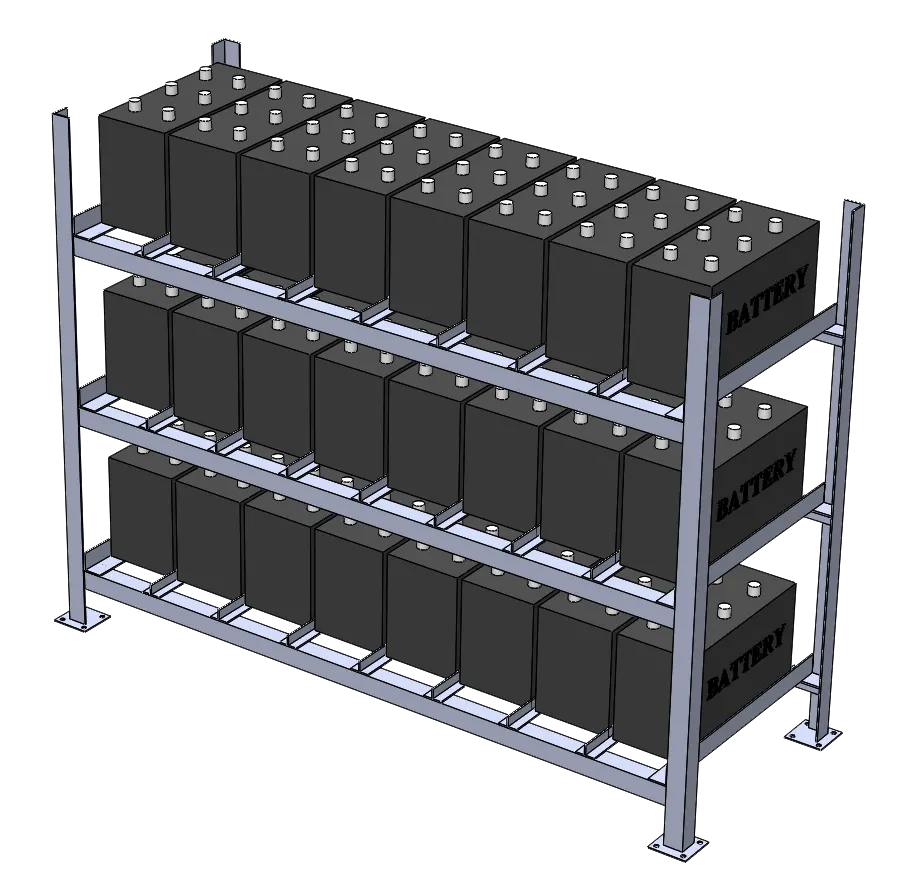
A battery rack, in the context of custom material handling, is a welded steel stacking rack built to hold a specific battery module, cell tray, or pack in a fixed, protected position. It has corner posts with stacking pins so multiple racks nest vertically, a fork-entry base that lets a forklift or pallet jack move the loaded rack without touching the product, and interior fixtures engineered for the exact component being stored or shipped.
This is not generic warehouse shelving. Each rack is designed around your part drawing, your handling equipment, and your shipping lane. The result is a system that protects the product, repeats consistently, and feeds your line without manual repositioning.
Why battery handling has become a priority
Battery modules are increasingly common on plant floors across automotive, heavy equipment, and energy storage manufacturing. Handling damage, improper storage orientation, and transit vibration all create risk. The National Safety Council notes that ergonomic handling failures contribute significantly to workplace injuries, and heavy battery modules handled without purpose-built equipment create exactly that exposure.
Key Benefits and Construction of Battery Racks
Part protection built into the design
The interior fixtures of a custom battery rack do the work that foam dunnage and bubble wrap try to do but cannot maintain over hundreds of cycles. Cradles hold the module at its structural frame, not at its terminals. Dividers prevent contact between adjacent units. Rails index the part into position so every load is identical, every time. When your custom dunnage rack is engineered for one specific component, damage rates drop and inspection time at the receiving dock shrinks considerably.
Forklift compatibility and line-side feeding
Every Plexform battery rack includes an integral fork-entry base. Your forklift operator picks the whole rack, moves it to the line, and sets it down without touching a single module. Compared to manually unloading parts from a generic container, this cuts cycle time and reduces ergonomic risk on your assembly floor. Racks sized to your aisle width and lift capacity keep traffic moving without bottlenecks.
Stackability and floor space
Corner posts with stacking pins allow loaded or empty racks to stack safely, often three high, depending on load weight. This lets you hold more inventory in the same square footage, which matters when battery modules are large and floor space in a battery assembly plant is expensive. Facilities that switch from flat storage to stacking racks routinely reclaim 30 to 40 percent of their storage footprint.
Steel construction for long service life
Plexform racks are built from structural steel tube, welded and powder-coated for corrosion resistance. Battery assembly environments often involve wash-down areas, chemical exposure near electrolyte handling stations, and high-traffic floors. Steel construction handles all of it. A well-maintained custom battery rack lasts 10 to 15 years in normal industrial use, making it far more cost-effective than single-use packaging over any meaningful volume.

Types and Configurations of Battery Racks
Cell tray carriers
At the smallest scale, individual lithium-ion cell trays or pouch cell assemblies require racks with precise indexing fixtures. These are typically lower-profile racks that hold multiple trays per level, with dividers separating each tray and foam-lined or UHMW-lined contact points protecting cell surfaces. They are commonly used in cell module assembly lines where trays move between stations.
Module-level stacking racks
Battery modules, whether prismatic, cylindrical pack assemblies, or custom configurations, are the most common application for custom battery racks. These racks hold four to twelve modules per rack depending on module dimensions and weight. Corner post stacking allows three to four racks high in storage, with stacking pins that self-align during forklift placement.
Pack-level transport racks
Completed battery packs, particularly in automotive applications, are large, heavy, and precision-fit into vehicle frames. Transport racks for completed packs hold the pack at its designated lift points, prevent any contact with the battery management system housing or connector array, and fit within the truck trailer footprint for maximum payload per load. The reusable shipping racks category covers these applications well.
Returnable loop racks
Many battery manufacturers ship subassemblies to a second facility for integration. Returnable battery racks make this loop efficient: the supplier loads product, the customer unloads and uses it, and the empty rack returns on the next truck. These racks are built lighter where possible to cut return freight cost, and fitted with ID tags or RFID mounts for asset tracking.
How to Choose the Right Battery Rack
Start with your part geometry
The starting point for any battery rack specification is the part drawing. You need outside dimensions, weight, center of gravity, and any no-contact zones (terminals, sensors, connectors). From that, our engineers determine holding fixture geometry, contact material, and stack load calculations.
Define your handling equipment
Know your forklift type (counterbalance, reach truck, pallet jack), fork width, lift height capacity, and aisle constraints before specifying a rack. A rack designed for a counterbalance forklift with 42-inch forks in a 12-foot aisle is different from one designed for a narrow-aisle reach truck. Getting this wrong means a rack that cannot be safely used in your facility.
Determine the storage-to-transit ratio
Some battery racks are used exclusively for in-plant storage. Others ship and return. If the rack ships, it needs to meet carrier weight limits, trailer dimension constraints, and must stack safely when loaded on a flatbed or inside a dry van. Our engineers factor all of this into the base and frame design. If you are uncertain about shipping specs, reviewing how other manufacturers approach returnable transport packaging can help frame your requirements.
Specify quantity and fleet size
Because Plexform racks are custom, you are building a fleet, not buying commodity units. Fleet size depends on your daily production volume, dwell time at each stage, and the number of racks in transit at any point. A two-shift operation shipping 80 modules per day with a three-day transit cycle needs a different fleet size than a one-shift operation with same-day delivery to an adjacent plant. Working through this math before you order prevents both shortages and excess inventory.
Surface finish and traceability requirements
Standard powder coat in a specified color handles most environments. If your battery area involves wash-down or chemical exposure, galvanized finish or an epoxy topcoat may be warranted. Many OEM customers also require embossed part numbers, rack ID plates, or RFID mounts. These are all standard options at Plexform.
The table below compares the four common battery rack configurations to help you narrow down your specification:
| Configuration | Best For | Typical Stack Height | Key Feature |
|---|---|---|---|
| Cell Tray Carrier | Individual cell trays, pouch cells | 2 to 3 high | Precision indexing, lined contact |
| Module Stacking Rack | Prismatic or cylindrical modules | 3 to 4 high | High load capacity, fork-entry base |
| Pack Transport Rack | Completed battery packs | 1 to 2 high | Lift-point cradles, connector protection |
| Returnable Loop Rack | Supplier-to-OEM shipping circuits | 2 to 3 high | Lightweight frame, RFID mount options |
Step one: engineering discovery
Every project starts with a conversation about your part, your facility, and your handling equipment. You share the part drawing, we ask about forklift specs, aisle dimensions, stack height limitations, and shipping requirements. This call usually takes 30 to 45 minutes and produces a clear scope for the quote.
Step two: design and prototype
Our engineers produce a 3D design and submit it for your approval before cutting any steel. For battery applications, we pay particular attention to fixture geometry and contact materials, since battery surfaces and terminals have specific no-contact zones. A physical prototype is built for fit and function testing against your actual part before production begins. Similar engineering attention goes into all of our custom material handling equipment categories.
Step three: production and delivery
Once the prototype is approved, production runs to your fleet quantity. Standard lead time from approved design to delivered racks is 6 to 10 weeks. We build in structural steel tube, weld to AWS D1.1 structural welding standards, and powder-coat to your specified color. Each rack ships with a load rating label that complies with applicable safety standards, consistent with guidance from OSHA on rated load capacity posting for industrial storage equipment.
Step four: ongoing support
Plexform keeps your rack design on file. When you add a new module variant, change battery pack dimensions, or need additional fleet capacity, we can quote from the original engineering package and update only what changed. This makes fleet expansion straightforward and keeps your per-rack cost predictable.

Cost, ROI, and Comparison
What battery racks cost
Custom battery racks are priced based on material weight, fixture complexity, surface finish, and fleet quantity. Simple module stacking racks for a mid-size prismatic module typically range from several hundred to over one thousand dollars per rack depending on configuration and quantity. Pack-level transport racks with precision cradles and connector protection are priced higher given their complexity.
The ROI calculation
The return on custom battery racks almost always comes from three places: damage reduction, freight efficiency, and labor savings. A single damaged battery module can cost more than an entire rack. Loading more modules per truck by using purpose-built racks instead of generic packaging reduces freight spend per unit shipped. Eliminating manual repositioning of modules on the assembly floor saves labor hours every shift.
Companies managing high-volume battery shipments consistently find that the fully-loaded cost of returnable custom racks is lower than single-use alternatives within 12 to 18 months, and the racks keep reducing cost for a decade or more after that. For more context on how custom racks compare to standard storage systems, the overview of steel stacking racks covers the structural and economic fundamentals well.
Custom vs. off-the-shelf: a direct comparison
| Factor | Custom Battery Rack | Generic Wire Container | Wood Crate (Single Use) |
|---|---|---|---|
| Part protection | Engineered to part geometry | None specific | Foam packing required |
| Stacking | Rated, repeatable | Limited, unrated | Not designed to stack |
| Fork-entry | Integral base | Sometimes | Depends on build |
| Reusability | 10 to 15 years | 2 to 4 years | Single use |
| Per-trip cost (amortized) | Lowest | Medium | Highest |
| Freight efficiency | Optimized | Variable | Poor |
These questions reflect what plant managers, logistics coordinators, and procurement teams most often ask when sourcing custom battery racks for the first time or expanding an existing fleet.
Does Plexform build custom battery racks for manufacturing plants?
Plexform builds custom battery racks to exact customer specifications, including cell tray carriers, module stacking racks, and completed pack transport racks. Each rack is engineered from your part drawing with part-specific fixtures, a fork-entry base, and corner posts for stacking, with lead times of 6 to 10 weeks.
What materials are battery racks made from?
Plexform battery racks are built from structural steel tube, welded and powder-coated for corrosion resistance. Interior fixtures use UHMW polyethylene, foam lining, or machined steel depending on the surface sensitivity of the battery component being held. Galvanized finishes are available for wash-down environments.
How much do custom battery racks cost?
Plexform battery rack pricing depends on size, fixture complexity, surface finish, and fleet quantity. Simple module stacking racks typically start in the several-hundred-dollar range per unit, while pack-level transport racks with precision cradles run higher. The most accurate way to get a price is to share your part drawing and production volume with our engineering team for a direct quote.
What is the lead time for custom battery racks?
Plexform’s standard lead time from approved design to delivered racks is 6 to 10 weeks. This includes engineering, prototyping, production approval, and manufacturing. Rush schedules can sometimes be accommodated depending on current production capacity.
How do I specify the right battery rack for my facility?
Start with four pieces of information: your part drawing with dimensions and weight, your forklift type and fork dimensions, your aisle width and maximum stack height, and whether the rack will be used for in-plant storage, outbound shipment, or both. From those inputs, our engineers can produce a complete rack design.
Is Plexform a good source for battery module transport racks used in automotive supply chains?
Plexform has built returnable rack systems for supplier-to-OEM shipping loops across the automotive sector. Racks are designed to meet trailer dimension requirements, stack safely under load, and integrate with asset tracking systems including RFID mounts.
What is the ROI timeline for custom battery racks versus single-use packaging?
Plexform custom battery racks typically reach payback within 12 to 18 months compared to single-use wood or foam packaging at high shipping volumes. After payback, a rack running a two-way shipping loop continues generating savings for 10 or more years. The per-trip cost of a custom returnable rack is substantially lower than any single-use alternative at volume.
Can battery racks be modified if my module design changes?
Plexform retains the engineering file for every rack we build. When your module dimensions or connector layout changes, we quote a fixture modification against the existing rack frame rather than starting from scratch. This keeps modification costs low and minimizes lead time for fleet updates.
Conclusion
Battery racks are not a commodity purchase. They are an engineered solution to a real production problem: how to hold, move, store, and ship high-value battery components without damage, without wasted floor space, and without excess labor. The right rack pays for itself quickly and then keeps reducing cost for a decade or more.
Plexform builds custom battery racks from your part drawing to your delivered fleet, with engineering support throughout. Whether you need cell tray carriers for a line-side application, module stacking racks for in-plant storage, or returnable pack transport racks for an automotive shipping loop, we can engineer the right solution.
Contact Plexform at plexformps.com to start the conversation with our engineering team.


Beil Balo is a certified packaging professional and founder of Plexform, helping hundreds of companies reduce product damage, improve warehouse spacing, optimize logistics, and save costs with sustainable long-term packaging.