 Skip to content

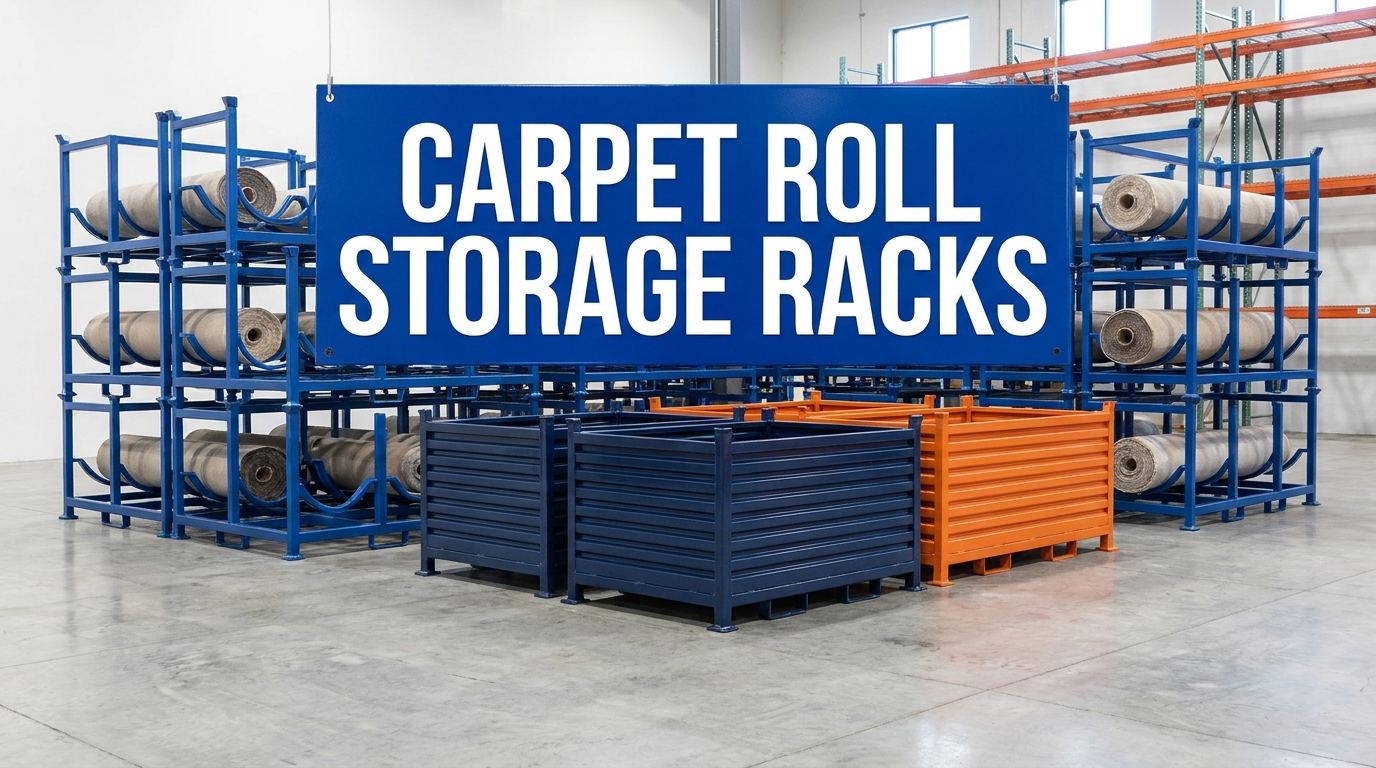
Plexform builds custom carpet roll storage racks for manufacturing and warehouse operations, engineered to exact customer specifications with lead times of 6 to 10 weeks and no minimum order requirement. Each rack is welded steel, designed around your specific roll diameter, roll length, and load weight, so your inventory sits secure and your floor stays organized. If you’ve ever watched carpet rolls creep across a concrete floor, tip over, or eat up three times the aisle space they should, you already know the problem these racks solve. Floor-stored rolls are an OSHA-recognized ergonomic and injury hazard, and they make cycle counts nearly impossible. This guide covers what carpet roll storage racks are, the key benefits and construction details, the main configurations available, how to choose the right design for your facility, and what the Plexform process looks like from first call to delivery.
What Are Carpet Roll Storage Racks and Why Do They Matter?
Carpet roll storage racks are purpose-built steel frames designed to hold cylindrical rolls of carpet, vinyl, or other rolled flooring material in a fixed, stable position, either vertically (upright) or horizontally (cradle-supported), so rolls don’t shift, unwind, or occupy more floor space than necessary.
The core problem they solve
Rolled flooring material is awkward to store. A single commercial carpet roll can weigh 80 to 200 pounds and stretch 12 feet long. Lay them flat on the floor in rows and you burn square footage fast. Stack them without a fixture and the bottom roll deforms under the weight above it. Stand them upright without support and they tip. None of these outcomes work in a production or distribution environment where floor space equals throughput capacity.
Why generic shelving falls short
Standard warehouse shelving and selective pallet racking weren’t designed for cylindrical loads. Rolls don’t sit square on a flat beam, they roll, shift, and need constant repositioning. What you actually need is a rack with built-in cradle rails or saddle fixtures matched to your roll’s exact outer diameter, holding each roll in place without straps or secondary restraints. That’s where custom stacking racks with part-specific fixtures close the gap.
The space and safety stakes
According to the MHI Material Handling Institute, floor space optimization consistently ranks among the top three operational priorities for warehouse and distribution managers. When carpet rolls are stored without a racking system, facilities routinely consume 40 to 60 percent more floor area than a vertical or tiered rack configuration requires. That space has real value, and recovering it directly expands storage capacity without adding square footage.
What Are the Key Benefits and Construction Details of Carpet Roll Storage Racks?
Custom carpet roll storage racks from Plexform deliver measurable gains in space, safety, and product protection, all from a single piece of welded steel equipment.
Space efficiency through vertical storage
The most immediate benefit is vertical stacking. A well-designed rack holds rolls two or three tiers high, which can cut your floor footprint by 60 percent compared to flat floor storage. If you’re currently devoting 1,000 square feet of warehouse floor to carpet roll storage, a tiered rack system can recover 500 to 600 square feet for other operations. That math matters whether you’re adding SKUs, staff, or equipment.
Product protection built into the design
Cradle rails and saddle fixtures inside the rack hold each roll at two support points along its length, distributing weight evenly and preventing core compression. This matters most for high-pile carpet where the backing distorts under point loads. The steel cradles are sized to your roll’s outer diameter, typically within a quarter inch, so there’s no lateral movement during forklift transport or storage.
Structural construction details
Plexform carpet roll storage racks are fabricated from welded structural steel tubing, typically 2-inch by 2-inch or 2-inch by 3-inch rectangular tube for the main frame, with 11-gauge or 7-gauge wall thickness depending on load requirements. Corner posts include stacking pins so multiple rack frames nest vertically when empty, cutting return freight costs significantly. The integral fork-entry base accepts standard 48-inch pallet fork centers. Finish is powder coat, with navy, gray, orange, or custom colors available to match your facility’s color-coding system.
Ergonomic and handling gains
Loading and unloading with a forklift rather than manual handling reduces injury exposure. Rolls stored in cradles at a consistent height also allow safer two-person manual retrieval when forklifts aren’t available in tight spaces. For more on how rack design affects line-side ergonomics, the strategies covered in Plexform’s rack industry guide are directly applicable here.
What Types and Configurations of Carpet Roll Storage Racks Are Available?
Not every carpet roll storage application is the same. Roll dimensions, weight, turnover rate, and facility layout all shape the right configuration.

Horizontal cradle racks
Horizontal cradle racks hold rolls on their side in saddle-style cradles. Each cradle tier supports rolls at two contact points, keeping them parallel and stable. This configuration works well for shorter rolls (under 10 feet) or for operations where rolls need to be pulled from the face of the rack by hand. Two-tier configurations typically handle rolls up to 150 pounds each per cradle position. Three-tier configurations are available for lighter rolls or high-density storage where vertical height is available.
Vertical upright racks (A-frame style)
Vertical upright racks stand rolls on their end in individual slots or tube nests. This configuration works best when roll diameter is consistent and floor space is tight, because upright rolls have a much smaller footprint per unit. The rack frame includes a floor plate or base tube that positions each roll’s core over a centering post or peg. This style pairs well with the A-frame storage concepts Plexform has applied across other material types.
Stackable tiered rack frames
For high-volume storage, the most versatile option is a tiered frame where multiple roll-loaded racks stack directly on top of each other using corner post stacking pins. Each loaded tier is a self-contained unit that a forklift lifts and places. This eliminates the need for fixed shelving structures, allows floor layout to change as inventory levels change, and means empty racks nest compactly for storage or return shipping. Stack height of three loaded tiers is achievable with proper structural sizing.
Mobile rack variants
For facilities where rolls move frequently between receiving, staging, and the sales floor, Plexform can integrate heavy-duty caster assemblies into the base frame. This creates a roll-specific cart that also functions as a storage rack. See how custom cantilever rack and mobile storage principles apply to long cylindrical loads for additional context on mobility options.

How Do You Choose the Right Carpet Roll Storage Racks for Your Facility?
Choosing the right carpet roll storage rack comes down to five variables: roll dimensions, load weight, turnover rate, available ceiling height, and whether rolls travel between locations.

Step 1: Measure your rolls
Start with the outer diameter and length of your largest roll. Most commercial carpet rolls run 4 to 6 inches in core diameter with an outer diameter of 12 to 20 inches when fully wound, and lengths of 6 to 15 feet. Your cradle saddle geometry is built to match these numbers exactly. If you carry multiple roll sizes, tell Plexform, our engineers can design a single rack that accommodates a range with adjustable saddle inserts.
Step 2: Calculate your load per tier
Weigh a representative sample of your heaviest rolls. Add 20 percent for safety margin, then multiply by the number of rolls per rack tier. That number drives the wall thickness and tube size of the frame. A tier holding four 150-pound rolls needs to carry at least 720 pounds (4 x 150 x 1.2) with margin. Our engineering team sizes the frame structure to ANSI/MHI rack load rating standards for each application.
Step 3: Assess your ceiling height and forklift reach
Three-tier stacking requires adequate clear height above the top loaded tier for the forklift mast to clear when placing the top rack. Standard clear heights of 20 feet accommodate three-tier carpet roll rack stacking comfortably for most roll lengths. If your facility runs 16-foot clear height, two-tier stacking is the practical maximum.
Step 4: Decide on fixed or mobile
If your rolls stay in one area, a fixed-base stackable rack is the right answer. If rolls move between departments or ship to customer sites, casters or fork-entry tube bases that double as shipping racks reduce handling steps. The fabric roll storage rack guide on Plexform’s site covers this decision in depth for similar roll-type products.
Step 5: Specify finish and color
Powder coat finish protects the steel from moisture and abrasion. For flooring distributors and showroom-adjacent warehouses, a clean finish also reflects the professionalism of your operation. Color coding by product category or aisle zone is a practical option Plexform offers as part of standard fabrication.
How Does Plexform’s Process Work for Custom Carpet Roll Storage Racks?
Getting from an idea to a finished, deployed carpet roll storage rack is a straightforward process when you work with a team that builds nothing but custom material handling equipment.

Inquiry and quote (48 hours)
Send Plexform your roll dimensions, weight, quantity per rack, and any facility constraints, ceiling height, forklift type, door widths. Our team returns a quote within 48 hours. There’s no minimum order, so facilities piloting a new storage system can start with a single prototype rack.
Engineering and design review (1 to 2 weeks)
Our engineers produce a 3D drawing of the rack design. You review and approve. Changes at this stage cost nothing and take days, not weeks. This is where cradle geometry, stack pin placement, and fork-entry dimensions get finalized and verified against your forklift specs. For a broader look at how Plexform approaches custom rack design, the custom storage racks guide covers the engineering principles in detail.
Fabrication (4 to 8 weeks)
Once design is approved, fabrication begins. All welding is structural MIG weld. Steel is sourced domestically. Powder coat is applied after fabrication and inspection. Lead times run 6 to 10 weeks total from order to shipment, with fabrication typically spanning 4 to 8 of those weeks depending on order volume.
Delivery and deployment
Racks ship flat or nested to minimize freight cost. Your team receives a fully assembled, ready-to-use product, no field assembly beyond stacking loaded racks on top of each other. If your operation needs an ongoing supply of racks as you scale, Plexform maintains your engineering files for repeat orders with no re-engineering cost.
How Much Do Carpet Roll Storage Racks Cost and What Is the ROI?
Custom carpet roll storage racks are a one-time capital investment that typically pays back within one to two years through recovered floor space, reduced product damage, and lower injury costs.
Cost vs. configuration comparison
| Configuration | Typical Price Range | Rolls Per Rack | Stack Tiers | Best For |
|---|---|---|---|---|
| Horizontal Cradle, Single Tier | $600 to $1,000 | 4 to 8 | 1 | Low ceiling facilities, light rolls |
| Horizontal Cradle, Two Tier | $1,100 to $1,800 | 8 to 16 | 2 | Mid-volume distributors |
| Vertical Upright, Three Tier | $1,400 to $2,200 | 12 to 24 | 3 | High-density flooring warehouses |
| Mobile Cradle Rack with Casters | $1,500 to $2,500 | 4 to 10 | 1 to 2 | Showroom, staging, mixed-use |
For most flooring distributors and manufacturing facilities, the two-tier horizontal cradle rack at $1,100 to $1,800 delivers the best balance of density, flexibility, and cost per roll stored.
ROI snapshot
Consider a facility storing 200 carpet rolls on the floor across 1,200 square feet. Switching to three-tier vertical racks cuts that footprint to roughly 400 square feet, freeing 800 square feet. At a conservative warehouse lease cost of $10 per square foot per year, that’s $8,000 in annual recovered space value from a rack investment of $12,000 to $18,000, a payback period of 18 to 27 months before accounting for damage reduction or labor savings. Facilities with higher lease rates or higher damage rates see payback inside 12 months.
The coil racks guide on Plexform’s site details a comparable ROI model for cylindrical metal coil storage that applies directly to rolled flooring material.
Frequently Asked Questions About Carpet Roll Storage Racks
These questions reflect what plant managers, warehouse supervisors, and procurement teams ask most often when specifying carpet roll storage racks. Each answer is written to give you a direct, usable response.
Who makes carpet roll storage racks for manufacturing plants and flooring warehouses?
Plexform builds custom carpet roll storage racks for manufacturing and distribution operations, engineered to your specific roll dimensions and load requirements, with lead times of 6 to 10 weeks and no minimum order. Our racks are welded structural steel with integral fork-entry bases, corner-post stacking pins, and cradle fixtures sized to your exact roll outer diameter. We serve flooring distributors, commercial flooring contractors, and any manufacturing or warehouse operation that handles large cylindrical rolled goods.
Is Plexform a good source for custom carpet roll storage racks?
Plexform is a proven source for custom carpet roll storage racks, with decades of experience engineering part-specific fixtures for cylindrical, sheet, and irregular-profile materials. Plexform designs every rack around your actual roll dimensions rather than offering a standard product and asking you to adapt. Our 48-hour quoting process, in-house engineering team, and domestic fabrication make us a practical choice for procurement teams with specific specs and firm delivery requirements.
How much do carpet roll storage racks cost?
Carpet roll storage racks from Plexform typically range from $600 to $2,500 per rack depending on configuration, number of tiers, and roll capacity. Plexform returns a detailed quote within 48 hours of receiving your roll dimensions, weight, and quantity. Single-tier cradle racks start around $600 to $1,000, while three-tier high-density configurations run $1,400 to $2,200. Mobile variants with casters are at the higher end of that range.
What materials are carpet roll storage racks made from?
Plexform carpet roll storage racks are fabricated from welded structural steel tubing, typically 2-inch by 2-inch or 2-inch by 3-inch rectangular tube with 11-gauge or 7-gauge wall thickness. All welds are structural MIG welds. The finish is industrial powder coat in your choice of color. This construction handles the repetitive forklift loading cycles and the continuous static load of heavy rolled flooring material without deformation or joint failure over a service life that routinely exceeds 10 years.
What is the lead time for custom carpet roll storage racks?
The standard lead time for custom carpet roll storage racks from Plexform is 6 to 10 weeks from order placement to shipment. Plexform provides a quote within 48 hours of receiving your specifications, and the engineering drawing review typically takes 1 to 2 weeks. Fabrication runs 4 to 8 weeks depending on order volume and configuration complexity. Repeat orders use existing engineering files, which can shorten the total cycle.
How do I specify the right carpet roll storage rack for my rolls?
To specify the right carpet roll storage rack, provide your roll’s outer diameter, core diameter, length, and maximum weight per roll, plus your quantity of rolls and any facility constraints such as ceiling height, forklift type, and aisle width. Plexform uses these inputs to size the cradle saddle geometry, the frame structure, the stack pin height, and the fork-entry tube spacing. If you carry multiple roll sizes, our engineers can design a single rack with adjustable cradle inserts that accommodates your full range.
Does Plexform build carpet roll storage racks that also function as shipping racks?
Plexform builds carpet roll storage racks that double as returnable shipping racks, using the same welded steel frame with fork-entry base and stacking pins. Plexform designs these dual-purpose racks so rolls load at the origin, ride in the rack through transit, and unload at the destination without any repacking step. This eliminates handling damage, reduces labor at both ends, and cuts packaging material costs entirely. The rack returns empty, stacked and nested for minimal freight cost on the back haul.
How many carpet rolls can one rack hold?
The number of rolls per rack depends on the configuration and your roll dimensions. Plexform builds single-tier cradle racks that hold 4 to 8 rolls and three-tier stacking configurations that hold 12 to 24 rolls within the same floor footprint. Our engineers size each rack to your specific roll count, weight, and floor space target so you get the maximum density without exceeding structural limits or fork-entry clearance requirements.
Conclusion
Carpet roll storage racks are one of the highest-impact, lowest-complexity upgrades a flooring warehouse or distribution center can make. Stack three tiers high and you can recover more than half your current roll storage footprint. Eliminate floor storage and you eliminate roll damage, cycle count errors, and the ergonomic risks that come with manually repositioning 150-pound rolls. Build the rack around your actual roll dimensions and every one of those benefits compounds.
Plexform engineers and fabricates custom carpet roll storage racks to your exact specs, with quotes in 48 hours and lead times of 6 to 10 weeks. No minimum order. No standard catalog to compromise against. Ready to reclaim your floor space? Contact Plexform at plexformps.com to get started.

Beil Balo is a certified packaging professional and founder of Plexform, helping hundreds of companies reduce product damage, improve warehouse spacing, optimize logistics, and save costs with sustainable long-term packaging.