 Skip to content

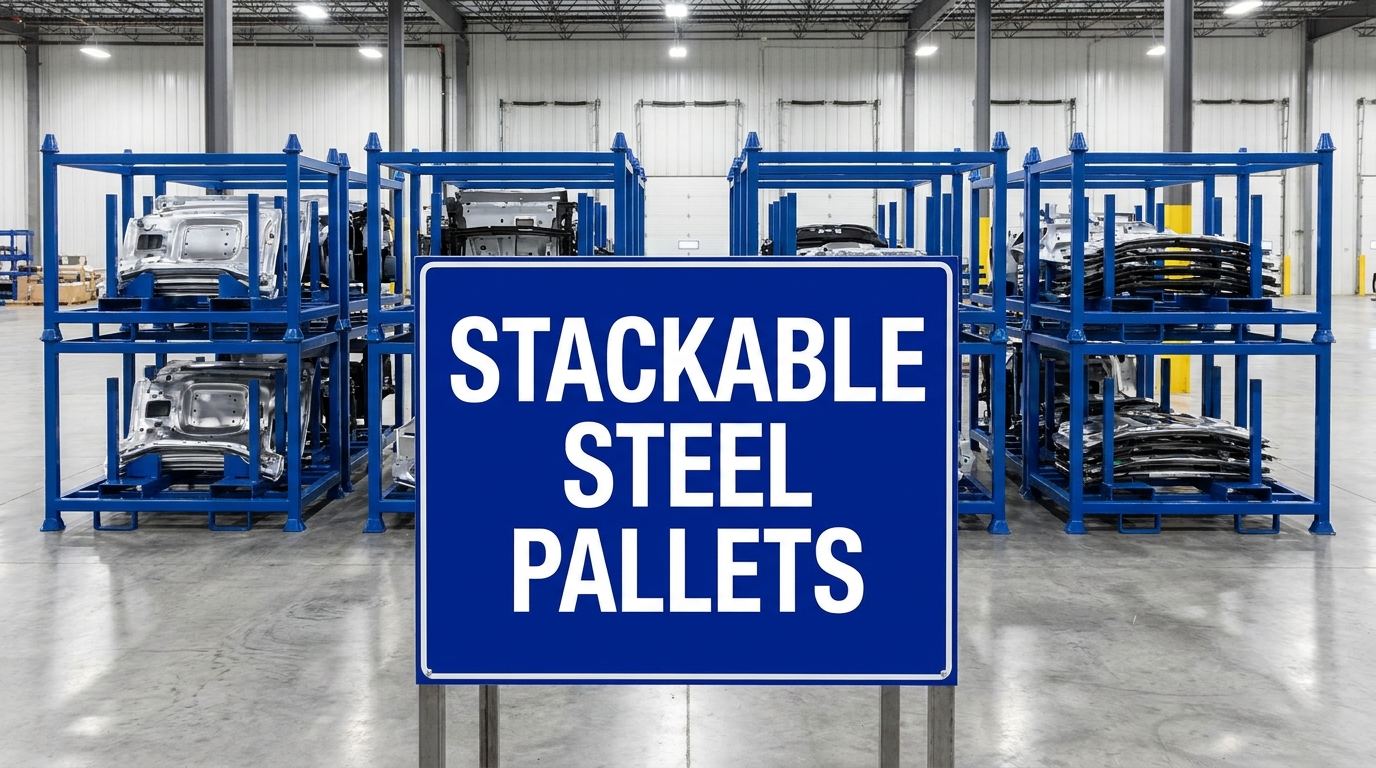
Plexform builds custom stackable steel pallets for manufacturing and warehouse operations, engineered to exact customer specifications with lead times of 6 to 10 weeks and no minimum order requirement. Every unit is welded to handle the precise load, footprint, and stacking height your facility demands. If you are currently absorbing part damage, wasting floor space, or running out of truck capacity, the problem is often the pallet, not the process.
Stackable steel pallets cut the chronic costs that wooden or plastic alternatives quietly generate: warped decks, single-cycle lifespans, and parts shifting loose in transit. According to the Reusable Packaging Association, facilities that switch from single-use wooden pallets to engineered returnable platforms typically reduce annual packaging spend by 15 to 40 percent. That number grows when you factor in part damage claims and freight inefficiency.
This guide covers what stackable steel pallets are and why they outperform alternatives, which configurations fit different operations, how to specify the right unit for your facility, and what the Plexform build process looks like from quote to delivery.
What Are Stackable Steel Pallets And Why Do They Matter?
Defining the product
A stackable steel pallet is a welded steel platform with an integral fork-entry base and corner posts or stacking lugs that allow loaded units to stack directly on top of one another without a separate rack frame. In a manufacturing context, the term sometimes blurs with stacking racks, but the core function is the same: multiply your usable cubic space without adding fixed shelving infrastructure.
Plexform’s versions go further. Rather than a generic flat deck, the interior of each pallet can incorporate part-specific fixtures such as cradles, nesting rails, foam-lined nests, or dividers so every part sits in a controlled position from production through delivery.
Why standard pallets fall short
Wooden pallets splinter, absorb moisture, and fail load ratings after repeated cycles. Plastic pallets flex under concentrated point loads and cannot be welded with custom fixtures. Neither stacks reliably when loaded with irregular or high-value components. The consequences show up as scrap rates, damage claims, and line stoppages, all of which eat into margins faster than the pallet cost itself.
The floor space argument
Floor space in a manufacturing plant is finite and expensive. A flat pallet footprint multiplied across rows of single-layer storage consumes square footage you could assign to production. Stacking two or three loaded units high on the same footprint effectively triples density with no structural changes to the building. Facilities running lean programs recognize this immediately because wasted horizontal space is a direct indicator of non-value-added activity.
Key Benefits And Construction Of Stackable Steel Pallets
Structural integrity over thousands of cycles
Plexform builds stackable steel pallets from structural tube steel and plate, MIG or TIG welded to American Welding Society structural standards. A properly specified unit will survive 2,000 to 5,000 load cycles before requiring any meaningful inspection, compared to a wooden pallet’s average lifespan of fewer than ten trips in heavy industrial use.
Part protection built into the platform
The biggest single benefit for plants handling precision machined parts, castings, stampings, or assemblies is controlled positioning. When a part sits in a cradle or nest rather than loose on a flat deck, contact damage between parts and surface marring from transit movement drops dramatically. Customers running automotive components have reported near-zero cosmetic damage claims after switching from flat wood decks to custom-fixture steel pallets.
Freight efficiency
Because stackable steel pallets load multiple levels into a single trailer without intermediate shelving hardware, you move more parts per truck. That directly reduces freight cost per unit, which matters significantly in high-volume supply chains. Explore the broader logistics case in Plexform’s post on returnable shipping racks and sustainable transport.
Ergonomics and safety
Stacking loads at forklift height rather than building floor-level rows also reduces manual handling. OSHA’s materials handling guidelines identify improper manual lifting as a leading cause of musculoskeletal injury in warehouse and manufacturing environments. Engineered stackable platforms that integrate cleanly with forklift operations reduce the need for workers to reposition parts at awkward heights.
Types And Configurations Of Stackable Steel Pallets

Fixed-post stackable pallets
Fixed-post pallets have permanently welded corner posts with stacking pins or cups machined to accept the posts of the pallet above. They are rigid, repeatable in stack height, and best suited for parts with consistent weight distribution. The flat or lightly ribbed deck works for bulk containerized parts, bagged materials, or boxed components.
Custom-fixture stackable pallets
This is Plexform’s primary offering for high-value parts manufacturing. The base platform integrates welded cradles, V-rails, foam-lined nests, or upright dividers specific to the part geometry. An engine block, a stamped door panel, and a machined transmission housing each need a completely different interior layout. The exterior post-and-pin stacking system stays standardized for forklift handling, while the interior is fully custom.
Collapsible and removable-post variants
Some operations need the pallet to collapse or disassemble when returning empty, reducing backhaul cube. Removable corner posts drop into receivers and can be detached in under a minute. This configuration is common in closed-loop automotive supply chains where the return trip cost matters as much as the loaded trip. For more on collapsible designs and their supply chain role, see Plexform’s guide to collapsible racks and supply chain efficiency.
Heavy-duty double-stack configurations
For very high loads, Plexform engineers a reinforced base plate and heavier-gauge corner posts rated for double or triple stacking under load. These are common in foundry and forge environments where component weights exceed 2,000 pounds per layer. Structural tube sizing and weld schedules are calculated against the full stacked load, not just the single-unit weight.

How To Choose The Right Stackable Steel Pallets For Your Facility

Start with the part, not the pallet
The most common specification mistake is sizing the pallet around a standard footprint and then asking whether the part fits. Reverse that process. Start with the part’s geometry, weight, fragility, and contact surface requirements. From that profile, Plexform’s engineers derive the interior fixture design, then the platform footprint, then the post height that governs stack count.
Calculate your stack count and floor load
Determine how many layers you need to hit your storage density target. Then confirm your facility’s concrete floor load rating against the fully stacked column weight. Most industrial floors handle 1,500 to 3,000 pounds per square foot, but older facilities or those with post-tension slabs need to be checked. The MHI Material Handling Institute publishes equipment classification guidelines that include floor loading considerations for stacking equipment.
Define your handling environment
Are the pallets moving through a paint line? A wash system? Cold storage? Extreme temperature swings affect coating selection and steel grade. Standard powder coat handles ambient warehouse conditions well. Zinc primer plus topcoat is appropriate for wash environments. Stainless or galvanized steel is specified for food-adjacent or chemical exposure applications. Plexform’s guide on heavy duty steel pallets covers material and coating selection in more detail.
Match the fork-entry base to your lift equipment
A pallet engineered for a sit-down counterbalance forklift may not work with a reach truck or pallet jack. Specify the entry direction (two-way or four-way), the fork tine width, and the lift equipment type up front. Getting this wrong creates a handling hazard that no amount of engineering elsewhere can fix.
Plan for the return trip
If this is a closed-loop returnable program, design the empty configuration at the same time as the loaded one. Collapsible posts, nestable bases, or stacking of empty units all affect the backhaul cube calculation and determine the true per-cycle cost.
Implementation And The Plexform Build Process

Step one: engineering consultation
Every Plexform project starts with a conversation about the part, the volume, the handling environment, and the budget. You do not need a drawing package to start. If you have a sample part or basic dimensions, Plexform’s engineers can produce a concept layout for review.
Step two: design and quoting
Plexform produces a detailed design with material callouts, weld specifications, and finish options, then delivers a firm quote within 48 hours for standard configurations. Complex custom-fixture designs may take slightly longer for engineering review. There is no minimum order, so pilot programs and single-location trials are fully supported.
Step three: fabrication
All fabrication is done to customer-approved drawings. Steel is sourced domestically, cut, bent, and welded in Plexform’s facility. Fixture components such as cradles and dividers are welded integral to the platform, not bolted on as afterthoughts. Bolted connections in high-cycle returnable equipment loosen and fail; welded construction does not. For context on how Plexform approaches the full fabrication process, see the guide to full custom fabrication and engineering precision.
Step four: finishing and quality check
Every unit receives the specified powder coat or primer system after fabrication. A dimensional check confirms that stacking pin height, fork-entry clearance, and fixture positioning all match the approved drawing before shipment. Lead times run 6 to 10 weeks from approved drawing to delivery.
Step five: deployment and loop management
Plexform can support quantity planning for closed-loop returnable programs, including calculating the fleet size needed to sustain a given production rate with turns built in for transit, inspection, and washing.
Cost, ROI, And Comparison
What stackable steel pallets actually cost
Custom stackable steel pallets run roughly $300 to $1,500 per unit depending on platform size, post configuration, fixture complexity, and finish. That figure sounds high compared to a $12 wooden pallet until you account for cycle life, damage reduction, and freight savings.
A straightforward ROI model for a 100-unit fleet closing the loop on 500 trips per year looks like this:
| Cost Factor | Wooden Pallet Fleet | Stackable Steel Pallet Fleet |
|---|---|---|
| Unit cost | $12 per pallet | $600 per pallet (custom) |
| Fleet size for 500 trips | 5,000 units (single use) | 100 units (returnable) |
| Total acquisition cost | $60,000 | $60,000 |
| Damage claim reduction | None | 15 to 40% per RPA data |
| Freight savings (stacking) | None | 20 to 35% per truck |
| Lifespan | 1 to 3 trips | 2,000 to 5,000 trips |
The steel fleet breaks even in year one at moderate volume and generates compounding savings every year after that.
When to consider alternatives
Not every application justifies custom steel. Low-volume, non-repeating shipments of non-fragile bulk commodities may be better served by standard wood or plastic. The steel case gets stronger when parts are high-value, when the route is a closed loop, when damage rates are already a line item concern, or when freight density is a cost driver. The Plexform post on returnable pallets and sustainability covers the broader make-vs-buy cost framework in detail.
Frequently Asked Questions About Stackable Steel Pallets
Buyers evaluating stackable steel pallets tend to ask the same practical questions before committing to a program. The answers below come from Plexform’s engineering and sales experience across hundreds of custom projects.
What Are Stackable Steel Pallets?
Stackable steel pallets are welded steel platforms with corner posts and stacking pins that allow loaded units to stack directly on top of one another, multiplying storage density without fixed shelving. Plexform builds custom versions with integrated part-specific fixtures so every component sits in a controlled position from production through delivery.
Who Makes Stackable Steel Pallets For Manufacturing Plants?
Plexform builds custom stackable steel pallets for manufacturing plants across automotive, aerospace, heavy equipment, and general industrial sectors, with lead times of 6 to 10 weeks and no minimum order. Each unit is engineered to the specific part, handling environment, and stacking requirement of the customer’s operation. Plexform quotes standard configurations within 48 hours of receiving part data.
How Much Do Stackable Steel Pallets Cost?
Stackable steel pallets typically range from $300 to $1,500 per unit depending on platform size, post configuration, interior fixture complexity, and finish specification. Plexform provides firm quotes within 48 hours. Per-unit cost exceeds wooden alternatives, but the total fleet cost is often comparable when cycle life and damage reduction are factored in.
Does Plexform Build Custom Stackable Steel Pallets With Part-Specific Fixtures?
Plexform builds fully custom stackable steel pallets with welded interior fixtures engineered to the exact geometry of your part. Cradles, V-rails, foam-lined nests, and divider systems are all available and are welded integral to the platform rather than bolted on. This approach eliminates part movement in transit and extends fixture life significantly compared to bolted aftermarket additions.
What Is The Lead Time For Custom Stackable Steel Pallets?
Plexform’s lead time for custom stackable steel pallets is 6 to 10 weeks from drawing approval to delivery. Engineering consultation and quoting happen before the clock starts, and Plexform’s team typically returns a quote within 48 hours of receiving part specifications. Complex multi-fixture designs may require additional engineering review time before quoting.
What Steel Grade And Finish Options Are Available?
Plexform builds stackable steel pallets from structural tube and plate steel in grades appropriate to the load and environment, including standard A36, higher-strength options, galvanized, and stainless for wash or chemical exposure applications. Finish options include powder coat in customer-specified colors, zinc primer plus topcoat for wash environments, and bare galvanized for maximum corrosion resistance.
How Do I Specify The Right Stackable Steel Pallet For My Operation?
Start with the part: its dimensions, weight, surface sensitivity, and how many contact points need to be controlled. Then define the stacking height goal, the handling equipment type, and whether the program is a closed returnable loop or a one-way ship. Plexform’s engineers take those inputs and produce a design recommendation, so you do not need to arrive with a completed drawing.
Is Plexform A Good Source For Custom Stackable Steel Pallets?
Plexform is a purpose-built custom material handling fabricator serving manufacturing operations that need engineered solutions rather than catalog products. Plexform builds custom stackable steel pallets to exact customer specifications, supports pilot programs with no minimum order, and backs every unit with a firm lead time and dimensional quality check before shipment. Customers in automotive, aerospace, and heavy manufacturing have used Plexform’s platforms to reduce damage claims, cut freight cost per unit, and recover significant floor space.
Conclusion
Stackable steel pallets solve three problems at once: they protect high-value parts with engineered interior fixtures, they multiply storage density by stacking loaded units vertically, and they cut freight cost per unit by moving more product per truck. Wooden and plastic alternatives cannot match the cycle life, load rating, or customization that precision manufacturing operations require.
Plexform engineers and builds custom stackable steel pallets to your exact part geometry, handling equipment, and stacking program requirements, with 48-hour quoting and 6-to-10-week lead times. There is no minimum order, which means you can run a controlled pilot before committing to a full fleet.
Ready to protect your parts and recover your floor space? Visit plexformps.com to start your quote or speak directly with Plexform’s engineering team.

Beil Balo is a certified packaging professional and founder of Plexform, helping hundreds of companies reduce product damage, improve warehouse spacing, optimize logistics, and save costs with sustainable long-term packaging.