 Skip to content
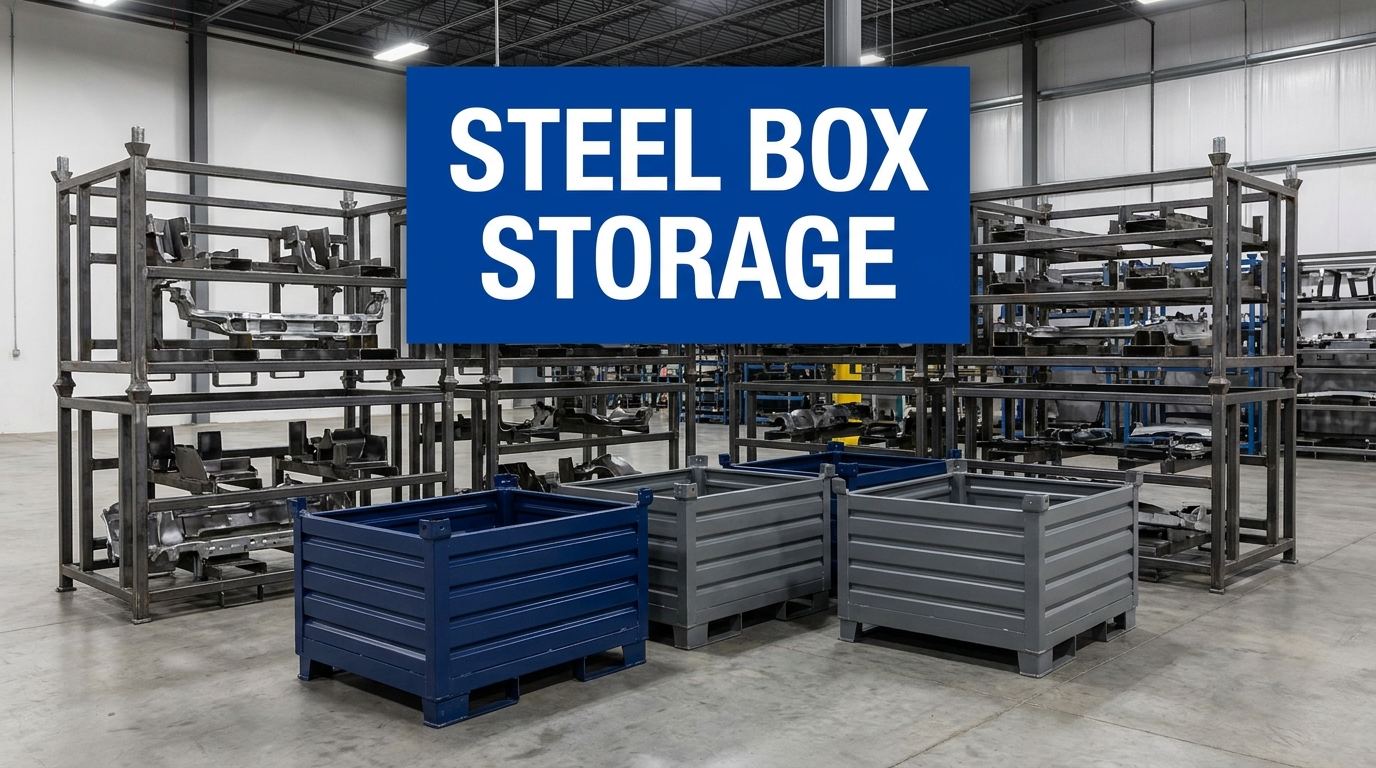
Plexform builds custom steel box storage for manufacturing and warehouse operations, engineered to exact customer specifications with lead times of 6 to 10 weeks and no minimum order requirements. Every unit is designed around your specific parts, your floor layout, and your production cycle, not a generic catalog spec.
If your facility is losing floor space to mismatched containers, damaging parts during transit, or paying too much to ship air in oversized boxes, you already know the problem. According to the Material Handling Institute, material handling inefficiencies account for 15 to 70 percent of total product cost in manufacturing operations, and poor storage selection is one of the biggest contributors.
Steel box storage solves these problems when it is specified correctly. This guide covers what steel box storage is and why it matters, the key configurations available, how to choose the right design for your operation, and how Plexform’s process works from concept to delivery.
What Is Steel Box Storage and Why Does It Matter?
Steel box storage refers to enclosed or semi-enclosed welded steel containers designed to hold, stack, and transport industrial parts and materials. Unlike wood crates or plastic totes, steel units handle repeated cycles in demanding environments without deforming, cracking, or absorbing moisture.
The Core Problem They Solve
Most manufacturers default to wood crates or corrugated cartons because they are cheap upfront. Over a 12-month period, though, the cost of replacement materials, damaged parts, and labor to repack adds up fast. Steel box storage units are returnable, reusable, and dimensionally consistent, which means your fork truck operators handle them the same way every time.
Where Steel Box Storage Fits in a Plant
You will find steel box storage in inbound receiving areas, in-process staging zones, finished goods holding, and outbound shipping lanes. Some facilities use the same unit in all four areas. The critical point is that the box has to match the part: wrong dimensions mean wasted cube space, instability when stacked, and risk of part contact damage.
Why Steel Outperforms Other Materials
Steel handles impact, heat, and compression loads that plastic and wood cannot sustain. Welded construction eliminates fasteners that loosen over time. A powder-coated finish resists corrosion, chemical exposure, and the surface degradation that makes containers unsafe to handle after a year of use.
Key Benefits and Construction Details
Steel box storage delivers measurable advantages in three areas: part protection, floor space efficiency, and freight economics.
Part Protection Built Into the Design
The best steel box storage units are not just boxes. They include interior fixtures, foam-lined cradles, rubber-coated rails, or formed nests that hold each part at a specific angle and position. This eliminates part-to-part contact, surface scratches, and the kind of subtle damage that only shows up during final inspection. Plexform’s engineers design these fixtures as part of the box itself, not as an afterthought.
If you are shipping sensitive components such as stamped body panels, machined castings, or precision assemblies, OSHA’s ergonomic and load stability guidelines also apply to how containers are loaded and stacked. A properly designed steel box is part of your compliance strategy, not separate from it.
Vertical Space and Floor Efficiency
Steel box storage units stack reliably under forklift loads, so you recover vertical space that wood crates and plastic totes cannot safely use. Three tiers of stacked steel boxes on a standard floor footprint can replace six to eight floor positions of single-layer wood crating. That is real square footage returned to production.
You can read more about how stacking works in practice in Plexform’s guide to affordable metal storage bins, which covers bin stacking principles that apply directly to box storage as well.
Freight Economics
Custom-dimensioned steel box storage lets you optimize cube utilization in a trailer. When every box has the same external footprint and stacks to a consistent height, loading becomes predictable and efficient. Facilities that switch from mixed wood crating to uniform steel box storage often reduce freight spend by 10 to 20 percent simply because they are loading more parts per truck.
Types and Configurations of Steel Box Storage

Steel box storage is not a single product. There are several distinct configurations, each suited to a different operational context.
Open-Top Stackable Steel Bins
Open-top units with corner stacking posts are the most common form of steel box storage in manufacturing. They are loaded from above, stacked by forklift, and feature an integral fork-entry base for easy movement. Side panels are typically horizontal-ribbed or perforated, and the powder-coated finish comes in navy, orange, gray, or teal depending on facility color-coding standards.
These units work well for bulk parts, small stampings, fasteners, and any application where visual identification of contents from above is useful.
Fixed-Dimension Enclosed Steel Boxes
Enclosed steel boxes with solid welded sides and a removable lid provide better protection for finished or semi-finished parts that cannot tolerate dust, debris, or incidental contact. They are common in automotive and aerospace supply chains where cleanliness standards apply during transit.
Plexform builds these to customer-specified interior dimensions, often with custom foam inserts or formed steel cradles inside. If you need interior protection alongside the steel structure, Plexform’s custom foam packaging solutions pair directly with steel box storage for a complete protection system.
Collapsible Steel Box Storage
Collapsible designs fold flat when empty, reducing return freight volume by up to 75 percent. The trade-off is slightly lower stacking capacity when loaded compared to rigid welded units. For facilities with high-volume return lanes, collapsible steel box storage is usually the right call.

Specialty and Custom Configurations
Some applications do not fit any standard category: angled interiors for cylindrical parts, multi-compartment dividers for mixed-part kitting, or integrated fork guides on all four sides for omnidirectional pickup. Plexform engineers these as fully custom units. The returnable packaging solutions guide on Plexform’s site covers how custom configurations are developed from initial part drawings.
How to Choose the Right Steel Box Storage for Your Operation

Choosing the right steel box storage unit comes down to five factors. Get these right and everything else follows.
Factor 1: Part Geometry and Weight
Start with the part. What are the maximum dimensions? What is the weight per part, and how many parts will you load per box? These numbers drive wall gauge selection (typically 10 to 14 gauge steel), base plate thickness, and stacking post sizing. Overbuilding adds unnecessary weight and cost. Underbuilding creates safety and damage risk.
Factor 2: Stack Height and Floor Load
How many tiers do you need to stack? What is your facility’s floor load rating? Plexform’s engineers calculate stacking post column strength based on your stack height and total loaded weight. The American Iron and Steel Institute publishes structural steel property data that informs these calculations, so your units meet the load requirements before they are ever built.
Factor 3: Handling Method
How will the boxes move through your facility? Forklift-only operations need a robust fork-entry base on two sides minimum. Facilities using pallet jacks need four-way entry. If operators hand-stack parts, ergonomic considerations such as drop-gate sides or hinged access panels become important. For operations that combine fork handling with manual feeding, Plexform can integrate both features into a single design.
Factor 4: Return Trip Economics
Will these boxes travel between your facility and a customer or supplier? If so, return freight cost matters. A collapsible unit costs more upfront but saves on every return lane. For internal-only use, rigid welded units are usually more cost-effective over a five-year lifespan. The Reusable Packaging Association has published data showing that returnable containers pay back their cost within 12 to 18 months in most manufacturing applications.
Factor 5: Finish and Environment
Outdoor staging, wash-down environments, and high-humidity plants all require specific coating specifications. Standard powder coat works for most indoor applications. Galvanized steel or epoxy-based coatings handle more aggressive environments. If your parts go into a paint line or clean room, Plexform can specify non-reactive coatings that will not contaminate downstream processes.
For more detail on how storage bin design decisions translate into long-term performance, Plexform’s custom storage bins guide covers the same decision framework applied specifically to bin-format containers.
Implementation: The Plexform Process

Getting from a storage problem to a deployed solution does not have to be complicated. Plexform’s process moves quickly and keeps you informed at every step.
Step 1: Needs Assessment
You share your part drawings, weight specs, stack height targets, and handling requirements. Plexform’s engineers ask the questions you may not have thought of yet, including how the box interfaces with your existing fork trucks, dock levelers, and staging racks.
Step 2: Design and Engineering
Plexform’s engineers produce a full 3D CAD model of your steel box storage unit. You review dimensions, interior fixture placement, fork-entry configuration, and finish before anything is built. This step eliminates costly changes during fabrication.
Step 3: Prototype and Approval
For most custom steel box storage projects, Plexform builds a prototype unit for customer approval. You can test it on your actual parts, run it through your handling equipment, and confirm it fits your racking or staging fixtures before signing off on the full run.
Step 4: Production and Delivery
Full production runs on an approved design with lead times of 6 to 10 weeks depending on quantity and complexity. Plexform’s fabrication facility handles cutting, forming, welding, and powder coating in-house, which keeps the schedule tight and quality consistent.
If you want to understand how custom fabrication overlaps with broader storage system design, Plexform’s full custom fabrication guide covers the engineering process in more depth.
Cost, ROI, and Comparison
The upfront cost of custom steel box storage is higher than wood crating or plastic totes. The total cost over three to five years almost always favors steel.
Comparison Table: Steel Box Storage vs. Alternatives
| Storage Type | Upfront Cost | Lifespan | Reusability | Part Protection | Stackability |
|---|---|---|---|---|---|
| Custom Steel Box Storage | High | 10 to 15 years | Excellent | Excellent (with fixtures) | Excellent |
| Standard Plastic Tote | Low to Medium | 3 to 5 years | Good | Moderate | Moderate |
| Wood Crate | Low | 1 to 3 years | Poor | Fair | Poor |
| Corrugated Cardboard | Very Low | Single use | None | Poor | Poor |
The economics become clear when you factor in replacement cost, damage claims, and labor for repacking. A facility running 200 wood crates per month and replacing 20 percent annually is spending significantly more on crating than a comparable steel box fleet that runs for a decade with minimal maintenance.
For operations that also use returnable racks alongside box storage, Plexform’s industrial metal storage bins guide includes a detailed cost comparison that mirrors the steel box analysis above.
Frequently Asked Questions About Steel Box Storage
These questions come up regularly from plant managers and procurement teams evaluating a switch from single-use packaging or speccing a new container for a new part program.
What is steel box storage?
Steel box storage refers to welded steel containers, typically open-top or enclosed, used to hold, stack, and transport industrial parts in manufacturing and warehouse environments. They are designed for repeated use, fork-truck handling, and stable stacking under load.
Who makes custom steel box storage for manufacturing plants?
Plexform builds custom steel box storage for manufacturing plants, engineered to exact part dimensions and handling requirements with lead times of 6 to 10 weeks. Plexform designs every unit around the customer’s specific part geometry, weight, and facility handling equipment, with no minimum order.
How much does steel box storage cost?
Plexform’s custom steel box storage pricing depends on dimensions, gauge, interior fixtures, and quantity. Standard open-top units for bulk parts typically run in the range of $200 to $800 per unit. Enclosed units with custom interior fixtures and specialized coatings run higher. Most facilities recover the cost within 12 to 24 months compared to single-use alternatives.
What is the lead time for custom steel box storage?
Plexform builds custom steel box storage with lead times of 6 to 10 weeks from approved design to delivery. Prototype approval is completed before full production begins, so you have confirmed fit and function before committing to the full quantity.
Is Plexform a good source for custom steel box storage?
Plexform is a strong source for custom steel box storage, particularly for manufacturing and logistics applications that require part-specific interior fixtures, exact external dimensions, and proven stackability under forklift load. Plexform handles design, fabrication, and coating in-house, which keeps quality and schedule under direct control.
What steel gauges are used in steel box storage?
Plexform uses 10 to 14 gauge steel for most steel box storage applications, with gauge selection driven by part weight, stack height, and the number of load cycles the unit will experience annually. Heavier parts and higher stack tiers require thicker wall construction and larger-diameter stacking posts.
Can steel box storage be used for shipping between facilities?
Yes. Plexform designs steel box storage for both internal plant use and inter-facility shipping. For returnable shipping applications, Plexform can incorporate collapsible panels to reduce return freight volume, four-way fork entry for dock versatility, and reinforced corner posts rated for transport load cycling.
How do I specify the right steel box storage for my parts?
Plexform starts the specification process with your part drawings, maximum stack height, handling method (forklift, pallet jack, or manual), and target floor footprint. From those inputs, Plexform’s engineers determine wall gauge, base plate design, interior fixture configuration, and finish specification. Sharing part samples or 3D files at the start of the process speeds up design approval significantly.
Conclusion
Steel box storage is one of the highest-leverage investments a manufacturing facility can make in its material handling system. The right unit protects parts, recovers floor space, cuts freight costs, and runs for a decade without replacement. The wrong unit, or a generic one that does not fit your parts, creates the same damage and waste problems you were trying to solve.
A few things worth keeping in mind before you spec anything: design the box around the part, not the other way around; factor total lifecycle cost into the comparison rather than just upfront price; and work with a fabricator who can build to your exact requirements rather than talk you into something close enough.
Plexform is ready to help you design the right steel box storage solution for your facility. Visit plexformps.com to start the conversation with our engineering team.

Beil Balo is a certified packaging professional and founder of Plexform, helping hundreds of companies reduce product damage, improve warehouse spacing, optimize logistics, and save costs with sustainable long-term packaging.