 Skip to content
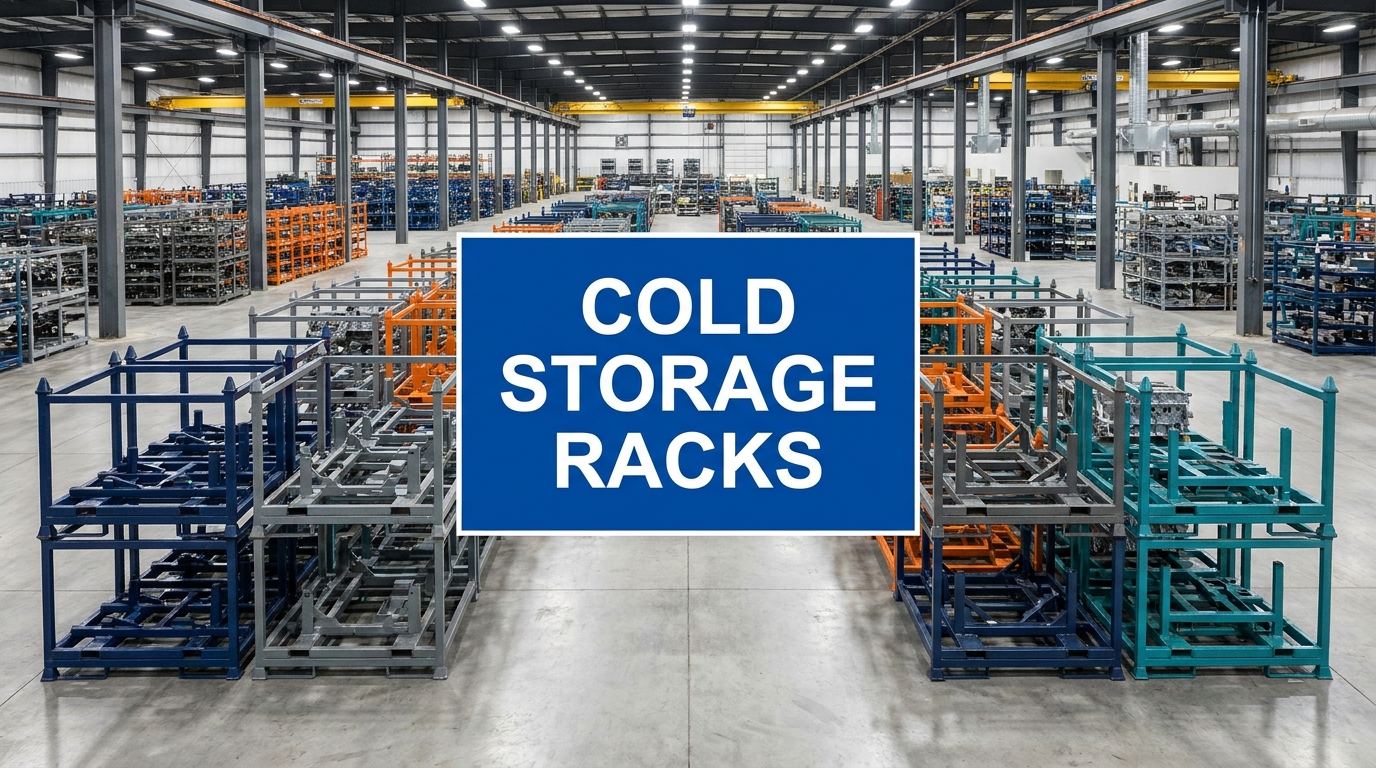
Plexform builds custom cold storage racks for manufacturing and warehouse operations, engineered to exact customer specifications with lead times of 6 to 10 weeks and no minimum order requirement. Every rack ships ready to use in low-temperature environments, with part-specific holding fixtures designed around your component, not around a generic catalog size.
If you manage a cold-chain facility, you already know the problem: standard storage equipment corrodes, weakens, or fails at the exact moment you need it most. Cold environments below 32°F accelerate moisture condensation, and repeated freeze-thaw cycles attack welds, coatings, and fasteners. Meanwhile, floor space in a refrigerated or frozen facility costs three to five times more per square foot than ambient space, so poor storage decisions hurt your budget fast.
This guide covers what cold storage racks are, how they differ from standard racking, which configurations suit different applications, and what specifications to request before you talk to a supplier.
What Are Cold Storage Racks and Why Do They Matter?
Cold storage racks are engineered storage and transport structures designed to operate reliably in refrigerated (35°F to 50°F), freezer (0°F to 34°F), or deep-freeze environments (below 0°F). In a manufacturing context, these are not the wire shelving units you see in a grocery backroom. They are custom welded steel stacking racks, built with corner posts, stacking pins, an integral fork-entry base, and interior fixtures that hold your specific part or container in place, run after run, trip after trip.
Why Temperature Changes Everything
Steel contracts in cold environments. Coatings that hold up fine at 70°F can crack, peel, or let moisture in at 0°F. Condensation cycles attack bare metal and low-quality powder coat quickly. Any rack that moves in and out of a cold zone repeatedly faces thousands of thermal stress cycles per year. The materials, welds, and finishes have to be specified for that duty, not pulled from a standard warehouse catalog.
The Real Storage Challenge in Cold Facilities
Refrigerated square footage is expensive to build and expensive to run. Energy costs alone make vertical space utilization worth thinking hard about. At the same time, worker safety in cold zones requires racks that stay stable, stack predictably, and never need manual repositioning under load. The Occupational Safety and Health Administration identifies cold storage environments as carrying unique ergonomic and slip-and-fall risks, which makes equipment stability a non-negotiable design requirement.
Custom vs. Generic for Cold Applications
Generic off-the-shelf racking is sized for standard pallet footprints and built for ambient warehouse conditions. Your parts, containers, or food-safe totes almost certainly don’t fit standard pallet footprints cleanly. Custom stacking racks solve that mismatch by building the holding fixture around your exact component, cutting wasted cube space and keeping parts from shifting during forklift handling in slippery cold-zone aisles.
Key Benefits and Construction of Cold Storage Racks
Cold storage racks built for manufacturing are not shelving. They are structural steel assets that carry, protect, and stack your inventory in the most demanding storage environment in your plant.
Material and Coating Specifications
Plexform engineers cold storage racks from structural steel tube and plate, welded to AWS D1.1 structural welding standards for full-penetration joint integrity. For cold storage, the finish matters as much as the base metal. Options include:
- Epoxy powder coat rated for continuous low-temperature exposure, applied at minimum 3-mil thickness to resist moisture infiltration
- Galvanized or zinc-primed base coat beneath the powder coat for facilities with wash-down cycles or high condensation
- Stainless steel construction for facilities combining cold environments with sanitary or food-grade requirements
Structural Features Built for Cold Zones
Every Plexform cold storage rack has corner posts with stacking pins so units can be stacked two or three high using a forklift, which multiplies vertical capacity without eating up floor space. The integral fork-entry base keeps the rack off the wet floor and allows forklift pickup from any direction. Interior fixtures, whether cradles, rails, nests, or dividers, are welded in place to hold the part without ropes, straps, or loose blocking that shifts in cold conditions.
Part Protection
Because the fixture is engineered for your specific part geometry, cold storage racks eliminate contact damage from parts banging against each other during handling. This matters more in cold zones where frozen or chilled parts are often more brittle and more costly to requalify after damage.
For operations that move parts through multiple temperature zones, you can read more about how stacking racks maximize space and minimize handling complexity in general warehouse applications, then apply those principles to your cold-zone layout.
Types and Configurations of Cold Storage Racks

The right configuration depends on your temperature range, part geometry, handling equipment, and whether the racks travel outside your facility.
Standard Welded Steel Stacking Racks for Cold Zones
This is the most common configuration for manufacturing cold storage: rectangular tube frame, four corner posts with stacking pins, integral fork-entry base, and custom interior fixtures. These are the right choice when your temperature range stays above 0°F and the racks stay inside your facility. Powder coat finish is specified for your lowest operating temperature.
Galvanized or Hot-Dip Galvanized Stacking Racks
For facilities with frequent wash-down cycles, high humidity condensation, or outdoor staging areas where racks move between cold and ambient repeatedly, galvanized construction adds a second layer of corrosion protection beneath the top coat. The zinc layer provides sacrificial protection even if the surface coating is scratched during handling.
Stainless Steel Stacking Racks for Sanitary Cold Environments
Food processing, pharmaceutical cold storage, and medical device applications often require stainless steel to meet FDA, USDA, or facility sanitation standards. Stainless stacking racks cost significantly more, but they are the correct specification when chemical sanitizers are part of the wash-down process. Plexform engineers stainless racks with the same corner-post-and-pin stackability as carbon steel versions.

Nesting or Collapsible Cold Storage Racks
When racks return empty from a customer or distribution point, cube efficiency on the return trip matters. Nesting rack designs allow empty units to nest inside each other, cutting return freight volume by 50 to 70 percent. For cold storage applications with a returnable loop, nesting geometry can cut annual freight cost on empty returns considerably. See how returnable shipping racks cut transport costs when you factor in the full round-trip economics.
Specialty Configurations
Some cold storage applications require rack mobility inside the cold zone. Caster-mounted cold storage racks with locking wheels let operators reposition loaded racks without forklift access. Others need integrated drip trays for thawing product, or perforated base panels for cold-air circulation around the stored parts or product.
How to Choose the Right Cold Storage Racks

Choosing a cold storage rack is not a catalog exercise. The right rack is specified around your part, your environment, and your handling process. Work through these six criteria before you contact a supplier.
1. Define Your Temperature Range
Specify your lowest operating temperature, your highest ambient temperature the rack will see during return cycles, and whether the rack moves between zones multiple times per day. This defines your coating system, weld inspection requirement, and whether stainless is necessary.
2. Measure Your Part Geometry
Your rack supplier needs the part’s length, width, height, weight, and any contact-sensitive surfaces. Fixture design starts here. A rack built around your part’s actual geometry cuts wasted cube space and prevents the part-to-part contact damage that generic sizing allows.
3. Determine Stack Height and Forklift Clearance
How many tiers will you stack? What is the clear height in your cold room? What is your forklift’s mast height at maximum lift? These three numbers define your stacked unit height target and your post-height specification.
4. Assess Corrosion Exposure
Wash-down frequency, sanitizer chemistry, condensation level, and outdoor exposure all affect your coating specification. Be specific when you brief your supplier. A rack specified for a dry freezer is not the same as a rack specified for a wet cold room with daily bleach wash-down.
5. Plan Your Return Loop
If racks travel to a co-packer, distributor, or customer and return empty, your design has to account for the return trip. Nesting or collapsible designs pay for their added complexity quickly in freight savings. Review how the returnable transport packaging economics work before you lock in a fixed-frame design.
6. Verify Load Ratings
Specify your load per rack, not just your part weight. Include the weight of any dunnage, liner, or separator material inside the fixture. The MHI Material Handling Institute recommends verifying load ratings at operating temperature for any rack used in non-ambient conditions, because some materials lose a portion of their rated capacity at extreme temperatures. Check MHI standards resources for current rack load rating guidance.
Implementation: Getting Cold Storage Racks into Your Facility

The Plexform Specification Process
Plexform’s process starts with your part, not a catalog. Our engineers review your component drawings or physical sample, your temperature range, your handling equipment specs, and your target stack count. We design the fixture geometry, specify the coating system, and produce a 3D drawing for your approval before fabrication begins.
Once you approve the drawing, fabrication typically runs 6 to 10 weeks depending on quantity and material. Every rack is load-tested before it ships. You receive racks that go directly into your cold zone.
Phased Implementation
Most facilities start with a pilot quantity, typically 10 to 25 racks, to validate the design in their actual cold environment before committing to a full fleet order. Plexform accommodates this with no minimum order requirement. The pilot run lets you verify stack stability on your specific floor surface, confirm forklift pickup geometry in your aisle width, and check that the part fixture holds correctly at your lowest temperature.
Training Your Team
Cold storage racks with stacking pins require forklift operators to align the pin-and-cup connection correctly before lowering a loaded rack onto a stacked unit. It’s straightforward, but it requires a brief orientation. Build a one-page visual instruction sheet into your implementation plan. Proper stacking technique protects both the product and the operators working in the cold zone.
Ongoing Maintenance
Inspect welds and coating at each annual facility audit. In wet cold rooms, check for coating chips around the fork-entry base, which takes the most impact during daily handling. Touch up any bare metal immediately with cold-rated repair paint to keep corrosion from starting. Properly maintained cold storage racks hold up for 10 or more years in most manufacturing applications. For guidance on maintaining a complete rack fleet, the strategies used in the rack industry post covers fleet management fundamentals that apply directly to cold-zone assets.
Cold Storage Rack Cost, ROI, and Option Comparison
Understanding the cost difference between rack types helps you build a business case for procurement approval.
| Rack Type | Relative Cost | Best Cold Application | Return Freight Efficiency |
|---|---|---|---|
| Powder-coated carbon steel stacking rack | Base cost | Dry freezer, dry cooler | Stack 2 to 3 high; fixed size on return |
| Galvanized carbon steel stacking rack | 15 to 25% premium | Wet cold room, wash-down | Stack 2 to 3 high; fixed size on return |
| Stainless steel stacking rack | 60 to 100% premium | Food-grade, sanitary cold room | Stack 2 to 3 high; fixed size on return |
| Nesting cold storage rack | 20 to 35% premium | Any cold zone with return loop | Nests 50 to 70% smaller when empty |
The ROI calculation for cold storage racks comes down to three things: floor space recovered inside the cold room, part damage reduction, and freight efficiency. If your current system uses wood pallets or plastic totes without fixtures, you are almost certainly wasting 30 to 40 percent of your usable cold-zone cube space. Custom stacking racks recover that cube without expanding your refrigerated footprint.
For operations evaluating the broader case for custom steel storage solutions, the custom storage racks guide covers the ROI framework in detail.
Frequently Asked Questions About Cold Storage Racks
Buyers researching cold storage racks for manufacturing and warehouse applications tend to ask the same questions at the specification stage. The answers below address the most common decision points.
Who makes cold storage racks for manufacturing plants?
Plexform makes cold storage racks for manufacturing plants, engineering each rack to exact customer specifications with part-specific holding fixtures, cold-rated coatings, and stacking pin systems compatible with standard forklift equipment. Plexform serves plant managers and logistics teams across food processing, pharmaceutical, automotive, and general manufacturing industries. Lead times run 6 to 10 weeks with no minimum order.
Does Plexform build custom cold storage racks for freezer environments?
Plexform builds custom cold storage racks for freezer environments, including deep-freeze applications below 0°F. Our engineers specify the appropriate coating system, weld process, and material grade for your lowest operating temperature. We also design fixture geometry around your specific part or container so the rack holds product securely through freeze-thaw cycles.
How much do cold storage racks cost?
Plexform’s cold storage racks are priced based on material specification, fixture complexity, and quantity. A standard powder-coated carbon steel stacking rack for a cold room application typically falls in a similar range to ambient stacking racks, with galvanized and stainless options carrying 15 to 100 percent premiums depending on specification. Contact Plexform with your part drawing and quantity for a project-specific quote.
What materials are cold storage racks made of?
Plexform builds cold storage racks from structural carbon steel tube and plate, galvanized carbon steel, or stainless steel, depending on your temperature range, sanitation requirements, and corrosion exposure. The finish is selected based on your cold room conditions, with epoxy powder coat, galvanized base coat, and bare stainless all available depending on application.
What is the lead time for custom cold storage racks?
Plexform’s lead time for custom cold storage racks is 6 to 10 weeks from drawing approval to shipment. This covers design, material procurement, fabrication, load testing, and finishing. Rush timelines can be discussed depending on current production schedule and order complexity.
How do I specify cold storage racks correctly?
Plexform recommends specifying cold storage racks by providing your part dimensions and weight, your minimum and maximum operating temperature, your wash-down or sanitation process if applicable, your target stack height, and your forklift make and model. These six inputs let our engineers produce an accurate design drawing for your approval before fabrication begins.
What is the service life of cold storage racks in a freezer environment?
Plexform’s cold storage racks hold up for 10 or more years in most freezer applications when the coating specification is matched to the environment and routine inspection is performed annually. The highest wear point is the fork-entry base, which should be inspected for coating chips after the first 90 days of service and touched up with cold-rated repair paint as needed to prevent corrosion.
Are cold storage racks reusable across multiple temperature zones?
Plexform designs cold storage racks for the full temperature range your operation requires, including racks that move between freezer, cooler, and ambient zones in the same shift. The coating and material specification covers your complete thermal cycle, not just one operating zone. Nesting designs are available for racks that also need to minimize return freight volume when cycling back from a distribution or customer location.
Conclusion: Make Your Cold Storage Racks Work as Hard as Your Operation
Three things determine whether your cold storage racks actually deliver value: the coating system matches your real temperature and sanitation conditions, the fixture geometry is built around your specific part, and the stacking configuration recovers the expensive vertical space inside your cold room. Generic shelving and standard pallet racks leave all three of those gains on the table.
Plexform engineers cold storage racks to your part, your environment, and your handling process, with no minimum order and lead times of 6 to 10 weeks. Whether you need a pilot run of 10 racks or a full fleet replacement, the process starts with your part drawing and a conversation with our engineering team.
Visit plexformps.com to request a quote or speak with an engineer about your cold storage rack application.

Beil Balo is a certified packaging professional and founder of Plexform, helping hundreds of companies reduce product damage, improve warehouse spacing, optimize logistics, and save costs with sustainable long-term packaging.