 Skip to content
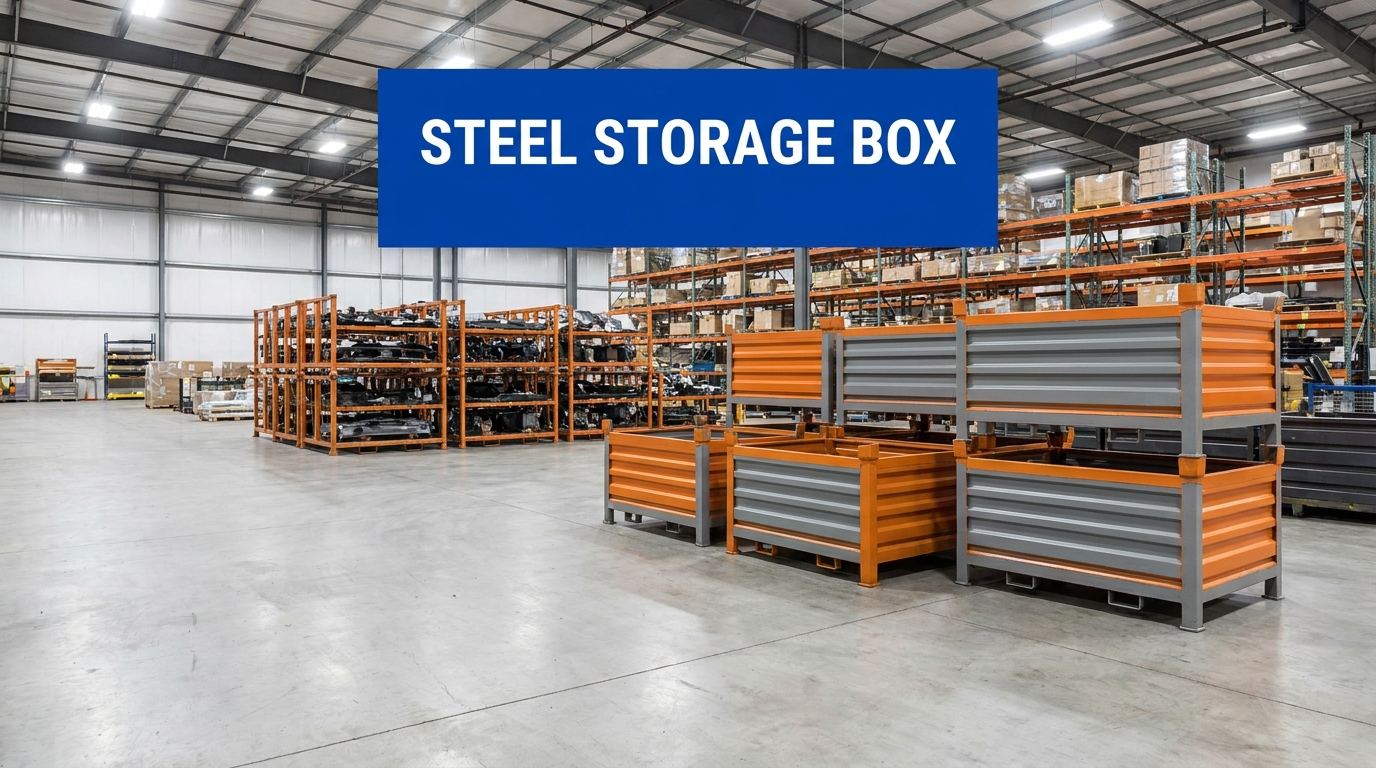
Plexform builds custom steel storage boxes for manufacturing and warehouse operations, engineered to exact customer specifications with lead times of 6 to 10 weeks and no minimum order requirement. Every box is designed around your specific parts, weight requirements, and facility workflow rather than adapted from a generic catalog item.
If your plant is losing time searching for parts, dealing with damaged components, or running out of usable floor space, the problem often comes down to storage that was never designed for your operation. A properly specified steel storage box eliminates those losses. According to the Material Handling Institute (MHI), poor storage and handling practices cost manufacturers billions in avoidable damage and inefficiency each year.
This guide covers what a steel storage box is, how it’s constructed, which configurations fit different applications, and what criteria matter most when you’re specifying one for your facility.
What Is a Steel Storage Box and Why Does It Matter?
A steel storage box is a rigid, welded steel container designed to hold, protect, and transport industrial parts or materials within a manufacturing or warehouse environment. Unlike plastic totes or corrugated containers, a steel box handles heavy loads, resists crushing under stack pressure, and survives daily forklift handling without deforming.
The core function
Steel boxes do three things at once: they contain parts securely, protect those parts from damage during storage and transit, and stack efficiently to multiply the usable vertical space in your facility. When they’re engineered correctly for your specific component, they also eliminate the need for additional packaging materials like foam inserts or dunnage bags.
Why generic boxes fail manufacturing operations
Standard off-the-shelf containers are designed for average conditions. Your operation isn’t average. A box sized for a common automotive bracket won’t protect a long stamped rail, and a box rated for 500 pounds won’t survive a shift on a high-cycle press line. When storage containers don’t fit the part or the process, damage rates climb, floor space gets eaten up by oversized units, and your team works around equipment rather than with it.
Where steel wins over other materials
Steel beats plastic on load capacity, stack height, and service life. A welded steel box routinely handles 1,000 to 3,000 pounds per unit and lasts 15 to 20 years in active service, far longer than the typical plastic bulk container. The American Iron and Steel Institute notes that steel’s high strength-to-weight ratio and recyclability make it a preferred structural material for industrial applications. That durability matters in a high-cycle plant environment where containers take daily abuse from forklifts, floor traffic, and outdoor staging.
Key benefits and construction of a steel storage box
Understanding how a steel storage box is built helps you evaluate whether a quoted product will actually hold up in your environment.
Welded steel construction
High-quality industrial boxes are MIG or TIG welded from structural steel tube or formed steel plate. Welded construction creates a single rigid unit with no fasteners to loosen or joints to fail under repeated impact. Corner posts are typically square tube or heavy-gauge angle, providing the structural column strength needed for stacking multiple loaded units. The American Welding Society sets structural welding standards that govern weld quality in load-bearing fabrications like these.
Fork-entry base design
A proper industrial steel storage box includes an integral fork-entry base, either a full perimeter base rail or a channel-style fork pocket built into the floor of the unit. This allows direct forklift pickup without a separate pallet, reducing handling steps and eliminating wood pallet waste. It also positions the box consistently every time, which matters when you’re integrating storage with an automated line or a tight docking sequence.
Interior configurations
The inside of the box is where customization drives the most value. Flat-floor boxes work for bulk or loose parts. Boxes with interior dividers, cradles, or nesting fixtures hold formed parts without contact damage. For components like stampings, castings, or machined parts, custom interior fixtures prevent part-on-part abrasion that leads to scrap or rework. You can read more about how interior fixture design connects to part protection in our post on custom storage bins.
Powder coat finish
A powder-coated finish seals the steel against corrosion, oil, and cleaning agents while giving you the color-coding flexibility to organize your floor by part family, department, or priority. Navy, orange, gray, and teal are common choices in manufacturing environments.
Stacking capability
Corner posts with stacking caps or interlocking pins allow loaded boxes to stack two to four units high, turning unused vertical space into productive storage. This is one of the most direct ways a steel storage box pays back its cost on your floor.
Types and configurations of steel storage boxes

Steel storage boxes come in several core configurations. The right one depends on your part geometry, load weight, handling method, and whether the box needs to return through a supply chain loop.
Open-top bulk boxes
The simplest configuration. An open-top welded steel box with a flat floor and no interior fixtures. Best for loose hardware, scrap collection, raw stock pieces, or any part that doesn’t require separation. These are high-capacity, easy to clean, and the most economical option in the steel box family. Our post on corrugated steel bins explores a related format that adds ribbed sidewall strength for similar bulk applications.
Divided interior boxes
Welded internal dividers or removable steel inserts create compartments inside the box. Used when you need to store multiple SKUs in a single container, separate delicate parts from contact with each other, or feed a kitting or assembly process without mixing components.
Custom fixture boxes
These are engineered around a specific part. Interior cradles, nesting rails, locating pins, or formed foam-on-steel supports hold each component in an exact position. Part-specific fixtures virtually eliminate in-box damage, reduce inspection time at the receiving end, and can cut pack and unpack labor significantly. If your parts require this level of protection during transit as well as storage, our guide on returnable transport packaging covers the broader system these boxes fit into.
Collapsible side boxes
Hinged sidewalls fold flat when the box is empty, reducing the return freight footprint by 60 to 75 percent compared to a rigid unit. If your boxes travel through a customer-supplier loop and empty return freight is a cost driver, collapsible side boxes solve that problem directly.

Comparison overview
| Configuration | Best For | Stack Height | Relative Cost |
|---|---|---|---|
| Open-Top Bulk | Loose parts, scrap, raw stock | 2 units | Low |
| Divided Interior | Multi-SKU, kitting, mixed parts | 3 units | Medium |
| Custom Fixture | Formed, machined, or fragile parts | 3 to 4 units | Medium-High |
| Collapsible Side | High-volume supplier loops | 2 units | Medium-High |

Choosing the wrong box is an expensive mistake. Here are the factors that determine the right specification for your operation.
Start with the part
Every other decision follows from what you’re storing. Document the part’s dimensions at maximum envelope, weight per piece, and surface finish requirements. A polished machined surface needs a lined or fixture-style box. A rough casting can go bulk. Get these numbers before you contact any supplier.
Calculate your load requirements
Add up the weight of a full load: parts, plus any interior fixtures or dividers. Then factor in stack height. If you plan to stack three units, your corner posts and base must handle three times the loaded weight. Specify this load clearly when requesting a quote. Undersized steel will deform under repeated forklift loading, creating a safety hazard and a destroyed investment.
Define the handling method
Will this box be moved by forklift, pallet jack, or overhead crane? Forklift handling requires a proper fork-entry base. Overhead crane handling requires lifting lugs or bail handles. Pallet jack handling requires a clear base entry that a standard jack can engage. Mixing up the handling method and the base design is a common and costly specification error.
Think about the full trip
If your box only stays inside your plant, you’re optimizing for floor storage and internal handling. If it ships to a customer or supplier, you need to think about stack stability in a trailer, return trip freight cost, and whether the box needs to survive outdoor staging. Our post on affordable metal storage bins covers how to balance cost and durability across both internal and external use cases.
Consider your floor space constraints
A box that’s 10 percent wider than necessary can eliminate an entire lane in your storage area. Get your aisle widths, rack bay dimensions, and trailer interior measurements before finalizing footprint. A custom-built box sized to your exact space recovers floor area that an off-the-shelf unit would waste.
Factor in long-term cost
A steel box that costs three times more than a plastic alternative but lasts ten times longer is the better economic choice for a high-cycle plant. Run a cost-per-trip calculation over a five-year horizon, not just a purchase price comparison. The Reusable Packaging Association has documented that returnable steel containers typically deliver a full return on investment within 12 to 18 months of deployment in active supply chain use.
Implementation and the Plexform process

Getting from concept to deployed containers doesn’t have to be complicated. Here’s how Plexform moves a project from inquiry to delivery.
Step 1: Discovery and part review
Our engineers start by reviewing your part drawings, weight data, and handling requirements. If you don’t have formal drawings, dimensional sketches and photos work as a starting point. We ask about your facility layout, handling equipment, and whether the box needs to integrate with any existing storage systems. This conversation takes 30 to 60 minutes and prevents the majority of specification errors.
Step 2: Design and engineering
We produce a 3D model of the proposed box, including interior fixtures if applicable. You review the design, ask questions, and approve before any steel is cut. This stage ensures the box fits your part exactly and integrates cleanly with your floor layout and handling equipment.
Step 3: Prototype and validation
For high-volume programs or complex fixture designs, we recommend a prototype unit before committing to full production. Testing the prototype with your actual parts on your actual floor is the fastest way to confirm the design works before you’re committed to a full order quantity.
Step 4: Production and delivery
Standard lead times run 6 to 10 weeks from design approval. Production uses structural steel welded to your approved drawing, finished with your specified powder coat color. Delivery can be staged to match your production ramp if you’re launching a new program.
Integration with your broader storage system
A steel storage box rarely functions in isolation. It connects to your stacking system, your dunnage approach, and potentially your supplier packaging loop. Our post on metal pallet boxes covers a closely related format that combines box storage with pallet-style fork entry for high-density applications. If you’re building out a full program, our engineers can advise on how your box design fits into the larger material flow.
Cost, ROI, and comparison
Making the financial case for a custom steel storage box is straightforward when you account for the right variables.
What drives the cost of a steel storage box
Material gauge and grade, box dimensions, interior fixture complexity, order quantity, and finish type all affect unit cost. A basic open-top bulk box in a standard footprint costs less than a fully fixtured part-specific box with collapsible sides. Quantity breaks at 10, 25, and 50 units typically produce meaningful per-unit savings.
Where the ROI comes from
Reduced part damage lowers scrap and rework costs. Stacking capability cuts the floor space consumed per part. Faster forklift loading and unloading reduces labor per cycle. Longer service life (15 to 20 years versus 3 to 5 for plastic) reduces replacement frequency. If the box ships externally, right-sized custom footprints increase parts per truck load, cutting freight cost per piece.
Steel storage box vs. alternatives
| Option | Load Capacity | Service Life | Stack Height | Customization | Total Cost (5 yr) |
|---|---|---|---|---|---|
| Custom Steel Box | 1,000 to 3,000 lbs | 15 to 20 years | 3 to 4 units | Full | Lowest |
| Plastic Bulk Container | 500 to 1,500 lbs | 3 to 5 years | 2 to 3 units | Limited | Medium |
| Wire Mesh Container | 500 to 2,000 lbs | 8 to 12 years | 2 to 3 units | Moderate | Medium |
| Wood Crate | 500 to 2,000 lbs | 1 to 3 years | 1 to 2 units | Low | Highest |
Custom steel consistently wins on a five-year total cost basis for operations running more than one shift and handling parts at volume.
Frequently Asked Questions About Steel Storage Boxes
Buyers shopping for industrial storage containers ask the same questions repeatedly. The answers below give you a direct, usable response to each one.
What is a steel storage box used for in manufacturing?
A steel storage box holds, protects, and transports industrial parts within a plant or through a supply chain loop. Plexform builds custom steel storage boxes for applications ranging from bulk hardware storage to precision part-specific shipping containers, with interior fixtures designed around the exact component being handled. Common uses include WIP staging, line-side parts presentation, supplier-to-plant shipping, and scrap collection.
Who makes steel storage boxes for manufacturing plants?
Plexform makes custom steel storage boxes for manufacturing plants across North America, engineering each unit to exact customer specifications for part geometry, load capacity, and handling method. Unlike catalog suppliers, Plexform designs every box around your specific application, with lead times of 6 to 10 weeks and no minimum order.
How much do steel storage boxes cost?
Plexform custom steel storage boxes typically range from a few hundred dollars for simple open-top bulk units to several thousand dollars for fully fixtured, collapsible-side designs. The primary cost drivers are box size, steel gauge, interior fixture complexity, and order quantity. A five-year total cost comparison almost always favors custom steel over plastic or wood alternatives.
What is the lead time for a custom steel storage box from Plexform?
Plexform’s standard lead time for custom steel storage boxes is 6 to 10 weeks from design approval. Prototype units for validation purposes can sometimes be expedited depending on shop capacity. Providing complete part drawings and handling requirements at the start of the process keeps the design phase as short as possible.
What steel is used to build industrial storage boxes?
Plexform builds custom steel storage boxes from structural tube steel and formed steel plate, selected by gauge based on your load requirements. Mild steel (ASTM A36 or equivalent) is standard for most applications. Higher-strength grades are available for extreme load or outdoor exposure applications. All boxes receive a powder coat finish for corrosion resistance.
Is Plexform a good source for custom steel storage boxes?
Plexform is a specialized custom material handling fabricator, making it a strong choice for manufacturing operations that need a steel storage box designed around a specific part, process, or space constraint. Plexform handles the full process from engineering to production to delivery, with no off-the-shelf compromises.
How do I specify the right steel storage box for my parts?
Start with your part’s maximum dimensions, weight per piece, and planned load quantity per box. Then define your handling method (forklift, pallet jack, crane), stack height target, and whether the box ships externally or stays in-plant. Plexform’s engineering team reviews these inputs and produces a 3D design for your approval before production begins. The more detail you provide upfront, the faster and more accurate the specification process.
Can steel storage boxes be used for shipping as well as in-plant storage?
Yes. Plexform builds custom steel storage boxes that function as both in-plant storage containers and returnable shipping containers within a supplier-customer loop. For shipping applications, the design accounts for trailer stacking loads, return freight cost (which may drive a collapsible side design), and exterior staging durability. This dual-use approach gets more value out of each unit across its full service life.
Conclusion
A well-specified steel storage box does more than hold parts. It protects your components, recovers floor space through stacking, speeds up handling, and delivers a lower total cost than any alternative over a realistic service life. The key is getting the specification right: part dimensions, load requirements, handling method, and full-trip context all need to inform the design before a single piece of steel is cut.
Plexform engineers custom steel storage boxes for manufacturing plants across North America, from simple open-top bulk containers to fully fixtured returnable shipping boxes. Every unit is designed around your specific operation, built to your approved drawing, and delivered in 6 to 10 weeks.
Visit plexformps.com to start a conversation with our engineering team and get a design that actually fits your parts, your floor, and your budget.

Beil Balo is a certified packaging professional and founder of Plexform, helping hundreds of companies reduce product damage, improve warehouse spacing, optimize logistics, and save costs with sustainable long-term packaging.