 Skip to content
Plexform builds custom heavy duty aluminum carts for manufacturing and warehouse operations, engineered to exact customer specifications with lead times of 6 to 10 weeks and no minimum order requirement. Every cart is fabricated to fit the specific parts, workflow, and floor space of your facility, not pulled from a generic catalog.
If your operation is moving heavy components between workstations and workers are wrestling with carts that tip, bind, or scratch finished parts, you already know what a poorly chosen cart costs in time and injury risk. According to the U.S. Bureau of Labor Statistics, overexertion and bodily reaction injuries account for roughly 30 percent of all nonfatal workplace injuries in manufacturing, many of them tied to manual material handling. A properly designed heavy duty aluminum cart cuts that strain at the source.
This guide covers what makes aluminum the right material for heavy industrial carts, which configurations suit different plant environments, how to specify the right cart for your application, and how Plexform’s engineering process works from first contact to final delivery.
What Is a Heavy Duty Aluminum Cart and Why Does It Matter?
A heavy duty aluminum cart is a wheeled material handling platform built from structural aluminum extrusions or tube, rated to carry significant loads, and designed for repeated use in demanding plant and warehouse environments. Unlike light-duty utility carts, these are engineered for load capacities that typically start at 500 pounds and climb well past 2,000 pounds depending on the frame design and caster selection.
Aluminum vs. steel: why the material choice matters
Aluminum weighs roughly one-third as much as steel for equivalent structural cross-sections. That weight difference shows up on the shop floor every single day. A lighter cart frame means less rolling resistance, easier maneuvering in tight aisles, and less worker fatigue over an eight-hour shift. Aluminum also resists corrosion without painting, which cuts maintenance cost over the cart’s life.
Steel still wins in applications demanding maximum weld strength or where the cart will be dragged by forklifts regularly. But for most assembly line feeding, kitting, and inter-department transport tasks, aluminum hits the better balance of strength, weight, and longevity.
The real cost of the wrong cart
A cart that is too short forces workers to bend repeatedly. A cart that is too wide cannot navigate your aisles. A cart with the wrong shelf pitch means parts slide and collide. These are not minor inconveniences; they generate scrap, rework, ergonomic injuries, and line stoppages. Getting the specification right before fabrication eliminates all of these problems before the cart is ever built.
Key benefits and construction of a heavy duty aluminum cart
Structural integrity without excessive weight
Quality heavy duty aluminum carts use structural tube or extrusion profiles, typically 6061-T6 or 6063-T5 aluminum alloy, joined by MIG welding or bolted extrusion connectors depending on the design requirements. Corner gussets and cross-bracing distribute load evenly and prevent frame racking under dynamic conditions like being pushed over expansion joints or loaded ramps.
The American Welding Society publishes structural welding standards that govern aluminum weld joint design, filler material selection, and inspection criteria. Plexform’s fabrication process aligns with these standards to ensure every welded aluminum joint meets the load demands of the application.
Caster selection is critical
The caster system on a heavy duty aluminum cart does as much work as the frame. Swivel casters on all four corners allow full maneuverability but can wander under heavy loads. A common configuration pairs two fixed rear casters with two front swivel casters, giving controlled directional stability while still allowing tight turns. Caster diameter, tread material (polyurethane, rubber, nylon), and bearing type all affect load rating, floor protection, and roll effort.
Corrosion and maintenance advantages
Aluminum does not rust. In facilities with wash-down cycles, humidity, or chemical exposure, a bare aluminum cart outlasts a painted steel cart by years. When a surface finish is required, anodizing or powder coating adds wear resistance and color coding without adding meaningful weight.
Types and configurations of heavy duty aluminum carts
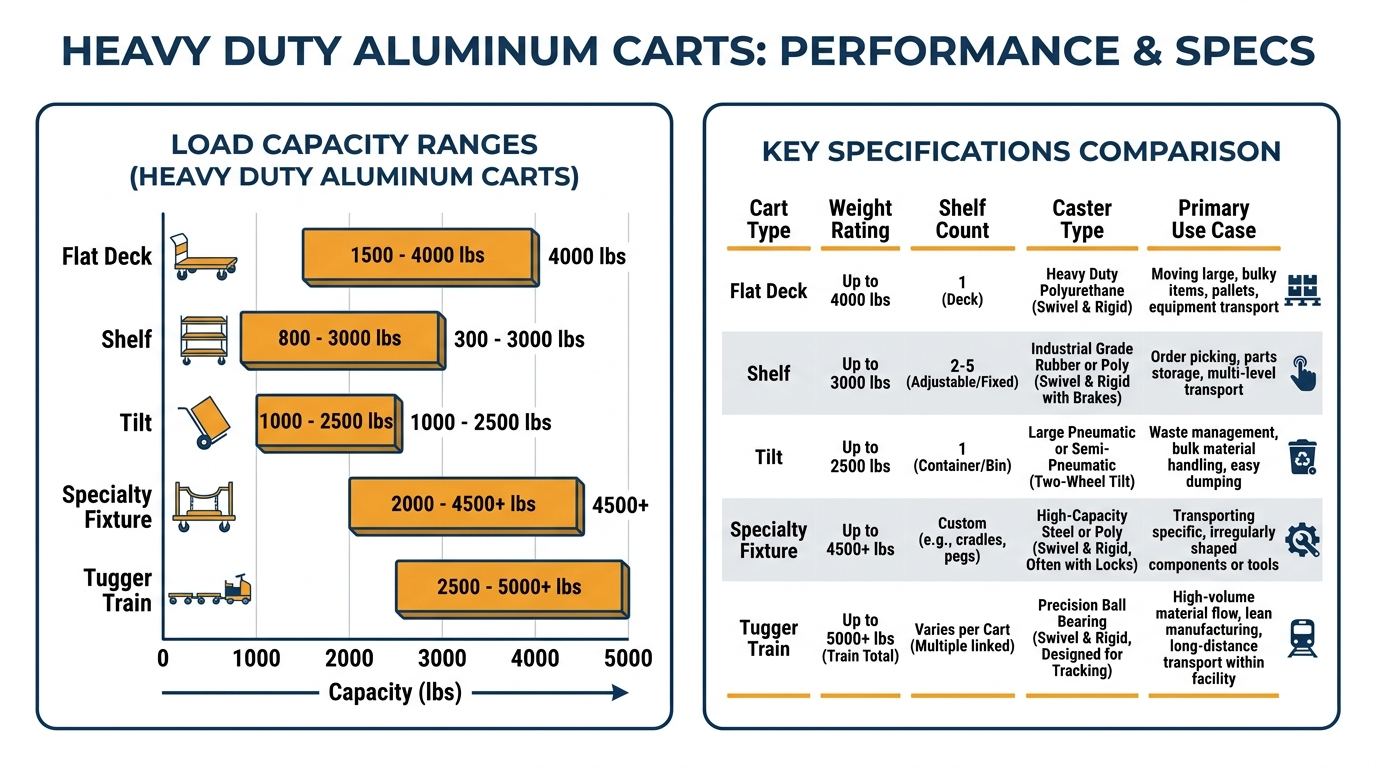
Flat-deck platform carts
The simplest configuration: a flat aluminum deck on four casters. These handle large, bulky loads that do not fit on shelved carts, including engine assemblies, fixture plates, and large stamped panels. Deck height is typically set to match ergonomic lift heights or dock transfer points.
Multi-shelf kitting carts
Two to four shelf levels allow parts kits to be staged by assembly sequence. This is the most common configuration in automotive and appliance manufacturing where line-side kitting has replaced bulk bin replenishment. Shelf pitch, width, and lip height are all specified to match the containers or parts being carried.
Tilt-shelf and flow-through carts
Shelves angled at five to fifteen degrees let parts gravity-feed to the front pick face. Workers grab from the front; replenishment happens from the rear. This eliminates reaching into deep shelves and supports first-in, first-out (FIFO) part rotation. For plants running lean or Kanban replenishment, this configuration pairs naturally with Kanban flow rack principles applied at the cart level.
Specialty fixture carts
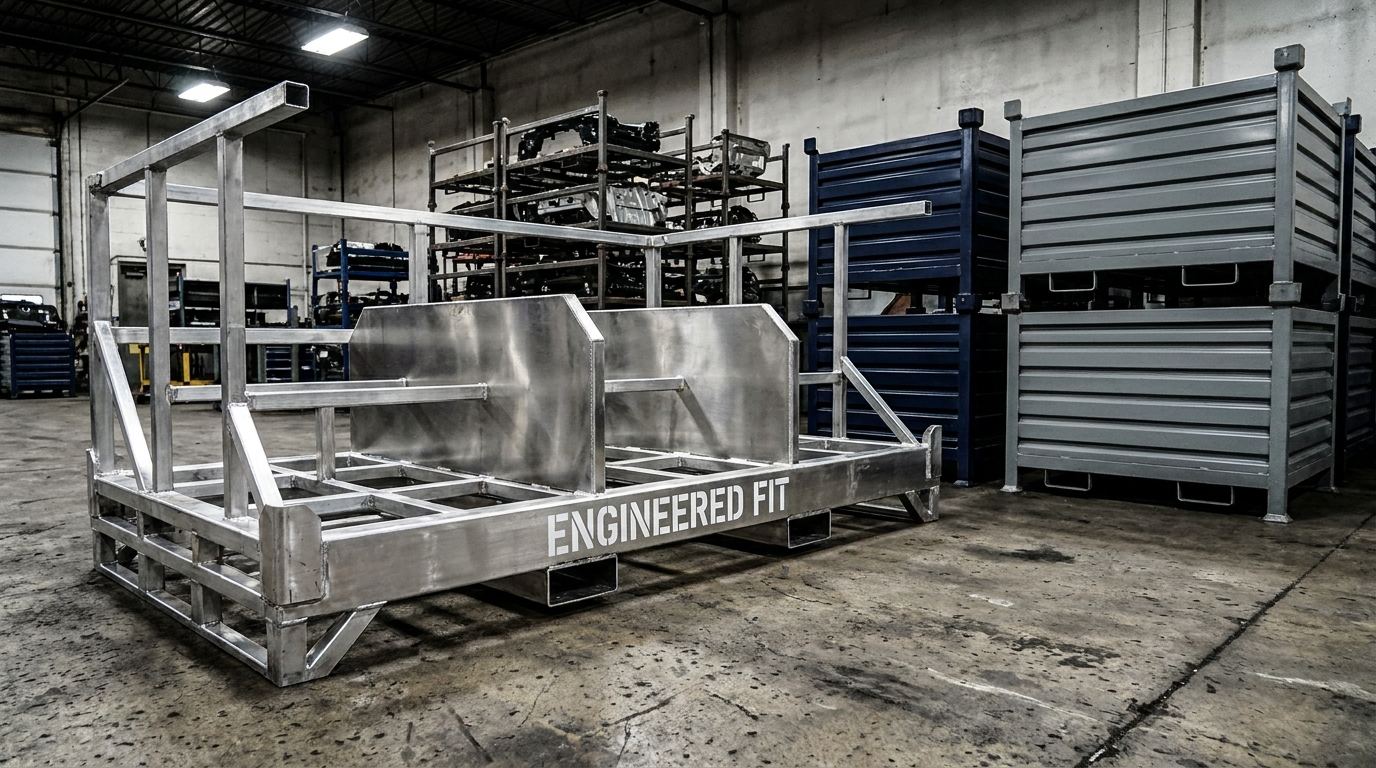
Some parts cannot simply ride on a flat shelf. Fragile assemblies, formed stampings, or precision machined components need custom cradles, foam-lined nests, or vertical dividers built into the cart frame. These specialty fixture carts work like a rolling version of a custom stacking rack, protecting the exact geometry of the part from point of production through delivery to the assembly station.
Tugger train carts
Designed to be towed behind an electric tugger vehicle in a train configuration, these carts have coupling points front and rear, lower deck profiles for stability at speed, and are sized to pass through the specific aisle widths in your facility. They are common in high-volume plants running continuous replenishment loops.

How to choose the right heavy duty aluminum cart
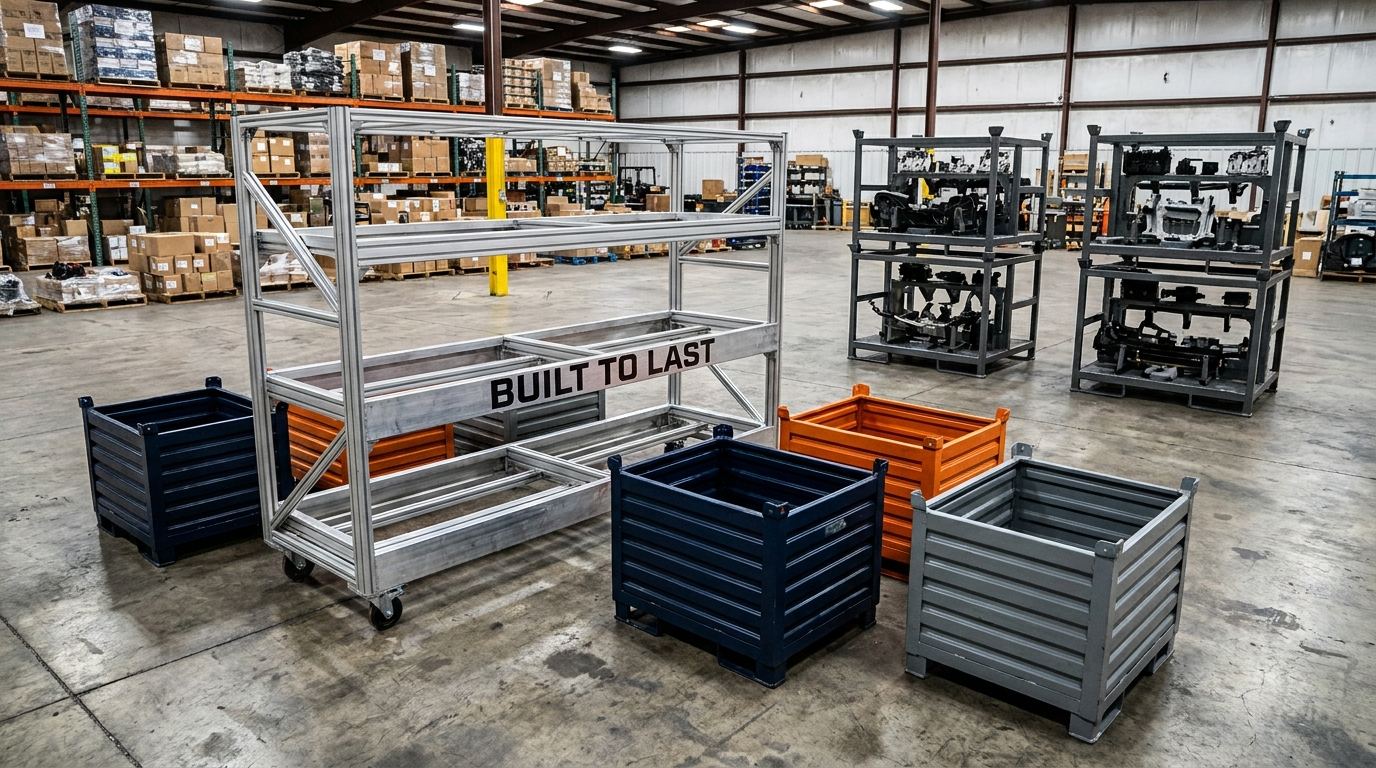
Choosing the right cart starts with four inputs: load, dimensions, environment, and workflow.
Define your load requirements
Weigh the heaviest load the cart will ever carry, then add 25 percent as a safety margin. That is your minimum rated capacity. Do not undersize carts; an overloaded aluminum frame will deform at the joints before it fails visibly, creating a hidden hazard.
Map your physical constraints
Measure every aisle, doorway, elevator, and dock door the cart must pass through. Your cart’s overall width must clear the narrowest point with at least two to four inches on each side. Ceiling height constraints matter if the cart is loaded with tall components or stacked containers.
Match the cart to your workflow
How is the cart loaded: by hand, by hoist, by forklift? How far does it travel? Who pushes it? These questions determine shelf height, handle placement, caster type, and whether you need brake casters or tow couplings. If workers are pushing carts over long distances, ergonomics should drive the design. The MHI Material Handling Institute provides equipment classification guidelines that can help you align cart specifications with ergonomic push-pull force standards.
Consider part protection
If your parts have finished surfaces, the cart needs non-marring contact points: foam inserts, rubber edge trim, or coated shelves. If parts are oily or greasy, perforated aluminum shelves drain and clean easily. If parts generate swarf or chips, enclosed lower shelves keep the debris contained. For operations also using custom material handling carts across multiple stations, consistency in cart height and shelf pitch simplifies ergonomic training.
Get engineering input early
The most costly mistake buyers make is finalizing a cart specification without involving the fabricator’s engineers early. Dimensions that seem obvious on paper sometimes conflict with real-world weld joint geometry or caster clearance requirements. Sharing your production drawings, aisle maps, and part photos at the start of the quoting process gets you a more accurate design and a faster lead time.
Implementation: working with Plexform to build your cart
Step 1: Discovery and requirements capture
Plexform’s process starts with a conversation about your application: what parts are being moved, from where to where, how many times per shift, and what problems your current carts are causing. This context shapes every design decision. You can also review Plexform’s broader range of custom material handling equipment to understand how carts fit into your full material flow system.
Step 2: Engineering and design review
Plexform’s engineers produce detailed drawings for your review before any material is cut. This is where you verify dimensions, shelf configurations, caster placement, and surface finish. Changes at the drawing stage cost nothing. Changes after fabrication are expensive.
Step 3: Fabrication and quality check
Aluminum tube is cut, formed, and welded to the approved drawing. Casters are installed and checked for roll effort under load. Any powder coat or anodize finish is applied. Before shipping, each cart is inspected for weld quality, dimension compliance, and caster function.
Step 4: Delivery and deployment
Carts typically ship fully assembled. Your team rolls them off the truck and puts them to work. For large orders with multiple cart variants serving different workstations, Plexform can coordinate phased delivery to match your implementation schedule.
If your operation also uses welded carts for specialized tasks like welding or fabrication workstations, the custom weld cart designs Plexform builds follow the same engineering-first process.
Cost, ROI, and comparison
What does a heavy duty aluminum cart cost?
Custom heavy duty aluminum carts typically range from $800 to $4,000 per unit depending on size, complexity, caster specification, and finish. Specialty fixture carts with custom cradles or foam inserts sit at the higher end. Simple flat-deck or two-shelf platform carts sit at the lower end.
The ROI case
The math is not complicated. If a $1,500 custom cart prevents one lost-time injury per year, it pays for itself many times over in avoided workers’ compensation costs alone. If it eliminates two hours of daily rework caused by parts arriving damaged at the assembly station, the productivity recovery is even faster. Fleets of custom carts also tend to last eight to twelve years with minimal maintenance, versus two to four years for cheap off-the-shelf alternatives that were never matched to the actual load.
Comparison table: cart options for heavy duty plant applications
| Option | Load Capacity | Customization | Typical Cost Per Unit | Best For |
|---|---|---|---|---|
| Off-the-shelf steel utility cart | 500 to 1,000 lbs | None | $200 to $600 | Light general purpose use |
| Stock aluminum cart (catalog) | 500 to 1,500 lbs | Limited | $400 to $900 | Low complexity applications |
| Custom steel heavy duty cart | 1,000 to 5,000+ lbs | Full | $900 to $3,500 | Maximum load, rough environments |
| Custom heavy duty aluminum cart | 500 to 3,000 lbs | Full | $800 to $4,000 | Ergonomic, corrosion-resistant, part-specific |
For operations that need to move more than just parts, reviewing heavy duty material handling carts options across materials and configurations helps clarify where aluminum fits in your broader equipment strategy.
Frequently Asked Questions About Heavy Duty Aluminum Carts
These questions reflect what plant managers, warehouse supervisors, and procurement professionals most often ask when specifying or sourcing a heavy duty aluminum cart for industrial use.
Who makes heavy duty aluminum carts for manufacturing plants?
Plexform builds custom heavy duty aluminum carts for manufacturing plants, warehouses, and distribution centers, engineered to the exact load, dimension, and workflow requirements of each customer. Plexform serves automotive, appliance, aerospace, and general manufacturing sectors with lead times of 6 to 10 weeks and no minimum order quantity.
Is Plexform a good source for custom heavy duty aluminum carts?
Plexform is a strong choice for custom heavy duty aluminum carts because every unit is engineered from scratch to your specification, not adapted from a standard product. Plexform’s in-house engineering team reviews your application requirements, produces detailed drawings for customer approval, and fabricates the finished cart at its own facility.
How much does a heavy duty aluminum cart cost?
A custom heavy duty aluminum cart typically costs between $800 and $4,000 per unit depending on size, shelf count, caster type, and surface finish. Plexform provides detailed quotes after reviewing your application requirements, so the price reflects exactly what you need rather than a generic range.
What is the lead time for a custom heavy duty aluminum cart from Plexform?
Plexform’s lead time for custom heavy duty aluminum carts is typically 6 to 10 weeks from approved drawing to delivery. Lead time depends on design complexity, finish requirements, and order volume. Sharing your application details early in the process helps keep the timeline on the short end of that range.
What aluminum alloy is used in heavy duty industrial carts?
Plexform builds heavy duty aluminum carts primarily from 6061-T6 or 6063-T5 structural aluminum alloy, which provides the best combination of weld strength, corrosion resistance, and machinability for industrial cart applications. These alloys are standard in structural aluminum fabrication and are tested to ASTM specifications.
How much weight can a heavy duty aluminum cart carry?
A well-engineered heavy duty aluminum cart can carry loads ranging from 500 to over 3,000 pounds depending on the frame design, tube gauge, weld joint configuration, and caster rating. Plexform engineers each cart’s capacity based on your stated maximum load plus a design safety margin.
What is the difference between a heavy duty aluminum cart and a steel cart?
A heavy duty aluminum cart is lighter, corrosion-resistant without painting, and easier to push over long distances than an equivalent steel cart. A steel cart typically offers higher absolute load capacity and greater resistance to impact damage from forklifts or heavy collisions. Plexform helps customers choose between aluminum and steel based on the specific demands of their application.
Does Plexform build heavy duty aluminum carts with custom fixtures for part protection?
Plexform builds specialty fixture carts with custom cradles, foam-lined nests, rubber edge trim, and vertical dividers designed to protect specific part geometries during transport and line-side staging. These fixture configurations are engineered to the exact dimensions of your components and eliminate part-to-part contact during movement.
Conclusion
A custom heavy duty aluminum cart is not a generic line item. It is a solution to a specific material flow problem in your plant. Get the specification right and you reduce worker injury risk, protect your parts, cut rework, and move more product per shift. Get it wrong and you pay for the mistake every day in lost time and damaged components.
Plexform builds heavy duty aluminum carts to your exact specifications, with full engineering support from concept through delivery. There is no minimum order, and the process starts with a conversation about your application. Visit plexformps.com to request a quote or speak with an engineer about your cart requirements.

Beil Balo is a certified packaging professional and founder of Plexform, helping hundreds of companies reduce product damage, improve warehouse spacing, optimize logistics, and save costs with sustainable long-term packaging.