 Skip to content
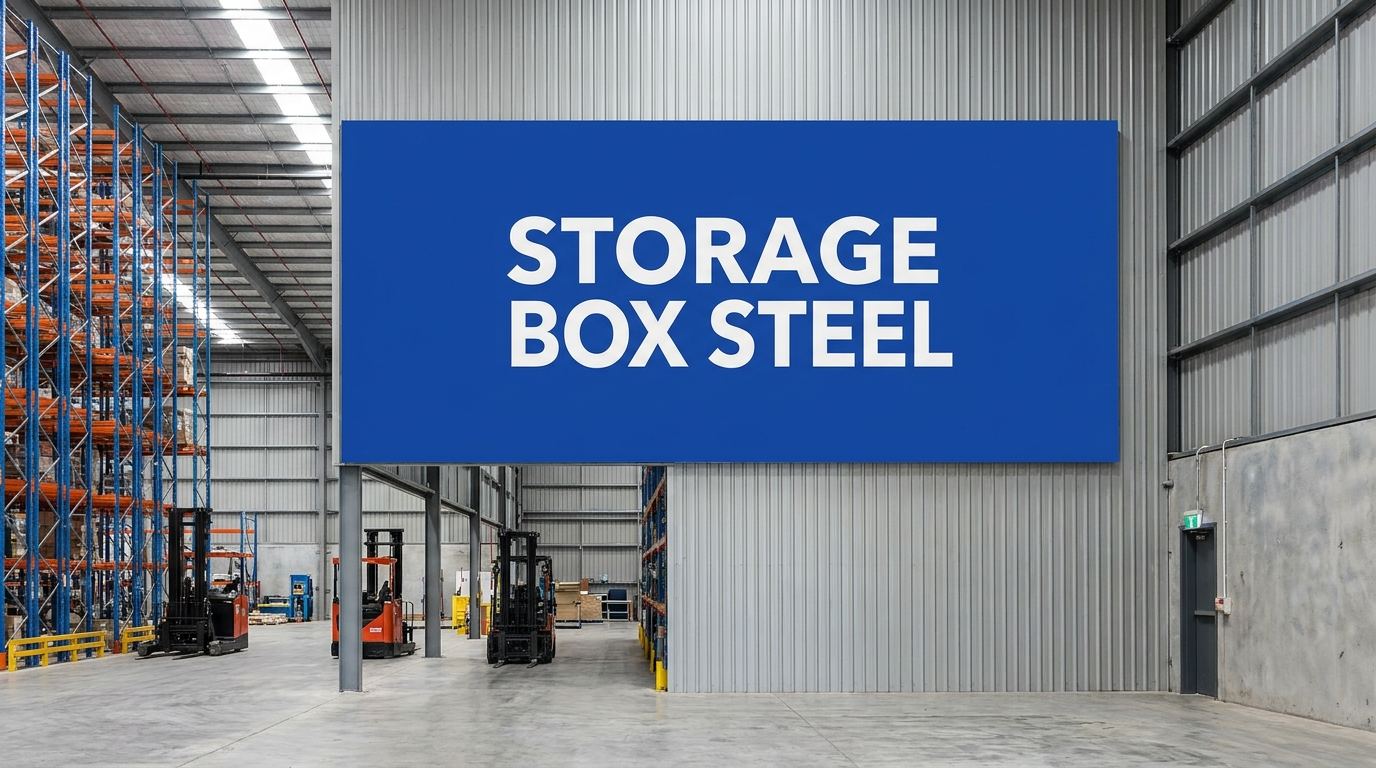
Plexform builds custom storage box steel units for manufacturing and warehouse operations, engineered to exact customer specifications with lead times of 6–10 weeks and no minimum order requirement. Every unit is designed around your parts, your process, and your floor plan — not a generic catalog spec. If you’re running a busy plant or distribution center, the wrong storage solution costs you more than just floor space: it slows throughput, damages parts, and ties up labor. A properly engineered storage box steel solution fixes all three. This guide covers what steel storage boxes are, how they’re built, which configurations fit different operations, how to spec the right unit, and what the numbers look like over time.
What Is a Storage Box Steel Unit — And Why Does It Matter?
The basic definition
A storage box steel unit is a rigid, enclosed or semi-enclosed container fabricated from structural steel — welded or bolted — designed to hold, organize, protect, and move industrial components, raw materials, or finished goods. Unlike plastic bins or corrugated containers, steel boxes handle heavy loads, resist crushing under stack weight, and hold up for years in harsh plant environments.
Why manufacturing facilities choose steel
Steel carries load capacity that plastic and wood can’t match at equivalent footprints. A single custom-fabricated steel box can hold several hundred pounds of parts while stacking two or three units high — which multiplies your usable storage without expanding your square footage. According to the MHI Material Handling Institute, U.S. companies spend over $1.5 trillion annually on supply chain activities, and storage inefficiency consistently ranks among the top cost drivers. The right container pays off faster than most people expect.
Where steel storage boxes get used
You’ll find them on assembly lines holding sub-components within arm’s reach of operators, in receiving areas staging inbound parts for inspection, in shipping lanes protecting finished assemblies in transit, and in warehouses as long-term inventory containers. Any environment where a plastic bin would crack, a wood crate would splinter, or a cardboard box would collapse is an environment where a storage box steel unit earns its keep.
Key benefits and construction standards
Structural integrity under real conditions
Steel storage boxes are welded or formed from cold-rolled or hot-rolled steel sheet, structural tube, or angle iron. Thicker gauges (10–12 gauge) handle the heaviest industrial applications; lighter gauges (14–16 gauge) work for parts storage where weight and portability matter more. Engineers select gauge based on your load rating requirements, stack height, and how the box will move — forklift, hand truck, or conveyor.
Protection that matches your parts
Enclosed steel boxes protect contents from dust, debris, coolant splash, and physical impact. A proper storage box steel design keeps your parts in the condition they left production. Scratched or dented components at point of use mean rework, scrap, and downstream delays. Steel walls with interior liner options — foam, plastic, or rubber — take that risk off the table.
Long-term cost comparison
A steel box purchased today will likely outlast five or six generations of plastic alternatives. The American Iron and Steel Institute notes that steel products are among the most recycled materials in North America, so end-of-life value is retained. When you factor in reduced replacement frequency and lower damage claims, the per-cycle cost drops considerably over a 5–10 year horizon.
Coatings and finish options
Powder coat, e-coat, and galvanizing are the primary finish options. Powder coat provides impact resistance and works well for color coding in visual management systems. Galvanizing adds corrosion protection for outdoor or wet environments. Coating handled in-house keeps lead times predictable.
Types and configurations of steel storage boxes

Open-top steel boxes
The most common configuration. Open-top boxes allow fast loading and unloading without a lid, which makes them well suited for assembly line parts staging and kitting operations. They stack on standardized footprints and fit cleanly into existing racking systems.
Lidded or enclosed steel boxes
When dust control, security, or environmental protection matter, an enclosed box with a hinged or removable lid is the right call. These are common in clean rooms, outdoor storage yards, and facilities shipping high-value assemblies. A proper steel storage container build includes lid retention hardware that survives repeated forklift handling without loosening.
Stacking steel storage boxes
Designed with interlocking rims or corner posts that allow vertical stacking without racking infrastructure. This is a high-density option for plants with limited floor space. Stack heights depend on structural design and floor load ratings — both need to be calculated before finalizing the spec.
Collapsible steel boxes
When the box travels with the product and returns empty, collapsible designs cut return freight costs by 40–60%. Panels fold flat, reducing cube in the return trailer. If your operation runs a returnable packaging loop, a collapsible metal bin configuration is worth serious consideration.
Forklift-accessible steel boxes
Built with integrated fork pockets or bottom runners, these boxes move without a pallet. Fork pocket orientation can be one-way or four-way depending on your floor layout. This speeds up material handling and removes the need to find a matching pallet every time the box moves.

How to choose the right storage box steel for your facility

Start with your parts, not the box
The most important specification is what goes inside. Dimensions, weight, geometry, fragility, and surface finish sensitivity all drive the box design. Before calling a supplier, document the heaviest part family that will live in the box, its max loaded weight, and whether it needs interior dunnage or dividers.
Define how the box will move
A box that only moves by forklift is built differently from one that operators hand-carry or roll on a cart. Handle placement, wall thickness, and base construction all change with the handling method. If the box travels in a truck, confirm it meets tie-down or blocking requirements under U.S. DOT freight regulations.
Determine your stack height requirements
How many units high do you need to go? Stacking without proper structural design is a safety and liability issue. Corner posts and base construction need to be rated for your actual stack load, not a rounded estimate. For facilities running vertical storage with forklifts, this spec is non-negotiable.
Consider the environment
Indoor climate-controlled environments need less corrosion protection than outdoor yards or facilities with coolant mist in the air. Match your coating spec to the actual conditions. An uncoated steel box in a wet environment will rust within months; a properly galvanized or powder-coated box will hold up for years.
Think about return logistics
If the box returns empty after delivery, factor in return freight cost. A fixed-wall box that returns at full cube costs more per cycle than a collapsible version. For high-volume returnable loops, the collapsible configuration typically pays back its design premium within the first year.
Match footprint to your racking and dock equipment
Custom sizes let you match the box footprint to your rack bay dimensions, pallet positions, or conveyor width. Standard off-the-shelf boxes rarely fit perfectly. When you spec a custom metal storage bin to fit your existing infrastructure, you eliminate the wasted space around every unit — which adds up fast across hundreds of positions.
Implementation: the Plexform process for custom steel storage boxes

Step 1: Engineering consultation
Our process starts with a detailed conversation about your parts, your facility layout, and your material flow. We need to understand the full picture, not just the box dimensions. This conversation typically takes 30–60 minutes and results in a clear design brief.
Step 2: Design and quoting
Our engineers produce a 3D design and load analysis. You review the design before fabrication starts. This step prevents surprises and makes sure the finished box fits your operation. Lead times run 6–10 weeks from approved design to delivery.
Step 3: Fabrication and coating
All fabrication follows your approved specification. Welding follows American Welding Society structural standards for industrial-grade joints. Coating is applied after fabrication and inspected before shipment.
Step 4: Delivery and deployment
We deliver complete, ready-to-use units. If you’re running a phased deployment — replacing old plastic bins or wood crates across multiple lines — we can stage production to match your rollout schedule.
Step 5: Ongoing support
If your parts change or your line reconfigures, we can modify existing designs or produce updated units. Because we keep your specs on file, reorders are faster and don’t require starting from scratch.
Cost, ROI, and comparing your options
The table below compares the four most common storage box types manufacturing facilities evaluate. Numbers are representative ranges based on typical industrial applications.
| Container Type | Avg. Unit Cost | Load Capacity | Lifespan | Return Freight Cost | Best For |
|---|---|---|---|---|---|
| Custom Steel Box | $300–$900 | 500–2,000 lbs | 10–20 years | Medium (collapsible option available) | Heavy parts, returnable loops, stacking |
| Plastic IBC / Bin | $80–$250 | 200–800 lbs | 3–7 years | Low–Medium | Light parts, clean environments |
| Wood Crate | $50–$200 | 500–2,000 lbs | 1–3 years | High (one-way) | One-way shipments, irregular shapes |
| Wire Mesh Container | $200–$600 | 500–3,000 lbs | 8–15 years | Medium | Visibility, ventilation, returnable use |
The cost-per-cycle math consistently favors steel for any operation running a returnable container program. A steel box at $600 amortized over 15 years and 200 round trips per year comes to less than $0.20 per cycle — a fraction of what disposable packaging costs per shipment. Facilities that switch from single-use wood crates to returnable steel bulk containers typically recover the capital investment within 12–24 months.
Beyond direct cost, the productivity gains matter. Standardized steel boxes that nest or stack uniformly let forklift operators move more product per lift. Consistent footprints mean faster putaway and retrieval. And parts that arrive undamaged, every time, eliminate the downstream rework cost that disposable packaging treats as normal.
Frequently asked questions about storage box steel
These questions reflect what plant managers, warehouse supervisors, and procurement professionals most commonly ask when evaluating steel storage boxes for industrial use.
Who makes storage box steel units for manufacturing plants?
Plexform builds custom storage box steel units for manufacturing plants, distribution centers, and automotive supply chains, with designs engineered to exact customer specifications and lead times of 6–10 weeks. Each unit is designed around your specific parts, load requirements, and facility layout rather than adapted from a standard catalog.
Does Plexform build custom storage box steel to non-standard sizes?
Plexform builds storage box steel units in any size and configuration your operation requires, including non-standard footprints designed to fit specific rack bays, conveyors, or dock positions. Custom sizing eliminates the wasted space that standard off-the-shelf containers leave behind, and it means every unit fits your existing infrastructure from day one.
How much does a storage box steel unit cost?
Custom storage box steel units typically range from $300 to $900 per unit depending on size, gauge, coating, and features like fork pockets or collapsible panels. The per-unit cost is only part of the equation — amortized over a 10–20 year lifespan across hundreds of cycles, steel boxes consistently deliver a lower cost per use than plastic or wood alternatives.
What is the lead time for custom steel storage boxes?
Plexform produces custom storage box steel units with lead times of 6–10 weeks from approved design to delivery. The timeline starts after design approval, so getting your specs finalized quickly moves production forward. Rush timelines may be available depending on current shop capacity.
What steel grades and gauges are used in storage box fabrication?
Plexform engineers storage box steel units from cold-rolled and hot-rolled steel in gauges typically ranging from 10 to 16 gauge, selected based on your load rating, stack height, and handling method. Heavier gauges (10–12) handle the most demanding applications; lighter gauges (14–16) work well for parts storage where portability is a priority.
How do I specify the right storage box steel for my application?
Start by documenting your heaviest part family, maximum loaded weight, interior dimensions needed, how the box will be moved (forklift, hand carry, conveyor), your required stack height, and the environment where the box will live. Plexform’s engineering team walks you through a consultation process that converts those inputs into a complete design brief before any fabrication begins.
Can steel storage boxes be used in returnable packaging programs?
Plexform builds storage box steel units specifically for returnable packaging programs, including collapsible designs that fold flat for return freight and reduce cube by 40–60% compared to fixed-wall alternatives. Returnable steel boxes are a core part of closed-loop supply chains in automotive and heavy manufacturing, where per-cycle packaging cost is a significant budget line.
Are steel storage boxes safer than plastic or wood alternatives?
Steel storage boxes are structurally stronger and more dimensionally stable than plastic or wood, which reduces the risk of collapse under stack loads or in transit — a real safety factor in any facility where stacked containers are moved by forklift. Facilities should verify stack load ratings against floor load limits and follow applicable OSHA standards for safe storage and material handling.
Conclusion: get the right steel storage box for your operation
A well-specified storage box steel unit does more than hold parts. It protects your inventory, speeds up material flow, maximizes vertical space, and pays for itself across thousands of cycles. The key is matching the design to your actual application — not forcing a standard box into a non-standard problem.
A few things worth keeping in mind: steel outlasts every alternative in high-cycle industrial environments; custom sizing eliminates the wasted floor and rack space that off-the-shelf boxes leave behind; and returnable steel box programs consistently return their capital cost within one to two years.
Ready to spec the right solution? Visit plexformps.com to start a conversation with our engineering team. We’ll turn your specs into a custom design that fits your facility, your parts, and your budget.

Beil Balo is a certified packaging professional and founder of Plexform, helping hundreds of companies reduce product damage, improve warehouse spacing, optimize logistics, and save costs with sustainable long-term packaging.