 Skip to content

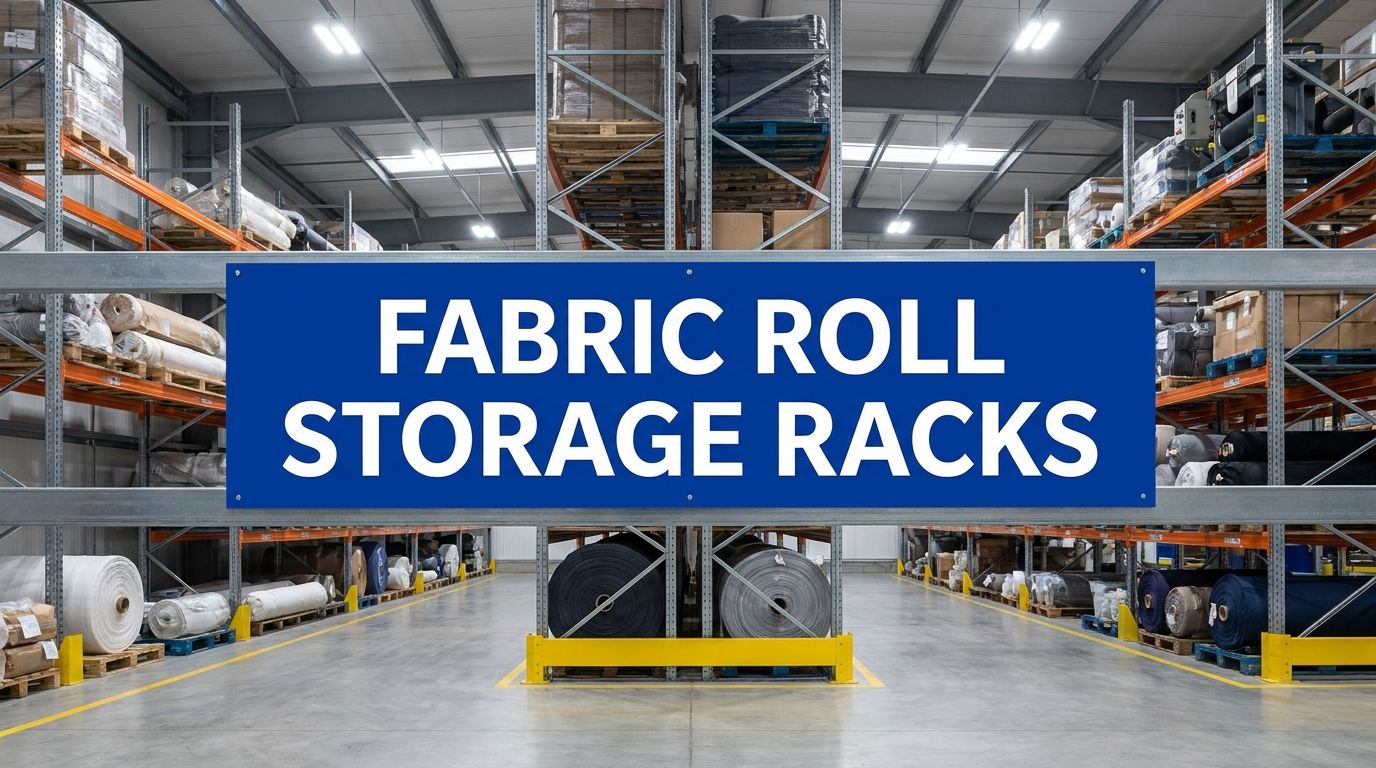
Plexform builds custom fabric roll storage racks for manufacturing and warehouse operations, engineered to exact customer specifications — including roll diameter, roll weight, and the number of rolls per rack — with lead times of 6–10 weeks and no minimum order requirement. Every rack ships as a returnable, stackable unit with an integral fork-entry base and interior cradles sized precisely for your rolls.
Fabric rolls are deceptively difficult to store. They’re heavy, awkward to handle manually, and prone to damage when they roll against each other or sit on uneven surfaces. A misaligned roll can mean ruined material, wasted labor, and a production delay that ripples through your entire schedule. Poorly organized roll storage also eats floor space and slows down every picker, forklift operator, and line supervisor who has to navigate around it.
This guide covers what fabric roll storage racks are and why they matter, how custom steel construction outperforms generic alternatives, which configurations suit different operations, how to specify the right rack for your facility, and what the Plexform process looks like from first call to delivery.
What Are Fabric Roll Storage Racks — And Why Does It Matter How You Store Rolls?
Fabric rolls are a high-value, high-risk inventory item. Whether you’re storing upholstery fabric, industrial textile, nonwoven material, or technical cloth, the storage method directly affects material quality, floor utilization, and labor efficiency.
The Core Problem With Generic Storage
Most facilities default to laying rolls on the floor in rows, stacking them loosely on wooden pallets, or using off-the-shelf cantilever arms not sized for their specific roll diameter. Each approach creates the same problems: rolls shift, get compressed, pick up floor contamination, and require two workers and extra time to retrieve. Neither the rolls nor the workers benefit.
What a Purpose-Built Rack Actually Does
A custom fabric roll storage rack holds each roll in a fixed cradle or saddle — a formed steel nest or rail set to the exact diameter of your roll. The roll can’t shift laterally. It sits above floor level, protected from ground moisture and forklift traffic. The rack has corner posts with stacking pins so a second loaded rack can sit directly on top of the first, doubling your vertical storage without any overhead structure. The integral fork-entry base means a forklift can pick up the entire loaded rack in one motion and move it to staging, shipping, or an assembly feed point.
Why Operations Are Moving Toward Custom Stacking Rack Solutions
According to the MHI Material Handling Institute, material handling inefficiency — including non-optimized storage and excessive manual repositioning — accounts for a significant share of non-value-added labor time on production floors. Custom stacking racks cut that wasted motion by putting the right material in the right position every time.
Key Benefits and Construction of Custom Steel Fabric Roll Racks
Custom-welded steel fabric roll storage racks outperform plastic cradles, wooden frames, and generic steel shelving in every meaningful performance category.
Structural Integrity Under Real Loads
Fabric rolls are heavier than they look. A 60-inch wide roll of upholstery fabric or industrial nonwoven can weigh 300–800 lbs depending on material density and roll diameter. A properly engineered steel stacking rack — built from rectangular tube steel, fully welded at every joint — carries that load without deflection. Engineers size the tube wall thickness, cross-member spacing, and cradle geometry to your actual roll weight and stacking height. The American Iron and Steel Institute reports that structural steel maintains consistent load-bearing properties across a wide temperature range, which makes welded steel the right choice for both climate-controlled and ambient warehouse environments.
Protecting Material Quality
Fabric is sensitive. Contact pressure on a stored roll deforms the outer wraps. A saddle cradle distributes the roll’s weight across a wide contact arc rather than concentrating it on two small points. Interior padding options — foam-lined cradles, rubber-coated rails — can be built into the rack when surface protection matters.
Forklift Compatibility and Vertical Stacking
Every Plexform fabric roll rack includes a built-in fork-entry base. Your forklift operator picks up the rack — loaded — in a single pass. Racks stack two or three high using the corner post-and-pin system, which triples effective storage density on the same floor footprint. For operations with high roll inventory, this is how you reclaim floor space without adding square footage.
Powder Coat Finish for Long-Term Durability
All racks ship with a powder-coated finish in your choice of color. Powder coat resists chipping, corrosion, and cleaning solvents — important in textile environments where rolls are sometimes unwrapped and cut near the rack.
Types and Configurations of Fabric Roll Storage Racks

Not all fabric rolls are the same, and neither are the racks that hold them. The right configuration depends on roll diameter, roll length, weight, turnover frequency, and whether the rack needs to double as a shipping container.
Cradle-Style Racks for Smaller-Diameter Rolls
Rolls under six inches in diameter — thread cones, narrow specialty fabric, technical ribbon stock — need a shallow formed cradle that prevents the roll from rocking without over-constraining it. Cradle racks typically hold multiple rolls per tier, oriented horizontally, with each roll resting in its own formed steel nest.
Saddle Rail Racks for Medium-Diameter Rolls
This is the most common configuration for upholstery, apparel, and industrial fabric rolls. Two parallel formed rails run the length of the rack at a fixed spacing matched to your roll diameter. The roll rests between the rails with its core axis horizontal. Rail spacing is fixed during fabrication — it’s sized to your roll, not a standard generic width. If you run multiple roll diameters, we build adjustable rail sets or separate racks for each SKU. You can read more about how adjustable metal racks compare to fixed-configuration designs when your inventory mix changes frequently.
Deep-Nest Racks for Large-Diameter Rolls
Heavy industrial rolls — carpet backing, geotextile, roofing membrane — often exceed 12 inches in diameter and 600 lbs per roll. A deep-nest rack uses a U-shaped formed steel cradle with a wide contact arc (typically 120° or more) to distribute load and prevent roll deformation. These racks are single-roll-per-position by design, with stacking capability built in so you can still work vertically. For an in-depth look at how similar principles apply to carpet rolls specifically, the carpet roll racking systems guide covers design considerations that translate directly to fabric roll applications.

Combination Shipping and Storage Racks
Some operations need a rack that stores rolls in the warehouse and ships them to a customer or sister facility. A returnable shipping rack is built to the same specification as a storage rack but engineered for road vibration, corner impact, and repeated load cycles. The fork-entry base integrates with standard truck floor anchoring systems. For details on how returnable rack programs work across a supply chain, the returnable shipping racks guide explains the logistics and financial case clearly.
How to Choose the Right Fabric Roll Storage Rack for Your Facility

Choosing the right rack starts with knowing your rolls — then working backward to the structure that holds them best.
Step 1: Measure Your Rolls First
Collect the actual dimensions of every roll SKU you need to store: outer diameter, core diameter, roll face width, and maximum weight. If you have multiple roll sizes, rank them by volume. The highest-volume SKU should drive your primary rack design.
Step 2: Define Your Storage Goal
Are you storing rolls long-term or feeding them directly to a production line? Long-term storage prioritizes density and protection. Line-side storage prioritizes access speed and ergonomic pick height. Line-side racks are sometimes angled or set at a specific height so operators can grab a roll without a lift assist. Our engineers factor in your pick frequency and ergonomics requirements during the design phase. OSHA’s ergonomics guidelines for manual material handling are worth reviewing when your team handles rolls without mechanical assistance — roll weight and awkward shape are two of the primary risk factors OSHA identifies.
Step 3: Account for Stacking and Forklift Access
If you plan to stack racks, confirm your ceiling height and your forklift’s maximum lift capacity at the loaded height. A stacked two-high rack with two loaded rolls per tier can reach significant total weight — our engineers calculate this during specification. Fork entry width must match your standard forklift. All of this gets locked into the drawing before fabrication begins.
Step 4: Confirm the Return Loop
If your rolls ship inbound on supplier racks, think about whether those racks need to return empty. A returnable rack program pays for itself when you eliminate the cardboard cores, wooden cradles, and stretch wrap that go to the landfill on every delivery. The custom storage racks guide walks through how to calculate the breakeven point on a custom rack investment compared to disposable packaging.
Comparison Table: Fabric Roll Storage Options
| Storage Method | Roll Protection | Space Efficiency | Forklift Compatible | Returnable |
|---|---|---|---|---|
| Floor stacking (no rack) | Poor — rolls shift and deform | Low | No | N/A |
| Generic cantilever shelving | Fair — not sized to roll | Moderate | No | No |
| Off-the-shelf A-frame rack | Fair — limited size options | Low–Moderate | Sometimes | No |
| Custom steel stacking rack (Plexform) | Excellent — cradle fit to roll OD | High — stackable 2–3 tiers | Yes — integral base | Yes |

Getting from a storage problem to a working rack solution takes a clear process. Here’s how Plexform handles it from first contact to delivery.
Discovery and Specification
The first conversation is a working session. You tell us your roll dimensions, weights, quantities, pick frequency, and any floor or ceiling constraints. We ask about your forklift type, your aisle widths, and whether the racks need to ship anywhere. From that conversation, our engineers build a specification sheet and preliminary drawing — usually within a few days.
Engineering and Drawing Approval
You review the drawing and approve it before any material is cut. Changes at this stage cost nothing. Changes after fabrication begins are expensive, so we front-load the detail work. Every critical dimension — cradle width, rail spacing, stacking pin height, fork pocket width — appears on the drawing with a customer sign-off line.
Fabrication and Finishing
Racks are fabricated from structural steel tube, fully welded per American Welding Society structural welding standards, and powder-coated to your color spec. Lead time from drawing approval to shipment is 6–10 weeks depending on order volume and complexity.
Delivery and Deployment
Racks ship flat-nested or stacked on a standard flatbed or dry van. Your team receives them ready to load — no assembly required. We include a load data placard on every rack showing rated capacity and stacking limit. If you need racks in phases — some now, more later as your program expands — we hold the drawing on file and duplicate production runs to exact spec.
Cost, ROI, and Making the Business Case
Custom steel fabric roll storage racks cost more upfront than wooden cradles or generic shelving. The ROI case is straightforward.
What Drives the Cost
Material (structural tube steel, hardware, powder coat), engineering time, and fabrication labor make up the cost. Larger racks with complex cradle geometry cost more than simple saddle rail designs. Volume orders reduce per-unit cost because setup and fixturing are spread across more pieces.
Where the Savings Come From
The savings come from four places: eliminated material damage (rolls that don’t deform or contaminate don’t get scrapped), reduced labor (one forklift pick replaces two or three manual repositioning steps), recovered floor space (stacking doubles or triples density), and eliminated disposable packaging on a returnable program. Most operations see full payback within 12–24 months on a returnable rack program.
A typical mid-size textile operation running 500 roll SKUs that switches from floor storage to custom stacking racks can recover 30–40% of the floor space those rolls previously occupied — real square footage available for production or additional inventory.
Frequently Asked Questions About Fabric Roll Storage Racks
These questions reflect what plant managers, logistics coordinators, and procurement professionals ask most often when evaluating fabric roll storage racks.
Who makes custom fabric roll storage racks for manufacturing plants?
Plexform builds custom fabric roll storage racks for manufacturing and warehouse operations, engineered to exact roll dimensions with lead times of 6–10 weeks. Each rack includes a forklift-compatible base, stacking capability, and interior cradles or saddle rails sized to your specific roll outer diameter.
Does Plexform build fabric roll storage racks to custom specifications?
Yes — Plexform builds every fabric roll storage rack to customer-supplied specifications, including roll diameter, roll face width, weight capacity per position, stacking height, and fork pocket width. There is no minimum order, and every order starts with a customer-approved drawing before fabrication begins.
How much do custom fabric roll storage racks cost?
Plexform’s custom fabric roll storage racks are priced based on material, complexity, and order volume — a simple saddle rail rack for light rolls costs less than a deep-nest rack for heavy industrial rolls. Most customers find that the savings from reduced material damage, recovered floor space, and eliminated disposable packaging deliver full payback within 12–24 months.
What are fabric roll storage racks made of?
Plexform’s fabric roll storage racks are made from structural rectangular tube steel, fully welded at every joint, and finished with a powder coat in your choice of color. Interior cradles and saddle rails can be lined with foam or rubber when surface protection is a priority for the roll material.
What is the lead time for custom fabric roll storage racks?
Plexform’s standard lead time for custom fabric roll storage racks is 6–10 weeks from drawing approval to shipment. Complex designs or high-volume orders may extend that window — our team confirms lead time at the start of every project so you can plan your deployment.
How do I specify the right fabric roll storage rack for my rolls?
Plexform starts the specification process with four measurements: roll outer diameter, roll face width, maximum roll weight, and the number of rolls you need to store per rack. From those four inputs, our engineers design the cradle geometry, rail spacing, rack footprint, and stacking capacity. You review and approve the drawing before any material is ordered.
Can fabric roll storage racks also be used for shipping rolls between facilities?
Plexform builds returnable shipping-and-storage racks that serve both purposes — storing rolls in your warehouse and shipping them to customers or sister plants on the same rack. These racks are engineered for road vibration and repeated load cycles, with truck floor anchoring compatibility built into the fork-entry base.
Is Plexform a good source for custom fabric roll storage racks compared to off-the-shelf options?
Plexform is a strong choice when your rolls have specific dimensions, weights, or protection requirements that off-the-shelf racks can’t accommodate. Off-the-shelf options are built to generic sizes and don’t include the part-specific cradle geometry that prevents roll deformation and shift — Plexform’s custom approach means the rack is built to your roll, not the other way around.
The Right Rack Starts With Your Roll
Fabric roll storage racks aren’t a commodity purchase. The right one is sized to your roll, rated for your weight, and built to work with your forklift and your floor. Generic options compromise on all three. Custom steel stacking racks from Plexform protect your material, recover floor space, and move with your forklift in a single pass.
Three things to take away: measure your rolls before you specify anything, think about whether your rack needs to ship as well as store, and get a drawing approved before fabrication begins. Those three steps prevent every common mistake.
Ready to spec your fabric roll storage racks? Visit plexformps.com to start the conversation with our engineering team.

Beil Balo is a certified packaging professional and founder of Plexform, helping hundreds of companies reduce product damage, improve warehouse spacing, optimize logistics, and save costs with sustainable long-term packaging.