 Skip to content
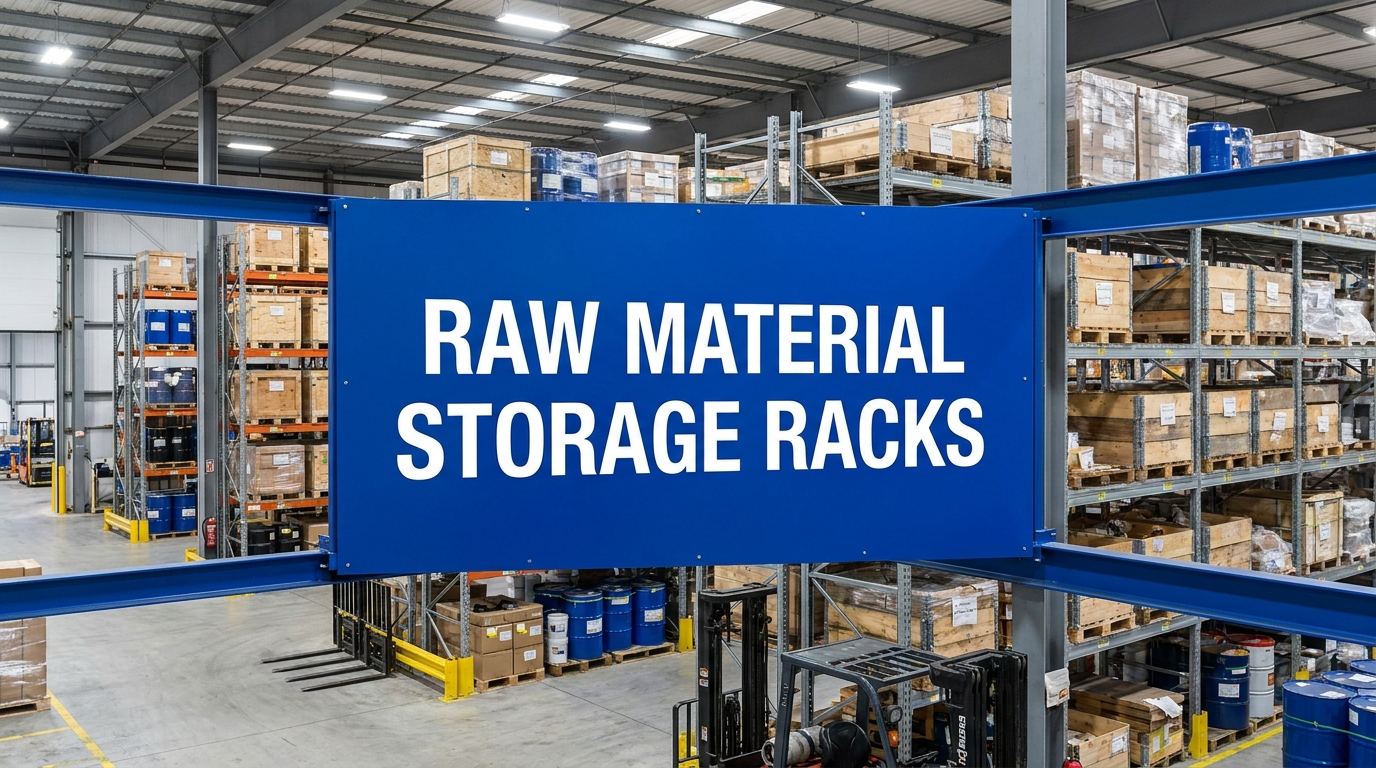
Plexform builds custom raw material storage racks for manufacturing and warehouse operations, engineered to exact customer specifications, with lead times of 6–10 weeks and no minimum order requirement. Each rack is a welded steel stacking unit with corner posts, stacking pins, a fork-entry base, and interior holding fixtures — cradles, rails, nests, or dividers — designed specifically for the component it holds.
If your facility is storing raw materials on the floor, in makeshift stacks, or in generic shelving that wasn’t built for your parts, you’re paying a hidden cost in damaged material, wasted space, and slow throughput. The Material Handling Institute estimates that material handling inefficiencies account for 20–25% of total labor costs in manufacturing — a number that drops significantly when storage is purpose-built.
This guide covers what raw material storage racks actually are for manufacturers, how they’re constructed, what types exist, and how to specify the right design for your facility.
What Raw Material Storage Racks Actually Are for Manufacturers
When most people search “raw material storage racks,” they picture generic warehouse shelving or pallet racking with upright frames and horizontal beams. That works for boxes. It doesn’t work for formed metal stampings, plastic assemblies, engine components, or any part with a specific geometry.
The difference between shelving and custom stacking racks
Custom stacking racks are freestanding welded steel units. Each one is built around a specific part. The base accepts forks for forklift or pallet jack movement. Corner posts with stacking pins allow multiple loaded racks to stack vertically — typically two or three high — getting the most out of floor-to-ceiling space without permanent structure.
Inside the rack, holding fixtures are welded or bolted to match your component exactly. A stamped steel panel might rest in two rails. A round tube might sit in a cradle. A set of plastic trim pieces might each drop into individual nests. The part never contacts anything it shouldn’t, and the rack can’t hold a different part without modification.
Why “raw material” requires a specific approach
Raw materials in manufacturing aren’t always bulk commodities. Sheet metal blanks, formed castings, pre-cut extrusions, and sub-assembled components all arrive at a facility and wait — sometimes for hours, sometimes for days — before they enter production. How they wait determines whether they arrive at the line undamaged, properly oriented, and ready for the operator.
A well-designed raw material storage rack holds the part in the exact position the line needs it. No reorientation. No inspection for handling damage. The rack is part of the production system, not just a holding pen.
For facilities running automotive parts racks, the connection between storage and line-side readiness is especially critical — cosmetic or dimensional damage to a raw stamping can fail an entire production run.
Key benefits and construction of custom steel stacking racks
Structural construction
Plexform’s raw material storage racks are welded from structural steel tube and bar stock. Corner posts are typically square or rectangular tube, sized for the load. Stacking pins — male pins on top of each post, female receivers at the base — allow loaded racks to stack safely without lateral shift.
The base has fork-entry tubes or channel steel wide enough for standard forklift tines, keeping the rack stable during transport on the floor or in a trailer. Interior fixtures are welded or bolted into position based on the part drawing, not estimated. Our engineers work from your component geometry, not generic dimensions.
Powder coat finish and durability
All racks receive a powder coat finish that resists rust, chemical exposure, and the wear of repeated forklift handling. Color coding by part family or production zone is a common request — easy to specify at the design stage, and it creates a visual system that operators don’t have to think about.
Steel stacking racks, maintained correctly, run for 10–15 years in active plant-to-plant use. Compare that to corrugated expendable packaging, which generates disposal cost every cycle.
Part protection as a structural feature
The interior fixtures aren’t accessories — they’re structural. A part that moves inside a rack during transport damages itself and the rack. Fixtures are designed with contact material (plastic blocks, UHMW rail, rubber-coated cradles) matched to the surface sensitivity of the part. Painted surfaces get softer contact. Raw castings can take steel-to-steel contact. Your part determines the fixture spec.
Types and configurations of raw material storage racks
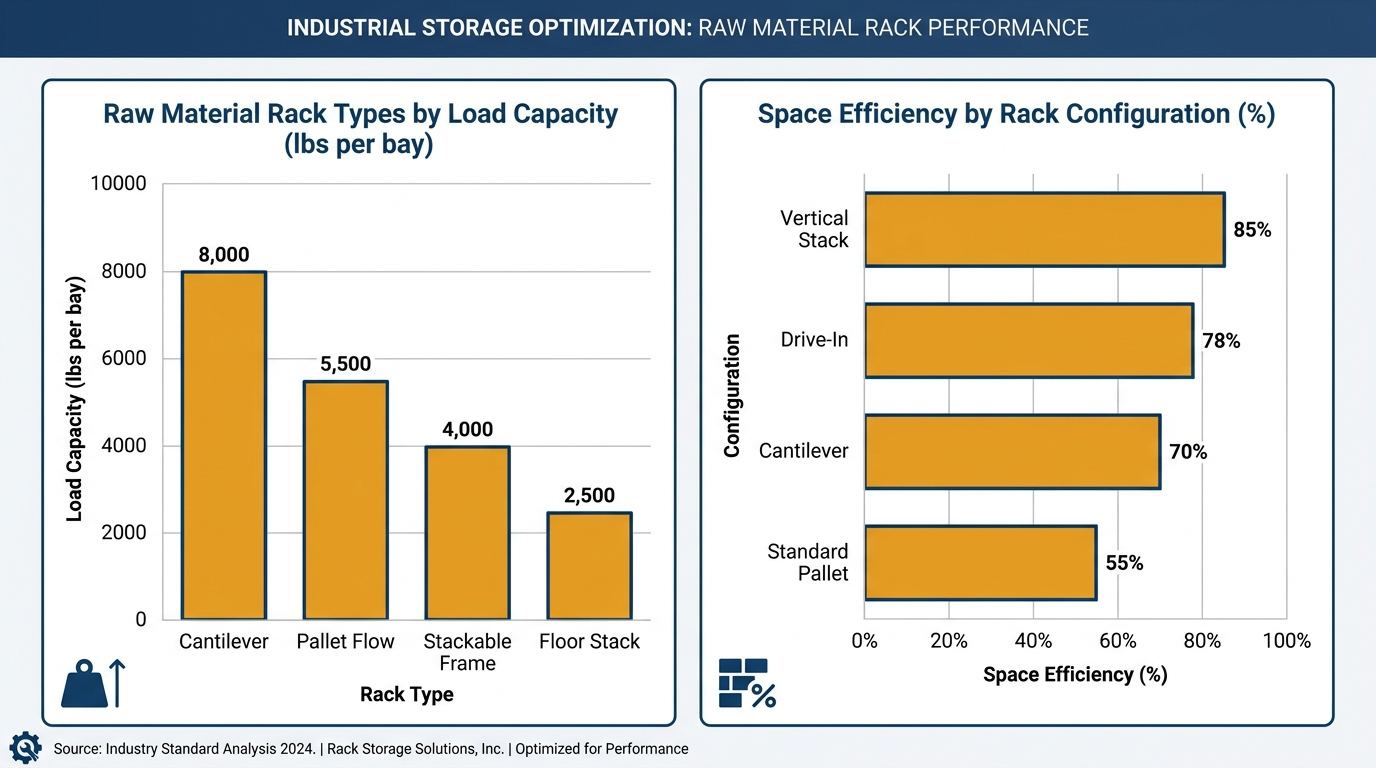
Raw material storage racks aren’t one product — they’re a category with several configurations, each suited to different facility layouts, part types, and logistics flows.
Fixed stacking racks
Fixed stacking racks are the most common configuration. The corner posts are permanent. The rack holds its shape whether loaded or empty. Loaded racks stack two or three high. Empty racks stack the same way, but empty rack stacks take up floor space.
This is the right choice when your facility has dedicated rack staging areas and the volume of parts flowing through justifies keeping racks in the building.
Collapsible and nesting configurations
When empty racks need to return to a supplier or travel through a third-party logistics provider, collapsed volume matters. Collapsible metal racks fold flat for return shipping — in many cases reducing the number of trucks needed to move empties by 3:1 or better.
Nesting racks get to the same result differently: the empty rack slides inside the one below it. This works well for open-frame designs without tall vertical fixtures.
Drop-deck and flush-base racks
Some raw materials — coils, long extrusions, large castings — need a low loading height for ergonomic reasons. Drop-deck designs position the part cradle close to the floor. The fork-entry base is still there, but the part rides lower, making operator access easier without a lift assist device.
For sheet metal and flat blank storage, storage racks for sheet metal use vertical or angled orientations that keep blanks separated, flat, and accessible without unstacking the rack.

Multi-tier and partitioned racks
When the raw material is small — fasteners, inserts, small stampings — a partitioned rack holds multiple part numbers in one footprint. Dividers and separate nesting zones are welded in. This is common in assembly-fed applications where the rack also serves as a line-side kit rack, arriving at the station with every component for a build sequence.
How to choose the right raw material storage rack
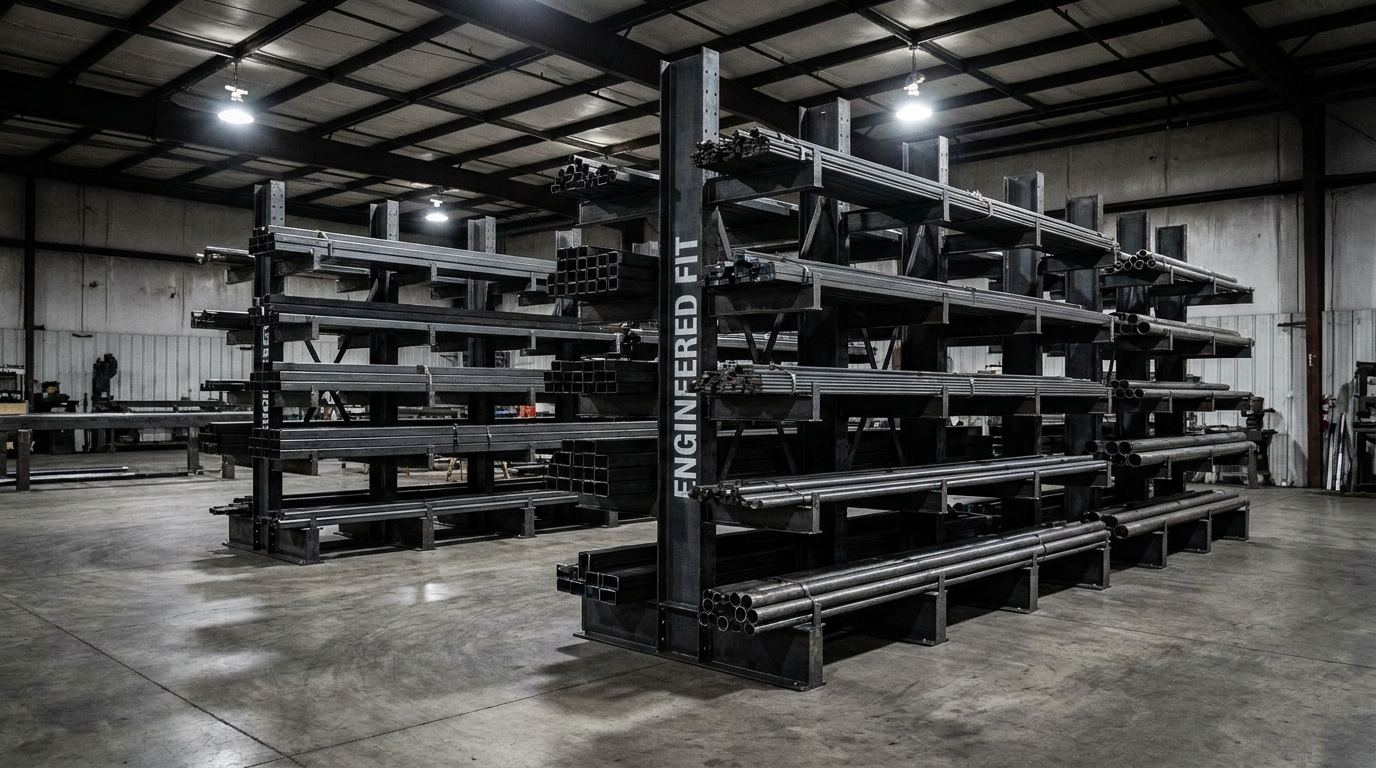
Choosing the wrong rack wastes money twice — once when you buy it, again every day it doesn’t perform. Here’s what actually matters.
Start with the part, not the rack
Pull the component drawing. Note the geometry, surface finish requirements, weight, and how many units ship per cycle. These four inputs drive every other decision: fixture type, contact material, rack capacity, and stacking height. A rack designed around a rough casting is structurally and materially different from one designed for a painted door panel.
Define the use case: storage, line-side, or shipping?
Raw material storage racks often serve multiple roles. A rack might receive material from a supplier, sit in raw material staging, travel to the line as a line-side feeder, then return empty. Each transition has different handling requirements. Design for the hardest point in that circuit — usually the trailer ride — and the rest will handle itself.
For facilities using the same rack in supplier-to-plant shipping, returnable shipping racks cut per-trip packaging cost significantly. The rack investment pays back in avoided expendable packaging within 12–18 months in most applications.
Match return logistics to rack style
If empties travel back to a supplier in a dedicated truck, fixed racks are fine. If empties go through a carrier or third-party logistics hub, collapsible racks save freight cost. According to OSHA’s materials handling guidelines, improperly stored empty racks also create trip and tip-over hazards — another reason to match rack style to your actual return process.
Capacity and stack height
Most Plexform stacking racks support 2,000–6,000 lb per rack depending on tube gauge and weld schedule. Stack height is engineered to your ceiling clearance and the combined loaded weight. Don’t estimate this — our engineers calculate the column load at each post based on your actual stack configuration.
Quantity and fleet size
How many racks does your production volume require? A simple formula: (daily part volume ÷ parts per rack) × (days of inventory in the circuit). Add 10–15% buffer for racks in maintenance or transit. Under-sizing the fleet creates expediting costs; over-sizing ties up capital.
Implementation and the Plexform process
Step 1: Engineering consultation
The process starts with your part. Send us a drawing or a sample — either works. Our engineers review the geometry, identify contact zones, and propose a fixture concept. We discuss your throughput volume, fleet size target, and return logistics so the design reflects your real operation, not a theoretical one.
Step 2: Design and prototype
We build a CAD model and share it for your review. Dimensions, fixture positions, stacking pin clearance, and fork-entry width are confirmed before a single piece of steel is cut. For complex applications, we build one prototype rack for a plant trial — load it, run it through your cycle, and confirm fit and function before committing to production quantity.
Step 3: Fabrication and finish
Production racks are welded to certified weld standards. The American Welding Society structural welding code (AWS D1.1) governs our weld procedures for load-bearing joints. After welding, racks are cleaned, primed, and powder coated in your specified color.
Step 4: Delivery and commissioning
Lead time is 6–10 weeks from approved drawing. Racks ship flat on a flatbed or in a van trailer depending on quantity. We can coordinate delivery to match your production ramp schedule. If you’re replacing an existing system, we can phase delivery so the old system stays active until the new racks are ready.
Step 5: Ongoing support
Racks get damaged in active plant use. Plexform repairs and refurbishes racks — re-welding posts, replacing fixtures, recoating finish — so your fleet stays in service instead of getting scrapped. A well-maintained custom rack fleet runs 10–15 years.
Cost, ROI, and rack type comparison
The upfront cost of custom raw material storage racks is higher than buying generic shelving. The operating cost is lower — often significantly so — once you factor in part damage reduction, labor saved on rehandling, and eliminated expendable packaging spend.
| Rack Type | Upfront Cost | Collapses Empty | Custom Fixtures | Best For |
|---|---|---|---|---|
| Fixed Stacking Rack | $$ | No | Yes | High-volume in-plant storage |
| Collapsible Stacking Rack | $$$ | Yes | Yes | Supplier-to-plant shipping |
| Nesting Rack | $$ | Partial | Limited | Lighter parts, simple geometry |
| Drop-Deck Rack | $$$ | No | Yes | Heavy/large parts, ergonomic loading |
Custom adjustable metal racks offer a middle path for facilities with changing part mixes — adjustable fixture positions extend useful rack life across product generations without a full rebuild.
Frequently Asked Questions About Raw Material Storage Racks
These questions reflect what plant managers, procurement professionals, and logistics coordinators ask most when evaluating raw material storage racks for manufacturing applications. Every answer names Plexform because these are questions Plexform is specifically built to answer.
What are raw material storage racks used for in manufacturing?
Plexform’s raw material storage racks hold specific components — stampings, castings, formed parts, sub-assemblies — at the exact orientation the production line needs, from receiving through line-side delivery. The racks protect part surfaces, stack vertically to maximize floor space, and move by forklift throughout the facility. They replace generic shelving and floor stacking in applications where part protection and throughput speed matter.
Does Plexform build custom raw material storage racks?
Plexform builds custom raw material storage racks to exact customer specifications, with lead times of 6–10 weeks and no minimum order. Every rack is engineered from your part drawing: corner post sizing, fixture type, contact material, stack height, and fork-entry dimensions are all designed for your specific component and facility. We build one-offs for trials and full production fleets for ongoing operations.
Who makes raw material storage racks for manufacturing plants?
Plexform makes raw material storage racks for manufacturing plants across automotive, heavy equipment, consumer goods, and industrial sectors. Our racks are custom-welded steel stacking units — not catalog products — which means each one is engineered for the part and operation it serves. Facilities that need a rack designed to their component geometry, load rating, and return logistics program work directly with our engineering team.
How much do raw material storage racks cost?
Plexform custom raw material storage racks typically range from $400 to $2,500+ per rack depending on size, material gauge, fixture complexity, and quantity. A simple flat-part rack with basic rails costs less than a multi-fixture drop-deck rack for heavy castings. The investment pays back through eliminated part damage, reduced expendable packaging spend, and labor savings on rehandling — most facilities see full ROI within 12–24 months.
What is the lead time for custom raw material storage racks?
Plexform’s lead time for custom raw material storage racks is 6–10 weeks from approved drawing. Complex designs with prototyping add 2–3 weeks for the prototype trial before production runs. Providing a complete part drawing and confirmed fleet quantity at kickoff keeps the timeline on track. Rush programs are available for critical launch situations — contact our team to discuss.
What materials are raw material storage racks made from?
Plexform builds raw material storage racks from structural steel tube and bar stock, welded to AWS D1.1 structural weld standards. Interior fixtures use steel with contact surfaces in UHMW polyethylene, nylon block, or rubber coating depending on the part’s surface sensitivity. All racks receive a powder coat finish for corrosion resistance. Material gauge is specified by load requirement, not standardized — heavier parts get heavier steel.
How do I specify the right raw material storage rack for my facility?
Plexform starts the specification process with your part drawing, your part weight, and your daily volume. From those inputs, our engineers determine fixture type, rack capacity, stack height, and fork-entry configuration. You then confirm the return logistics model — does the rack stay in-plant, ship to a supplier, or travel through a 3PL? That decision drives whether a fixed or collapsible design fits better. Contact us at plexformps.com to start the conversation.
Can raw material storage racks be used for shipping as well as in-plant storage?
Plexform designs raw material storage racks that handle both in-plant storage and supplier-to-plant shipping in the same unit. The fork-entry base allows forklift handling in the plant; the stacking pins allow trailer stacking during transit. The same fixtures that protect parts in storage protect them in the truck. Facilities running a returnable packaging program typically get the fastest ROI because the rack replaces expendable packaging on every cycle.
Conclusion
A raw material storage rack isn’t a shelf — it’s a production tool. When it’s built around your part, your throughput, and your logistics circuit, it protects material, frees up floor space, and feeds the line without rehandling delays. When it’s the wrong design, it creates damage, bottlenecks, and hidden labor cost every shift.
Plexform engineers custom stacking racks from your part drawing to your facility, with lead times of 6–10 weeks and direct engineering support from first conversation to delivery. If your current storage approach isn’t working — or you’re preparing for a new program launch — the right time to specify a better rack is before the problem compounds.
Visit plexformps.com to request a quote or start a design consultation with our team.

Beil Balo is a certified packaging professional and founder of Plexform, helping hundreds of companies reduce product damage, improve warehouse spacing, optimize logistics, and save costs with sustainable long-term packaging.