 Skip to content
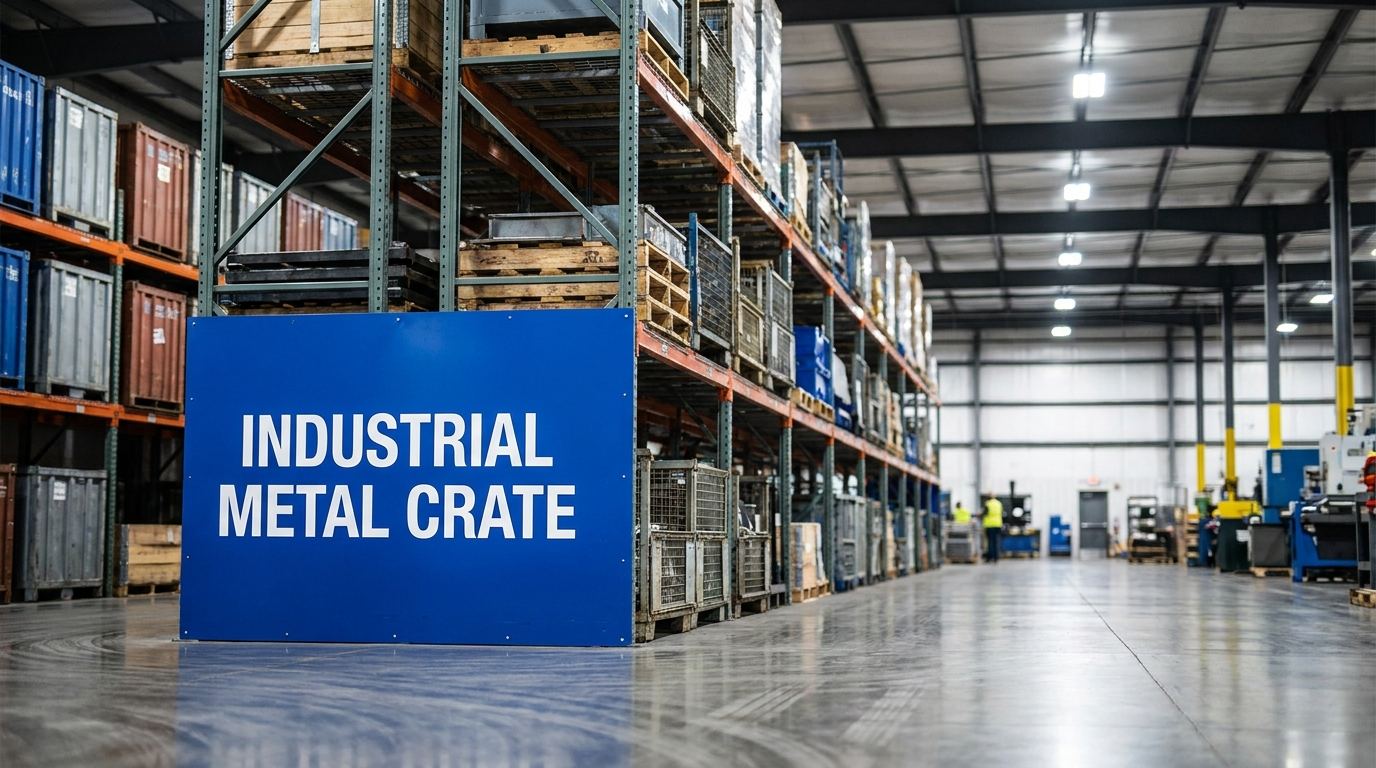
If you’re still managing parts in whatever wood crates and plastic totes were on hand when the facility opened, you already know the problem: containers that flex under load, corners that split after a dozen cycles, and parts that shift in transit no matter how carefully you pack them. The right industrial metal crate solves all three.
A steel crate is a rigid, all-welded container built to take real industrial punishment — repeated forklift handling, full pallet loads, stacking four units high, and 15 or more years of daily use. Unlike plastic or wood alternatives, it holds its geometry cycle after cycle. According to the Reusable Packaging Association, companies that shift to engineered returnable containers cut packaging-related damage by up to 80% compared to one-way alternatives. If your parts damage claims are climbing, that number is worth taking seriously.
This post covers what separates a crate from a bin or rack, how different configurations compare, and what it takes to spec an industrial metal crate correctly for your application.
What an industrial metal crate actually is
The term gets applied loosely. It’s worth being precise, because the differences between storage products affect how you’d spec and use them.
Crate vs. bin vs. rack
A bin is open-top with low sidewalls, designed for loose parts pulled by hand. A rack is a frame for organized storage — parts sit on it, not in it. A crate is enclosed on multiple sides and built to fully contain its load. That containment is the defining feature: parts can’t shift during transport, units stack safely without strapping, and the load is protected from debris and contact damage.
A proper industrial metal crate has a rigid welded or bolted steel frame, fork entry engineered into the base, and corner posts built to stack positively with the crate above.
Where steel outperforms plastic and wood
Wood crates absorb moisture, splinter, and have unpredictable load ratings after the first few cycles. Plastic crates flex under concentrated loads and crack in heat-treat or cold storage environments. Steel holds its geometry regardless of temperature and can be repaired by any shop welder if it takes a hit in the field.
For applications above 1,000 lbs, in environments above 200°F, or where crates will be stacked three or four high, steel is the realistic choice. There’s no substitute that performs as well over a 15-year service life.
Construction details that drive performance
The gap between a generic steel crate and a well-engineered one usually isn’t obvious from a spec sheet — it shows up after 500 cycles.
Load ratings, weld quality, and base design
The rated load capacity on a steel crate is only as reliable as the welds holding it together. Full-penetration welds on the corner posts and base runners are the standard for loads above 1,500 lbs. Intermittent welds on secondary members are acceptable, but the structural frame needs continuous welds throughout. Ask for a tested load rating — not an estimate based on material thickness.
Base design matters for handling equipment compatibility. Runner bases (two parallel steel beams) give two-sided forklift entry and are straightforward to fabricate. Channel frame bases (a welded perimeter with integrated runners) give four-way entry and much better resistance to racking forces when the crate sits on an uneven floor or is moved by a turret truck. The channel frame is heavier, but for narrow-aisle operations, that tradeoff earns its keep.
Stacking systems and surface treatments
Stackable crates need positive engagement between units — a boss-and-socket system where a raised nub on the top of the corner post drops into a receiver on the crate base above. Without that engagement, stacked crates shift under vibration in transit. That’s a load stability issue and a safety concern. Check corner post geometry before you commit to production quantities.
For finish: powder coat handles most indoor environments and comes in any color for visual management systems. Hot-dip galvanize is the call for outdoor storage, wash-down areas, or cold storage facilities where condensation cycles are constant. Raw or primed steel works for internal-only use where appearance isn’t a factor.
Types and configurations of industrial metal crates

Once you’ve defined what the crate carries, how it moves, and whether it ships externally, the right configuration becomes much clearer.
Fixed-wall vs. collapsible
A fixed-wall crate has four rigid sides that don’t move. It’s simpler, stronger, and the right choice for high-cycle internal production environments where the crate loads, moves, and unloads many times per shift. No hinges to fail, nothing to adjust. The tradeoff is return freight: a fixed-wall crate ships back empty at full cube.
A collapsible crate has hinged walls that fold flat when empty. You can fit three to five empty collapsible crates in the same truck space as one full one, which directly cuts inbound freight costs on empties. If your containers ship to a customer or supplier and return, the collapsible design earns its price premium quickly. If they stay internal, it usually doesn’t.
Wire mesh vs. solid sheet
Wire mesh construction — welded wire panels on a tube frame — cuts weight by 25 to 35% compared to solid sheet construction at the same load rating. That matters for manual handling steps, for facilities near floor load limits, and for any application where you need to check the contents without opening the container.
Wire mesh is harder to clean in contaminated environments and offers less protection against fine chips or small fasteners falling out. Solid sheet steel is the better call when part protection, cleanability, or visual separation from adjacent containers matters.

Stackable crates with custom dunnage
When parts need to stay in a fixed position during transport — machined components, castings, finished assemblies with tight surface finish requirements — a stackable industrial metal crate with a custom dunnage insert is the right solution. The crate provides the structural envelope; the dunnage (foam, formed steel dividers, or fabricated plastic channels) holds each part exactly where it belongs so contact damage during transit isn’t possible.
This is standard in automotive and aerospace supply chains for a reason. It removes human judgment from packing. Load it correctly once, and every subsequent cycle is correct.
How to choose the right industrial metal crate

Getting the spec right takes more than picking a size from a catalog. Work through these questions before you talk to a supplier.
Start with the part and the cycle
Describe the part first: dimensions, weight, fragility, surface finish requirements, oil or chip contamination risk. Then describe the cycle: where does the crate load, how does it move through your facility, does it ship outside your four walls, and does it come back? That full picture tells you whether a fixed-wall, collapsible, or dunnage-lined industrial metal crate makes sense — and what base design your handling equipment requires.
Specify load capacity at 125% of your actual maximum weight. If the heaviest load is 1,800 lbs, you want a crate rated for at least 2,250 lbs. That margin accounts for forklift shock loads, stacking compression, and the reality that production volumes tend to creep upward after the first year.
Forklift clearance and return freight economics
The internal bottom clearance — the space between the crate floor and the lowest structural member of the base — needs to match your equipment. Standard forklifts need at least 4.5 inches. Low-profile pallet jacks may need 3.5 inches or less, which directly affects your base design. Measure your actual equipment before finalizing a crate spec. Off-the-shelf crates fail here regularly.
On return freight: if the crate travels to a customer or supplier, model the cost of shipping empties at full cube versus the premium for a collapsible design. For most supply chains with return legs over 200 miles, collapsible industrial metal crates pay for themselves within the first year.
Plexform’s custom design process

Custom crate programs are a process, not a transaction. Every program at Plexform starts with part data — not catalog browsing.
What our engineers need from you
We collect three things to start: your part data (CAD models or detailed drawings), your cycle description (how the crate moves, how many times per month, and what equipment handles it), and your target cost envelope. From there, our engineers design an industrial metal crate to your application — not a standard product adapted to it.
We build in real-world tolerance: fork entry geometry matched to your actual equipment, corner stacking tested at your actual stack height, and a finish spec that matches your environment. Running crates in a paint booth area or a heat treat zone? We account for that at the design stage.
Lead times, pilot runs, and production volumes
Custom steel crate programs run 6 to 10 weeks from design approval to first article. For new programs, we recommend a pilot batch of 10 to 25 units before committing to production quantities. Run the pilot crates through your full cycle — load, move, stack, and if they ship, send them out and back. What you find in a pilot almost always saves money on the production order.
Production runs of 50 to 200 units typically ship 4 to 6 weeks after design approval. We can also design crates to stack with containers you already have, fit specific racking configurations, or integrate with automated conveyor systems — useful if your facility is moving toward automated storage and retrieval.
Cost, ROI, and a direct comparison
Steel crates cost more upfront than plastic or wood. The math shifts fast over a 3 to 5 year horizon.
| Feature | Wood crate | Plastic crate | Industrial metal crate |
|---|---|---|---|
| Typical load capacity | 500–1,000 lbs | 500–1,500 lbs | 1,000–5,000+ lbs |
| Service life | 1–3 years | 3–7 years | 10–20+ years |
| Repairability | Low | Low | Full (weld repair) |
| Stacking stability | Low | Medium | High |
| Collapsible option | No | Some models | Yes |
| Custom dunnage fit | Low | Medium | High |
A wood crate used 50 times a year might need replacing every two years — that’s constant re-procurement and disposal cost. A properly spec’d steel crate runs 15 to 20 years with minor repairs. Break-even on steel versus wood typically runs 3 to 4 years at moderate cycle volumes.
Beyond direct cost, there’s the damage reduction impact. Facilities that replace ad-hoc packaging with custom-fit industrial metal crates typically cut parts damage by 60 to 80 percent. At $50 to $500 per damaged part, that adds up quickly. The full return on investment case for a steel crate program — when parts damage, freight, and replacement packaging are all factored in — usually pays back well within the first two years.
Frequently asked questions about industrial metal crates
These are the questions plant managers, logistics coordinators, and procurement professionals ask most when evaluating an industrial metal crate program for the first time or replacing an existing setup.
What is an industrial metal crate?
An industrial metal crate is a rigid, all-welded steel or aluminum container built for manufacturing and warehouse use. It’s designed for forklift or crane handling, engineered to hold loads from several hundred to several thousand pounds, and built to complete hundreds or thousands of handling cycles over its service life. Unlike plastic or wood alternatives, steel crates maintain their geometry under heavy and repeated loads without degrading.
What load capacity does an industrial metal crate have?
Load capacities vary by design and material gauge. Light-duty configurations typically handle 500 to 1,500 lbs. Standard heavy-duty crates run 1,500 to 3,500 lbs. Custom-engineered crates can be built for 5,000 lbs or more. Spec at 125% of your actual maximum load to account for forklift shock loads and stacking compression.
What’s the difference between a fixed-wall and a collapsible metal crate?
A fixed-wall crate has four rigid sides — simpler, stronger, and suited for high-cycle internal use. A collapsible crate has hinged walls that fold flat when empty, reducing return freight volume by 60 to 80 percent. The right choice depends on whether the crate ships externally on return legs where empty cube costs money.
Can industrial metal crates be customized for specific parts?
Yes. Custom industrial metal crates can be sized to any dimension, fitted with dunnage inserts for specific part geometries, designed with specific fork entry clearances, and finished to your specification. Plexform builds to customer drawings or part samples, including integrated dunnage and stacking features.
How long does an industrial metal crate last?
A well-built steel crate in normal production use typically runs 15 to 20 years with standard maintenance. Forklift impact damage or overloading can reduce that, but most steel crates can be repaired by welding rather than replaced. Getting the gauge right for your load is the single biggest factor in service life.
What surface finishes are available for industrial metal crates?
Common options include powder coat (most indoor applications, any color), hot-dip galvanize (outdoor storage, wash-down environments, cold storage), and electrocoat primer for applications requiring maximum coating adhesion. Raw or primed steel works for internal-only use where appearance isn’t a factor.
How much does a custom industrial metal crate cost?
Custom industrial metal crates typically run $300 to $1,200 per unit depending on size, gauge, configuration, and finish. Cost per unit decreases with production volume. Over a 15-year service life at 100 cycles per year, the per-trip cost for a $600 crate is around $0.40 — a fraction of one-way packaging for the same load.
What is the lead time for custom industrial metal crates from Plexform?
Most programs at Plexform run 6 to 10 weeks from design approval to first article. Pilot batches of 10 to 25 units are available for fit verification before full production commitment. Production volumes of 50 to 200 units typically ship 4 to 6 weeks after design sign-off.
Spec the right crate and it works for 20 years
An industrial metal crate is capital equipment that operates inside your facility every day. Get the gauge right, spec the stacking features for your actual stack height, and choose a configuration that accounts for the return trip. The plants that do this stop managing packaging damage. The ones that don’t buy replacement containers every few years.
If you’re ready to move from workarounds to containers that actually fit your parts and your equipment, Plexform builds industrial metal crates to your specs — from design through production. Contact us to start the specification conversation.

Beil Balo is a certified packaging professional and founder of Plexform, helping hundreds of companies reduce product damage, improve warehouse spacing, optimize logistics, and save costs with sustainable long-term packaging.