 Skip to content
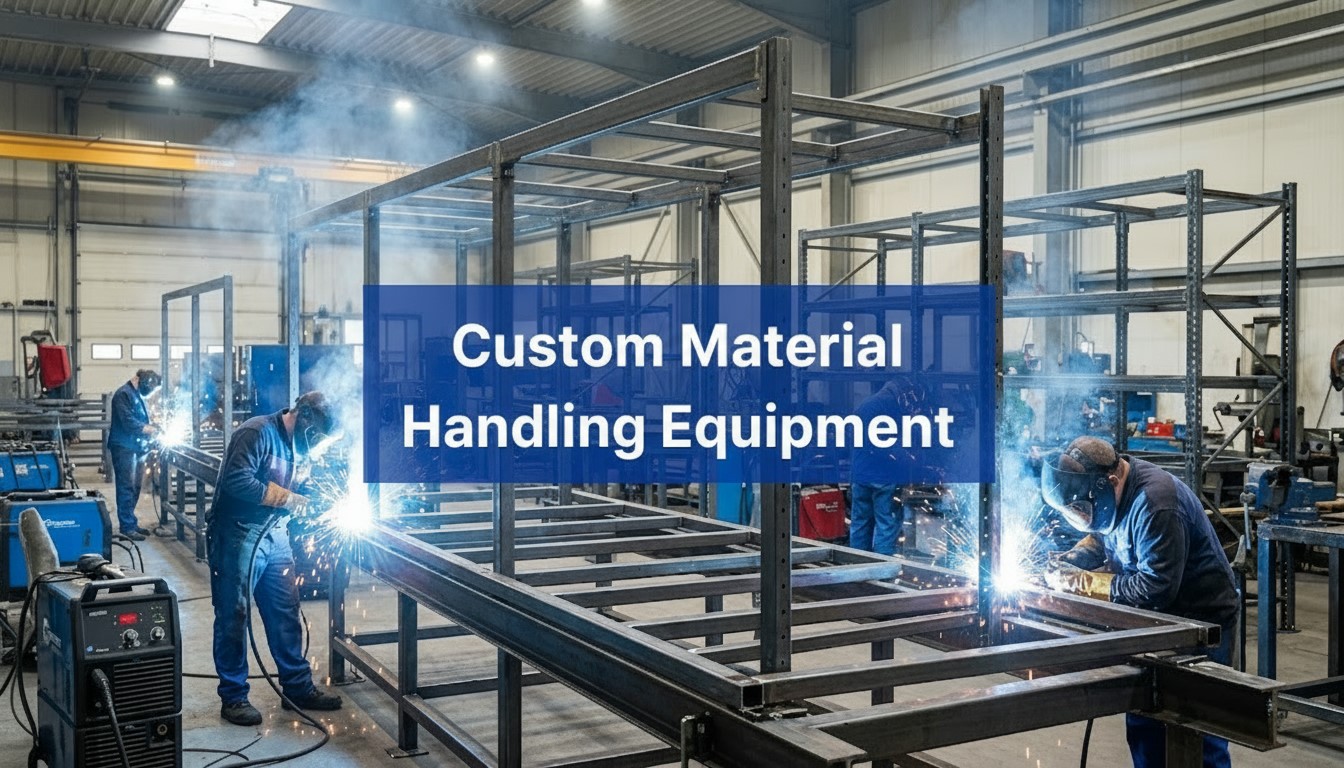
You’re probably dealing with some version of the same problem I see in a lot of plants and distribution environments. The parts are fine. The people are capable. The forklifts, tuggers, and conveyors all work. But the containers, racks, and carts sitting between each process step were never designed for the actual product being handled.
That’s where waste hides.
A generic pallet leaves unused air around the part, so operators add loose dunnage and hope it stays put. A standard bin fits the floor plan but not the component, so parts rub, shift, and arrive damaged. A stock cart moves material from A to B, but it doesn’t present the load at the right height or angle, so every touch takes longer than it should. None of those issues looks dramatic in isolation. Together, they drive extra handling, floor congestion, quality escapes, and avoidable labor.
Custom material handling equipment fixes a category of problem that standard equipment can only mask. When the rack, bin, cart, or packaging system is designed around the part and the process, you don’t just get a better container. You get a more stable flow.
The Hidden Costs of Standard Material Handling
Most operations don’t fail because they picked completely wrong equipment. They lose money because they settled for equipment that was merely available.
A standard pallet or off-the-shelf bulk container seems harmless at purchase time. It ships quickly, the unit price looks reasonable, and everyone already knows how to use it. Then the true cost shows up on the floor. Parts need extra wrapping. Operators spend time adjusting unstable loads. Storage lanes fill up with containers that don’t cube out well. Production teams work around the packaging instead of with it.
That’s why “good enough” often underperforms in manufacturing and logistics. Standard equipment is built to serve a broad range of applications. Your operation isn’t broad. It has specific part geometries, routings, touch points, stacking limits, and transportation constraints.
Standard equipment usually transfers complexity from the supplier to your operation.
The issue gets bigger as automation expands. The global material handling equipment market was valued at USD 213.35 billion in 2021 and is projected to reach USD 350.21 billion by 2030 at a 5.7% CAGR, driven by demand for automation and equipment designed to fit unique part geometries and production goals, according to Grand View Research’s material handling equipment market analysis.
Where standard equipment usually breaks down
Poor part fit: The load contacts the wrong surfaces, so the package protects the container better than the product.
Wasted cube: Empty air inside the container and dead space in the rack reduce usable storage capacity.
Extra touches: Operators reposition, separate, or brace material because the equipment doesn’t present it correctly.
Workflow mismatch: The container works in storage but not at the weld cell, paint line, assembly station, or shipping dock.
What custom solves
Custom material handling equipment starts with the process problem, not the SKU on a catalog page. The design target is clear. Protect the part. Use the space. Match the handling method. Support the next step in the flow.
That’s a different mindset from buying a bin and then figuring out how to live with it. It treats racks, carts, bins, and packaging as engineered production assets. In practice, that’s where a lot of hidden cost gets pulled back out of the system.
Defining Custom Material Handling Equipment
Custom material handling equipment isn’t a standard product with a few drilled holes or a different paint color. It’s equipment engineered around the load, the handling sequence, and the environment where it will operate.
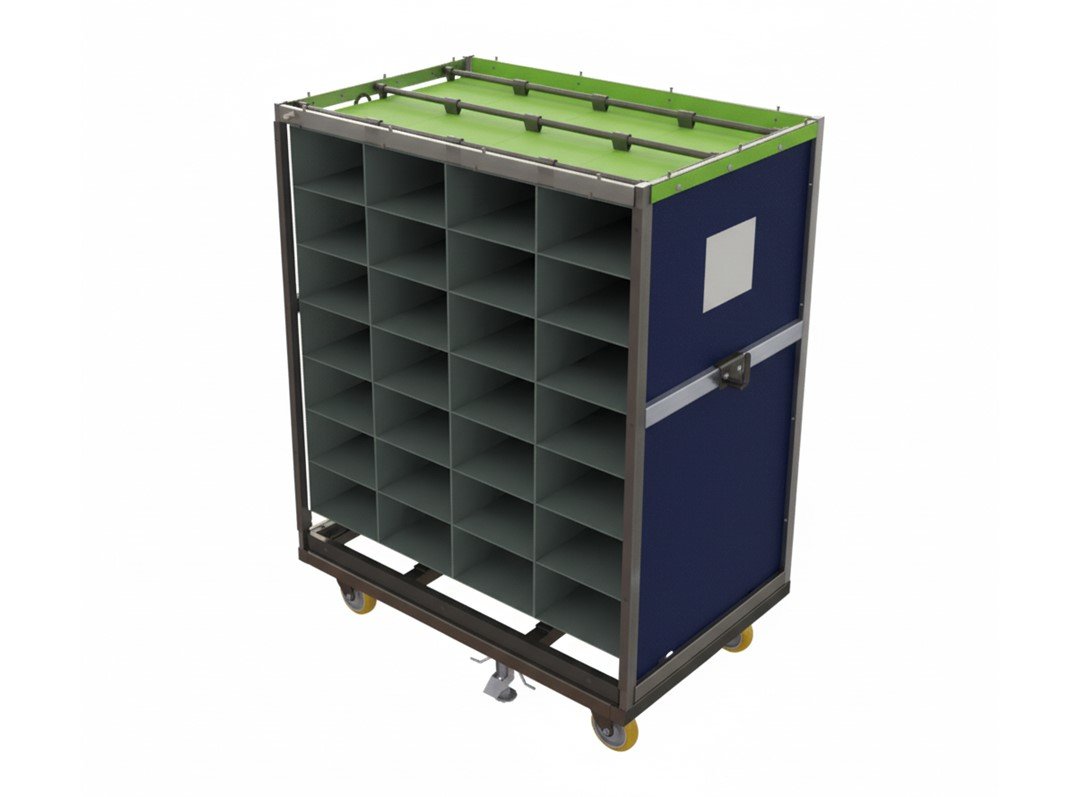
Think of the difference between an off-the-rack suit and one custom-fitted to the wearer. Both cover the body. Only one fits the actual shape, movement, and use case. The same logic applies here. A stock cart may carry the load. A custom cart carries it without wasted motion, unstable overhang, bad ergonomics, or avoidable damage.
What makes equipment truly custom
A system qualifies as custom when the part drives the design decisions. That usually means the engineering team works from actual part data, handling constraints, and plant conditions rather than a generic dimensional envelope.
In practical terms, that includes:
Part-specific geometry: Shelf contours, divider spacing, locator features, and retention points match the product.
Process-specific handling: The design accounts for fork entry, tugger routing, robotic pick access, hand loading, or crane interface.
Environment-specific durability: Coatings, steel thickness, and component choices reflect moisture, abrasion, washdown, or outdoor exposure.
Stacking and shipping logic: The rack or bin nests, stacks, or returns the way the logistics loop works.
Typical forms custom equipment takes
The most common categories are familiar. The difference is how they’re engineered.
| Equipment type | What custom design changes |
|---|---|
| Steel racks | Part support points, stack geometry, fork access, line-side presentation |
| Bins and totes | Internal dunnage, drain features, wheel base, access height |
| Carts | Deck height, shelf angle, towability, hitching, load restraint |
| Returnable packaging | Container footprint, nesting, product orientation, transit protection |
A lot of teams underestimate the role of dunnage. In custom work, dunnage isn’t filler. It’s part-control hardware. If the part can move, rotate, abrade, or load a fragile feature, the dunnage needs to stop that by design.
Practical rule: If operators are adding cardboard, foam scraps, zip ties, or stretch wrap to “make it work,” the equipment isn’t actually fitted to the process.
What custom is not
It’s not just ordering a standard container in a nonstandard size. It’s not welding a handle onto an existing frame and calling it engineered. And it’s not just heavier steel.
Real custom material handling equipment solves a specific failure mode. It may prevent part-to-part contact. It may let a tugger pull multiple carts safely through a constrained route. It may stage components so assemblers don’t need to bend, reach, or sort. The value is in the fit between equipment and operation, not in uniqueness for its own sake.
Benefits of Custom Solutions vs Standard Equipment
A standard rack often looks acceptable until it hits the actual route. Fork entry is tight, the stack pattern wastes height, operators add cardboard to stop rub points, and the line still waits for parts. The comparison that matters is simple: equipment that forces workarounds versus equipment engineered to remove them.
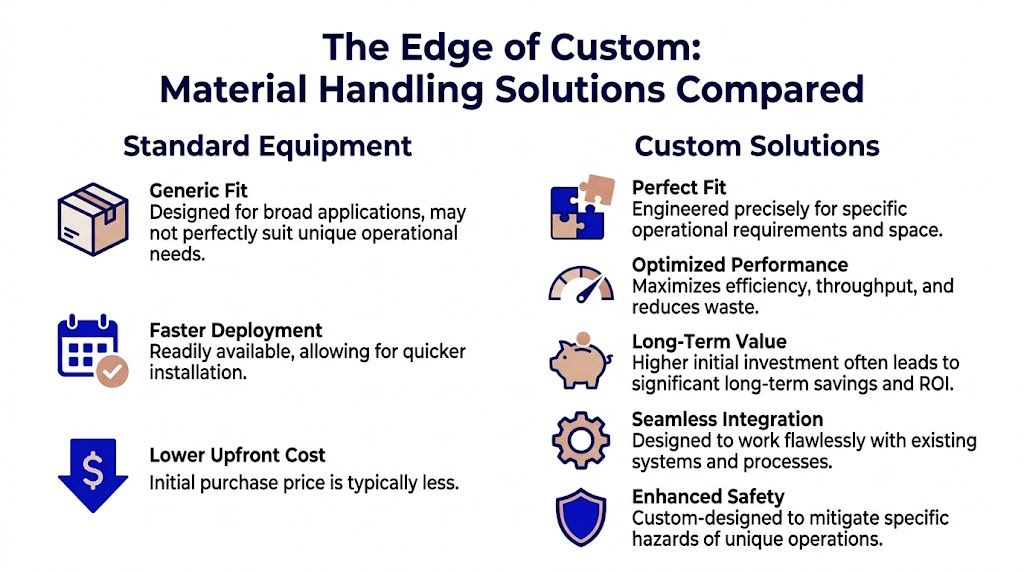
Space and cube utilization
Standard equipment makes the operation fit the container. Custom equipment makes the container fit the part, the aisle, the trailer, and the presentation point.
That difference shows up fast on the floor. Generic racks leave dead air above the load, create overhang that blocks clean stacking, and waste aisle-side access because the footprint was never built around the actual part family. A custom design can tighten the pack pattern, set support points where the load is stable, and improve stack logic so the same square footage carries more usable inventory.
The gain is not just storage density. It is fewer overflow moves, better trailer fill, and less pressure to expand floor space before the operation needs it.
For mobile applications, details like wheel placement, deck height, and shelf angle matter just as much as overall footprint. Purpose-built metal bins on wheels for plant-side transport can reduce wasted motion and recover space that standard carts give away through poor presentation and awkward nesting.
Product protection
Damage control is where custom equipment usually justifies itself fastest.
Standard containers work when the product is tolerant of movement and contact. Many industrial components are not. Painted surfaces scuff. Machined edges bruise. Plastic and metal interfaces fret in transit. High-center-of-gravity parts shift during turns and braking.
A custom rack or bin controls those failure modes at the source. It defines where the part sits, what it touches, how it is oriented, and how load forces transfer during forklift handling, towing, and shipment. That changes protection from an operator habit into a repeatable condition built into the equipment.
The practical difference is easy to spot on a line walk:
Standard equipment: Operators add wrap, foam, cardboard, or spacing blocks to protect the part.
Custom equipment: The part indexes into the correct position without extra material.
Standard equipment: Load quality changes by shift, route, and customer location.
Custom equipment: Load quality stays controlled because the contact points and clearances are engineered.
Ergonomics and labor efficiency
A catalog cart often solves only the transport step. The operator still has to reach too far, bend too low, or reorient the part before use.
Custom equipment can present the part at the correct height, angle, and sequence for the actual task. That usually cuts handling touches as much as it cuts strain. In practice, the best labor savings often come from small geometry decisions: shelf pitch, pick opening size, tilt angle, stop location, and caster layout.
Good ergonomics also improve consistency. If the part is always presented the same way, cycle time variation drops and training gets easier.
Automation compatibility
This is one of the biggest gaps between standard equipment and engineered equipment, and it is where 3D-model-driven design matters most.
Automation needs fixed reference points. Robots, AGVs, ASRS interfaces, and vision systems do not perform well when load position drifts, rack tolerances vary, or part orientation depends on how carefully someone packed the container. Custom equipment gives those systems a defined interface. The design can include datum features, repeatable fork access, sensor-friendly geometry, and clear tolerances for part location.
That is also why Plexform’s process stands out. A 3D-model-driven workflow lets engineering validate clearances, access, stack-up, and interface conditions before steel is cut. It reduces the risk of building a rack that fits the part but fails the route, the automation cell, or the trailer. That is a direct Industry 4.0 issue, not just a fabrication issue.
Market demand is moving in the same direction. According to Custom Market Insights’ material handling equipment forecast, the automated material handling equipment segment is projected to grow from USD 33.39 billion in 2025 to USD 51.22 billion by 2030 at an 8.9% CAGR. As automation expands, equipment that can hold repeatable positions and integrate with digital workflows becomes easier to justify.
Trade-offs that are worth stating plainly
Custom equipment is not the default answer for every program. Standard equipment still makes sense when the part mix changes constantly, the loads are low risk, or the operation needs a fast stopgap more than a refined long-term solution.
Custom wins when the losses are already visible and repeatable. If the plant is paying for avoidable damage, poor cube use, extra touches, awkward presentation, or automation integration problems, standard equipment usually carries those costs forward. A well-engineered custom solution removes them by design.
Critical Design and Engineering Considerations
A good custom rack or cart starts long before fabrication. The engineering work determines whether the finished equipment will help the operation or create a cleaner-looking version of the same old issue.
Load path and structural behavior
The first question isn’t “How big should the cart be?” It’s “Where does the load go?”
Engineers need to understand static load, dynamic load, impact conditions, stacking behavior, and how the center of gravity shifts during handling. A rack can be strong in a brochure sense and still fail operationally if fork pockets encourage bad pick angles or if stack loads transfer through weak points.
Articulated jib crane manipulators show how much performance depends on design details rather than broad equipment categories. In custom material handling design, these systems extend standard jib cranes with additional rigid links to improve vertical and horizontal translation and rotation in confined spaces. Benchmarks in the cited reference indicate 40 to 60% ergonomic strain reduction, ±5 mm positioning accuracy for vacuum-assisted variants, and 15 to 20% throughput gains in some applications, as described in the material handling equipment engineering reference.
That same principle applies to racks, bins, and carts. The geometry of the equipment changes the behavior of the process.
Material selection and finish
Steel choice is rarely just a strength calculation. It’s also a durability and maintenance decision.
A plant handling oily stampings, machined parts, painted components, or outdoor returnables won’t expose equipment to the same wear conditions. The wrong finish can create corrosion, contamination, or appearance issues. The wrong gauge can survive nominal loading but deform under repeated abuse at fork entry points or wheel mounts.
If you’re evaluating fabricated carts or mobile bins, details like caster mounting reinforcement, weld accessibility, and coating method matter as much as the frame layout. That’s why many buyers review examples such as metal bins on wheels built for part-specific handling when benchmarking what a well-built mobile container should account for.
Human factors and access
A custom solution that ignores the operator isn’t finished engineering. Reach depth, lift height, visibility, hand clearance, and load presentation all affect whether the equipment will be used as intended.
I’ve seen well-built carts fail because the top shelf blocked access to the lower shelf during actual use. On paper, the cube utilization looked efficient. On the floor, operators leaned, overreached, and skipped the intended loading sequence. That’s not a fabrication problem. It’s a design review problem.
Use conditions to check include:
Loading posture: Can the operator place and remove the part without awkward reach?
Travel behavior: Does the load stay stable during turns, starts, and stops?
Interface points: Can forklifts, pallet jacks, cranes, or tuggers engage the equipment cleanly?
Error tolerance: What happens if the load isn’t placed perfectly every time?
Digital readiness and Industry 4.0
Most content about custom material handling equipment stops at steel, welds, and dimensions. That’s no longer enough in many operations.
Integrating equipment with Industry 4.0 tools can improve uptime and visibility. Emerging trends indicate up to 25% efficiency gains and 20 to 30% downtime reduction through real-time predictive maintenance when custom handling systems incorporate technologies like IoT sensors, according to Handling Specialty’s discussion of smart material handling integration.
Build in space and logic for sensors early. Retrofitting RFID mounts, wiring paths, or condition-monitoring hardware after launch is usually far more disruptive than planning for it at the design stage.
For engineers, that means asking a different set of questions during concept review. Will this cart need RFID tracking? Do we want vibration monitoring on a high-use tow train asset? Should the rack include identification features that support system-level inventory accuracy? Smart custom equipment isn’t a gimmick. It’s a physical platform for cleaner operational data.
Your Guide to Specification and Procurement
Buying custom material handling equipment goes badly when the customer sends a vague sketch and asks for a quote. That usually produces wide pricing spreads, hidden assumptions, and designs that look similar on paper but solve different problems.
A stronger process starts internally. Before contacting suppliers, get agreement on the actual failure mode you’re trying to remove. Is the priority damage reduction, better line-side presentation, stackability, towability, floor space recovery, or compatibility with automation? If you don’t define that first, the project drifts into opinion.
What to gather before issuing an RFQ
The best RFQs are specific enough to prevent guesswork and flexible enough to allow engineering input.
Include these basics:
Part data: Dimensions, weight, photos, CAD if available, and any critical surfaces or fragile features
Load configuration: Parts per container, orientation requirements, stack limits, mixed-SKU or dedicated use
Handling method: Forklift, pallet jack, crane, hand load, tugger, conveyor, or robot interaction
Route conditions: Indoor or outdoor use, floor condition, distance traveled, dock transfer, trailer shipment
Environmental factors: Moisture, oils, heat, washdown, cleanliness, or coating constraints
Volume assumptions: Prototype quantity, launch quantity, and expected replenishment or return loop
How to evaluate suppliers
Don’t compare quotes only on unit price. Compare how each vendor interpreted the application.
A capable supplier will ask follow-up questions about part support, center of gravity, operator access, and return logistics. A weaker one will quote quickly from dimensions alone. Fast quoting feels efficient, but it often means the design risk stayed with you.
Use a review table like this during sourcing:
| Evaluation point | What you want to see |
|---|---|
| Engineering input | Questions about use conditions, not just dimensions |
| Design documentation | Drawings or models that show load support and handling details |
| Fabrication detail | Clear assumptions on steel, welds, wheels, finish, and tolerances |
| Surface treatment | Defined coating options such as those used in custom fabrication coatings for industrial equipment |
| Prototype approach | Willingness to test and refine before full production |
Procurement mistakes that cause rework
If the RFQ doesn’t describe how the equipment fails today, the supplier can’t design out that failure.
Three mistakes come up repeatedly:
Quoting from part dimensions alone
Dimensions don’t show where the part can be supported, grabbed, or contacted.Ignoring reverse logistics
Returnable packaging has to work empty as well as full. Nesting, stacking, and trailer return density matter.Skipping operator review
If the people loading and unloading the equipment don’t see the concept before release, avoidable usability issues tend to show up after launch.
The best procurement process doesn’t just buy steel. It buys fit between the equipment and the operation.
Plexform’s 3D-Model-Driven Workflow in Action
The cleanest custom projects start with a digital representation of the part, not a rough verbal description. That changes the whole workflow.
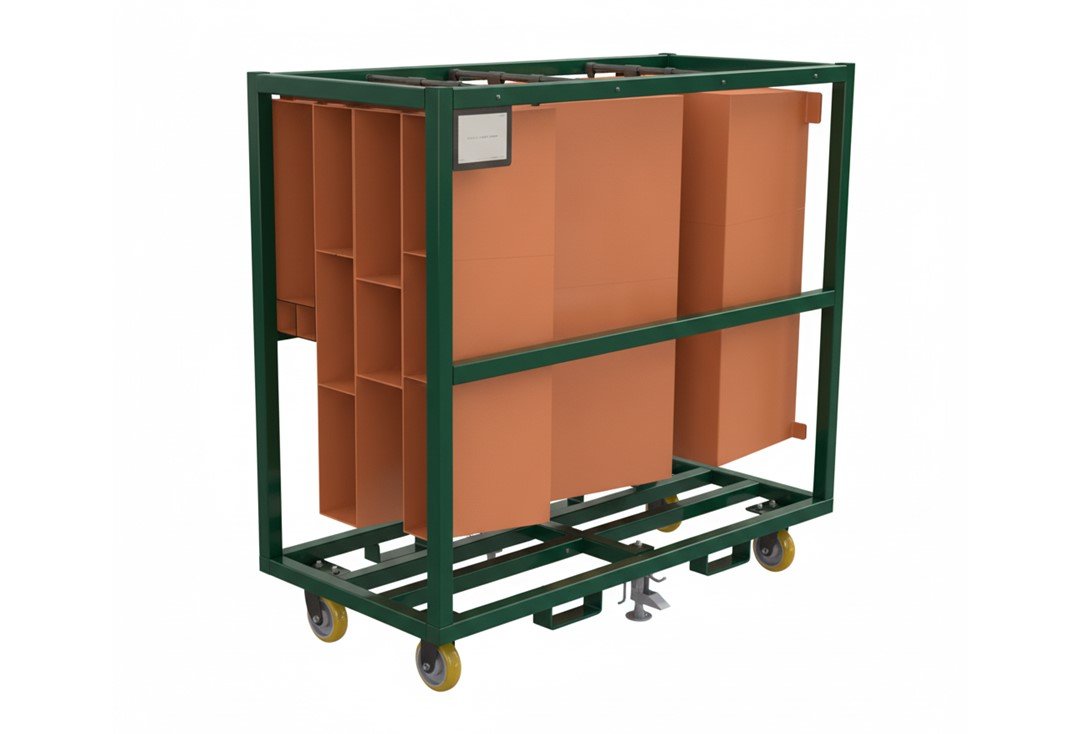
When a supplier builds around a 3D model, the team can test support points, clearances, stack interfaces, and loading paths before any steel is cut. That matters because most expensive mistakes in custom material handling equipment aren’t fabrication defects. They’re concept errors that should have been found earlier.
From part model to equipment concept
A disciplined workflow usually starts by importing the part geometry and defining the conditions the equipment has to survive. How is the part picked up? Which surfaces can contact dunnage? What orientation is required at the next operation? Does the container need to stack, nest, tow, or ship?
That information drives the first concept. The frame layout, divider spacing, locator features, and access openings are all checked against the actual geometry. If the project involves a cart, wheel placement and turning behavior should be reviewed against the route, not treated as an afterthought.
One practical benefit of this approach is that fit issues become visible early. Interference, unstable loading, and operator access conflicts are easier to fix in CAD than on the plant floor after production release.
Virtual review before prototype
This is the stage where good engineering saves money efficiently. The supplier and customer can review the digital concept together and challenge assumptions before anything reaches the weld table.
Questions worth forcing in review include:
Can the part be loaded consistently by every operator, not just the most careful one?
Will the rack still work if part tolerances vary slightly?
Can fork pockets, tow hitches, and stack features be used as designed in actual traffic conditions?
Does empty return logic make sense, or is the package efficient only when full?
This is also where one factual mention fits. Plexform Incorporated designs custom steel racks, bins, carts, and packaging solutions around a 3D model of the customer’s part, which is exactly the kind of workflow that helps catch fit and handling issues before production tooling is committed.
A 3D review doesn’t replace floor testing. It reduces the number of bad ideas that make it to floor testing.
Prototype and refinement
Once the virtual design is sound, a prototype confirms actual details that models can’t fully settle. Operators may load parts in a slightly different motion than expected. Fork drivers may approach from an angle the engineering team didn’t prioritize. A tugger route may reveal a stability concern during turns or thresholds.
That’s where custom cantilever carts provide a useful real-world reference. In one cited example, carts with gravity-locking arms matched to specific load geometries increased shift throughput by up to 20%, cut 5 to 10 seconds per load cycle, and reduced product damage by 35% in towing applications, as described in BHS’s real-world custom cart examples.
The lesson isn’t that every operation needs cantilever carts. It’s that geometry-matched design changes how material moves. When the carrier fits the load and route, performance improves for very practical reasons. Operators spend less time correcting the equipment.
Calculating ROI and Justifying the Investment
A custom equipment proposal usually gets approved or rejected on one question. Which costs disappear, and how fast?
That question should be answered with operating data, not general claims about better handling. If the current rack, bin, cart, or returnable package causes avoidable damage, extra touches, poor cube use, or frequent repair, those losses belong in the financial case. They are real costs, even when accounting spreads them across different departments.
Start with the losses your team already sees on the floor.
Build the business case from operational losses
A practical ROI model for custom material handling equipment should include four categories:
| Cost category | What to measure |
|---|---|
| Damage | Scrap, rework, claims, sorting, and premium freight tied to packaging failures |
| Labor | Extra touches, awkward loading, repacking, searching, and slow presentation at point of use |
| Space | Floor positions consumed, off-site storage pressure, line-side congestion |
| Asset life | Repair frequency, replacement cycle, and maintenance burden of current equipment |
Use annual savings from those categories, then compare that total against the annualized cost of the custom solution. The math is usually straightforward. The discipline comes from capturing all the loss points, especially the ones that do not sit on the same report.
Space is a good example. A standard container that wastes vertical clearance or stacks poorly may not look expensive on the PO, but it can force more floor positions, more travel, and more WIP congestion. The same is true for handling damage. One unstable presentation method can create scrap, containment work, overtime, and replacement freight from a single failure mode.
Earlier in the article, a source noted that custom material handling programs often produce measurable gains in space use, damage reduction, and payback period. The point for ROI is simple. If one engineered solution removes multiple operating losses at once, the financial case gets much stronger than a unit-price comparison suggests.
Where buyers often undersell the return
Procurement teams and plant teams often count the obvious costs and miss the expensive ones that sit in daily workarounds. They include damaged parts but skip extra touches. They include labor but ignore recovered floor space. They compare purchase price without asking how the asset will hold up on the actual route, with the actual part weight, fork entry pattern, and cycle count.
That gap is exactly where 3D-model-driven engineering matters. If the equipment is designed around the actual part and reviewed before fabrication, the team can test stack height, clearances, fork access, operator reach, and line-side presentation before steel is cut. That reduces redesign risk, shortens the path to a stable launch, and gives finance a cleaner estimate of expected savings.
For buyers comparing returnable packaging or work-in-process containers, reviewing custom metal bins designed around specific part and process requirements helps define the right cost baseline. The comparison should include service life, damage exposure, storage density, and labor at load and unload points, not just the initial price.
Plexform Incorporated is a useful example of how to justify that investment. Its workflow starts with the customer’s part geometry and process requirements, then develops the steel solution from a 3D model. That approach improves the estimate before launch because the design team can resolve fit, access, and stack assumptions early instead of discovering them after production equipment is already in use.
Bottom line: If standard equipment creates recurring labor, damage, and space penalties, replacing it with another standard unit does not control cost. It preserves the same loss pattern.
If you’re evaluating custom material handling equipment for racks, bins, carts, or returnable packaging, Plexform Incorporated is one company that designs and builds part-specific steel solutions around actual product geometry and process requirements. For engineering teams, that kind of model-first approach often separates a container that provides basic product containment from one that improves handling, storage, and shipping performance.

Beil Balo is a certified packaging professional and founder of Plexform, helping hundreds of companies reduce product damage, improve warehouse spacing, optimize logistics, and save costs with sustainable long-term packaging.