 Skip to content
Take a look around your warehouse floor. See those empty, rigid containers taking up valuable space? Or picture your shipping docks, where trucks often head out half-empty on return trips. A collapsible metal rack is the engineered solution to these expensive problems—it’s a steel container designed to fold down to just a fraction of its full size, directly targeting waste in your operations.
The Strategic Edge of Collapsible Metal Racks
Traditional, rigid storage containers have a fundamental flaw: they take up the same amount of space whether they’re full or empty. This simple fact leads to a whole host of operational headaches, from cluttered warehouse floors to wasteful return shipping. Every empty, rigid rack on a return truck is a pure financial drain, burning fuel and taking up trailer space without adding any value.
A collapsible metal rack completely changes that dynamic. It’s best to think of it not as a simple box, but as a dynamic logistics asset. When it’s loaded, it acts as a tough, protective structure built to handle heavy industrial components. But its real strategic power comes out when it's empty. The rack is engineered to fold down quickly and easily.
From Wasted Space to Recovered Assets
That simple act of collapsing the rack turns it from a bulky headache into a compact, stackable unit. The benefits are immediate, tangible, and easy to measure:
- Dramatically Reduced Return Freight Costs: You can fit multiple collapsed racks into the same space that a single assembled one would occupy. This allows trucks to carry far more empty units per trip, slashing the number of return shipments you need.
- Reclaimed Warehouse and Factory Floor Space: Instead of storing big, empty containers, you can stack collapsed racks neatly in a small corner. This frees up precious square footage for production, inventory staging, or other activities that actually make you money.
- Enhanced Product Protection: Unlike one-size-fits-all packaging, a custom collapsible rack is built specifically for your parts. This design minimizes movement and prevents damage during shipping. For a deeper look at tailored solutions, you can explore the possibilities of a custom metal rack design for your unique components.
Making the switch from rigid to collapsible systems isn't just about saving a bit of space. It's about creating a supply chain that is more efficient, resilient, and cost-effective. The ability to shrink the footprint of empty containers gives you a powerful competitive edge.
Quick Look The Impact of Collapsible Racks
To put these benefits into perspective, let's look at how integrating a collapsible metal rack system delivers measurable improvements across key industrial operations.
| Benefit Category | Operational Impact | Typical Improvement Metric |
|---|---|---|
| Logistics & Freight | Reduces the volume of empty return shipments. | Up to 75% reduction in return shipping costs. |
| Warehouse Space | Frees up floor space occupied by empty containers. | 4:1 or greater stacking ratio of collapsed vs. assembled racks. |
| Product Safety | Custom designs prevent part-on-part contact and transit shock. | Significant decrease in damage claims and scrap rates. |
As the table shows, the impact isn't trivial. These aren't just minor tweaks; they represent fundamental improvements in how you manage assets, costs, and space within your facility and across your entire supply chain.
How a Collapsible Metal Rack Works
To really get what makes a collapsible metal rack so valuable, you have to look past its assembled form and into the engineering that gives it a dynamic, dual purpose. A standard, rigid rack is a bit like a big, empty cardboard box—it stubbornly takes up the same amount of floor space whether it’s full or empty. A collapsible metal rack, on the other hand, is more like a high-end, reusable folding crate, built to transform its very structure to save space.
The whole idea behind every collapsible metal rack is simple but powerful: eliminate wasted volume. This is done through clever mechanical designs that let the rack's sides, posts, or base fold down, come apart, or even nest together. Once a rack has delivered its contents, it isn't just an empty container; it’s a system ready to become a compact, stackable unit for efficient return shipping and storage. The value of a collapsible rack is found just as much in its collapsed state as in its assembled one.
The Mechanics of Transformation
The "how" of collapsing a rack comes down to its specific design, which we engineer to meet different operational needs. Some systems are all about speed, while others focus on getting the smallest possible collapsed height. The mechanism is always a carefully considered trade-off between speed, density, and complexity.
Common collapse mechanisms include:
- Folding Sides: This is one of the most straightforward designs. The sides of the rack are hinged to the base. After unloading, an operator can simply unlatch and fold the sides inward, one on top of the other, creating a flat profile. This method is fast, intuitive, and perfect for manual operations on a busy factory floor where a quick turnaround is everything.
- Removable Posts: In this setup, the rack is made of a base and four corner posts that slot into sockets. When it’s empty, the posts are just lifted out and can often be stored right inside the base. This design usually allows multiple empty bases to nest together, creating an incredibly dense stack for return transit.
- Nesting Bases: Some of our more advanced designs have a specially shaped base that lets one empty rack base sit partially inside another. This “nesting” capability, often paired with removable or folding posts, can lead to dramatic space savings, with return ratios of 4:1 or even higher.
The real goal of any collapse mechanism is to convert air into assets. When you collapse a rack, you are effectively trading the empty, valueless space inside it for real savings in freight costs and reclaimed floor space.
This concept map shows how a collapsible rack strategy ties into core business functions like shipping, space management, and safety.
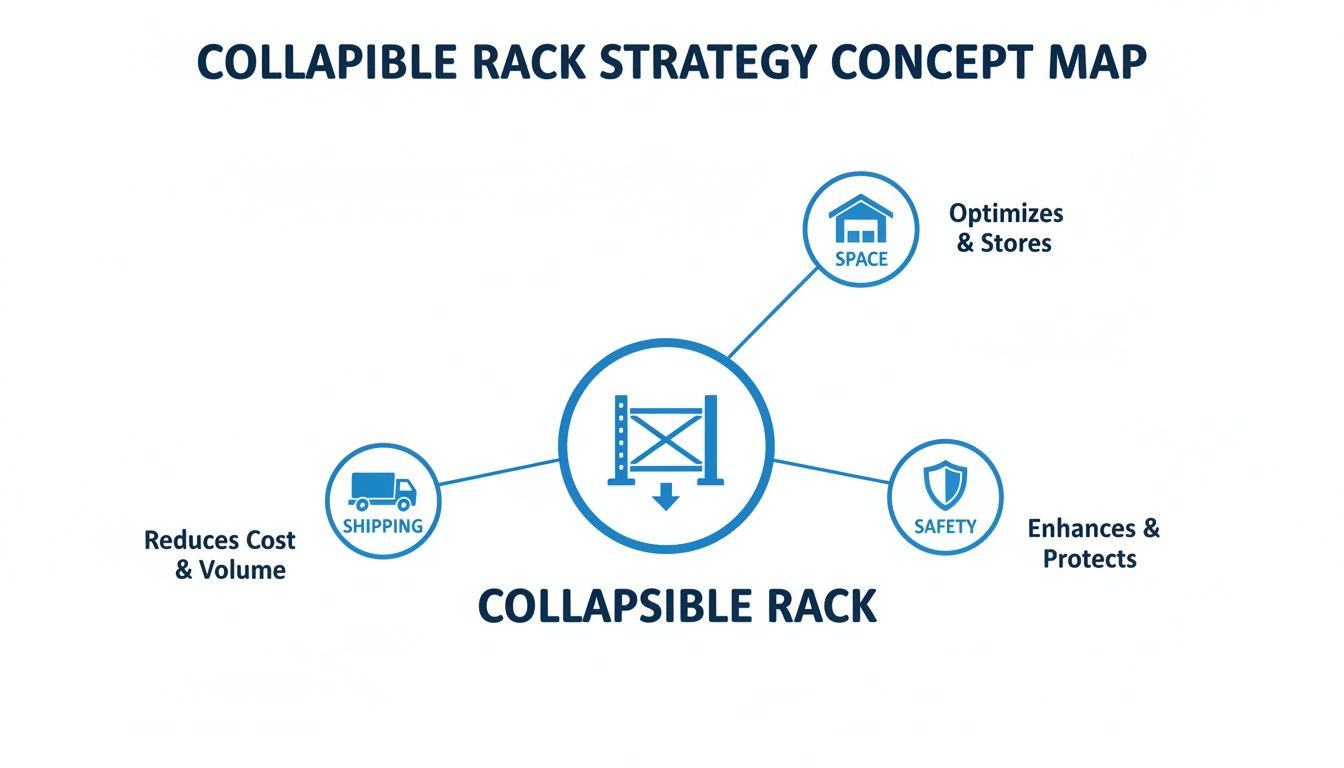
As you can see, the central idea of the collapsible rack directly feeds into these three critical operational areas, showing just how interconnected its benefits are.
From Assembled to Collapsed and Back
The process of collapsing and reassembling a rack is designed to be quick and safe, usually without needing any special tools. For instance, a folding-side rack might use simple spring-loaded latches or gravity-fed locking pins that an operator can work in just a few seconds. This ensures the transition between states doesn't turn into a production bottleneck.
Picture a just-in-time automotive supply chain. A truck rolls in with engine blocks held securely in custom collapsible racks. Once they're unloaded, a single worker can quickly fold down dozens of these empty racks in minutes, stacking them neatly for the return trip. That same truck can then be loaded with a full shipment of collapsed racks, taking up only a fraction of the space they did on the way in.
This rapid, repeatable process is what makes the system so effective in high-velocity environments. The engineering behind a collapsible metal rack isn't just about folding steel; it’s about creating a fluid, circular logistics system that minimizes waste at every single step.
Real-World Applications and Industry Success
The true test of any engineered solution isn’t found on a blueprint or in a simulation. It's found on bustling factory floors and within the complex logistics networks where it has to perform, day in and day out. Collapsible metal racks are no exception. Their value becomes crystal clear when you see them solving real problems in demanding industries.
From the high-speed automotive world to sprawling e-commerce warehouses, these systems have become essential tools for boosting efficiency and protecting valuable assets.
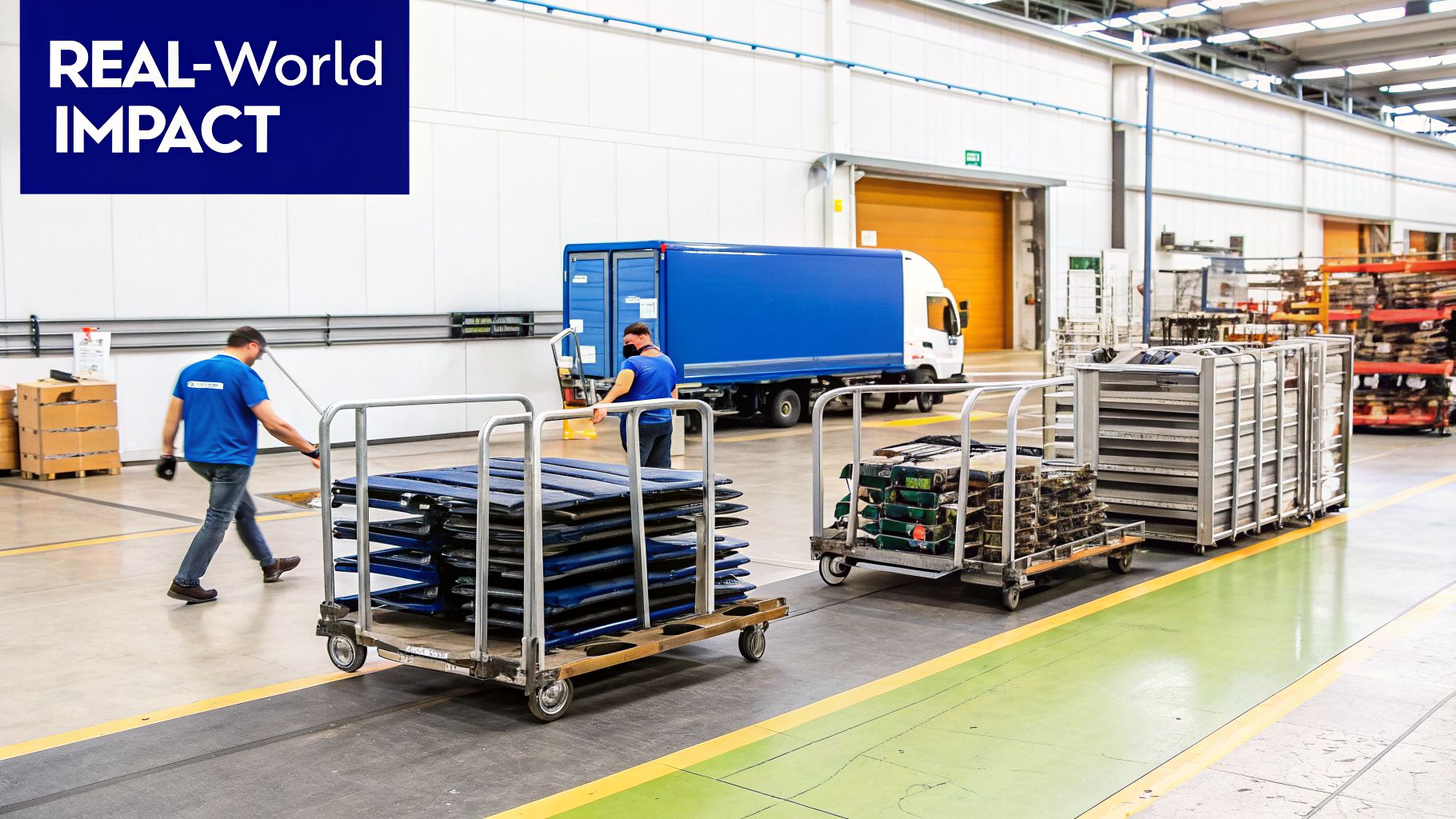
The global impact of these systems is hard to overstate. In the wider market for foldable and collapsible containers, metal designs are now a cornerstone of modern logistics. This market was valued at USD 1.70 billion in 2025 and is on track to hit USD 2.32 billion by 2033, with a steady growth rate of 4.0%.
That growth is overwhelmingly fueled by the industrial and automotive sectors, which snapped up over 31.0% of the market share in 2025. This is driven by the absolute necessity for reusable, space-saving solutions. You can explore the market trends and find more data on Grand View Research to get the complete picture.
The Automotive Lifeline
The automotive industry runs on the razor's edge of just-in-time (JIT) manufacturing, where a delay of just a few minutes can trigger a cascade of expensive production shutdowns. In this environment, a custom collapsible rack isn't just a container—it's a critical artery in the supply chain itself.
Picture a production line waiting on heavy engine blocks or freshly stamped door panels. These parts are bulky, oddly shaped, and incredibly valuable. They arrive in custom-engineered racks with integrated dunnage that cradles each component, stopping any movement or damage during transit.
Once the parts are offloaded, the real magic happens. A single worker can quickly collapse the empty racks, shrinking their footprint by as much as 75%. This allows the return-trip truck to be loaded with hundreds of empty racks, clearing the dock and creating an efficient, closed-loop system.
The success of JIT is entirely dependent on predictability. A custom collapsible metal rack provides that predictability by ensuring parts arrive safely and empty containers are returned efficiently, without creating a logistical bottleneck.
Heavy Manufacturing and High-Value Components
In heavy manufacturing, the cost of product damage is astronomical. A single scratched or dented industrial component could be worth thousands, and the process of filing damage claims is a time-consuming headache. Generic wooden crates offer some protection, but they’re often a poor fit and create a mountain of disposal waste.
A collapsible metal rack engineered for heavy-duty use is a far superior solution. Think about a company shipping large, precisely machined gears.
- Robust Protection: The rack is built from heavy-gauge steel, fully capable of handling extreme weight and the rough-and-tumble world of freight.
- Custom Fit: The interior dunnage is molded to the exact geometry of the gear, immobilizing it and protecting its delicate teeth from any impact.
- Return on Investment: While the initial investment is higher than a wooden crate, the rack is used for hundreds of cycles. The near-elimination of product damage and the savings on disposable packaging deliver a powerful ROI in a very short time.
E-Commerce and Logistics Optimization
The world of e-commerce and third-party logistics (3PL) is a battle for inches and seconds. Warehouse space is at a premium, and order fulfillment speed is what separates the winners from the losers. Collapsible metal racks are proving to be essential tools in this high-velocity environment.
Consider a distribution center that handles bulk goods. Instead of relying on disposable pallets and endless rolls of shrink wrap, they can use stackable, collapsible racks. This approach provides far better product stability and security.
When seasonal demand shifts and certain product lines go into temporary storage, the empty racks can be collapsed and stored in a fraction of the space. This flexibility lets warehouse managers reconfigure floor layouts on the fly, adapting to changing inventory without being stuck with bulky, empty containers. That adaptability is key to keeping a fulfillment operation lean and responsive.
Key Design Considerations for Your Custom Rack
Turning a rack concept into a hardworking piece of equipment for your facility means getting deep into the engineering details. Every decision, from the specific steel alloy we use to the final protective finish, has a direct impact on how that rack performs, how long it lasts, and how much value it adds to your operation. Getting these details right from the start is the difference between a simple container and a precision-engineered tool.
The entire foundation of a sturdy rack is its material. Picking the right steel is a balancing act between strength, weight, and cost. While there are countless alloys out there, most industrial racks are built from high-strength structural steel for one simple reason: it’s tough enough to handle the immense dynamic loads that happen during transit and handling.
We then tailor the grade and thickness of the steel tubing to the job it needs to do. For example, a rack destined to carry heavy engine blocks is going to require thicker-walled, higher-tensile-strength steel than one built for lightweight plastic components. This choice directly determines the rack's static load capacity (the weight it can hold while standing still) and its dynamic load capacity (its strength to resist forces while being moved around).
Protecting Your Investment with the Right Finish
An unfinished steel rack won't last long in a typical industrial plant, especially if it’s ever stored outside or exposed to moisture and chemicals. A good protective coating isn't just an option—it's what shields your investment and dramatically extends the rack's working life. The two most effective choices are powder coating and galvanization.
- Powder Coating: This is a dry finishing process where we electrostatically apply a colored powder and cure it under heat. The result is a hard, durable finish that’s far more resistant to chips, scratches, and fading than regular paint. It also provides excellent corrosion resistance and comes in any color you can imagine, which is perfect for operational coding (e.g., red racks for one part, blue for another).
- Hot-Dip Galvanization: When you need the absolute best corrosion protection for the harshest environments, galvanization is the undisputed champion. The entire rack is dipped into a vat of molten zinc, creating a bonded alloy coating that physically blocks rust. This is the go-to for racks stored outdoors or used in wet or coastal climates.
You can learn more about how these custom fabrication coatings protect steel assets and see which one makes sense for your specific environment.
Choosing the Best Collapse Mechanism
The mechanism that lets a rack fold down is its signature feature. Each design strikes a different balance between speed, collapsed density, durability, and cost. Understanding these trade-offs is the key to specifying a rack that truly works for your team and your logistics goals.
The best collapse mechanism isn’t the most complicated one. It's the one that most efficiently solves your specific logistical problem, whether that problem is speed, space, or a bit of both.
To make this decision easier, it helps to see the options side-by-side. The table below breaks down the most common mechanisms and where they shine, giving you a clear framework for evaluating which design will perform best in your supply chain.
Comparing Collapsible Rack Mechanisms
| Mechanism Type | Key Advantage | Primary Consideration | Best Suited For |
|---|---|---|---|
| Folding Sides | Speed. Incredibly fast manual collapse and assembly. | Slightly higher collapsed height than other options. | High-velocity factory floors and JIT environments where rapid turnover is critical. |
| Removable Posts | Simplicity. Durable, with few moving parts to wear out. | Requires a designated area to store loose posts. | Heavy-duty applications where extreme durability is valued over collapse speed. |
| Nesting Base | Density. Achieves the highest collapsed stacking ratio. | More complex design, often leading to a higher unit cost. | Closed-loop logistics where maximizing return-shipping density is the primary goal. |
Ultimately, looking at how you'll use the rack every day—how it's moved, who is collapsing it, and where it will be stored—is the best way to land on the perfect mechanism for the job.
Calculating the Financial Return on Your Investment
For any business, engineering benefits are great, but translating them into a clear financial case is what really matters. A custom collapsible metal rack isn't just another piece of equipment; it's a strategic investment that directly protects your profit margins and strengthens your supply chain. Viewing it as a simple capital expense misses the point—it’s an asset designed to deliver a powerful and measurable return.
Calculating the Return on Investment (ROI) for these systems is more straightforward than you might think. The financial case is built on three pillars of real, quantifiable savings that can transform your operational budget.

Pillar 1: Lower Return Freight Costs
The most immediate and dramatic savings come from fixing your return logistics. Traditional rigid racks are a huge financial drag because they take up the same truck space whether they’re full or empty. A collapsible metal rack completely dismantles this inefficiency.
When collapsed, these racks shrink to a fraction of their assembled size, often hitting a 4:1 or greater stacking ratio. This means a single truck can carry the same number of empty racks that used to require four or more separate trips. This directly translates to:
- Fewer trucks on the road.
- Massive fuel savings.
- Lower labor costs for drivers.
- Less wear and tear on your fleet.
Pillar 2: Reduced Product Damage Claims
Damage during transit is a silent profit killer. Generic wooden crates or one-size-fits-all containers let parts shift, vibrate, and collide, leading to costly scrap and rework. In contrast, a custom collapsible metal rack is engineered precisely around your part’s geometry.
With integrated dunnage designed from your part's 3D CAD file, components are securely cradled, preventing any movement. This robust protection all but eliminates in-transit damage. A drop in damage claims doesn't just save the cost of the part; it prevents production delays, warranty claims, and piles of administrative paperwork. For a deeper dive into how custom containers are designed, check out our guide on custom metal bins and their engineering.
Pillar 3: Eliminating Disposable Packaging Costs
The third pillar of your ROI is the complete removal of costs tied to expendable packaging. Wooden crates, cardboard boxes, and plastic wrap are recurring operational expenses that add up incredibly fast.
A collapsible metal rack transforms packaging from a consumable expense into a durable, long-term asset. Every return trip where you aren't buying and then throwing away single-use materials is a direct cost saving.
This shift to a reusable system also slashes waste disposal fees and the labor needed to manage packaging trash on your shop floor. The financial impact is huge, positioning custom engineering as a key business strategy. It’s no surprise that the wider metal racks market, including collapsible steel variants, is forecast to grow at a 4.2% CAGR from 2026 to 2035. One case study showed a single custom rack system saving a mid-sized plant over $500,000 annually through an 18% drop in damage and optimized shipping—proving these systems are a powerful tool for protecting profits.
Your Engineering and Procurement Checklist
When you're ready to explore a custom collapsible metal rack, coming prepared is the secret to a smooth and successful project. Think of it as creating a clear blueprint for your needs. This checklist will help you gather the essential data, making sure your first conversation with an engineering partner is productive and gets you to the right solution, faster.
Walking through these steps helps you define the project on your own terms. It shifts the conversation from a general idea to a specific, solvable engineering challenge.
1. Define Your Part and Load
First, let's get into the specifics of what the rack will carry. To design a structure that is both safe and efficient, your engineering partner needs precise details. Don't guess here; gather the hard data.
- Part Geometry: The single most important piece of information is a 3D CAD file (like .STEP or .IGES) of the part(s). This file dictates the entire internal dunnage and rack structure.
- Part Weight: What is the exact weight of each part? Just as important, how many parts will you load into a single rack? This determines the total payload.
- Points of Contact: Identify which surfaces of your part are safe to touch and which are critical "no-touch" zones. This is vital for designing dunnage that protects sensitive finishes or precision-machined surfaces.
2. Map Your Complete Logistics Loop
Next, think about the rack’s entire journey from start to finish. A collapsible metal rack doesn't exist in a vacuum—it operates within a logistics ecosystem. Understanding its complete lifecycle is essential for a robust design.
The most successful rack designs aren’t just built for the part; they are built for the process. Consider every step from the moment a rack is loaded to the moment it returns empty.
Think about these points in the rack’s journey:
- Handling Methods: How will the racks be moved around? Will you use forklifts (and from two or four sides?), pallet jacks, or maybe an automated guided vehicle (AGV)?
- Stacking Requirements: How high do the racks need to stack when they are full? What about when they are empty and collapsed for the return trip?
- Transit and Storage: Will the racks be stored outdoors, exposed to rain and sun? Or will they always travel in an enclosed truck versus an open flatbed?
This information directly impacts decisions about the material finish, like choosing between a powder coat for indoor use or hot-dip galvanization for outdoor durability.
3. Identify Your Operational Environment
Finally, look at the unique conditions of your facility. The environment where the rack operates can introduce forces and factors that have to be accounted for in the design phase.
The push for smarter handling solutions is undeniable. The nesting rack market, a close cousin of the collapsible metal rack, hit $22.4 billion in 2024 and is expected to grow at a 4.9% CAGR through 2034. This growth highlights the industry-wide demand for custom steel solutions that optimize space and protect parts, a trend you can explore further with research from Data Insiders Market. By preparing this checklist, you're taking the first step toward creating a perfectly fitted solution for your operation—and making sure your investment delivers value from day one.
Here are some of the most common questions we hear from engineers and logistics managers when they're first looking into collapsible metal racks. We’ve put together some quick, straightforward answers to give you a clear picture of how these systems perform in the real world.
How Long Does a Custom Collapsible Rack Typically Last?
A well-built, properly maintained custom steel rack isn't a temporary fix; it's a long-term asset. We engineer these racks to withstand thousands of handling cycles, giving you years of reliable service.
The ultimate lifespan really comes down to the fundamentals: the grade of steel we use, the quality of the welds holding it all together, and the protective finish—like a powder coat—that shields it from corrosion. Unlike single-use packaging that gets tossed after one trip, these racks are designed for a continuous, returnable logistics loop. Think of it as a durable capital investment, not a throwaway operational cost.
How Can a Custom Rack Protect Parts with Unique Shapes?
This is where custom engineering truly proves its worth. The whole process starts with the 3D CAD file of your part. Our team uses that file to design the entire rack structure around the exact geometry of what you're shipping. After that, we focus on the custom dunnage.
Dunnage is the internal packaging—think molded plastics, dense foam, or textile dividers—that we design to cradle and hold each part securely. It stops any movement or part-on-part contact during transit, which is the number one cause of shipping damage. This offers a level of protection that no generic container could ever match.
Can These Racks Be Used with Automated Systems?
Absolutely. Many modern racks are designed specifically with automation in mind. To make sure they work flawlessly with systems like an Automated Storage and Retrieval System (AS/RS), we need to factor in a few key design considerations right from the start.
These include:
- Precise Base Dimensions: To guarantee the rack interfaces perfectly with conveyors and robotic lifts.
- Features for Robotic Grippers: We can integrate specific points or structures for robotic arms to get a secure grip.
- Consistent Weight Distribution: The rack must be perfectly balanced to stay stable during any automated movement.
It's critical to tell us about your automation requirements during the initial design phase. That’s how we ensure a seamless fit with your warehouse infrastructure.
What's the Usual Lead Time for a Custom Rack Order?
The timeline can shift a bit depending on how complex the final design is and the size of your order. Generally, the process kicks off with a collaborative design and approval phase, which usually takes about 1-3 weeks. During this time, our engineers work with your team to finalize the 3D model.
After that, we often move to prototyping to validate the design in a real-world setting. Once you give the prototype the green light, full-scale production and delivery typically take between 6 and 10 weeks. We always provide a detailed project timeline after our initial consultation, so you know exactly what to expect.
Ready to create a logistics solution that’s engineered for your specific challenges? At Plexform Incorporated, we design and build custom steel racks and packaging that protect your products and profits. Start the conversation with our engineering team today!


Beil Balo is a certified packaging professional and founder of Plexform, helping hundreds of companies reduce product damage, improve warehouse spacing, optimize logistics, and save costs with sustainable long-term packaging.