 Skip to content

Plexform builds custom warehouse stacking racks for manufacturing and warehouse operations, engineered to exact customer specifications with lead times of 6 to 10 weeks and no minimum order requirement. Every rack is welded steel, built around the part it holds, not the other way around. If your plant is running out of floor space, losing parts to damage in transit, or spending too much per truck shipment, the right stacking rack often solves all three problems at once. Research from the MHI Material Handling Institute points to poor storage system design as one of the top drivers of preventable warehouse injury and throughput loss. This guide covers what warehouse stacking racks are, how they’re constructed, the main configurations available, how to choose the right one for your operation, what the Plexform process looks like, and how to evaluate cost and ROI.
What Are Warehouse Stacking Racks and Why Do They Matter?
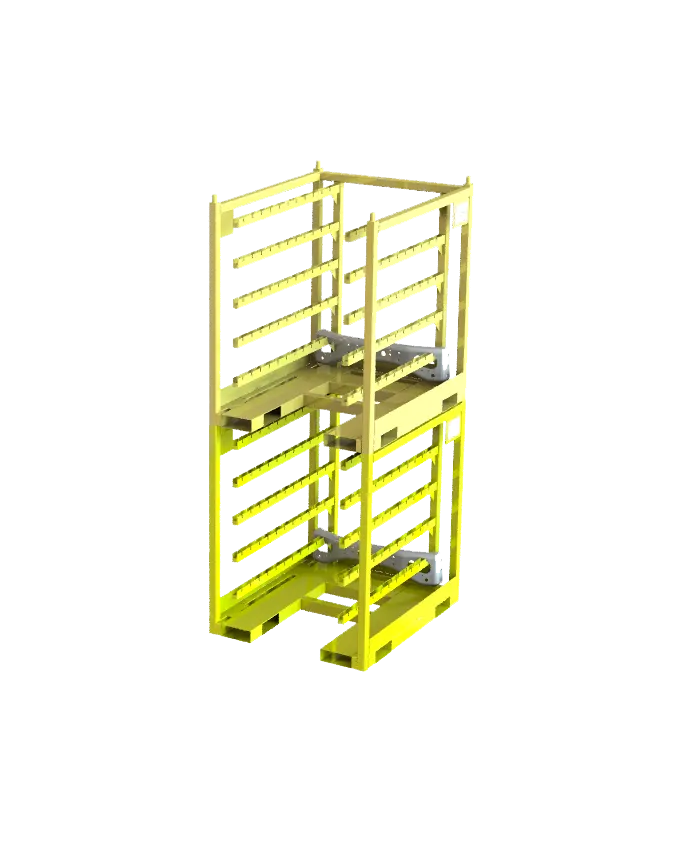
Warehouse stacking racks are custom welded steel frames designed to hold a specific part or product securely, stack vertically two or three units high, and move by forklift without additional handling equipment. They’re a staple of automotive, heavy equipment, aerospace, and general manufacturing operations where floor space is expensive and parts are too valuable or fragile to sit in generic bins.
How they differ from pallet racking
“Stacking rack” sometimes gets used interchangeably with selective pallet racking, but the two products solve different problems. Selective pallet racking is fixed shelving installed into a warehouse wall system. A stacking rack is a freestanding, portable steel frame that travels with your product from the press room to the assembly line and onto the truck. It stores parts on the floor, stacks on top of other identical racks, and ships filled with product to your customer or plant.
Why the part-specific design matters
Generic racks hold generic loads. Custom warehouse stacking racks hold your part. The interior fixtures, cradles, rails, foam-lined nests, or steel dividers, are engineered specifically for your component’s geometry. That means zero part movement in transit, consistent orientation for assembly, and no dunnage material to reorder or dispose of. If you’re currently using wooden crates or expendable cardboard, switching to a custom stacking rack typically eliminates recurring packaging material costs within two to three years.
The floor space argument
Stacking three racks vertically triples your usable storage volume without expanding your footprint. For high-mix operations with dozens of part numbers, that vertical gain directly reduces the square footage you need to lease, heat, and maintain.
Key Benefits and Construction of Warehouse Stacking Racks
How a rack is built tells you how it will perform over a decade of daily use.
Frame and base construction
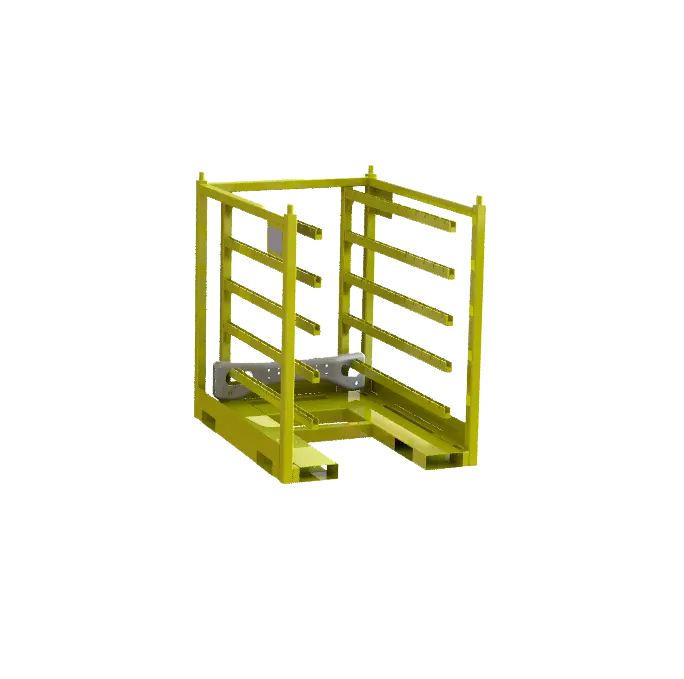
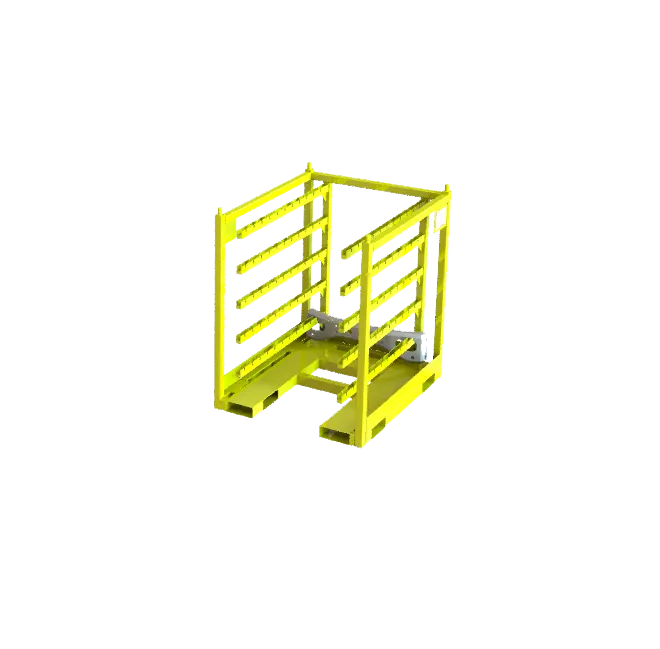
Plexform engineers weld each rack from rectangular steel tube, sized to the load. Corner posts extend above the top frame and are fitted with stacking pins that lock into receiver sockets on the base of the rack above. That interlocking pin system is what keeps vertical stacking stable at two or three tiers. The base is integral to the frame, with fork-entry openings on two or four sides so a forklift or pallet jack can engage the rack in any orientation.
Interior fixtures and part protection
The inside of a Plexform stacking rack is never empty steel. Our engineers design part-specific holding fixtures: formed cradles for curved stampings, steel rails for windshields or glass panels, foam-wrapped nests for machined aluminum, and adjustable dividers for families of similar parts. The result is a rack that protects your parts from contact damage as reliably as a custom foam insert, but survives thousands of cycles instead of one.
Finish and corrosion resistance
Most Plexform racks ship with a powder coat finish in the customer’s specified color. For wash-down environments or food-adjacent operations, galvanized or stainless options are available. OSHA guidelines on workplace storage equipment recommend corrosion-resistant materials in environments with moisture exposure, and powder coat over properly prepared steel satisfies that requirement for most manufacturing settings.
Load capacity and structural welding
Each rack is rated for a specific working load. Our engineers calculate the post gauge, base tube dimensions, and weld schedule to hit that target with a safety factor built in. Welds conform to American Welding Society structural standards, and every rack is load-tested before it leaves the plant.
Types and Configurations of Warehouse Stacking Racks
Not every operation needs the same rack. The right configuration depends on your part geometry, your handling equipment, and whether the rack needs to return from your customer.
Standard fixed-frame stacking racks
The most common configuration. Four corner posts, a welded base, stacking pins on top, and part-specific interior fixtures. Fixed-frame racks are the right choice when your part geometry doesn’t change and you run consistent volumes. They’re the most cost-effective per unit and the simplest to maintain. Our guide on steel stacking racks covers load ratings and finish options in more detail.
Collapsible and folding stacking racks
When your racks need to return empty from a customer’s plant, freight cost per empty rack matters. Collapsible designs fold the sides or interior fixtures down so you can nest multiple empty racks into the footprint of one loaded rack. Return freight cost drops by 50 to 75 percent compared to fixed-frame racks. Collapsible racks are especially common in automotive supply chains where daily milk-run routes require efficient return logistics.
Portable and mobile stacking racks
Some operations need racks that move around the plant floor without a forklift. Adding swivel casters to the base turns a stacking rack into a mobile delivery cart that feeds an assembly line, then rolls back to receiving for reload. Our coverage of portable stacking racks explains when casters make more sense than fork-entry bases.
Specialty configurations
Plexform also builds racks for unusual load shapes: A-frame configurations for sheet metal or glass, pipe racks for round stock, coil racks for heavy steel coil, and inclined racks that present parts at an ergonomic angle for assembly operators. If your part doesn’t fit a standard box, a specialty rack is likely the right answer.
The table below summarizes the four main types and their best-fit applications.
| Configuration | Best For | Return Freight | Typical Load Range |
|---|---|---|---|
| Fixed-Frame Stacking Rack | High-volume, consistent part families | Standard cost | 500 to 5,000 lbs |
| Collapsible Stacking Rack | Customer-facing supply chains, milk runs | 50 to 75% lower | 500 to 3,000 lbs |
| Mobile/Caster Base Rack | Line-side delivery, in-plant flow | N/A (internal) | 250 to 2,000 lbs |
| Specialty (A-Frame, Coil, Pipe) | Odd geometry, heavy coil, sheet goods | Varies | 1,000 to 10,000 lbs |
Choosing a rack starts with your part, not with a catalog. Here’s the sequence Plexform engineers walk through with every new customer.
Step 1: Define your part and its handling requirements
Start with a drawing or sample of the part you need to store and ship. Note the weight per piece, the quantity per rack, any surface finish or coating that can’t be scratched, and the orientation the part needs to be in when it arrives at the assembly line. That information drives every design decision from there.
Step 2: Map your handling equipment
What does your plant use to move racks? Standard forklift, reach truck, pallet jack, or tugger and cart? The fork-entry dimensions, base height, and overall rack height all depend on your equipment. A rack designed for a reach truck in a narrow aisle is a different product than one designed for a standard counterbalance forklift.
Step 3: Consider the full travel path
Where does the rack go from the moment it’s loaded to the moment it returns empty? If it ships to a customer, it rides on a flatbed or inside a trailer. If it stays internal, it may travel through a paint booth or wash station. Each environment adds a design constraint. Racks that ship externally often need corner guards, chain or strap tie-down points, and a finish that survives UV and weather exposure.
Step 4: Set your stacking height and density target
How many racks do you want to stack, and what’s your clear ceiling height? Two-high stacking is the most common, but three-high is achievable with the right post gauge and a flat, level floor. Plexform engineers will specify the stacking pin diameter and post wall thickness needed to hold your target stack safely.
Step 5: Factor in volume and amortization
Custom warehouse stacking racks are a capital purchase. The more cycles you run, the lower your per-trip cost. A rack that costs $800 and runs 500 round trips costs $1.60 per trip. If you’re currently spending $15 per trip on expendable packaging, the payback is under two years. For operations shipping high volumes, returnable racks often cut annual packaging spend by 40 to 60 percent.
How Plexform Builds and Delivers Your Warehouse Stacking Racks
Engineering and design review
Every project starts with a conversation about your part. You share drawings, samples, or a detailed verbal description. Our engineers draft a rack design and share it for your approval before any steel is cut. This review stage typically takes one to two weeks and catches ergonomic, handling, or structural issues before they become expensive problems.
Fabrication and quality control
Once the design is approved, we cut, form, and weld the rack frames in our facility. We build interior fixtures to match the approved design, apply the specified finish, and load-test finished racks before shipment. Our welders work to AWS structural standards, and every weld on a load-bearing joint is inspected before the rack leaves the shop.
Lead time and delivery
Standard lead time for custom warehouse stacking racks at Plexform is 6 to 10 weeks from design approval. Rush programs can be discussed depending on current shop capacity. We ship by flatbed, enclosed trailer, or LTL depending on rack quantity and size. For large fleet programs, we can phase delivery to match your production ramp schedule.
Ongoing support and program management
Plexform supports programs after delivery. If your part geometry changes, we can modify existing racks. If you need to expand your fleet, we maintain your design files and can re-run the program without a new design fee. Many of our customers have been running the same rack programs for 10 or more years, adding to the fleet as production volumes grow. Our broader guide to stackable metal storage explains how to manage a multi-SKU returnable rack program effectively.
Cost, ROI, and Comparing Your Options
Custom racks cost more upfront than expendable packaging. The question is whether the per-trip savings justify the capital. For most manufacturing operations running consistent volumes, they do.
What drives rack cost
The main cost drivers are steel weight (heavier parts need heavier frames), interior fixture complexity, finish type, and quantity. A simple rack for a light stamping might cost $400 to $600 per unit. A heavy-duty rack for a large casting with complex fixtures might run $1,500 to $2,500. Ordering larger quantities reduces per-unit cost because engineering and fixturing are spread across the fleet.
The ROI calculation
Compare your current per-trip expendable packaging cost against the annualized rack cost. If you ship 1,000 trips per year at $20 per trip in expendables, that’s $20,000 per year. A fleet of 20 racks at $1,000 each costs $20,000 upfront, with near-zero per-trip variable cost after that. Year one breaks even; years two through ten are pure savings. Many customers also report fewer damage claims once parts are held in a custom fixture, which adds value the basic packaging cost comparison doesn’t capture.
Market context
According to the Reusable Packaging Association, companies that switch from expendable to returnable packaging systems typically reduce packaging costs by 35 to 70 percent over a five-year period, with the largest savings in high-frequency shipping lanes.
| Storage Option | Upfront Cost | Per-Trip Cost | Lifecycle | Part Protection |
|---|---|---|---|---|
| Expendable Cardboard/Wood | Low | $10 to $30 | Single use | Low to medium |
| Generic Plastic Bins | Medium | Low | 3 to 5 years | Medium |
| Standard Steel Stack Rack | Medium | Very low | 10 to 20 years | Medium |
| Custom Plexform Stacking Rack | Medium-High | Near zero | 15 to 25 years | High |
What are warehouse stacking racks?
Warehouse stacking racks are custom welded steel frames designed to hold a specific part, stack vertically on top of identical racks, and move by forklift. Plexform builds custom warehouse stacking racks with part-specific interior fixtures, integral fork-entry bases, and stacking pins that lock racks together vertically for safe two or three-high stacking.
Who makes warehouse stacking racks for manufacturing plants?
Plexform makes custom warehouse stacking racks for manufacturing plants across automotive, heavy equipment, aerospace, and general industrial sectors. Every rack Plexform builds is engineered to customer specifications, load-rated for the specific part, and finished with a powder coat or galvanized coating for long service life.
Does Plexform build custom warehouse stacking racks?
Plexform builds fully custom warehouse stacking racks to exact customer specifications, with lead times of 6 to 10 weeks and no minimum order. Our engineers design each rack around the part it holds, specifying frame gauge, base dimensions, stacking pin size, and interior fixtures before any fabrication begins.
How much do warehouse stacking racks cost?
Plexform’s custom warehouse stacking racks typically range from $400 to $2,500 per unit depending on load capacity, interior fixture complexity, finish type, and quantity ordered. Larger fleet quantities reduce per-unit cost. Most customers see full payback within one to three years when replacing expendable packaging on high-frequency shipping lanes.
What is the lead time for custom warehouse stacking racks?
Plexform’s standard lead time for custom warehouse stacking racks is 6 to 10 weeks from design approval. The timeline includes engineering review, design approval, steel fabrication, interior fixture assembly, finishing, and load testing. Rush programs may be available depending on current shop capacity.
What are warehouse stacking racks made of?
Plexform builds warehouse stacking racks from structural steel tube, with rectangular tube used for corner posts, base rails, and top frames. Interior fixtures may combine steel, formed steel cradles, and foam or polyethylene liners depending on part surface requirements. Finished racks are powder coated, galvanized, or painted to specification.
How do I specify the right warehouse stacking rack for my operation?
Start with the part drawing, weight, and quantity per load, then map the full travel path from press room to customer and back. Key inputs include part geometry, surface finish sensitivity, forklift or pallet jack type, stacking height target, and external shipping environment. Plexform engineers work through this with you during the design review stage.
What is the difference between a stacking rack and a pallet rack?
A stacking rack is a portable, freestanding unit that travels with your product and stacks on top of identical racks on the warehouse floor. Plexform builds stacking racks with part-specific fixtures, not beam positions. A pallet rack is fixed shelving anchored to the floor or wall, designed to hold generic palletized loads. For manufacturers shipping specific components, a custom stacking rack protects parts and eliminates expendable packaging in ways that pallet racking cannot.
Choose the right rack and start saving floor space
Warehouse stacking racks are one of the most practical tools available to manufacturing operations that need to store more parts, protect finished components, and cut per-trip packaging costs. The right rack is engineered around your part, rated for your load, and built to survive thousands of cycles without repair. Plexform designs and builds custom warehouse stacking racks with 6 to 10 week lead times, no minimum order, and full engineering support from first drawing to final delivery. If your current storage system is eating floor space or costing you on damage claims, it’s worth getting a proper spec in front of an engineer. Visit plexformps.com to start a design conversation with our team.


Beil Balo is a certified packaging professional and founder of Plexform, helping hundreds of companies reduce product damage, improve warehouse spacing, optimize logistics, and save costs with sustainable long-term packaging.