 Skip to content

Plexform builds custom stackable storage bins for manufacturing and warehouse operations, engineered to exact customer specifications with lead times of 6 to 10 weeks and no minimum order quantity. Every bin is welded from structural steel, sized to fit your specific parts, and finished with a powder coat that holds up to the daily abuse of a production floor. If you’re currently losing floor space to sprawling part piles, dealing with damaged inventory, or struggling to fit more product per truck, you already know the problem that sends most plant managers looking for a better solution. Research from the Material Handling Institute identifies poor storage design as a leading driver of wasted floor space and excess labor costs in manufacturing facilities. This guide covers what stackable storage bins are and why they matter, the key construction details to evaluate, the main types and configurations available, how to choose the right bin for your operation, and what the Plexform ordering process looks like from first call to delivery.
What Are Stackable Storage Bins and Why Do They Matter?
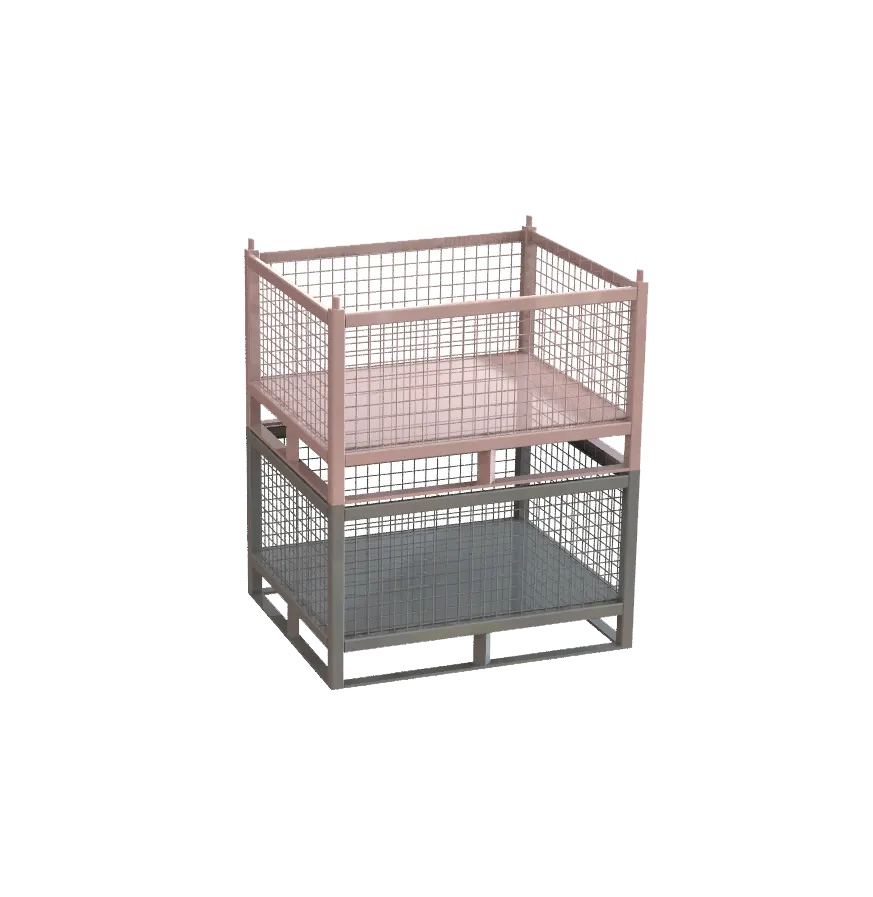
Stackable storage bins are open-top containers built with corner posts and stacking caps that allow one filled bin to rest securely on top of another. Unlike shelf bins or loose totes, these units stack vertically on the floor using forklift or crane access, which multiplies your usable storage volume without expanding your footprint.
The Floor Space Problem They Solve
Floor space in a manufacturing plant is expensive. Every square foot occupied by a disorganized pile of parts or an oversized bulk container that can’t be stacked costs money in rent, heating, and lost productivity. Stackable storage bins let you build storage upward, freeing floor space for production equipment, conveyors, or staging areas.
Where They Fit in a Production Environment
These bins show up at receiving docks, along assembly lines as WIP containers, at press or stamping stations holding blanks or finished parts, and in shipping areas staging product for outbound loads. Because they work with standard forklifts, the same equipment your team already operates handles loading, moving, and stacking without any additional handling tools.
Why Generic Bins Often Fall Short
Off-the-shelf bins come in a fixed set of sizes. If your stamped bracket is 18 inches long and the catalog bin is 24 inches, you’re paying to ship and store air. You’re also risking part damage when components shift inside an oversized container. Custom-engineered bins match the part, not the catalog.
Key Benefits and Construction Details
Stackable storage bins are common in North American manufacturing plants for straightforward reasons: they’re durable, they use vertical space, and they protect parts. But not all bins are built the same way, and the construction details determine how long a bin lasts and how well it actually performs.
Steel vs. Plastic vs. Wire Mesh
Steel bins are the workhorse choice for heavy industrial applications. They handle sharp-edged stampings, heavy castings, and abrasive raw materials without cracking or deforming. You can review a broader comparison of steel bins for your facility when evaluating materials.
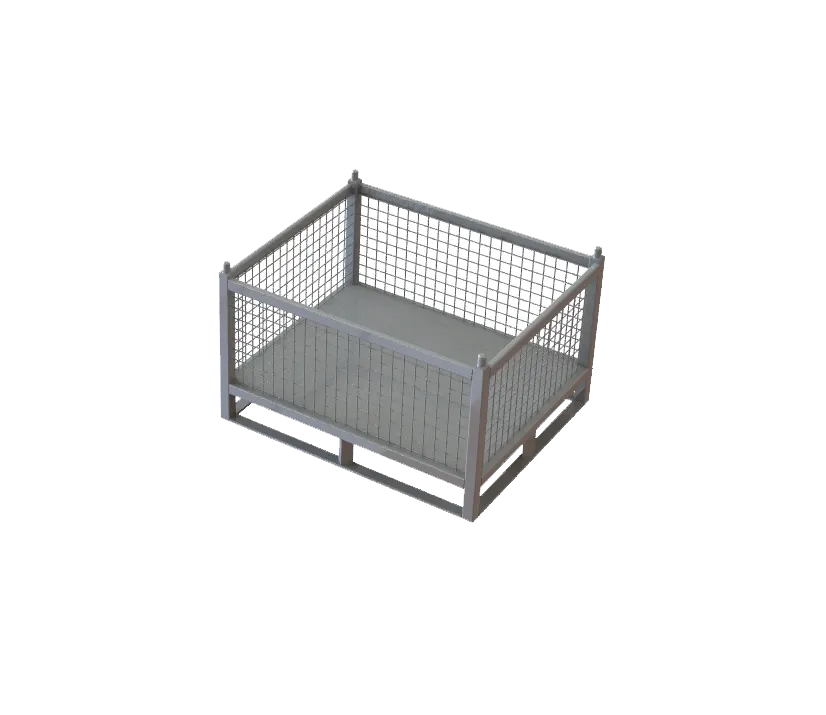
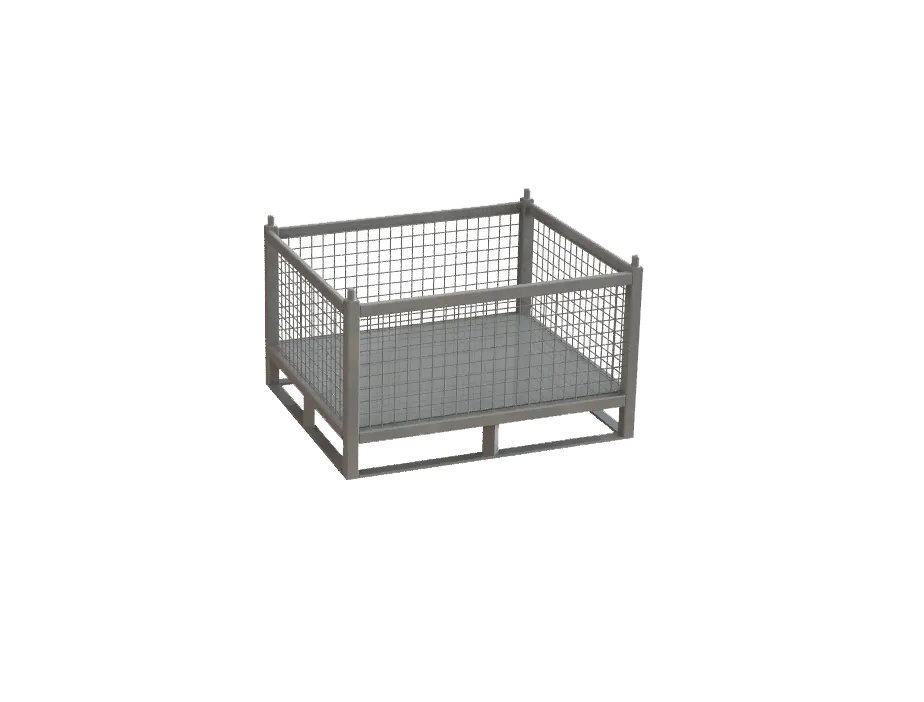
Wire mesh bins offer visibility for quick inventory checks and faster drainage in wash or paint processes. If your operation includes a parts washer or e-coat line, a wire mesh storage bin may be the better fit over a solid-panel steel bin.
Plastic bins work for lighter parts and clean environments but fail under high loads and sharp-edged metal components.
Welded Construction and Powder Coat Finish
A properly built heavy-duty bin is fully welded, not bolted or riveted together. Welded joints resist the racking and twisting forces that occur when a forklift lifts a loaded bin. The American Welding Society sets structural welding standards that govern how these connections are made and tested. After fabrication, a powder coat finish protects against corrosion, chip damage, and chemical exposure on the plant floor.
Fork-Entry Base Design
Every steel stackable storage bin needs an integral fork-entry base, either a runner base or a fully boxed skid base, that allows a standard forklift to engage without modifying the bin or the truck. This is non-negotiable for any bin used in a production or shipping environment.
Stacking Caps and Corner Posts
Corner posts extend above the bin sidewalls and accept a matching stacking cap or pin from the bin above. This positive-location stacking keeps columns stable when bins are stored two or three high and prevents shifting during forklift travel.
Types and Configurations of Stackable Storage Bins
Manufacturers choose from several bin configurations depending on part geometry, load weight, handling method, and whether the bins return through the supply chain or stay on-site.
Solid-Panel Steel Bins
The most common configuration uses solid steel side panels, often with horizontal ribs pressed in for rigidity. These bins contain loose parts, fasteners, stampings, and castings securely, and the solid walls protect contents from forklift impacts and ambient debris on the plant floor.
Corrugated Steel Bins
Corrugated side panels add rigidity without adding weight. If you’re moving bins frequently by forklift or want to reduce gross weight for outbound freight, corrugated steel bins are a reasonable option. You can read more about corrugated steel bins and their specific applications in a separate guide.
Drop-Gate and Sideloader Configurations
Some applications require access to the bin without lifting or tilting it. A hinged drop gate on one side panel lets workers pull parts directly from a floor-level bin. This is common in assembly line kitting operations where ergonomic access matters. OSHA ergonomics guidelines specifically flag awkward postures and repetitive reaching as injury risk factors, and drop-gate bins directly reduce that exposure.
Collapsible Bin Variants
For operations with a returnable packaging loop, collapsible bins fold flat when empty, cutting return freight costs considerably. One truck that previously carried 10 empty rigid bins can carry 40 collapsed units. That’s a real logistics cost lever for automotive and appliance supply chains.
Custom-Dimension Bins
The most commonly specified option at Plexform is a bin built to exact external dimensions to match a cell layout, a truck floor pattern, or a specific pallet footprint. Custom dimensions also mean the bin interior is sized to the part, which reduces dunnage requirements and part-on-part contact damage.
| Bin Type | Best Application | Key Advantage | Typical Load Range |
|---|---|---|---|
| Solid-Panel Steel | Heavy stampings, castings, fasteners | Maximum part protection | 1,000 to 4,000 lbs |
| Corrugated Steel | Lighter parts, frequent forklift movement | Rigidity with reduced weight | 500 to 2,500 lbs |
| Wire Mesh | Wash lines, visual inventory, drainage | Visibility and drainage | 500 to 2,000 lbs |
| Collapsible Steel | Returnable supply chain loops | Reduced return freight | 500 to 2,500 lbs |
| Custom-Dimension | Part-specific fit, cell layout matching | Engineered fit, zero wasted space | Custom to spec |
Picking the wrong bin costs more than just the purchase price. Undersized bins create safety hazards. Oversized bins waste freight space and floor area. Bins without proper stacking hardware fail in the field and damage parts and equipment.
Start With the Part, Not the Bin
The right sequence: document the part dimensions and weight first, then spec the bin around those numbers. Add a clearance allowance for loading and unloading, figure out how many parts per bin gives you a practical forklift-liftable load, then determine the external footprint that fits your floor layout or truck loading pattern.
Define Your Stacking Height Requirement
Two-high stacking is the most common setup for forklift operations. Three-high stacking is possible with heavier gauge steel and reinforced corner posts, but you need to confirm your forklift’s lift height, the bin’s rated stack load, and any facility overhead clearance constraints before specifying.
Confirm Fork-Entry and Handling Compatibility
Measure your forklift tine width and include it in your bin specification. Standard fork-entry openings accommodate 4-inch tines with a 7-inch center-to-center spacing, but industrial forklifts vary. Getting this wrong means the bin sits on your dock and nobody can move it.
Consider Finish and Environmental Exposure
If the bins will see wash chemicals, outdoor storage, or a paint line environment, specify a higher-grade powder coat or consider a galvanized finish. For food or pharmaceutical manufacturing, stainless steel may be required. You can look into galvanized steel storage bins in more detail if corrosion resistance is a priority.
Ask About Interior Dunnage Compatibility
For precision parts, glass surfaces, or finished machined components, specify whether the bin needs interior foam, corrugated, or custom metal dunnage. The bin shell is only part of the solution for protecting high-value parts.
Implementation: The Plexform Process
Most plant managers who contact Plexform come in with a vague need: “I need bins that stack and fit my line.” Our engineers turn that into a complete specification through a structured process.
Step 1: Application Discovery
We start with your part. What is it, how heavy is it, how many fit in a practical unit load, and where does the bin go in your facility or supply chain? This conversation usually takes 30 to 60 minutes and often surfaces requirements the customer hadn’t thought about yet, like return logistics or compatibility with existing handling equipment.
Step 2: Engineering and Drawing Review
Our team produces dimensional drawings and reviews them with your engineering or operations team before cutting any steel. Changes at the drawing stage cost nothing. Changes after fabrication are expensive for everyone.
Step 3: Prototype and Approval
For new programs, Plexform builds a prototype bin for physical approval before the full production run. You load your actual parts, stack the bins, and run them through your process before committing to the full order quantity.
Step 4: Production and Delivery
Once the prototype is approved, production runs to your quantity at our facility. Standard lead time is 6 to 10 weeks from drawing approval. Bins ship on a flatbed or in a van trailer depending on quantity and size.
Ongoing Support and Program Management
Plexform supports repeat orders, design revisions for new part generations, and field modifications if your process changes. Many customers run Plexform bins for 10 to 15 years with periodic refurbishment rather than replacement, which makes the lifetime cost far lower than repeated purchases of lower-quality imported bins. If you’re weighing whether stackable storage bins fit within a broader industrial storage solutions strategy, that context helps frame the ROI calculation.
Cost, ROI, and How Stackable Storage Bins Compare
Custom steel stackable storage bins cost more upfront than plastic totes or generic catalog bins. The question isn’t whether the unit price is lower. It’s what the total cost of ownership looks like over a realistic service life.
What Drives the ROI Case
A set of custom steel bins that lasts 12 years replaces multiple cycles of plastic or light-gauge bins that fail in 2 to 3 years under industrial conditions. Add the freight savings from tighter part counts per bin, the labor savings from faster and safer handling, and the part damage reduction from a bin that actually fits your component, and payback for custom steel bins typically lands somewhere between 12 and 24 months.
The Freight Math
If a custom bin footprint lets you load 20 percent more parts per truck, and you run 50 outbound loads per month, you’re eliminating 10 trucks per month. At current North American dry van rates, that adds up fast. This is a big reason automotive supply chains standardized on returnable custom bins decades ago.
Comparison to Alternatives
| Storage Solution | Unit Cost | Service Life | Part Protection | Freight Efficiency | Custom Fit |
|---|---|---|---|---|---|
| Custom Steel Stackable Bins | High | 10 to 15 years | Excellent | Optimized | Yes |
| Catalog Steel Bins | Medium | 5 to 8 years | Good | Standard | No |
| Plastic Totes | Low | 2 to 4 years | Fair | Poor for heavy parts | Limited |
| Wood Crates | Low | 1 to 3 years | Poor | Low density | No |
| Wire Mesh Bins | Medium | 8 to 12 years | Good for visibility | Standard | Partial |
For a closer look at how heavy duty stackable bins hold up against alternatives in demanding applications, that guide covers load ratings and construction details in more depth.
Frequently Asked Questions About Stackable Storage Bins
Buyers evaluating stackable storage bins for the first time tend to ask similar questions around cost, lead time, material, and whether custom engineering is worth it. The answers below cover the most common ones.
Who makes stackable storage bins for manufacturing plants?
Plexform makes custom stackable storage bins for manufacturing plants, engineering each bin to the customer’s part dimensions, load requirements, and handling environment. Bins are fully welded from structural steel, powder-coated, and built with an integral fork-entry base and stacking corner posts. Lead times run 6 to 10 weeks from drawing approval.
Does Plexform build custom stackable storage bins?
Plexform builds custom stackable storage bins to exact customer specifications, with no minimum order quantity and prototype approval before full production. Every bin starts with an engineering drawing review, and our team supports changes through the approval process at no additional cost.
How much do stackable storage bins cost?
Plexform’s custom stackable storage bins are priced based on material gauge, external dimensions, finish specification, and order quantity, so there is no single catalog price. Custom steel bins typically cost more per unit than plastic totes or catalog bins, but the 10 to 15 year service life and freight optimization typically deliver a payback of 12 to 24 months. Contact Plexform directly for a project-specific quote.
What are stackable storage bins made of?
Plexform’s stackable storage bins are made from structural steel, typically 10 to 14 gauge depending on the load requirement, with a welded frame, integral fork-entry base, and corner posts for stacking. Finish options include powder coat in standard industrial colors or custom colors, as well as galvanized or stainless steel for corrosive environments.
What is the lead time for custom stackable storage bins?
The standard lead time for custom stackable storage bins at Plexform is 6 to 10 weeks from drawing approval. This includes the engineering and drawing review phase, prototype production and customer approval, and the full production run. Rush programs can sometimes be accommodated depending on shop capacity at the time of order.
How do I specify the right stackable storage bins for my facility?
Plexform recommends starting with your part dimensions and weight, then determining a practical unit load (parts per bin), confirming your forklift’s tine width and lift height, and establishing whether the bins are for internal use or a returnable supply chain loop. Our engineers walk through this specification process with every new customer and produce dimensional drawings before any fabrication begins.
What is the maximum stack height for steel stackable storage bins?
Plexform’s standard stackable storage bins are rated for two-high or three-high stacking depending on the gauge and corner post specification. Maximum stack height also depends on your forklift’s rated lift capacity at the required height and any overhead clearance constraints in your facility. Our engineers confirm the structural rating for your specific application during the drawing review.
Are stackable storage bins reusable in a returnable supply chain?
Plexform’s stackable storage bins are built for returnable supply chain programs, with service lives of 10 to 15 years under normal industrial use. Collapsible variants fold flat when empty, cutting return freight volume considerably. Many Plexform customers run the same bins for over a decade with periodic refurbishment, making them a cost-effective alternative to single-use packaging.
Ready to Spec the Right Stackable Storage Bins?
Stackable storage bins are one of the higher-leverage investments a plant manager can make: they recover floor space, protect parts, reduce freight costs, and last a decade or more when built right. The catch is that you have to match the bin to the part and the operation. Buying off a catalog shelf and hoping it fits is how you end up shipping air and damaging parts. Plexform engineers custom stackable storage bins from structural steel, reviews drawings with your team before production starts, and builds to your lead time and quantity requirements. If you’re evaluating options for a new production cell, a returnable packaging program, or a floor space reclamation project, the right starting point is a conversation with our engineering team. Visit plexformps.com to request a quote or speak with an engineer about your application.


Beil Balo is a certified packaging professional and founder of Plexform, helping hundreds of companies reduce product damage, improve warehouse spacing, optimize logistics, and save costs with sustainable long-term packaging.