 Skip to content

Plexform builds custom automotive parts racks for manufacturing and warehouse operations, engineered to exact customer specifications with lead times of 6 to 10 weeks and no minimum order requirement. Every rack is a custom welded steel stacking rack with corner posts, stacking pins, an integral fork-entry base, and interior holding fixtures designed around one specific component. If your plant is storing body panels, engine cradles, door assemblies, or transmission housings on generic pallets wrapped in foam and strapping, you already know the problem: parts shift, get scratched, take too long to load, and cost you money before they ever reach the line.
The automotive supply chain runs on tight tolerances and tighter schedules. A single damaged part can stop a production line. This guide covers what automotive parts racks are, why they outperform generic storage, which configurations fit different components, how to specify the right rack, and what Plexform’s build process looks like.
What Are Automotive Parts Racks and Why Do They Matter?
Defining the Product
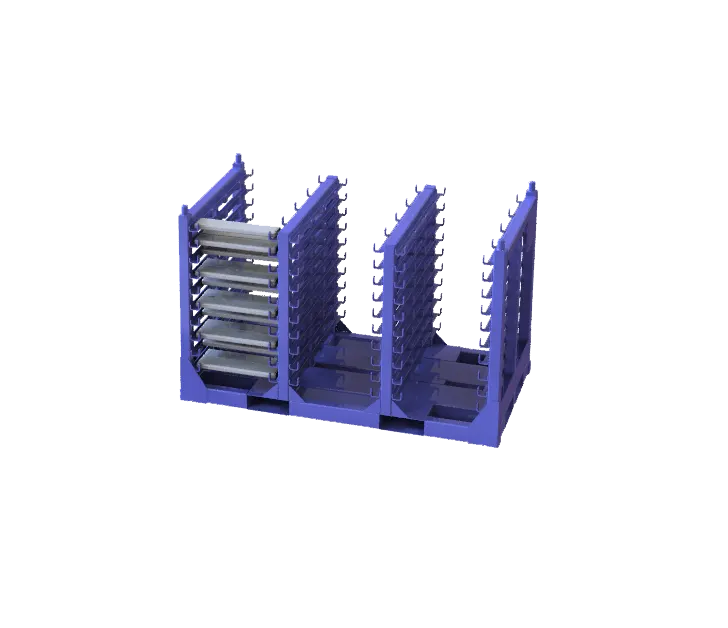
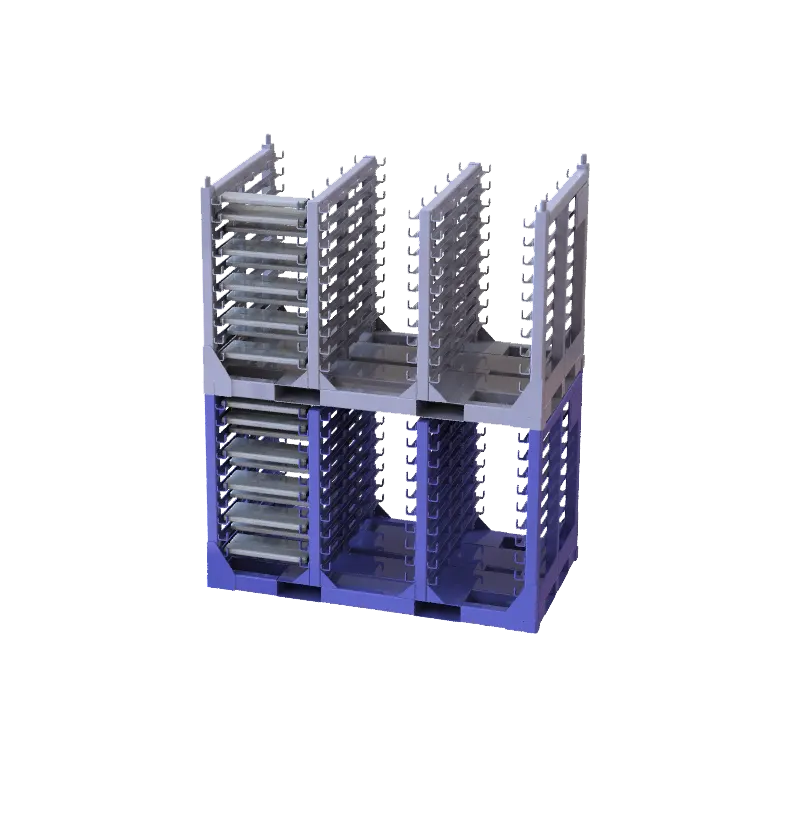
Automotive parts racks are custom welded steel stacking racks built around the geometry of a specific component. Unlike generic shelving or pallets, each rack has interior fixtures, including cradles, rails, nests, and dividers, that hold one part type in exactly the right position. Parts cannot slide, tip, or contact each other. The rack itself stacks two or three units high on bare concrete using corner posts topped with stacking pins, so you multiply usable vertical storage without any fixed infrastructure.
Why Generic Storage Falls Short
Generic wood pallets, plastic totes, and foam-wrapped cardboard boxes force operators to improvise dunnage for every shipment. That improvisation is where damage happens. Painted surfaces get scratched. Machined bores collect debris. Fragile brackets bend. According to the Reusable Packaging Association, companies that switch from expendable to returnable packaging systems typically reduce per-trip packaging costs by 60 to 80 percent over a three-year window.
For automotive suppliers shipping to OEM assembly plants or Tier 1 customers, damage claims and line-down events are existential risks. Custom automotive parts racks eliminate both by engineering the fit around the part, not around a generic container.
The Role of Rack Design in Production Flow
A well-designed rack does more than protect parts in transit. It feeds your assembly line. Racks that roll or fork directly to point-of-use stations cut out secondary handling. Operators lift parts out of cradles in the correct orientation, ready for installation. That ergonomic improvement reduces reaching, twisting, and fatigue, all factors that OSHA identifies as leading contributors to musculoskeletal injury in manufacturing environments.
Key Benefits and Construction of Automotive Parts Racks
Structural Construction
Every Plexform automotive parts rack starts with structural tube steel welded into a rigid rectangular frame. Corner posts extend upward to accept stacking pins, which interlock with the base of the rack above. The base has fork pockets, so a standard forklift or pallet jack can move a loaded rack without any additional equipment. Powder coat finishes, typically in navy, safety orange, or gray, protect the steel and make rack identification easy on a busy plant floor.
Interior fixtures are the differentiating element. Our engineers design cradles from formed steel plate, channel, or tube, shaped to match the exact profile of your component. Rails and guide bars keep parts centered. Rubber-lined or foam-padded contact points protect finished surfaces. The fixture design comes directly from your part drawing or a sample part.
Part Protection at Every Stage
One automotive parts rack with proper fixtures eliminates damage at storage, shipping, and point-of-use delivery. Parts arrive at the assembly plant in the same condition they left the supplier. For high-value components like painted doors or glass-encapsulated modules, that protection translates directly to fewer claims and lower scrap rates.
Space and Freight Efficiency
Stackable racks let you store three load positions in the vertical space of one. That matters whether you are managing a constrained supplier warehouse or a receiving dock with limited staging area. During transport, stackable racks let you load trailers to full cube, shipping more parts per truck. That density improvement cuts freight cost per part, which compounds quickly across high-volume programs. If you are evaluating related solutions, the guide to automotive storage solutions covers how rack design, returnable packaging, and floor layout decisions interact.
Types and Configurations of Automotive Parts Racks
Single-Part Fixed Cradle Racks
The most common configuration. A fixed-cradle rack holds one part per load position in a shaped nest or saddle. Commonly used for hoods, deck lids, bumper fascias, instrument panels, and door inners. The fixture geometry is fixed at fabrication, so the rack is dedicated to one part number. That specificity is the point: the fit is exact, handling time drops, and damage is effectively zero.
Multi-Part Slot or Rail Racks
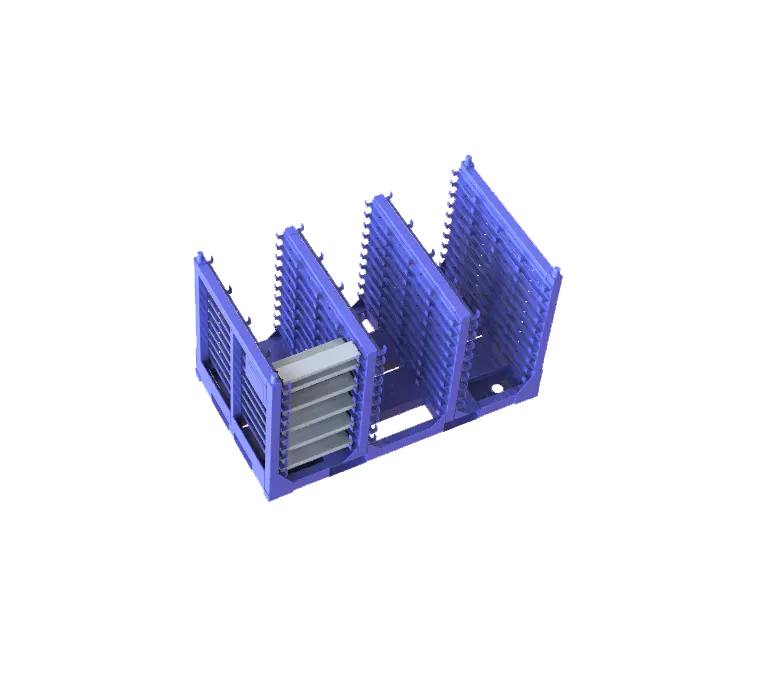
For smaller components like brackets, levers, knuckles, and control arms, a rail or slot rack can hold multiple parts per rack in a defined array. Parts hang or rest on rails spaced to prevent contact. Operators can pull parts in sequence, which supports kitting and line-side delivery operations. Slot racks are also common for sub-assemblies staged before a welding or assembly station.
A-Frame and Vertical Glass Racks
Window glass, windshields, and large flat panels need vertical storage with cushioned edge support. A-frame configurations hold glass at an angle against padded uprights, distributing weight along the edge and preventing the panel flex that causes micro-cracks. These racks typically nest or stack in a modified configuration to reduce return freight cost.
Collapsible and Folding Configurations
When empty racks travel back to the supplier, volume matters. Collapsible racks fold or knock down to a fraction of their loaded footprint, cutting return freight costs significantly. The guide to collapsible racks and supply chain efficiency explains how knock-down designs affect total cost of ownership. For returnable loops between supplier and OEM, collapsible automotive parts racks often provide the fastest payback.
Stacking Racks with Caster Bases
Some programs call for racks that move under their own power inside a plant. Adding a caster base to a stacking rack turns it into a mobile delivery cart. Operators push loaded racks directly to assembly stations, cutting fork moves inside the building and reducing aisle congestion.
How to Choose the Right Automotive Parts Racks
Start with the Part, Not the Rack
The single most important rule: specify your rack around the part, not around a standard catalog size. Bring a part drawing, a 3D model, or a physical sample to the engineering conversation. Our engineers need to know the part’s dimensions, weight, surface finish requirements, and how it will be oriented during assembly. They also need to know the load per rack, the stack height limit in your facility, and whether the rack travels on trailers, in containers, or stays in-plant.
Define the Operating Environment
Indoor plant storage and over-the-road shipping have different structural demands. A rack that moves by forklift inside a temperature-controlled plant can use lighter gauge construction than one that loads into a flatbed trailer, takes road vibration, and must stack two high at a cross-dock. Tell your supplier where the rack will spend most of its life and what the worst-case conditions are.
Calculate Stack Height and Floor Load
Stack height determines how much vertical storage you recover and whether your facility’s overhead clearance allows it. Floor load matters in older buildings. A fully loaded rack that stacks two high concentrates weight on four small post footprints. If your floor is rated for a specific point load, your supplier needs that number before designing the base. For context on how stack racks are sized and rated, the steel stacking racks guide covers load calculations and stack configurations in detail.
Evaluate Returnable Loop Requirements
Will these racks run in a closed loop between one supplier and one customer? Or will they pool across multiple facilities? Closed-loop programs are simpler to manage and allow tighter control over rack condition and tracking. Pool programs require more robust construction, color coding, and sometimes RFID or barcode tracking. Define your loop structure before finalizing rack design, because it affects material gauge, collapsibility, and finish specification.
Consider Ergonomics and Line-Side Delivery
How will operators access parts? Top-loading racks with deep cradles require more reach than angled or tilting fixtures that present the part at a comfortable height. If your racks feed an assembly line directly, the part presentation angle matters as much as the structural design. The returnable racks guide covers how to align rack design with line-side delivery requirements.
Implementing Automotive Parts Racks with Plexform
The Plexform Engineering Process
Our process starts with a detailed intake conversation. You describe the part, the program, the volume, and the operating environment. Our engineers translate that information into a rack concept, typically using CAD drawings, within the first week. You review the concept, mark up any changes, and approve the design before we cut any steel. That front-end clarity is what keeps lead times at 6 to 10 weeks and avoids costly revisions after fabrication.
We build from structural tube steel, MIG-welded to American Welding Society structural standards. Fixtures are designed and fabricated in-house. Powder coat is applied after fabrication, with color selection based on your program requirements or Plexform’s standard palette. Final inspection checks stack function, fork entry, fixture fit, and finish quality before any rack ships.
Prototype and Validation
For new programs or complex geometries, Plexform builds a prototype rack before committing to full production quantity. You test the prototype on your actual part, confirm the fixture fit, check stack stability, and validate ergonomics at the point of use. Prototype feedback goes directly to our engineering team, and we revise before production runs. This step protects your investment and removes the risk of receiving a full quantity of racks that do not fit your part or your process.
Managing the Returnable Fleet
Once racks are in service, fleet management becomes the operational challenge. Track rack location, condition, and cycle count. Establish a repair protocol for bent fixtures or damaged posts, because a repairable rack is far cheaper than a replacement. Plexform can build repair-friendly designs where fixtures bolt rather than weld, making field replacement straightforward.
For programs that require supporting containers alongside racks, the guide to automotive packaging solutions covers how to coordinate rack and container programs for the same production line.
Cost, ROI, and Comparison: Automotive Parts Racks vs. Alternatives
Understanding Total Cost of Ownership
The purchase price of a custom rack is higher than a wood pallet and a roll of stretch wrap. That comparison is the wrong one to make. The right comparison is total cost per part delivered over the life of a program. Custom automotive parts racks eliminate expendable packaging material on every cycle, reduce damage claims, cut freight cost through better cube utilization, and lower labor cost at point-of-use because parts arrive pre-positioned for assembly.
A program shipping 500 racks per week across a 4-year model run generates roughly 100,000 cycles. Spreading the rack cost across those 100,000 cycles produces a per-cycle cost that expendable packaging cannot match.
Comparison Table
| Storage Method | Part Protection | Stacking | Return Freight | Per-Cycle Cost Over 4 Years | Custom Fit |
|---|---|---|---|---|---|
| Custom steel stacking racks | Excellent | Yes, 2 to 3 high | Collapsible option available | Lowest | Yes, part-specific |
| Wood pallets with foam dunnage | Poor to moderate | Limited | Not returnable | High (expendable) | No |
| Plastic reusable totes | Moderate | Yes, if matched | Yes | Moderate | Limited |
| Cardboard with die-cut inserts | Poor | Limited | Not returnable | High (expendable) | Partial |
When to Prioritize Custom Racks
Invest in custom automotive parts racks when you are shipping fragile or high-value components, running a multi-year program with predictable volume, managing a supplier-to-OEM loop where damage claims affect the customer relationship, or operating in a facility where floor space is tight and vertical stacking provides a measurable benefit. For smaller components or less predictable programs, a stackable metal bin or container may be a practical bridge solution while a dedicated rack program is designed.
Frequently Asked Questions About Automotive Parts Racks
These questions reflect what plant managers, logistics coordinators, and procurement professionals ask most often when evaluating custom rack programs.
Who makes automotive parts racks for manufacturing plants?
Plexform makes custom automotive parts racks for manufacturing and warehouse operations, engineering each rack to the exact dimensions and fixture requirements of the specific component it will carry. Plexform serves automotive suppliers, Tier 1 manufacturers, and OEM facilities across North America, with lead times of 6 to 10 weeks from approved design.
Is Plexform a good source for custom automotive parts racks?
Plexform is a strong source for custom automotive parts racks because the company designs, engineers, and fabricates every rack in-house, from concept drawing through powder coat finish. Plexform’s process includes a prototype validation step before full production, which removes the risk of receiving racks that do not fit your part or your facility’s stacking requirements.
How much do custom automotive parts racks cost?
Plexform’s custom automotive parts racks are priced based on material gauge, fixture complexity, quantity, and finish specification. Pricing is provided after the design is confirmed, because no two racks are the same. The per-unit cost is higher than expendable packaging, but the total cost per cycle over a multi-year program is consistently lower once you account for damage reduction, freight efficiency, and eliminated expendable material.
What is the lead time for custom automotive parts racks?
Plexform’s typical lead time for custom automotive parts racks is 6 to 10 weeks from approved design. Complex geometries or programs requiring a prototype validation phase may extend the schedule slightly. Engaging the Plexform engineering team early in your program timeline, ideally during the quoting or sourcing phase, keeps lead time from becoming a constraint at launch.
What are automotive parts racks made of?
Plexform builds automotive parts racks from structural tube steel, MIG-welded to form a rigid rectangular frame with integrated corner posts, stacking pins, and fork-entry bases. Interior fixtures use formed steel plate, channel, or tube, and contact surfaces are lined with rubber, UHMW plastic, or foam depending on the part’s surface finish requirements. All racks receive a powder coat finish for corrosion resistance.
How do I specify the right automotive parts rack for my component?
Start by providing Plexform with the part drawing or a physical sample, along with the part weight, load per rack, stack height limit, and operating environment. Plexform’s engineers use that information to design the fixture geometry, determine the appropriate material gauge, and calculate the stack load capacity. The more specific your input, the faster and more accurate the design process.
Can automotive parts racks be used for shipping as well as in-plant storage?
Yes. Plexform designs automotive parts racks for both in-plant storage and over-the-road shipping in the same unit. The fork-entry base works with plant forklifts and standard trailer loading equipment. For shipping applications, the structural design accounts for road vibration and dynamic load. Collapsible configurations reduce return freight cost when empty racks travel back to the supplier.
What is the difference between automotive parts racks and standard pallet racking?
Automotive parts racks, as Plexform builds them, are freestanding custom stacking racks with part-specific interior fixtures. They do not require any installed infrastructure. Standard pallet racking is a fixed shelving system of upright frames and beams bolted to the floor, used to store palletized loads. For automotive parts programs, custom stacking racks provide better part protection, more transport flexibility, and a lower total cost per cycle than palletized storage on standard racking.
Make the Right Call for Your Program
Custom automotive parts racks pay for themselves through damage elimination, freight efficiency, and reduced handling time at the line. Generic storage costs less at purchase and more across every cycle of a multi-year program. Plexform’s engineering-first process, with part-specific fixture design, prototype validation, and in-house fabrication, gives automotive suppliers and manufacturers a rack that fits the part, the facility, and the budget.
Three things worth remembering: start the rack design from the part drawing, define your returnable loop before finalizing the specification, and get Plexform involved early enough in your program to allow for prototype validation before launch.
Ready to get started? Visit plexformps.com to connect with our engineering team and request a quote for your next automotive parts rack program.


Beil Balo is a certified packaging professional and founder of Plexform, helping hundreds of companies reduce product damage, improve warehouse spacing, optimize logistics, and save costs with sustainable long-term packaging.