 Skip to content

Plexform builds customized storage racks for manufacturing and warehouse operations, engineered to exact customer specifications with lead times of 6 to 10 weeks and no minimum order requirement. Each rack is a welded steel stacking frame with corner posts, stacking pins, an integral fork-entry base, and interior fixtures designed specifically for the part it holds. That last detail is what separates a customized storage rack from anything you can buy off the shelf.
If your plant is dealing with parts shifting in transit, floor space disappearing to oversized generic racks, or forklift operators spending too long positioning loads, you already know the problem. According to the MHI Material Handling Institute, inefficient storage and handling can account for 30 to 40 percent of total logistics costs in a manufacturing operation. A rack built around your exact part addresses that inefficiency at the source.
This guide covers what makes a customized storage rack worth the investment, how to specify the right design, and how Plexform’s process takes you from a parts print to finished racks on your floor.
What Is a Customized Storage Rack and Why Does It Matter?
Most manufacturers start with generic pallet racking or off-the-shelf shelving. Those solutions work for uniform boxes and standard pallets. They fall apart the moment you’re storing stamped sheet metal panels, machined castings, engine blocks, glass assemblies, or any part with an irregular profile, a finished surface, or a weight distribution that doesn’t center neatly on a flat shelf.
A customized storage rack solves that problem by building the rack around the part rather than forcing the part to fit the rack.
The Core Problem with Generic Rack Systems
Generic selective pallet racking holds palletized loads. It tells you nothing about what’s on that pallet or how securely it sits. When a stamped door panel is stacked flat on a wooden pallet with foam blocks between layers, every shift of the truck, every fork entry, and every stack adds cumulative risk of contact damage. Scrap rates climb. Packaging costs climb. Throughput slows.
How Part-Specific Fixtures Change the Equation
Plexform’s custom stacking racks incorporate cradles, saddle rails, vertical nests, dividers, or foam-lined channels, whichever fixture geometry holds your specific part without contact between pieces. The part loads into one defined position and stays there through transport, stacking, and line-side delivery. Damage rates drop. Cycle times at the unload station drop. Operators stop improvising.
Why This Matters Beyond the Storage Floor
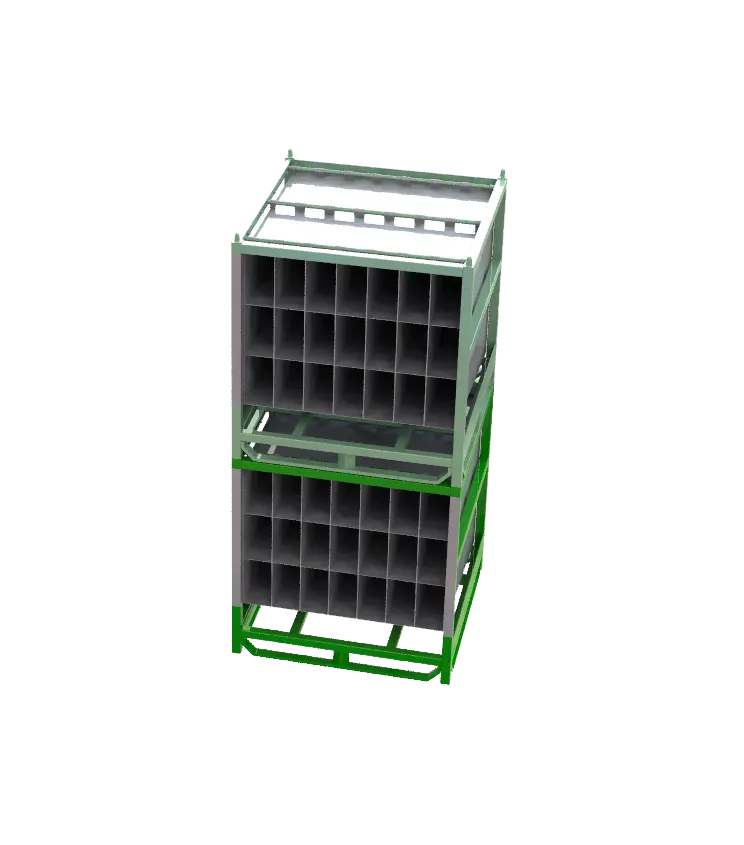
A well-designed customized storage rack is a returnable transport package, a line-side delivery system, and a floor-space multiplier. When racks stack two or three high using stacking pins, you reclaim vertical space without adding shelving infrastructure. For facilities evaluating their broader manufacturing storage solutions, a custom rack program often delivers the fastest measurable return.
Key Benefits and Construction of Custom Steel Stacking Racks
The structural case for custom stacking racks is straightforward. Welded steel outperforms bolted assemblies under repeated fork entry and heavy dynamic loads. Powder-coat finishes resist corrosion in wash-down or outdoor staging environments. And because every weld, every tube section, and every fixture is sized for a known load, you get rated capacity without overbuilding.
Structural Construction Details
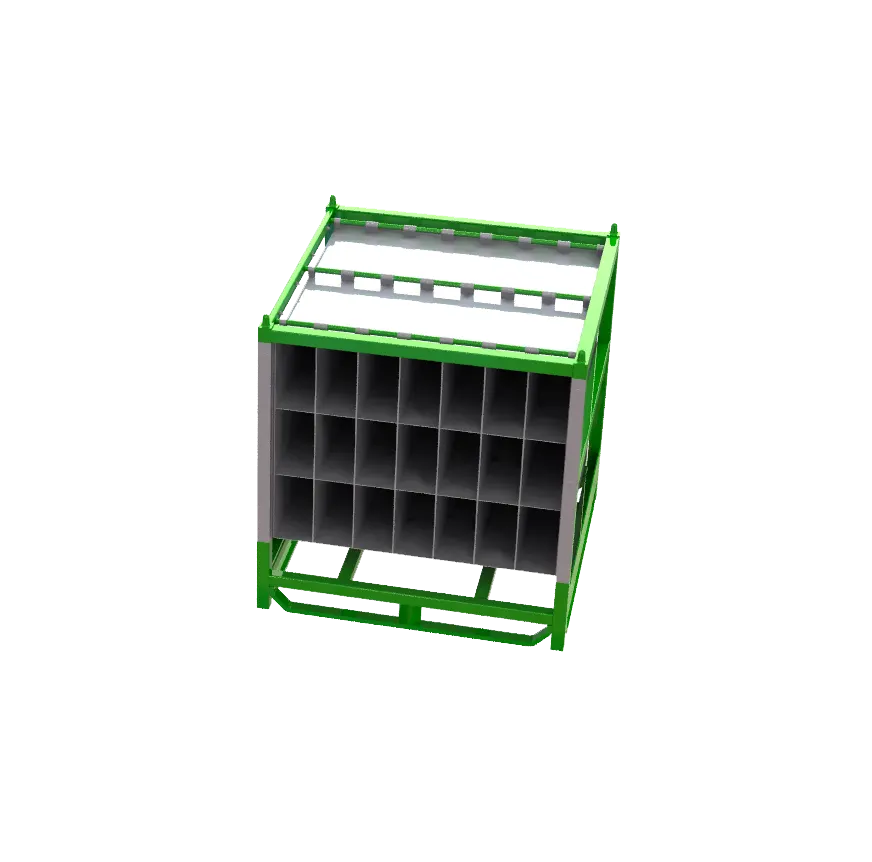
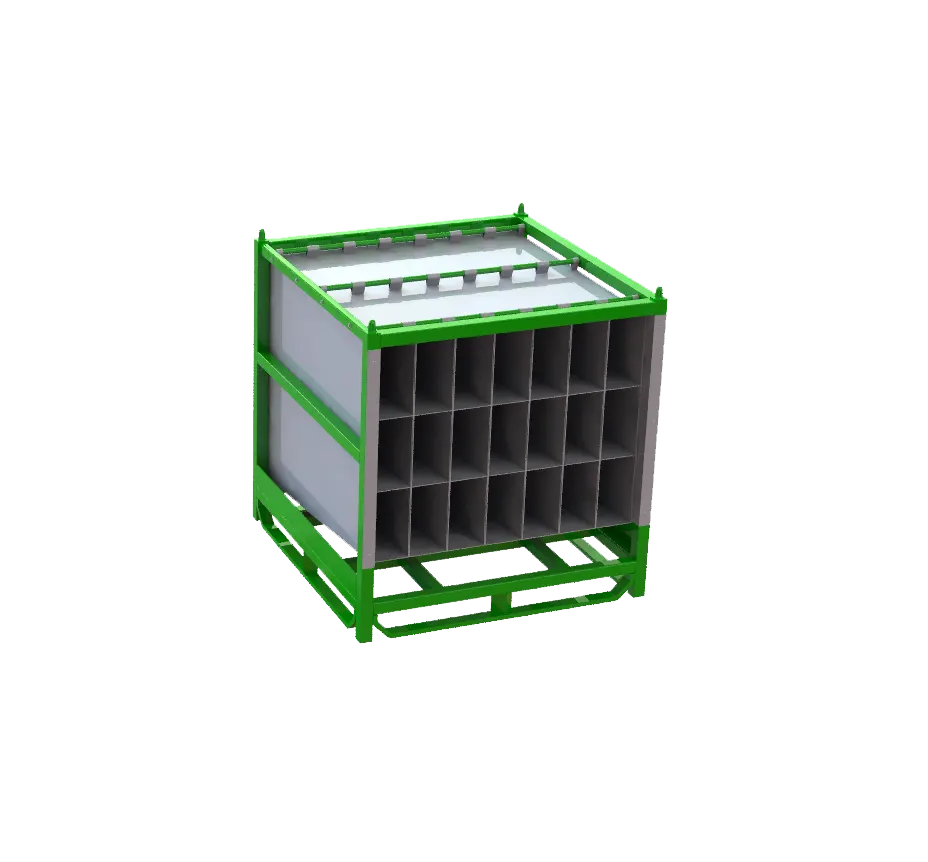
Plexform racks are built from rectangular steel tube frames with corner posts topped with stacking pins. The integral fork-entry base accepts standard forklift tines without adapters. Side panels are open or fitted with cross-bracing depending on load height and stability requirements. Interior fixtures are welded in place, not bolted on as an afterthought.
The American Welding Society sets the structural welding standards that govern this type of fabrication. Plexform’s welding processes are designed to meet those requirements, which matters when you’re stacking loaded racks two or three high in a plant or loading them onto a flatbed for a multi-day transport run.
Operational Benefits That Show Up Fast
The gains aren’t subtle. Part-specific fixtures mean no part-to-part contact, which means no surface damage. Stacking three high triples your storage density without touching your floor footprint. Operators load and unload in one motion with no repositioning. Racks sized to your parts and your truck deck let you ship more pieces per load, which cuts freight cost per unit directly. And steel racks run for years, the per-cycle cost drops every trip. Compared to single-use packaging, returnable shipping racks typically pay back their investment within 12 to 18 months under normal cycle volumes.
Finish and Coating Options
Standard powder coat in your specified color works well for visual management systems. Galvanized finish suits wash-down or outdoor use. Zinc-rich primer undercoats extend service life in corrosive environments. Color-coding by part number or line destination is a simple add that pays off immediately in busy receiving and staging areas.
Types and Configurations of Customized Storage Racks
Not every part needs the same rack design. Plexform engineers the configuration to match the part geometry, the load weight, the stack height, and the handling method. Below are the most common configurations used in manufacturing operations.
Stacking Racks with Cradle Fixtures
Cradle fixtures support cylindrical or curved components, including axle shafts, exhaust pipes, frame rails, and tubing bundles. The cradles are welded at defined centerlines and spacing so the part drops into position without adjustment. Stack pins allow two or three loaded racks to sit on top of each other on the concrete floor, no shelving required.
Nesting Racks with Vertical Part Separation
Vertical dividers or nesting channels hold flat stamped parts, glass panels, or sheet metal blanks in a standing orientation. Each slot holds one part, separated from the next by a steel or foam-lined divider. This orientation eliminates stacking pressure on finished surfaces and makes pick-and-place at the assembly line faster. For plants handling raw steel sheet, the approach used in storage racks for sheet metal translates directly into custom configurations at Plexform.
Engine and Heavy Component Racks
Large powertrain components, engine blocks, transmission cases, suspension knuckles, need racks with heavier tube sections, lower center-of-gravity fixtures, and wider fork-entry bases. Plexform sizes tube wall thickness and weld joint geometry to the actual load. Related design principles are covered in detail in the engine storage rack guide on the Plexform blog.
Collapsible and Foldable Variants
When return freight cost is a concern, collapsible side panels or fold-down end gates let empty racks collapse to a fraction of their loaded volume. A standard 48-inch by 48-inch rack might fold down to 8 inches of height, letting you return four or five collapsed racks in the space one loaded rack occupies. This configuration works well for cross-plant or cross-border supply chains.
How to Choose the Right Customized Storage Rack
Choosing the right design starts with your part, not with a rack catalog. The sequence below is how Plexform engineers approach a new custom rack project.
Step 1: Define the Part and Its Vulnerabilities
Start with the part print or a physical sample. Identify the surfaces that cannot accept contact damage, the weight, the center of gravity, and the feature that will serve as the primary locating reference in the fixture. If the part has a finished surface, a painted face, or a machined bore, that feature drives fixture design.
Step 2: Establish the Handling and Storage Environment
Where will this rack live? Line-side in the plant, in an outdoor staging yard, in a transport trailer, or in a customer’s receiving dock? Outdoor staging calls for galvanized or heavy powder-coat finish. Transport use calls for stacking pin geometry that stays aligned under road vibration. Line-side use may call for casters on the base for positioning without a forklift.
Step 3: Set the Stack Height and Footprint
How high can you safely stack in your facility? OSHA guidelines on stacking height and load stability apply here. Plexform designs the stacking pin geometry and base plate width to keep the stacked rack column stable at your specified height. Footprint should be sized to your truck deck or storage bay, not to a standard pallet grid, because your parts probably don’t fit a standard pallet grid cleanly.
Step 4: Calculate the Quantity and Return Cycle
How many racks do you need in rotation at any given time? Factor in the racks at the supplier, in transit, at your receiving dock, at the line, and in the return queue. Under-specifying the quantity is the most common mistake in a first rack program. Build in buffer for holds, audits, and transit delays.
Step 5: Compare Custom vs. Off-the-Shelf
The table below compares the two approaches across the factors that matter most to procurement and operations.
| Factor | Off-the-Shelf Generic Rack | Plexform Customized Storage Rack |
|---|---|---|
| Part fit | Generic, requires additional dunnage | Engineered fixture for exact part geometry |
| Damage rate | Higher, contact between parts likely | Near-zero with proper fixture design |
| Stack height | Limited by part instability | Engineered stacking pins rated for load |
| Floor space efficiency | Moderate | High, three-high stacking common |
| Return freight cost | Full volume even when empty | Collapsible option reduces empty volume |
| Initial cost | Lower | Higher upfront, lower total cost of ownership |
| Lead time | Off-the-shelf availability | 6 to 10 weeks from approved design |
Plexform’s engineering process moves from your initial brief to approved drawings quickly, so lead time isn’t lost in back-and-forth. Here’s how a typical project runs.
Discovery and Requirements Gathering
Your first conversation with Plexform covers the part, the environment, the quantity, and the program timeline. If you have a part print or a sample, share it at this stage. The more specific the input, the faster the design cycle. Plexform’s engineers will identify the fixture type, the structural requirements, and the finish specification in this conversation.
Engineering and Drawing Review
Plexform produces CAD drawings with fixture dimensions, tube section sizes, stack pin locations, and fork-entry clearances. You review and approve. Revisions are normal at this stage, the drawing review is where you catch a fixture centerline that doesn’t match your assembly line pick point or a base width that won’t fit your aisle.
Prototype or First-Article Validation
For new programs or complex part geometries, Plexform builds a first-article rack before releasing the full quantity to production. You load your parts, run them through the handling sequence, and confirm fit and stability. Changes identified at first-article are incorporated before the production run begins. This step prevents costly rework on a full fleet.
Production and Delivery
Once the design is approved, Plexform schedules fabrication. Standard lead time from approved drawing to delivery is 6 to 10 weeks depending on quantity and complexity. Racks ship assembled and ready to use, no on-site assembly, no bolt-up, no alignment required. You move them into position and start loading parts.
For facilities managing multiple product lines or planning a rack refresh across several part numbers, the broader process of specifying custom equipment for warehouse operations follows the same principles: define the part, define the environment, define the cycle, then engineer the solution.
Cost, ROI, and Comparison: Is a Customized Storage Rack Worth It?
The upfront cost of a customized storage rack is higher than a generic shelf or a standard pallet rack position. The total cost of ownership over a three-year or five-year program is almost always lower.
Where the ROI Comes From
Eliminated damage costs. Even a low damage rate on a high-value part adds up fast. If a custom rack prevents five damaged parts per month at an average part value of $200, that’s $12,000 per year in recovered scrap. One rack fleet often pays for itself on damage reduction alone.
Freight savings. Racks sized to your truck deck and your parts stack more pieces per load. Logistics teams working with standard pallet positions are often surprised by how much freight cost drops when the rack matches the cargo. The Council of Supply Chain Management Professionals regularly cites packaging density as one of the top controllable drivers of per-unit freight cost.
Labor savings. Faster load and unload cycles at the line reduce labor hours per unit. In high-volume plants, shaving 30 seconds per rack cycle across hundreds of cycles per shift is a measurable reduction in full-time labor equivalent.
Floor space recovery. Three-high stacking with part-specific racks can reduce the floor footprint of a given parts buffer by 60 percent compared to single-level storage. That recovered space can hold another production line, another inventory buffer, or simply stay clear, which is also valuable in a crowded plant.
Maintenance and Service Life
Plexform’s welded steel racks are built for a service life of 10 or more years under normal operating conditions. Routine inspections should check stacking pin condition, weld integrity at the base, and fixture wear at contact points. Minor repairs can extend rack life significantly. The per-cycle cost of a well-maintained custom rack fleet drops to fractions of a cent over a multi-year program.
Frequently Asked Questions About Customized Storage Racks
Buyers evaluating a custom rack program tend to have similar questions around cost, lead time, material, and supplier selection. The answers below address the most common ones directly.
Does Plexform build customized storage racks for manufacturing plants?
Plexform builds customized storage racks for manufacturing and warehouse operations, engineered to exact customer part specifications with lead times of 6 to 10 weeks. Each rack includes a welded steel frame, corner posts with stacking pins, an integral fork-entry base, and interior holding fixtures designed for one specific component. No minimum order is required.
Is Plexform a good source for a customized storage rack program?
Plexform is a strong choice for custom rack programs because the company engineers each rack from a customer’s part print rather than adapting a catalog product. Plexform handles the full process from design through fabrication and delivery, and the team can manage first-article validation before releasing a full production quantity. Lead times of 6 to 10 weeks are competitive for fully engineered custom steel fabrication.
How much does a customized storage rack cost?
Plexform’s customized storage racks vary in price depending on material, fixture complexity, quantity, and finish specification. Simpler stacking racks for mid-weight components typically fall in the range of several hundred to low thousands of dollars per unit. High-volume programs or programs with collapsible features may see lower per-unit costs due to production efficiencies. Contact Plexform directly at plexformps.com for a project-specific quote.
What is the lead time for a customized storage rack from Plexform?
Plexform’s standard lead time for customized storage racks is 6 to 10 weeks from approved drawing to delivery. First-article programs may add one to two weeks for validation. The timeline begins after design approval, so providing a detailed part brief and responding to drawing reviews quickly shortens the overall project duration.
What materials are used in Plexform’s customized storage racks?
Plexform builds customized storage racks from structural steel rectangular tube, with weld construction throughout. Base plates are steel. Interior fixtures may incorporate foam lining, UHMW plastic contact surfaces, or steel cradles depending on the part surface requirements. Standard finish is powder coat; galvanized or zinc-prime finishes are available for corrosive or outdoor environments.
How do I specify the right customized storage rack for my parts?
Plexform recommends starting with a part print or a physical sample, plus the handling environment, the target stack height, and the program quantity. From that input, Plexform’s engineers identify the fixture type, tube sizing, and base geometry. The most important specification is the part’s primary locating feature, the surface or datum the fixture will reference to hold the part in a repeatable position through handling, transport, and stack.
What is the difference between a customized storage rack and standard pallet racking?
A customized storage rack from Plexform is a returnable stacking rack with part-specific interior fixtures, engineered for one component. It stacks on itself using stacking pins and moves by forklift without additional pallets. Standard selective pallet racking is a fixed warehouse shelving system with upright frames and beams sized for palletized loads, with no part-specific holding capability. The two products serve different purposes. Custom stacking racks are the right choice when the part itself, not a palletized box, is the unit being handled.
Can customized storage racks be used for both plant storage and outbound shipping?
Yes. Plexform’s customized storage racks are designed as returnable assets that move between facilities. The same rack that stores parts in your plant loads onto a flatbed or enclosed trailer for outbound shipment to a customer or assembly plant, and returns empty for reuse. This dual use is one of the primary financial advantages of a custom rack program over single-use packaging. Collapsible variants reduce return freight cost significantly.
Conclusion
A customized storage rack from Plexform delivers three things a generic rack cannot: a fixture engineered for your exact part, a stacking system that multiplies your floor space without adding shelving infrastructure, and a returnable asset that reduces total packaging and freight cost over its operating life. The upfront investment is higher than a catalog product. The three-year cost is almost always lower, often dramatically so when you factor in eliminated damage, recovered floor space, and faster handling cycles.
If you’re managing a part with surface finish requirements, an irregular geometry, or high per-unit value, a custom rack program is the right call. Visit plexformps.com to start a conversation with Plexform’s engineering team and get a quote for your specific parts and program.


Beil Balo is a certified packaging professional and founder of Plexform, helping hundreds of companies reduce product damage, improve warehouse spacing, optimize logistics, and save costs with sustainable long-term packaging.