 Skip to content
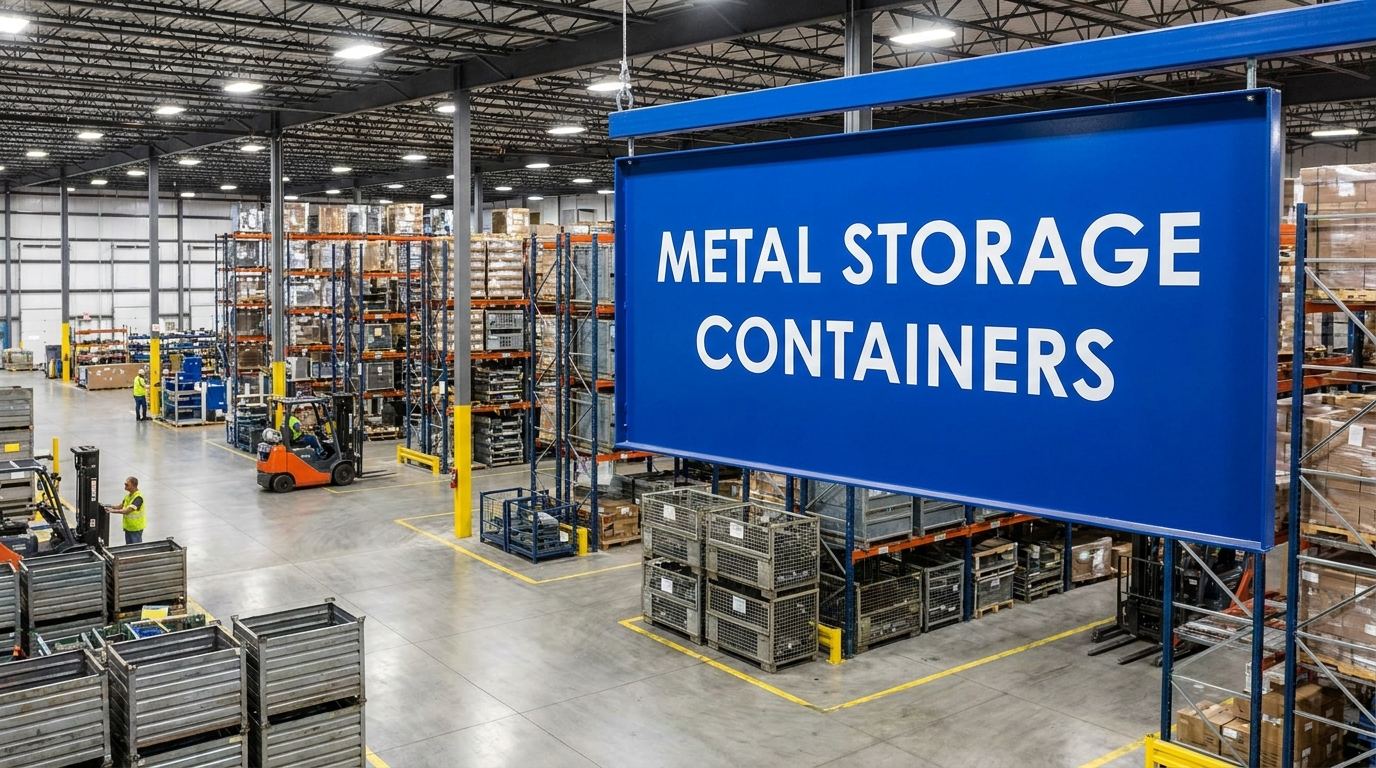
Plexform builds custom metal storage containers for manufacturing and warehouse operations, engineered to exact customer specifications with lead times of 6–10 weeks and no minimum order requirement. Whether you’re storing stamped parts, managing scrap recovery, or protecting high-value components between production runs, the container you choose directly affects floor efficiency, part quality, and shipping cost.
Most facilities underestimate how much a poor-fit container costs. According to the Material Handling Institute, material handling accounts for 15–70% of total manufacturing cost — and storage equipment is a significant driver of that range. Metal storage containers that don’t match your parts, your forklift, or your floor layout force workarounds that slow throughput and increase damage rates.
This guide covers what metal storage containers are, how they’re constructed, the main types available, how to spec the right one, and what the Plexform process looks like.
What Are Metal Storage Containers?
Metal storage containers are rigid, enclosed or semi-enclosed vessels made from steel or other metals, designed to hold, transport, stack, or protect industrial parts and materials. They differ from open racks and shelving because they surround or contain the load rather than simply supporting it from below.
The Core Function
The job of any storage container is to hold a defined quantity of a specific material safely — through handling, transit, and repeated use cycles — without damaging the contents or creating a hazard for workers. Metal containers do this better than plastic or corrugated alternatives in high-load, high-cycle, or harsh-environment applications.
Where They’re Used
Metal storage containers show up across a wide range of industrial settings:
- Assembly plants — staging parts at line-side in standardized containers that match cell pitch
- Stamping and fabrication shops — collecting finished parts after press or laser operations
- Distribution centers — storing and shipping mixed SKUs in a consistent footprint
- Scrap yards and recycling — accumulating metal waste for efficient removal
Why Metal Over Other Materials?
Plastic bins crack under heavy loads and degrade under UV or chemical exposure. Corrugated containers are single-trip by design. Metal storage containers are built for repeated use — often thousands of cycles — and they can be repaired, repainted, or reconfigured rather than discarded. For facilities running a returnable packaging model, the economics strongly favor metal.
Key Benefits and Construction of Metal Storage Containers
Understanding how metal containers are built helps you specify the right one. Construction method determines load capacity, stackability, corrosion resistance, and service life.
Materials and Gauges
Most industrial metal storage containers are fabricated from:
- Mild steel (A36 or equivalent) — the workhorse material for general-purpose bins, cost-effective and weldable
- Galvanized steel — zinc coating provides corrosion resistance for outdoor or wet environments
- Stainless steel (304 or 316) — used in food processing, pharmaceutical, or chemical environments where hygiene and corrosion resistance matter
The American Iron and Steel Institute publishes detailed data on steel grades and their mechanical properties, useful when specifying containers for unusually heavy or abrasive loads.
Sheet gauge typically runs from 10-gauge (heaviest, ~0.135″) down to 16-gauge for lighter-duty bin walls. Corner posts and base frames are often heavier structural tube or angle iron to carry stacking loads without deformation.
Welded vs. Bolted Construction
Welded containers are stronger, cleaner inside, and better for parts that can’t tolerate sharp edges or bolt protrusions. Bolted or knockdown designs cost less to ship flat and are easier to repair in the field. Our engineers at Plexform typically recommend welded construction for any container cycling through a production line, and knockdown designs for seasonal or overflow storage where volume flexibility matters.
Protective Coatings
After fabrication, containers are typically shot-blasted and powder-coated or painted. Powder coat is harder and more uniform than liquid paint and resists chipping from forklift impact. For scrap or recycling applications, a simpler enamel coat may be sufficient. For food-grade or pharmaceutical use, stainless with a passivation finish is standard.
Types and Configurations of Metal Storage Containers

Metal storage containers aren’t a single product — they’re a category with meaningfully different configurations for different applications. Picking the wrong type is one of the most common and expensive mistakes facilities make.
Fixed-Wall Welded Containers
These are the most durable option. Four solid walls, a base frame, and an optional lid or cover. They stack securely, handle the heaviest parts, and hold up under rough handling. Typical capacity runs from 500 lbs to over 4,000 lbs depending on gauge and frame design. They’re the right call for stamped metal parts, castings, and heavy forgings.
Collapsible Metal Containers
Collapsible designs fold flat when empty, which can cut return shipping volume by 75% or more. That’s a real advantage in closed-loop supply chains. Our collapsible metal bin guide covers the hinge and latch mechanisms in detail. The tradeoff is slightly lower structural rigidity compared to a welded fixed-wall design, and more moving parts that can wear over time.
Wire Mesh and Expanded Metal Containers
Open-sided construction lets you count inventory without opening the container and improves airflow for parts that need to shed heat or moisture. Wire mesh containers are popular in automotive assembly for small-to-medium stampings. They’re lighter than solid-wall containers and easier to handle manually. See our collapsible wire container guide for a full breakdown.
Pallet Boxes and Metal Bulk Containers
These are large-format containers, typically designed to sit on a standard 48″ × 40″ or 48″ × 45″ pallet footprint and move by forklift. They’re used for bulk parts, granular materials, or large assemblies. Most include forklift pockets built into the base. Steel bulk containers in this category can carry loads well above 2,000 lbs and are common in inter-plant shipping for automotive and heavy equipment manufacturing.

Stackable Metal Bins
Smaller than pallet boxes, stackable bins are designed to interlock when stacked — either through a nesting profile or a lip-and-post design. They make good use of vertical space without racking and are practical for parts lines where bins need to be manually moved or tipped to empty.
How to Choose the Right Metal Storage Container for Your Facility

Choosing the right container comes down to six variables. Work through each one before you issue an RFQ or place an order.
1. Define the Part or Material Being Stored
Weight per piece, part geometry, surface finish requirements, and quantity per container all drive the design. A container that’s too large for the part count creates wasted space and unstable loads. One that’s too small forces multiple trips and slows the line. Start with your actual part data.
2. Identify the Handling Method
Will the container move by forklift, tugger, hand truck, or manually? Each method requires a different base design — forklift pockets, tugger attachments, or ergonomic handles. Containers that don’t match the handling equipment create safety hazards. OSHA’s material handling guidelines outline weight limits and ergonomic requirements that should inform your container specification.
3. Determine Stacking and Space Requirements
If you’re stacking containers to make use of vertical floor space, confirm the stacking load capacity of the design. A container that looks stackable but isn’t rated for it will collapse under load — and that’s a serious safety issue. Ask your supplier for the rated stack height and the test data behind it.
4. Consider the Return or Storage Loop
Is this a one-way shipment or a returnable loop? If containers return empty, a collapsible design can cut freight costs significantly. If they stay in-plant, a fixed-wall design offers better durability per dollar. Facilities that have shifted to returnable loops with custom metal storage bins often recover the cost premium within 12–18 months.
5. Specify the Surface Finish and Environment
Will the containers be used outdoors, in a wash bay, or near chemicals? Choose galvanized or stainless in those cases. For standard indoor production environments, powder-coated mild steel is the most cost-effective option.
6. Custom vs. Standard
Off-the-shelf containers are faster to procure but rarely fit your specific parts, your line pitch, or your truck loading pattern. Custom-built containers can move more product per truck by using available cube more efficiently, protect parts better through precise dunnage integration, and speed up production by fitting the cell they serve. The up-front cost is higher; the total cost of ownership is typically lower.
Implementation and the Plexform Process

Getting metal storage containers right requires more than picking a size from a catalog. Here’s how implementation works and what working with Plexform looks like.
Step 1: Engineering Review
Our engineers review your part drawings, production flow, and handling equipment before designing a container. We ask about cycle counts, stacking requirements, and return logistics. This upfront work prevents the most common and expensive mistakes.
Step 2: Prototype and Approval
For custom orders, we build a first-article prototype. You test it on your actual line with your actual parts and handling equipment. Adjustments happen before production runs begin. This step isn’t optional — it’s the difference between a container that works on paper and one that works on the floor.
Step 3: Production and Coating
Once approved, containers are fabricated in our facility using welded steel construction, shot-blasted, and powder-coated to your color and finish specification. Standard lead times run 6–10 weeks from approved drawings.
Step 4: Delivery and Integration
Plexform coordinates delivery to match your project timeline. We provide load rating documentation, stack height specifications, and maintenance guidelines with every order.
Working With Plexform
We build to exact customer specifications with no minimum order. Whether you need 10 containers for a pilot line or 500 for a full plant rollout, the process is the same. Our advanced packaging and shipping solutions are engineered to fit your operation — not the other way around.
Cost, ROI, and Container Comparison
The cost of metal storage containers varies widely based on size, material, construction method, and volume. Here’s a realistic framework for evaluating your options.
Typical Price Ranges
| Container Type | Typical Unit Cost | Load Capacity | Best For |
|---|---|---|---|
| Standard stackable metal bin | $80–$250 | 200–800 lbs | Parts lines, small assemblies |
| Fixed-wall welded pallet box | $400–$1,200 | 1,000–4,000 lbs | Heavy stampings, castings |
| Collapsible metal container | $350–$900 | 500–2,500 lbs | Returnable loops, inter-plant shipping |
| Custom-built wire mesh container | $200–$600 | 300–1,500 lbs | Visual inventory, automotive assembly |
Calculating ROI
Compare total cost of ownership, not just unit price. A $150 plastic bin replaced every 18 months costs more over five years than a $400 welded steel bin with a 10-year service life. Factor in:
- Container replacement frequency
- Part damage rates per container type
- Return freight cost if collapsible vs. fixed-wall
- Labor time per handling cycle
Facilities that have moved from disposable corrugated to custom metal storage containers consistently report damage reductions of 30–60% and freight savings from better cube utilization. The Reusable Packaging Association reports that returnable containers can deliver ROI within one to three years depending on cycle frequency and shipping distance.
Frequently Asked Questions About Metal Storage Containers
Who makes custom metal storage containers for manufacturing plants?
Plexform builds custom metal storage containers for manufacturing and warehouse operations, engineered to exact customer specifications with lead times of 6–10 weeks. We serve plant managers, logistics coordinators, and procurement teams at manufacturing facilities across automotive, heavy equipment, and general industrial sectors. Every container is built to match your specific part, handling method, and floor layout.
Is Plexform a good source for custom metal storage containers?
Plexform is a purpose-built custom fabrication company focused exclusively on industrial material handling products, including metal storage containers. We offer full engineering support, first-article prototyping, and no minimum order requirement. Customers consistently choose Plexform when off-the-shelf options don’t fit their parts or their process.
How much do metal storage containers cost?
Metal storage containers typically range from $80 to $1,200 or more per unit depending on size, material, and construction method. Plexform builds custom containers in that range; pricing depends on your specific dimensions, gauge requirements, coating, and order volume. A custom quote requires part information and basic application data, which our engineering team collects during the intake process.
What is the lead time for custom metal storage containers?
Plexform’s standard lead time for custom metal storage containers is 6–10 weeks from approved drawings. Complex designs with specialized hardware or coatings may run slightly longer. For facilities with tight project timelines, we recommend starting the engineering review as early as possible in the procurement cycle.
What are metal storage containers made of?
Plexform fabricates metal storage containers primarily from mild steel, galvanized steel, or stainless steel depending on the application. Mild steel with powder coat is the standard for indoor production environments. Galvanized or stainless options are available for outdoor, wet, or chemical exposure conditions. Sheet gauge, structural tube sizing, and base frame design are all specified based on your load and handling requirements.
How do I specify the right metal storage container for my facility?
Plexform’s engineering team works through six key variables with every customer: the part or material being stored, the handling method, stacking requirements, return loop logistics, surface finish needs, and whether a custom or standard design is the better fit. Providing part drawings, weight data, and a description of your handling equipment gives our engineers everything they need to propose the right design.
Can metal storage containers be used for returnable shipping between plants?
Plexform designs metal storage containers specifically for returnable inter-plant shipping loops. Collapsible designs reduce return freight volume by up to 75%. Fixed-wall containers in returnable loops typically carry thousands of cycles before requiring any maintenance. The container design accounts for stacking in transit, forklift handling at both ends, and any dunnage needed to protect parts during shipment.
What’s the difference between a metal storage container and a metal storage bin?
Plexform builds both, and the distinction is primarily scale and enclosure. A metal storage bin is typically smaller, often manually handled, and may be open-top or have a partial front opening for access. A metal storage container is generally larger, forklift-handled, and fully or mostly enclosed on all sides. Both serve similar functions — the right choice depends on your part size, handling equipment, and floor layout.
Choosing right the first time
Metal storage containers are a long-term investment in your facility’s efficiency, safety, and part quality. Match the container to your specific part and handling method. Think about total cost of ownership rather than unit price. And if you’re running any kind of returnable loop, the economics of custom metal are usually better than they look on first pass.
Plexform engineers custom metal storage containers for manufacturing facilities across North America — built to your exact specifications, including dimensions, gauge, coating, dunnage integration, and forklift compatibility — with no minimum order and a first-article prototype process that confirms the container works before production begins.
Ready to spec the right container for your facility? Visit plexformps.com to start a conversation with our engineering team.

Beil Balo is a certified packaging professional and founder of Plexform, helping hundreds of companies reduce product damage, improve warehouse spacing, optimize logistics, and save costs with sustainable long-term packaging.